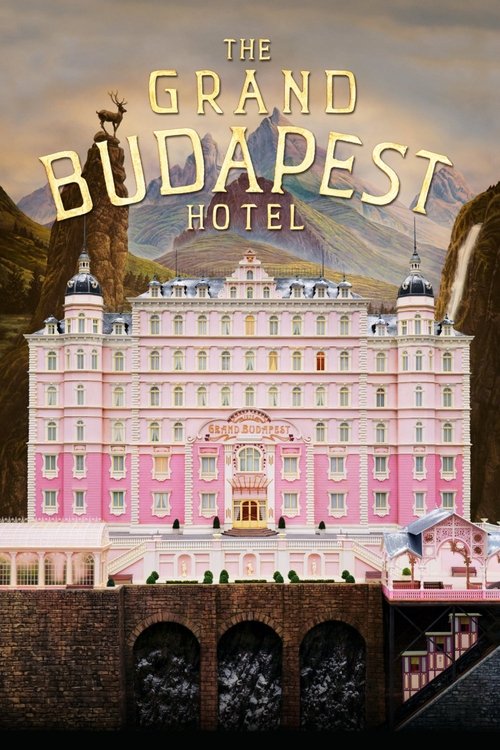
The Grand Budapest Hotel
2014 · Wes Anderson
His style became so recognizable it turned into a TikTok filter trend and AI-parody genre, prompting discourse about whether pastiche had swallowed the artist; Asteroid City and The Phoenician Scheme kept the "self-parody or late-style depth" argument alive. Finally won his first Oscar for a Roald Dahl short.
For when you want to be delighted — a comfort watch with real craft, perfect for a night in when you need charm, momentum, and a little melancholy at the bottom of the glass.
What it's about
In a grand mountain hotel in a fictional European country between the wars, the legendary concierge M. Gustave takes a young lobby boy, Zero, under his wing. When a wealthy patron dies and leaves Gustave a priceless painting, her furious family comes after him — setting off a caper of theft, prison, pursuit, and inheritance, all as fascism creeps across the borders. It's the story of a friendship, told decades later, about a vanished world of manners and grace.
The experience
Fast, funny, and dizzyingly ornate — like being handed a pastry box that turns out to contain a eulogy. You laugh for two hours and then realize the film has quietly broken your heart.
Performances
Ralph Fiennes is a revelation in comic mode: his Gustave is fussy, profane, vain, and deeply decent, often within a single sentence. Tony Revolori's solemn Zero is the perfect straight man, and the supporting cast is a parade of stars committing fully to tiny roles.
The craft
Wes Anderson at his most architecturally precise: shifting aspect ratios for each time period, handmade miniatures, whip-pans, and pastel sets built like a wedding cake. Alexandre Desplat's balalaika-driven score keeps the whole contraption dancing. It rewards a big screen — every frame is packed edge to edge.
Why it matters
Anderson's biggest commercial and awards success, sweeping the design and music Oscars and cementing his style as one of the most recognizable — and most imitated — in modern cinema.
Snapshot
A confection of nested frames, pastel masonry, and bittersweet elegy, The Grand Budapest Hotel follows the legendary concierge M. Gustave H. (Ralph Fiennes) and his protégé Zero Moustafa (Tony Revolori) through a baroque adventure involving stolen Renaissance painting, contested inheritance, and the slow encroachment of fascism across a fictional Central European republic. Anderson sets his most architecturally intricate narrative structure inside a tragedy about the death of a civilization—the world of European courtesy, art, and institutionalized grace that World War II would obliterate. The film is simultaneously an affectionate comedy, a caper film, an elegiac literary work in spirit if not letter, and a meditation on how stories are told and who survives to tell them.
Industry & production
The Grand Budapest Hotel was produced by American Empirical Pictures—Wes Anderson and Jeremy Dawson's production company—alongside Scott Rudin Productions and Indian Paintbrush, for Fox Searchlight Pictures, Anderson's longstanding domestic distributor. Trade press coverage placed the budget roughly in the range of $25–30 million; Anderson himself has not publicized precise figures, and that range should be treated as approximate.
Principal photography took place in Germany in 2013. The primary location was the Kaufhaus Görlitz, a monumental Wilhelmine-era department store in Görlitz, a border town on the German-Polish frontier whose dense pre-war architecture survived World War II largely intact—earning it the informal industry nickname "Görliwood" among German production professionals. The Kaufhaus's palatial interior stood in for the hotel lobby and guest floors, while its exterior was extended by practical scale models for wide establishing shots. Additional studio work was done at Babelsberg in Potsdam. The choice of Görlitz was not merely opportunistic: the building's layered pre-war commercial grandeur physically embodied the film's central subject—a European civilization preserved in amber, awaiting catastrophe.
The film premiered at the Berlin International Film Festival in February 2014 and received a wide North American release the following month. It earned nine Academy Award nominations and won four: Best Production Design, Best Costume Design, Best Makeup and Hairstyling, and Best Original Score.
Technology
Anderson and director of photography Robert D. Yeoman made the deliberate decision to shoot The Grand Budapest Hotel in three distinct aspect ratios corresponding to its temporal frames. The innermost story, set in 1932, was filmed in the Academy ratio (approximately 1.37:1), echoing the frame proportions of pre-CinemaScope cinema. The 1968 scenes, in which the elderly Zero narrates his past to a young author, were shot in 2.35:1 anamorphic Scope. The 1985 framing sequences and the present-day outermost frame use 1.85:1. A viewer learns to read the shift in frame shape as a temporal and ontological cue—each ratio signals not just a period but a relationship to memory and mediation.
The hotel's exterior—an impossibly pink confection above a mountain—was realized as a practical scale model rather than a digital composite, as were a funicular railway and mountain terrain. Anderson and production designer Adam Stockhausen's preference for hand-built miniatures over CGI gives the film a haptic strangeness: a sense of scale that purely digital work of the period struggled to replicate.
Technique
Cinematography
Yeoman's work is defined by the formal discipline Anderson has developed across his career: frontal compositions, strict bilateral symmetry, brief lateral tracking shots, and overhead angles that flatten space into graphic planes. Within the 1.37:1 frame, vintage spherical lenses slightly soften the image, approximating the textural quality of 1930s studio cinematography without slavish pastiche. The lighting favors warm interior sources—chandeliers, sconces—that give the hotel sequences a golden-hour permanence even in Central European winter. For tonal contrast between eras, the 1932 sections carry a richer, more saturated palette; the 1960s scenes, when the hotel has passed to communist management, are visibly cooler and more drained—the same geometry, but the warmth has left.
Editing
Anderson's editing is metronomic in its precision, each cut timed to Alexandre Desplat's score so that the rhythm of images and music forms a single pulse. The film's characteristic unit of movement is a hard cut between locations, often preceded by a brief pan that arrives at a symmetrical endpoint. Montage sequences—Zero and Agatha's courtship, the prison break, the alpine chase—are edited as comedic set-pieces whose internal tempos borrow from silent-film farce. The nesting of four narrative frames required crisp transitions that announce register shifts; Anderson and his editing team manage this primarily through the aspect-ratio change and a clean cut rather than dissolves, treating time as a spatial rather than a gradual phenomenon.
Mise-en-scène / staging
The film's staging reflects Anderson's longstanding practice of treating the screen as a proscenium: characters enter and exit frame like stage actors, face the camera in two-shot symmetry, and move through spaces organized along strict central axes. Doors open onto precisely aligned corridors; elevators traverse the hotel in perfect vertical lines. This theatrical formalism is not mere mannerism—it encodes the film's moral world, where civilization is a set of agreed-upon protocols and rituals. When the fascist soldiers and Dmitri Desgoffe-und-Taxis's enforcers enter the frame, they violate its formal laws: they crowd, jostle, and bring asymmetry.
The film makes extensive use of diorama-scale environments and hand-painted backdrops, particularly in exterior mountain sequences, that evoke illustrated Central European children's books and early twentieth-century commercial lithography more than contemporary realist cinema.
Sound
Desplat's score draws on Central and Eastern European folk instrumentation—balalaika, zither, taiko drums repurposed for comic effect—to construct a hybrid sonic world belonging to no single national tradition. The zither, associated in English-language cinema primarily with Anton Karas's score for Carol Reed's The Third Man (1949)—another film about Central European civilization under pressure—carries intertextual freight, connecting Grand Budapest Hotel to a lineage of films about Europe in extremis. The score modulates between march tempos, lullaby passages, and chase-scene propulsion; its light touch is crucial to the film's tonal balance. Sound design employs cartoonish effects during the action sequences, reinforcing the slapstick register and maintaining comedic distance from what is, narratively, genuine violence.
Performance
Ralph Fiennes's M. Gustave H. was widely received as a revelation partly because it was unexpected: Fiennes had built his career on intensity and constraint (Schindler's List, The English Patient), and Grand Budapest Hotel asked for comic timing, rapid-fire verbal delivery, and operatic emotional pivots within individual scenes. He inhabits Gustave as a man who has constructed himself—a persona of Continental grace whose periodic eruptions of profanity reveal the mortal beneath the façade. Tony Revolori's Zero provides the counterpoint: his stillness and watchfulness anchor the film emotionally. F. Murray Abraham as the elderly Zero is quietly devastating in the framing sequences. Tilda Swinton, Willem Dafoe, Adrien Brody, Jeff Goldblum, and others make brief appearances in Anderson's characteristic mode of celebrity cameo as emblem—each a cartoon of a type, legible in seconds.
Narrative & dramatic mode
The film employs a four-level frame narrative. The outermost frame establishes a present-day reader encountering a book; the next introduces the Author (Tom Wilkinson) in 1985 speaking directly to camera; the third shows a younger Author (Jude Law) in 1968 meeting the elderly Zero; and the innermost frame, occupying the bulk of screen time, is Zero's account of 1932. This Rahmenerzählung structure places the film in the tradition of European literary fiction—Boccaccio's Decameron, Schnitzler's Reigen, Zweig's own novella frames—and insists that we experience the adventure as an act of memory and narration, already elegiac before it begins. The dramatic mode is tragicomedy: farce conventions (madcap chases, disguises, mistaken identity) are deployed in a world the audience understands to be on the verge of catastrophe. Zero's backstory—a refugee from a country destroyed by political violence—arrives late and quietly, and retroactively recontextualizes the entire film. What felt like playful adventure reveals itself as a survivor's account.
Genre & cycle
The Grand Budapest Hotel occupies the intersection of several genre traditions: caper film (the theft and recovery of "Boy with Apple," a Klimt-adjacent Renaissance painting), chase comedy with roots in Mack Sennett and Buster Keaton, prestige heritage cinema, and Central European literary adaptation by sensibility if not source. It belongs to a broader cycle of early 2010s art-house comedies that deployed elaborate visual formalism and period setting—a moment when Fox Searchlight, A24, and similar distributors discovered that rigorous aesthetic vision could constitute a reliable commercial proposition. Anderson had helped create this cycle; Grand Budapest Hotel was its apotheosis.
Authorship & method
Anderson's method is comprehensive and totalizing: he controls color palette, production design, music, performance style, and editing rhythm in a manner that positions him among the most thoroughly auteurist directors in contemporary American cinema. The film was written by Anderson from a story developed with Hugo Guinness, with the writings of Stefan Zweig serving as the primary literary inspiration. Zweig (1881–1942) was an Austrian Jewish novelist and memoirist whose The World of Yesterday (posthumously published, 1942) catalogs the pre-war European civilization fascism destroyed. Several of Anderson's structural and tonal choices—the mournful frame narration, the sense that a world of courtesy and culture has been definitively lost—derive from Zweig's sensibility without adapting any single text directly. Zweig is the emotional climate rather than the source material.
Robert D. Yeoman, ASC, has been Anderson's director of photography since Bottle Rocket (1996), one of the most sustained director–DP partnerships in contemporary American cinema. Yeoman executes Anderson's precisely pre-visualized compositions while solving the specific technical problems of period simulation: sourcing vintage spherical lenses for the 1930s material, managing the shift between three formats without calling attention to the artifice.
Alexandre Desplat joined Anderson on Moonrise Kingdom (2012) before scoring Grand Budapest Hotel; his ability to write music that is simultaneously emotionally sincere and generically self-aware made him an ideal collaborator for Anderson's tragicomic register. Production designer Adam Stockhausen and set decorator Anna Pinnock constructed the world of Zubrowka from German department stores and studio soundstages, winning the Academy Award for their work. Costume designer Milena Canonero—a veteran of Kubrick (A Clockwork Orange, Barry Lyndon) and Sofia Coppola (Marie Antoinette)—brought historical knowledge and idiosyncratic invention to the hotel's distinctive plum-and-purple livery.
Movement / national cinema
Anderson is an American director operating at the edge of studio and independent production, but The Grand Budapest Hotel is deeply European in its cultural imaginary. Shot in Germany with a largely international cast, inspired by Austro-Hungarian literature, and set in a fictional Central European republic, it participates in what might be called the Mitteleuropa tradition in cinema: the lineage of directors in the exile tradition—Ernst Lubitsch, Billy Wilder, Max Ophüls—who carried pre-war Central European sensibility into Hollywood and inflected American genre filmmaking with Old World irony, melancholy, and formal elegance. Anderson is not himself an exile but an avid student of this tradition; Grand Budapest Hotel is his most direct engagement with it. The practical choice of Görlitz for its intact pre-war architecture reflects a desire for embodied authenticity unavailable in a studio backlot and positions the film, however obliquely, within a specifically German-Central European spatial history.
Era / period
The film appeared in 2014 at a moment when the prestige art-house market—sustained by Fox Searchlight, the newly founded A24, and their counterparts in Europe—had become a commercially significant sector with its own audience infrastructure and awards economy. Anderson had cultivated his following across two decades; Grand Budapest Hotel represented the point at which his formal ambitions and commercial viability fully aligned. The film also arrived in a cultural moment marked by nostalgia for Old World institutional elegance—a reaction, perhaps, to the disorientations of the post-2008 period. Its themes of refugee identity and the fragility of civilized institutions would acquire additional resonance as the decade advanced and Europe again confronted mass displacement.
Themes
The film's central subject is the death of a civilization and the people who memorialize it. M. Gustave embodies a pre-war European courtesy culture—exquisitely attentive to guests, devoted to beauty and ritual, convinced that manners are a form of moral seriousness. The advancing fascists, whose insignia deliberately echoes the SS double-lightning bolt, represent the force that will obliterate this world. Zero, as a stateless refugee without papers, is the film's moral center: a person the old European order failed catastrophically, yet who transmits its finest spirit through memory and narration.
Art as civilization's distillate runs throughout: the stolen painting, Gustave's recitation of poetry in prison, the hotel itself as a collective aesthetic achievement. Anderson argues, elegiacally, that beauty is both the finest thing a culture produces and hopelessly insufficient protection against violence. Memory and the mediation of the past—how stories are told, who survives to tell them, what is lost in retelling—are encoded in the film's very structure. The four-level narration insists we never reach the past directly; we reach only someone's account of someone's account of someone's account.
Reception, canon & influence
The Grand Budapest Hotel received near-universal critical acclaim on release, with particular praise for Fiennes's performance and for Anderson's architecture of nested narratives and nested frames. It became the highest-grossing film of Anderson's career at that point and confirmed his transition from cult director to mainstream prestige filmmaker without apparent aesthetic compromise. Its nine Academy Award nominations—including Best Picture and Best Director—represented the Academy's fullest embrace of Anderson to date. The film also won the Golden Globe for Best Motion Picture, Musical or Comedy.
Influences on the film. Stefan Zweig is the acknowledged literary climate. Within cinema, the tradition of European hotel films—most notably Edmund Goulding's Grand Hotel (1932), whose ensemble narrative of intersecting lives in a luxury establishment provided a genre substrate—looms in the background. Ernst Lubitsch's pre-war European comedies (Trouble in Paradise, 1932; Ninotchka, 1939) offer the model of sophisticated comedy encoded in Continental manners. Max Ophüls is a direct connection: he adapted Zweig's Letter from an Unknown Woman (1948) and his own films are characterized by elaborate formal movement through the spaces of bourgeois European life—a sensibility Anderson inherits from both directions. Silent-film physical comedy, Keaton especially, informs the chase-sequence construction. Billy Wilder, another Central European exile, supplies the model of sharp intelligence worn lightly inside genre.
The film's legacy. The Grand Budapest Hotel has become a touchstone for filmmakers interested in highly controlled visual formalism combined with emotional sincerity. Its influence is visible in several subsequent prestige productions and, more pervasively, in the proliferation of symmetrical, pastel-palette visual styles across advertising and commercial image culture—often stripped of the formal rigor that justifies Anderson's choices, producing what critics have described as the "Andersonification" of visual design. Within Anderson's own work, Grand Budapest Hotel opened the door to Isle of Dogs (2018) and The French Dispatch (2021), both of which push the nested-narrative and multi-format experiments further. The film has entered film school curricula as a primary text for studying production design, the semiotics of aspect ratio, and the construction of a cinematic world from a single director's totalizing vision.
A Deleuzian reading
Start at the table where the old man begins to talk.
The full Deleuzian reading of The Grand Budapest Hotel →
Reception
No reappraisal needed — it opened in March 2014 as an instant hit, became Anderson's biggest box office to that point, tied Birdman with nine Oscar nominations and won four. If anything has shifted, it's that the film has hardened from 'crowd-pleaser' into the consensus pick for peak Wes Anderson.
How The Grand Budapest Hotel was received, from release to now →
Influences: the films it descends from and the films it influenced
- Grand Hotel (1932) — The luxury European hotel as a self-contained social world organizing an ensemble of intersecting narratives across class lines; Anderson inherits this genre chassis wholesale — the hotel as civilizational microcosm — as the structural container for GBH's entire world-building logic.
- Trouble in Paradise (1932) — The Continental caper comedy in which criminality is aestheticized through sophistication of staging and ellipsis rather than exposed through moral weight; Anderson's debt is specifically the Lubitsch touch — wit expressed through what the mise-en-scène withholds, the heist as an occasion for civilized performance.
- To Be or Not to Be (1942) — Theatrical farce and nested deceptions deployed as the primary mode of confronting fascist catastrophe; Lubitsch's model of comedy that encodes historical violence within genre rather than evading it establishes the tragicomic register — darkness acknowledged inside the farce — that GBH sustains throughout.
- Grand Illusion (1937) — The prison as a space encoding class and nationality, where courtesy and civilization function as active resistance to barbarism; Renoir's sense of men of refinement performing their social manners at the precise moment of historical inevitability is the emotional structure Anderson inherits for GBH's elegiac mode.
- Letter from an Unknown Woman (1948) — A direct Zweig adaptation establishing the retrospective frame narrator mourning a vanished European world of romantic cultivation; Ophüls's melancholic tracking movements through hotel corridors and domestic interiors encode the mournful retrospection that Anderson's four-level nested frame systematizes.
- Lola Montès (1955) — The explicit theatricalization of a life through a ringmaster-narrator presenting episodes within a circus performance space; Anderson takes this proscenium-framing principle — narrator as impresario, each scene as a discrete staged turn — and makes it the systematic staging grammar of GBH.
- The Third Man (1949) — Anton Karas's solo zither score, recorded at a Viennese café, established the instrument as the definitive sonic marker of Central European moral dissolution and postwar melancholy; Desplat's GBH instrumentation is a direct intertextual citation of this zither tradition, invoking the same geographic and historical register.
- The General (1926) — Chase sequences constructed as mechanical precision comedy — the physics of vehicles and spaces generating gags with engineering exactness, independent of character psychology; Anderson's alpine ski chase and prison break sequences inherit Keaton's approach of treating physical space as a precision instrument for timed comic effect.
- Moonrise Kingdom (2012) — The first Anderson–Desplat collaboration and the immediate formal laboratory for GBH: Desplat here developed the folk-instrument palette, the score-synchronized cutting rhythm, and the anachronistic percussion textures that GBH inherits and refines into its Central European register.
- Playtime (1967) — A director's absolute architectural control over a purpose-built environment as the primary generator of comedy — gags that emerge from spatial precision and compositional geometry rather than from performance; Tati's logic of the world-as-designed-set is what Anderson operationalizes through his totalizing production design.
- La Ronde (1950) — Frames its tale through a nested storyteller-host and propels it on lateral tracking shots across a nostalgically artificial Mitteleuropa, a self-aware revival of the meneur de jeu and the Ophülsian moving camera.
- The Cook, the Thief, His Wife & Her Lover (1989) — Builds entire spaces as color-coded rooms shot in frontal symmetry and lateral whip-tracking, treating total chromatic design as narrative system in Greenaway's mode.
- Isle of Dogs (2018) — Extends GBH's nested-narrator architecture into stop-motion animation, with a comparable anachronistic folk-percussion palette organized through the same score-synchronized cutting rhythm; the embedded translator-narration device replicates GBH's multi-level frame logic in a new cultural register.
- The French Dispatch (2021) — Takes GBH's four-level frame narrative and multiplies it into an anthology structure with full aspect-ratio and format shifts between stories; the direct formal continuation of GBH's nested-narrative experiment, exploding the single frame into a magazine of discrete nested worlds.
- Paddington 2 (2017) — Bilateral symmetry, saturated production design, and a wrongly-imprisoned protagonist orchestrating an ensemble prison escape; King applies Anderson's specific principle of institutional space as a designed theatrical set — cells and corridors arranged for visual rhyme — extending GBH's prison-caper formalism into British children's cinema.
- Jojo Rabbit (2019) — Confectionary symmetrical mise-en-scène with creeping fascism intruding on a pastel toy-world — the precise tension of whimsical design versus historical horror Jojo replicates.
- The French Dispatch of the Liberty, Kansas Evening Sun (2021) — Its Russian-doll narration (author → aged Zero → the hotel's past) and per-era aspect-ratio switching between 1.37, 1.85 and 2.35 is the direct template for Dispatch's nested reportage and ratio shifts.
- Emma. (2020) — Anderson's dead-center frontal framing, dollhouse symmetry, and pastel storybook palette are the explicit visual grammar de Wilde borrows for Hartfield's tableaux and whip-timed ensemble gags.
- Asteroid City (2023) — Nested-narrator framing with aspect ratios keyed to each narrative level (1.37 / 1.85 / 2.35) — the dual-aspect-ratio storytelling device Asteroid City extends to distinguish black-and-white broadcast from color play.
- Wonka (2023) — Centered storybook symmetry paired with overt digital-miniature and scale-shift trickery that King's frontal compositions and Wonka's miniaturization gags directly mirror.
- The Phoenician Scheme (2025) — The immediate production ancestor: same Stockhausen–Canonero–Desplat–Weisse workshop at Babelsberg, in-camera funicular and hotel miniatures, and Barney Pilling's cutting-on-the-line rhythm that returns here as the faster, plot-forward assembly.
- Kind Hearts and Coronets (1949) — A condemned aristocrat narrates his elegant series of murders in prison memoirs; the nested retrospective frame — the ironic distance between the narrator's perfectly composed voice and his violent acts, written behind bars — maps directly onto GBH's architecture of a protagonist recounting past criminality with cultivated, nostalgic detachment.
- The Discreet Charm of the Bourgeoisie (1972) — Nested dream-within-dream frames exposing a bourgeois social class mechanically performing its own rituals; Buñuel's deadpan staging of social ceremony disrupted by arbitrary violence offers a structural model for the comedy of a civilization that cannot stop enacting its customs even as it collapses around it.
- A Pigeon Sat on a Branch Reflecting on Existence (2014) — Planimetric frontal compositions and flattened deadpan blocking that turn the frame into a painterly plane, a parallel codification of the static-tableau mode.
- Petrov's Flu (2021) — Uses discrete aspect-ratio shifts to code distinct time periods, the same temporal-coding-by-format device that organizes Petrov's flu eras.
- Mommy (2014) — Released the same year, Anderson likewise weaponizes shifting aspect ratios — switching among 1.37, 1.85 and 2.35 to encode distinct time registers — making format itself a narrative signal.
- Delicatessen (1991) — A single building as a meticulously designed dollhouse populated by an ensemble of grotesques, orchestrated through rhythmic, music-like cross-cut montage.
- Silent Friend (2026) — The device of assigning each historical era its own distinct film idiom (here aspect ratio / stock) — the closest precedent for the three-format-capture structuring the three time-panels.
- Little Women (2019) — Alexandre Desplat's rhythmic, nested-timeframe chamber scoring method — motifs that signal shifts between temporal frames — is the collaborator technique he brings to Little Women's dual timeline.
- Donkey Skin (1970) — Shares Donkey Skin's living-storybook aesthetic: flat frontal tableau staging, in-camera miniatures and painted backings, and a meticulous pastel palette coded to place and era.
- You, the Living (2007) — Deploys flat, planimetric frontal staging and centered deadpan performance where figures face the lens against a shallow built backdrop — a shared debt to Tati's composed, self-consciously artificial frame.
- Fallen Leaves (2023) — Shares the frontal, centered, planimetric compositions and bold color-blocked production design — the same tableau-and-primary-palette formalism deployed toward a very different tone.
Similar films
- Isle of Dogs (2018) — influence & lineage · often watched together
- Paddington 2 (2017) — influence & lineage
- Moonrise Kingdom (2012) — influence & lineage
- Casablanca (1943) — often watched together
- The Royal Tenenbaums (2001) — shared sensibility
- Fantastic Mr. Fox (2009) — shared sensibility
- The Brutalist (2024) — shared sensibility
- The Great Beauty (2013) — shared sensibility
All the films related to The Grand Budapest Hotel →