Kind Hearts and Coronets
1949 · Robert Hamer
For when you're in the mood for wit sharpened to a razor's edge — a civilized evening's entertainment about thoroughly uncivilized behavior. Perfect with company that appreciates a well-turned sentence.
What it's about
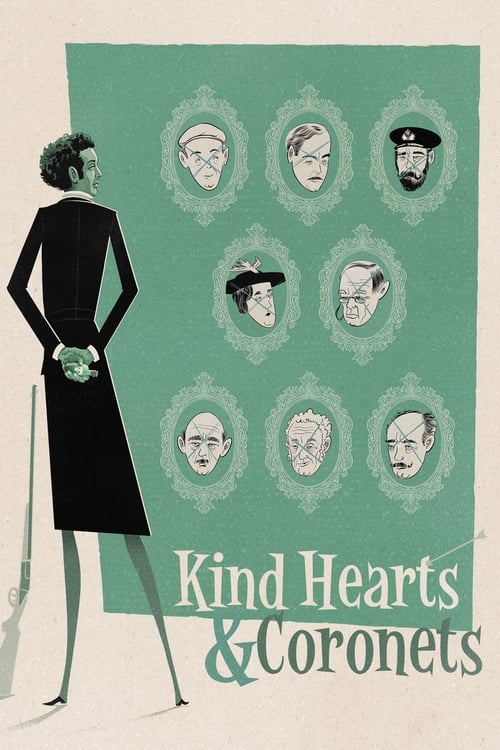
Disinherited because his mother married for love beneath her station — and enraged when her family denies her even a place in the mausoleum — an impeccably mannered young draper's assistant sets about murdering his way through the aristocratic relatives standing between him and a dukedom. All eight of those relatives, from bluff general to suffragette, are played by Alec Guinness. Complicating the campaign: two very different women, and a heart less orderly than his methods.
The experience
Deliciously dry — a film about serial killing conducted entirely in perfect syntax, where the laughs come from the gap between the horror of the deeds and the exquisite politeness of their telling. It's elegant, wicked fun that keeps a sting in reserve.
Performances
Alec Guinness plays all eight doomed aristocrats in a legendary feat of transformation, while Dennis Price's silken, self-satisfied narration carries the whole murderous enterprise with the poise of a drawing-room epigram.
The craft
Robert Hamer's direction is the darkest, most elegant thing Ealing Studios ever produced: Edwardian settings, a screenplay of Wildean polish, and violence delivered almost entirely through voiceover and implication. The famous closing stroke is a mechanism of irony so precisely tooled it still draws gasps — go in knowing nothing.
Why it matters
The high-water mark of British black comedy, it fixed Guinness's reputation as a master of transformation and set a standard for satire of class and inheritance that films are still measured against.
Disinherited because his mother married for love beneath her station, an impeccably mannered young draper's assistant sets about murdering his way through the aristocratic family that wronged her — all eight obstacles played, in a legendary feat of transformation, by Alec Guinness, from bluff general to suffragette. Robert Hamer's Edwardian black comedy is the darkest and most elegant thing Ealing Studios ever produced: a film about serial killing conducted entirely in perfect syntax, its violence delivered through Dennis Price's silken voiceover with the poise of a Wilde epigram. The satire cuts at class, primogeniture and English propriety itself, and the famous ending is a mechanism of irony so precisely tooled it still draws gasps. Hamer, a gay man in an industry and era that permitted no such acknowledgment, was perhaps Ealing's most sophisticated intelligence; his career would be undone by drink within a decade, making this urbane masterpiece both his peak and his epitaph. Few comedies have ever been so funny about anything so cold.
A Deleuzian reading
A family vault with the door shut.
The full Deleuzian reading of Kind Hearts and Coronets →
Reception
A critical hit on release in 1949 (though Ealing boss Michael Balcon was reportedly uneasy about its elegant amorality), it has only climbed since — now routinely ranked the greatest of the Ealing comedies and a fixture on lists of the best British films ever made.
How Kind Hearts and Coronets was received, from release to now →
Influences: the films it descends from and the films it influenced
- Le Roman d'un tricheur (1936) — Builds an entire film from a rogue's first-person memoir-voiceover laid over near-pantomimed action, the exact ironic narration architecture Hamer hands to Louis Mazzini.
- Monsieur Verdoux (1947) — Reframes a serial murderer of well-off spouses as an impeccably mannered gentleman, converting homicide into a bourgeois comedy of manners rather than horror.
- Trouble in Paradise (1932) — The 'Lubitsch touch' of elegant amorality made delightful through epigram and discreet implication rather than depiction — the tonal template for Mazzini's charming villainy.
- The Playhouse (1921) — Pioneers the single-actor-as-a-whole-cast feat via precise matte multiple-exposure, the technical precedent for Guinness sharing frames with himself as eight D'Ascoynes.
- Arsenic and Old Lace (1944) — Stages repeat homicide inside genteel, respectable domesticity as macabre drawing-room farce, normalizing murder through decorum.
- Oliver Twist (1948) — Guinness's Fagin proved a lead could vanish under prosthetics and invented vocal mannerism without losing the audience; the eight D'Ascoynes, made a year later, are the direct commercial consequence of that demonstration.
- The Ladykillers (1955) — Ealing black comedy that plays escalating murder for polite laughs, its violence buffered by prim period respectability.
- The Importance of Being Earnest (1952) — Transposes Wildean epigrammatic delivery and Edwardian drawing-room manners to the screen, carrying forward the arch verbal wit that laces Mazzini's narration.
- Dr. Strangelove (1964) — Peter Sellers's three-role tour de force in a single black comedy directly extends Guinness's one-actor-plays-many stunt as a virtuoso comic set piece.
- A New Leaf (1971) — A fastidious gentleman coldly plotting the murder of his wealthy spouse, played as deadpan comedy of manners in Mazzini's amoral-charmer mold.
- Barry Lyndon (1975) — Deploys detached ironic voiceover to undercut a social climber's ascent through the aristocracy, staged in immaculate period tableaux — Kind Hearts' narrated class-ascent engine at epic scale.
- Coming to America (1988) — Eddie Murphy's prosthetic multi-role ensemble descends from Guinness's device of one actor embodying a whole gallery of comic character types.
- The Favourite (2018) — An acidly Wildean period court comedy where genteel manners mask murderous ambition, extending the class-satire-with-poison-underneath tone Hamer perfected.
- Dr. Strangelove or: How I Learned to Stop Worrying and Love the Bomb (1964) — Alec Guinness's eight-character performance established multiple-role casting as the signature formal device of British black comedy, giving Kubrick — working within the same national studio tradition at Shepperton — the precise precedent for Peter Sellers' three simultaneous characterizations.
- The Skeleton of Mrs. Morales (1960) — Renders murder as a drawing-room comedy of manners where impeccable etiquette and cool narration make the killing funnier and more damning, the tonal register Mrs. Morales inherits.
- Wild Tales (2014) — Model for black-comedy revenge executed with fastidious tonal control, where murderous escalation is kept elegant and ironic rather than lurid.
- Divorce Italian Style (1961) — Perfected the suave first-person confessional voiceover of a genteel, self-justifying murderer narrating his own crime as elegant black comedy of manners — Fefè's exact narrative device.
- The Criminal Life of Archibaldo de la Cruz (1955) — Models the first-person confessional-flashback narration of an elegant, ironic murderer whose account is riddled with reversals between intention and outcome.
- Rope (1948) — Near-contemporary study of aesthete killers who treat murder as a refined art performed with cultivated poise and after-dinner wit.
- The Lavender Hill Mob (1951) — Ealing crime comedy framed as a genial first-person confession by an outwardly meek gentleman, mirroring Mazzini's retrospective narration and Guinness's central turn.
- The Man in the White Suit (1951) — Ealing satire that turns Guinness's blank civility into a weapon against an entrenched class system, extending the studio's needle-sharp social irony.
- Sunset Boulevard (1950) — Structured around a doomed narrator recounting his own downfall in mordant voiceover, the same ironic retrospective-confession frame delivered in the same year's register.
- The Grand Budapest Hotel (2014) — A condemned aristocrat narrates his elegant series of murders in prison memoirs; the nested retrospective frame — the ironic distance between the narrator's perfectly composed voice and his violent acts, written behind bars — maps directly onto GBH's architecture of a protagonist recounting past criminality with cultivated, nostalgic detachment.
- The Life and Death of Colonel Blimp (1943) — The one-actor-many-roles conceit (Guinness as eight D'Ascoynes) and the affectionate skewering of English-establishment complacency parallel Blimp's caricature-humanised colonel and Deborah Kerr's three women.
- Dead of Night (1945) — Hamer repeats the closed-circle architecture in comic register — a memoir composed in the condemned cell whose final shot returns to the dropped manuscript, snapping the frame shut on its own narrator.
Similar films
- The Ladykillers (1955) — influence & lineage
- Monsieur Verdoux (1947) — influence & lineage
- Rope (1948) — influence & lineage
- Arsenic and Old Lace (1944) — influence & lineage
- The Lion in Winter (1968) — shared sensibility
- Hamlet (1948) — shared sensibility
- Henry V (1989) — shared sensibility
- The Heiress (1949) — shared sensibility