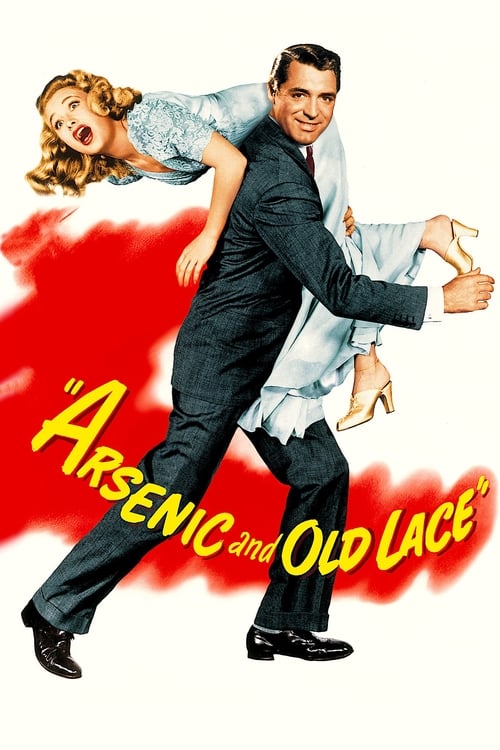
Arsenic and Old Lace
1944 · Frank Capra
For when you want to laugh at something dark without feeling bad about it — a perfect Halloween-season comedy, or a cozy black-and-white night when you need silliness executed at the highest level. Total comfort, skeletons included.
What it's about
Mortimer Brewster, a drama critic famous for mocking marriage, has just eloped — and swings by the family home in Brooklyn to tell his sweet maiden aunts the news. In the window seat he finds a corpse: the aunts, it turns out, have a charitable hobby of poisoning lonely old men with elderberry wine and burying them in the cellar. Over one increasingly unhinged night, Mortimer tries to manage his aunts, his delusional brother, a genuinely menacing criminal sibling, and his brand-new wife waiting next door.
The experience
Pure escalating farce — doors slamming, bodies shuffling, Cary Grant doing double-takes at full gallop. It's macabre without ever being grim, and it plays like a stage machine wound tighter every ten minutes until the whole house is spinning.
Performances
Cary Grant gives maybe the most unrestrained comic performance of his career — mugging, sprinting, practically vibrating — while Josephine Hull and Jean Adair, reprising their Broadway roles, make the murderous aunts genuinely, hilariously sweet.
The craft
Frank Capra shoots a single-house, single-night stage farce with real momentum, using the Brewster home's doors, stairs, and window seat like moving parts in a machine. The timing is the star: entrances, exits, and reveals choreographed to the second.
Why it matters
One of Hollywood's most enduring black comedies and the odd film out in Capra's career — proof the director of earnest populist dramas could run pure farce — it kept the play alive for generations of audiences.
Horror · Horror comedy & camp · Serial-killer thriller. One Brooklyn house, one frantic night, two sweet old aunts and a window seat: a door-slamming black farce, all laughs and no grimness.
Snapshot
Arsenic and Old Lace is Frank Capra's screen adaptation of Joseph Kesselring's 1939 stage hit, a black farce in which drama critic Mortimer Brewster (Cary Grant) discovers, on his wedding day, that his gentle maiden aunts have been poisoning lonely old bachelors with elderberry wine and burying them in the cellar. The picture is at once one of the most atypical films in Capra's body of work — no populist uplift, no everyman crusade — and one of his most durably popular, a manic single-night farce staged almost entirely inside the Brewster house in Brooklyn. Shot quickly at Warner Bros. in late 1941, just before Capra entered military service, but withheld from release until 1944 by contract with the still-running Broadway production, it belongs to two moments at once: the pre-war screwball peak and the wartime market into which it finally emerged. Its enduring identity is that of an ensemble comedy of controlled hysteria, a "filmed play" whose theatrical origins are worn openly rather than disguised.
Industry & production
The film is a product of the classical studio system at Warner Bros., built on a property with impeccable Broadway pedigree. Kesselring's play, produced on stage by Howard Lindsay and Russel Crouse, was a substantial hit, and the screen rights carried an unusual stipulation: the film could not be released while the stage production was still running. Capra shot the picture in a compressed schedule at the end of 1941 — commonly reported as roughly four weeks — precisely because he was on the verge of joining the U.S. Army Signal Corps, where he would oversee the Why We Fight orientation series. The completed film then sat on the shelf for the better part of three years, reaching general audiences in 1944.
Several of the stage cast were brought to Hollywood to reprise their roles: Josephine Hull and Jean Adair as the murderous aunts Abby and Martha, and John Alexander as brother Teddy, who believes he is Theodore Roosevelt. The most-cited casting story concerns Boris Karloff, who had played the menacing brother Jonathan on Broadway — a role written around the running gag that Jonathan "looks like Boris Karloff." Karloff could not be spared from the stage production (in which he was also an investor), so Raymond Massey took the film role, made up to evoke the Karloff resemblance the joke depends on. Cary Grant, borrowed for the lead, reportedly donated his fee to wartime relief; he is also famous for having disliked his own broad performance in the finished film, a self-assessment often repeated in accounts of his career.
Technology
Technologically the production is conventional for a major-studio comedy of its moment: black-and-white 35mm, standard Academy aspect ratio, orthodox optical sound recording, and a soundstage-bound design. There is no technical innovation to claim here, and it would be false to manufacture one. The relevant "technology" is really the mature Warner Bros. craft apparatus — deep-focus-capable lenses, controlled studio lighting, and a matte/optical department used sparingly for the exterior of the house and the surrounding cemetery — deployed to make a nearly single-set film feel visually alive rather than static.
Technique
Cinematography
Sol Polito, one of Warner's most accomplished cinematographers, photographed the film. The photographic problem is the classic one of the confined stage adaptation: how to keep a single interior — the Brewster parlor, staircase, and window seat — visually dynamic across a feature length. Polito's lighting leans toward a high-key comedic brightness rather than the shadow-heavy noir register he could also command, while reserving pockets of low-key menace for Jonathan and Dr. Einstein's arrivals, so that the "old dark house" atmosphere flickers in and out of a fundamentally bright farce. Camera movement and angle variation do much of the work of preventing staginess, reframing the ensemble as characters cycle through doors and the cellar entrance.
Editing
Daniel Mandell edited the picture. The comedy is fundamentally an editing-and-timing machine: the humor depends on the rhythm of entrances, reactions, and the audience's knowledge of what is in the window seat while characters remain ignorant. The cutting supports a rising tempo of near-discoveries and interruptions, accelerating as the night grows more crowded and chaotic. Given the material's farce structure, the editing's job is less montage-as-meaning than the precise metering of revelation and delay.
Mise-en-scène / staging
This is the film's defining formal fact: it is staged, openly and unapologetically, as filmed theater. Almost the entire action occurs within the Brewster house on a single night, with the layout of doors, staircase, cellar, and window seat functioning as the comic apparatus — a farce geometry in which bodies (living and dead) must be hidden, moved, and nearly exposed. Capra choreographs a large ensemble through this space with traffic-management precision. The staging accepts its proscenium logic rather than "opening up" the play, and much of the film's charm and its occasional airlessness both derive from that fidelity.
Sound
Beyond dialogue delivery, the sound design is unremarkable in a technical sense and appropriate to a dialogue-driven farce. The comedy is verbal and reactive, so intelligibility and pace of speech govern the mix. Max Steiner's score (see below) carries the non-diegetic weight.
Performance
Performance is the film's real medium, and it is deliberately pitched at a theatrical, sometimes cartoonish volume. Grant's Mortimer is a study in escalating panic — double-takes, wild-eyed reactions, physical recoils — a performance he later judged too broad, though it is central to the film's engine of comic hysteria. Against his frenzy, Hull and Adair play the aunts with an unshakable, beatific sweetness that is the film's best joke: their serene conviction that poisoning lonely men is a form of charity. Massey's Jonathan supplies genuine menace, Peter Lorre's Dr. Einstein a nervous, put-upon comic pathos, and Alexander's Teddy a recurring bugle-charge up the stairs. The tonal contract of the film is the collision of these registers — Grant's frenzy, the aunts' calm, Jonathan's horror — inside one room.
Narrative & dramatic mode
The film's mode is farce built on dramatic irony. The audience knows almost immediately what Mortimer will spend the film discovering and then desperately concealing, and the comedy flows from that gap between knowledge and ignorance, and from the accumulation of complications on a single wedding night: a new bride waiting next door, a homicidal brother arriving with a fresh corpse of his own, a body count that must be reconciled, and the recurring threat of the police. The structure is classically unified — one set, one night, a compressed near-real-time pressure cooker — which is also the structure of the source play. The dramatic question is not "whodunit" but "will Mortimer contain the chaos," and the resolution turns on a comic reframing of Mortimer's own fear of inherited madness.
Genre & cycle
The film sits at the intersection of several genres. It is a black comedy — arguably one of the most mainstream and beloved examples Hollywood produced in the era — using murder, corpses, and insanity as farce material. It draws on the "old dark house" tradition of comic-macabre thrillers, complete with a spooky home, a menacing intruder, and a cellar full of secrets. And its rapid-fire verbal energy and romantic frame connect it to the tail end of the screwball comedy cycle, though its subject matter is far darker than the screwball norm. It also belongs to the small class of stage-to-screen adaptations in which the theatrical origin is a feature, not a bug. Its release into the 1944 wartime market situates it, incidentally, among the era's appetite for escapist comedy, though it was conceived and shot before U.S. entry into the war.
Authorship & method
The screenplay is credited to Julius J. and Philip G. Epstein — the twin brothers who, in the same period, worked on Casablanca — adapting Kesselring's play (with the stage production's structure and much of its dialogue preserved). Their task was largely one of shaping and trimming an already tightly built farce for the screen and for the Production Code, which required softening some of the play's edges.
For Capra himself, the film is an outlier and, by his own later account, a somewhat detached professional assignment: a hit property to be executed efficiently on a tight schedule before he shipped out to make wartime documentaries. It lacks the authorial signature — the sentimental populism, the community-versus-corruption drama — of Mr. Deeds, Mr. Smith, or It's a Wonderful Life. What it does share with Capra's best work is a gift for orchestrating large casts and for sustaining a driving, breathless comic tempo. The key collaborators are the Warner Bros. craft team assigned to the picture rather than Capra's longtime associates: cinematographer Sol Polito, editor Daniel Mandell, and composer Max Steiner, whose score frames the macabre farce with the studio's characteristically emphatic orchestral cueing. The performances of the reprising Broadway players arguably constitute a second layer of "authorship," carrying the play's original stage conception directly into the film.
Movement / national cinema
The film is a straightforward product of classical Hollywood and the studio system at its height — American commercial cinema of the early 1940s, made within the constraints of the Production Code and the economics of adapting a proven Broadway hit. It belongs to no avant-garde or national-cinema movement; its lineage is the Broadway–Hollywood pipeline that fed the studios a steady supply of pre-tested theatrical properties.
Era / period
The picture straddles a historical seam. It was shot in late 1941, on the eve of America's entry into World War II and Capra's own military service, and it reflects the sensibility of the pre-war screwball peak. But it did not reach audiences until 1944, deep into the war, held back by the contractual link to the Broadway run. This gap makes it a curious time capsule: a late-screwball black comedy delivered to a wartime public, its production world (and its still-touring stage cast) already a few years in the past by the time of release.
Themes
The central thematic joke is madness as family inheritance — the "Brewster blood." The film treats insanity as both hereditary curse and comic engine: the aunts kill out of what they sincerely believe is kindness; Teddy has retreated wholesale into a Rooseveltian fantasy; Jonathan is a genuine killer warped into something monstrous. Mortimer's arc is the fear that this madness runs in him too, and the comedy resolves that anxiety with a final reframing. Beneath this runs a strain of satire on respectability and charity: the sweet, church-going aunts commit serial murder as a benevolent civic service, a joke that quietly skewers genteel piety. The framing romance and Mortimer's professional identity as an anti-marriage writer give the film a lighter thematic thread about marriage and commitment as their own kind of terrifying leap. The macabre material — mercy-killing, buried bodies, cellars — also lets the film play, in a defanged register, with mortality and domestic secrecy.
Reception, canon & influence
On release the film was received as a broad, popular entertainment and has remained a perennial favorite, particularly as a Halloween-season staple, thanks to its combination of star power and macabre good humor. Critical assessment has long been double-edged: admiration for the ensemble (especially Hull and Adair) and the sheer velocity of the farce, set against a recurring judgment that the film is too stagey and that Grant's performance is pitched too broadly — a criticism Grant himself famously endorsed, repeatedly citing it as among his least favorite of his own films. In auteurist accounts of Capra, it is typically treated as a skillful anomaly rather than a defining work.
Its influences (backward) are clear and acknowledged: Kesselring's play above all, which supplies the plot, structure, and much of the dialogue; the "old dark house" comic-thriller tradition; and the fast-talking farce idiom of 1930s screwball. The casting joke about Jonathan resembling Boris Karloff is itself an in-reference to Karloff's horror stardom, folding the horror genre's own iconography into the comedy.
Its legacy (forward) is best understood as helping to popularize and legitimize black comedy for a wide mainstream audience — demonstrating that murder and corpses could be the stuff of affectionate farce in a major studio release with a top star. The property's afterlife is substantial: the play remains a staple of community, school, and regional theater, and the 1944 film endures in steady revival and broadcast, keeping the title in circulation long after many of Capra's own message pictures faded from casual view. Direct, documented lines of specific stylistic influence from this film onto later works are harder to trace with confidence, and it would be overreaching to assign it a precise causal role in the later flowering of screen black comedy; its more secure legacy is as a widely seen, widely revived template for the affectionate-macabre farce and as one of the most enduring proofs that the genre could be genuinely mass-market entertainment.
A Deleuzian reading
He lifts the lid of the window seat.
The full Deleuzian reading of Arsenic and Old Lace →
Reception
A hit on release and never really out of favour — but it's climbed from 'minor Capra romp' to a perennial Halloween comfort classic, the rare dark comedy from 1944 that modern audiences find genuinely, laugh-out-loud funny.
How Arsenic and Old Lace was received, from release to now →
How to watch Arsenic and Old Lace: what to notice on a first viewing
- Watch how the whole story stays inside one house. Nearly every scene happens in the Brewster parlor, staircase, and window seat on a single night, with doors and the cellar entrance doing the comic work. Everything the comedy needs is packed into one small, fixed layout instead of a changing world.
- Watch the aunts offer elderberry wine to their guest. Once you have learned what the wine really contains, every polite offer of a glass becomes a small countdown the aunts greet with a smile. The horror is invisible to them; their warmth is completely sincere, which is the whole joke.
- Watch Cary Grant's double takes get bigger each time. Grant plays Mortimer's panic as a study in escalation, wild eyed reactions and physical recoils building every time he opens the window seat again. His hysteria is the only thing in the house registering the situation as actually horrifying.
- Notice the room brighten and darken as different characters enter. Sol Polito lights the parlor in high-key comic brightness overall, then drops in pockets of low-key shadow whenever Jonathan or Dr. Einstein arrive. The light itself tells you when the old dark house movie is briefly elbowing its way into the farce.
- Count how many times a discovery is almost made. Daniel Mandell cuts the entrances and reactions to a rising tempo of near misses, timing each close call against what the audience already knows. The comedy runs entirely on the gap between what you know and what the characters still don't.
The whole guide to watching Arsenic and Old Lace, with the keys for a rewatch →
Influences: the films it descends from and the films it influenced
- The Cat and the Canary (1927) — Codifies the 'old dark house' machinery Arsenic inherits wholesale — inheritance plot, corpses concealed in the furniture, and a single mansion whose doors, window-seats and staircases are the engine of suspense-turned-gag.
- Frankenstein (1931) — Karloff's flat-headed, scarred silhouette is the exact iconography the Jonathan gag cites — the film builds a running joke on the audience recognizing that a character 'looks like Boris Karloff' (a role Karloff himself played on Broadway).
- The Old Dark House (1932) — Establishes the comic-macabre tonal blend — a stormy single-set house of grotesque relatives where dread and deadpan farce share the same frame — that Capra's picture adopts as its whole register.
- Twentieth Century (1934) — Prototype of the stage-derived, breathless-tempo screwball in which theatrical broadness is a virtue, not a flaw — the pitched-to-the-back-row playing that Grant's much-debated performance extends.
- You Can't Take It With You (1938) — Capra's own template for orchestrating a large eccentric-household ensemble adapted from a Broadway hit, honing the crowd-choreography and sustained comic tempo he reuses here.
- Bringing Up Baby (1938) — Fixes Cary Grant's signature mode — the flustered straight man escalated into wide-eyed physical panic — the exact register his Mortimer Brewster mugging pushes to its broadest extreme.
- His Girl Friday (1940) — Demonstrates how to film a talky single-location stage play as pure velocity — overlapping, machine-gun dialogue that keeps a filmed-theater property from feeling static, the trap Arsenic works to outrun.
- Monsieur Verdoux (1947) — Carries the affectionate-macabre premise to its logical edge — a genteel serial murderer played for comedy — extending the proof Arsenic offered that corpses could be the stuff of mainstream farce.
- Kind Hearts and Coronets (1949) — Perfects the drawing-room black comedy of methodical murder among respectable relatives, the satire-of-respectability strain and polite-killer irony that Arsenic mainstreamed.
- The Trouble with Harry (1955) — Builds an entire comedy on the corpse-as-recurring-prop — the body that must be repeatedly hidden, moved and dug up — the same dead-body-as-farce-object logic as the Brewster cellar.
- Young Frankenstein (1974) — Reanimates the exact Karloff/Universal horror iconography Arsenic joked about, mining affectionate parody from the audience's shared memory of the 1930s monster image.
- Murder by Death (1976) — Revives the old-dark-house farce as filmed-theater — a single mansion, an ensemble of broad theatrical turns, and murders staged for laughs within the confined single-night unity of time and place.
- Clue (1985) — Pure inheritor of the farce-geometry — door-slamming choreography through a single mansion, bodies stashed in successive rooms, all played at theatrical broadness with strict unity of place.
- The Addams Family (1991) — Domesticates the murderous-relatives premise into affectionate household comedy, extending the 'hereditary madness played as warm family sitcom' tone that Arsenic's homicidal aunts pioneered.
- Noises Off (1992) — The apotheosis of filmed-theater farce geometry — precision-timed entrances, exits and slamming doors treated as clockwork mechanism — the same stage-farce architecture Capra transferred to film.
- The Ladykillers (1955) — Establishes the black-comic engine of homicide concealed inside genteel domestic respectability, the lethal-innocence collision of sweet old ladies and bodies in the house.
- The Skeleton of Mrs. Morales (1960) — Perfects the domestic-space murder farce, concealing corpses within the genteel household as the primary comic engine, prefiguring the taxidermist's skeleton gambit.
- Panchatanthiram (2002) — Accelerating door-slamming stage farce built on concealed bodies and a protagonist's spiraling panic to keep newcomers from discovering them, modeling the 'farce geography' of a single pressurized space.
- Harvey (1950) — Direct cast and method lineage: Josephine Hull reprised her Broadway sweet-deranged-aunt turn on screen, and its fidelity to stage blocking and single-room farce is the adaptation model Harvey follows.
- The Cat and the Canary (1939) — Bob Hope's contemporaneous recalibration of the old-dark-house thriller into a star-driven laugh machine, proving the same haunted-house mechanics could carry a top comedian — the commercial bet Warner made on Grant.
- The Man Who Came to Dinner (1942) — Julius Epstein's near-simultaneous adaptation of a Broadway farce, preserving the play's structure and much of its dialogue and its reprising theatrical playing — the same Epstein trimming-for-screen method applied to a single-set comedy.
- Casablanca (1942) — The Epstein brothers' dialogue-shaping and Max Steiner's emphatic orchestral cueing are the same authorship layer — Steiner's score frames both pictures, here underlining the macabre farce with the studio's characteristic scoring.
- The Little Shop of Horrors (1960) — Stage-bound black-comedy-horror played at frantic farce tempo with the cast committing deadpan to murder-as-domestic-routine — the tonal template for treating homicide as breezy comic business.
- The Miracle of Morgan's Creek (1944) — Runs the same strategy of smuggling genuinely transgressive material (serial murder) past the Code through farce acceleration, letting breakneck pace and indirection defuse what the plot literally contains.
Similar films
- His Girl Friday (1940) — influence & lineage
- Bringing Up Baby (1938) — influence & lineage
- Monsieur Verdoux (1947) — influence & lineage · same viewing thread
- Bride of Frankenstein (1935) — same viewing thread
- Shadow of a Doubt (1943) — same viewing thread
- Double Indemnity (1944) — shared sensibility
- The Big Sleep (1946) — shared sensibility
- Beetlejuice (1988) — shared sensibility
All the films related to Arsenic and Old Lace →
Watch it with: curated runs of related films
- Horror With a Wicked Grin — A run of films that play monsters, killers and the macabre for laughs as much as screams. Watch them together to see how the joke-and-jolt trick goes from James Whale's arch 1930s Universal pictures and Capra's homicidal aunts, through the Joe Dante/John Landis creature-feature era, to Scream's rule-quoting…
- Killers Among Us — A run of films that put a murderer inside ordinary life (the beloved uncle, the charming documentary subject, the polite clerk, the hitchhiker, the man who lives next door) and watch these when you want to see nine decades of cinema working out what it means to live alongside one, from the city hunting a child-killer…