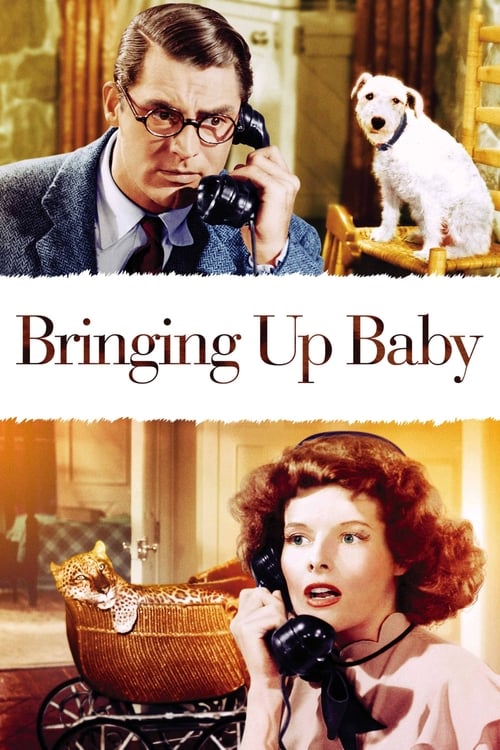
Bringing Up Baby
1938 · Howard Hawks
For when you need to laugh — a fizzy, zero-stakes pick-me-up after a rotten day, or a date-night comedy that still out-paces almost everything made since. Total comfort; zero challenge.
What it's about
A mild paleontologist, days from both completing his brontosaurus skeleton and marrying his no-nonsense fiancée, collides with a chaotic heiress who decides — instantly and unshakably — that he's hers. What follows is a day and a half of escalating catastrophe involving a missing dinosaur bone, a Connecticut country house, a dog with a burying habit, and a tame leopard named Baby. And then a second leopard, distinctly less tame.
The experience
Breathless, giddy, and relentlessly funny — the dialogue overlaps, the disasters compound, and it never once slows down to let anyone (onscreen or off) regain their dignity. Pure accelerating chaos, played by everyone with total conviction.
Performances
Katharine Hepburn is a force of nature as Susan, weaponizing charm and non-logic in equal measure, and Cary Grant — bespectacled, flustered, occasionally in a marabou dressing gown — proves the funniest thing a leading man can do is lose control completely. Their rat-a-tat timing is the gold standard.
The craft
Howard Hawks directs at full throttle: overlapping dialogue, gags stacked on gags, and a plot engineered so every scene strips the hero of one more piece of his ordered life. The pacing is so precise it plays like music — and it's a masterclass in how far a comedy can go without a single wasted minute.
Why it matters
A flop on release that helped get Hepburn branded 'box-office poison,' it was rediscovered decades later and crowned the definitive screwball comedy — the template every fast-talking romantic comedy still works from.
Snapshot
A paleontologist named David Huxley spends a catastrophic day-and-a-half with heiress Susan Vance, a tame leopard called Baby, a lost dinosaur bone, and a second, distinctly less tame leopard — losing, in roughly that order, his bone, his dignity, his clothes, his fiancée, and his carefully ordered life. Bringing Up Baby is the screwball comedy at full pressure: the form's vertiginous pace, its comedy of embarrassment, its sexual panic and social dissolution compressed into ninety-two minutes of almost unbroken acceleration. A commercial failure in 1938 that contributed to the dismantling of Katharine Hepburn's first Hollywood career, the film was rehabilitated by auteurist criticism in the 1950s and 1960s and now stands as the genre's canonical reference point — the film against which all subsequent screwball comedies measure themselves.
Industry & production
Bringing Up Baby was produced at RKO Radio Pictures, at the time a studio navigating the economic pressures of the Depression while sustaining a prestige program around marquee directors and stars. Hawks had come to RKO fresh from significant work at other studios and brought considerable creative authority to the project. The screenplay was adapted by Dudley Nichols and Hagar Wilde from Wilde's short story, originally published in Collier's Weekly in 1937; Wilde's conception of the chaos-generating heroine and her hapless prey is already largely complete in the source, and the adaptation expands its physical and social scale considerably.
Katharine Hepburn, who starred as Susan, was by 1938 a prestige liability at RKO despite earlier Oscar success — her box-office returns had declined sharply through the mid-1930s. Cary Grant, cast as David Huxley, was still consolidating the screen persona that would make him a defining Hollywood star; his work here, and in Hawks's His Girl Friday two years later, would prove foundational to that persona. The production was reportedly difficult: animal trainers managed Nissa, the female leopard playing Baby, whose behavior on set was unpredictable despite professional handling. Various accounts describe nervous production conditions around the animal scenes, though the degree of actual danger involved is difficult to verify from the historical record.
The film was a significant commercial failure. RKO lost a substantial sum on the release — various archival estimates have placed the loss in the hundreds of thousands of dollars, though precise figures are not always consistent across sources. The failure contributed materially to Hepburn's decision to buy out her RKO contract. That same year, theater exhibitor Harry Brandt published his now-notorious piece labeling Hepburn, along with Greta Garbo, Joan Crawford, and others, as "box office poison" — a phrase that marked the effective end of Hepburn's first Hollywood period and her strategic retreat to the stage, where The Philadelphia Story would rebuild her standing.
Technology
The film was shot in black and white on RKO's Culver City soundstages, with the Connecticut setting — Susan's aunt's rural estate, the nearby town, the jail — constructed as studio interiors and backlot environments. The production's technical infrastructure is standard late-1930s Hollywood: panchromatic film stock, studio lighting rigs, synchronous sound recording. The trained leopard necessitated careful coordination between animal handlers, the camera department, and the actors, with doubles and careful staging managing the riskier animal-actor proximities. No particular technological innovation distinguishes the film's physical production; its achievements are fundamentally those of performance, writing, and directorial management of comic tempo.
Technique
Cinematography
Russell Metty, a technically accomplished RKO house cinematographer who would later shoot Orson Welles's Touch of Evil (1958), served as director of photography. The visual approach is functional rather than expressive — high-key, evenly lit interiors that keep the actors and their physical comedy legible at all times. Hawks had no interest in elaborate pictorialism in his comic work; the camera exists primarily to capture performance. Metty's framing tends toward medium and medium-long shots that preserve the actors' full bodies, accommodating the physical business that comedy requires. The night sequences — the backyard hunt for Baby, the excursion into the wilds of Connecticut — use lower-key contrast without sacrificing comic clarity.
Editing
The cutting rhythm supports the film's relentless velocity. George Hively is credited as editor, and the assembly maintains continuity while enabling the rapid scene-to-scene acceleration that screwball comedy demands. What matters at the editorial level is less the individual cut than the management of pace across sequences: the film never slows to let confusion settle, stacking new complications onto unresolved ones with a precision that requires careful structural control in the editing room. The comedy of accumulated disaster — David's coat, then his hat, then Susan's dress, then the leopard, then the second leopard — depends on an editorial logic that denies relief.
Mise-en-scène / staging
Hawks's staging philosophy in the comedies prioritizes spatial chaos as emotional expression. Susan's introduction of disaster into David's orderly world is rendered physically: she appears in his space, displaces his objects, rearranges his relationships. The Connecticut sequences use the full geography of the studio sets — rooms, hallways, the yard, the barn — as a field of misadventure, with characters repeatedly separated, misdirected, and reencountered. The famous sequence in which David must conceal his compromised state while Susan stands before him is staged for maximum embarrassment through the exploitation of spatial proximity and the threat of visibility. Hawks understood comedy as a problem of bodies in space and arranged his scenes accordingly.
Sound
Roy Webb composed the score, which functions conventionally as underscore and mood support. More significant than the composed music is Hawks's management of spoken dialogue: Bringing Up Baby operates at a delivery speed considerably above naturalistic speech, with lines cascading into one another and characters talking through — rather than at — each other. This rapid verbal texture would become even more extreme in His Girl Friday (1940), where Hawks and his cast achieved a near-systemic overlapping of dialogue; here the technique is present but not yet fully systematized. The acoustic quality of Hepburn's speech — high, sharp, inexhaustible — functions as its own comic instrument, matching the leopard for unpredictability.
Performance
Cary Grant's performance as David Huxley is among his most physically committed and analytically precise: a meticulous construction of the comic male as prim, bespectacled, reactive, perpetually insufficient. Grant uses his body as a register of humiliation — the stiffened posture, the double-take carried to its logical extreme, the growing exasperation calibrated to always fall just short of decisive action. The role required a willingness to be dominated on screen that not every male star of Grant's standing would have accepted; his ability to make passivity funny rather than merely pathetic is fundamental to the film's success.
Hepburn's Susan is the more difficult performance to assess historically, in part because it was not well received in its moment: contemporary critics found her brittle, and the film's failure was often attributed partly to her. Retrospective criticism has been kinder, recognizing in Susan a characterization of considerable comic aggression and internal consistency. She is not simply scatterbrained; she is strategic, relentless, and fully aware of what she is doing to David, which is what makes her dangerous. The comic electricity between Hepburn and Grant was not immediately repeated — they would not appear together again until Holiday (also 1938) and later The Philadelphia Story (1940), the latter directed by George Cukor.
Narrative & dramatic mode
The film operates as a comedy of systematic dismantlement. David begins the film with two goals: acquire the dinosaur bone that will complete his museum's brontosaurus skeleton, and secure a million-dollar donation for the museum from a wealthy patroness. He ends the film having lost both goals, his fiancée, and the skeleton itself — while having gained a wife. The MacGuffin of the intercostal clavicle — a term that may be intentionally absurd — anchors a narrative about the irrelevance of professional ambition in the face of erotic disorder.
The dramatic mode is what Stanley Cavell's philosophical analysis of the related screwball tradition calls the acknowledgment of the self through the destabilizing presence of another: David cannot remain David in Susan's presence, and the film argues that this is fortunate. The resolution — Susan swinging from the collapsed brontosaurus scaffold while confessing her love — dismantles the very object David had organized his life around, making room for the only thing worth having.
Genre & cycle
Bringing Up Baby arrives at the height of the screwball comedy cycle that had been energized by It Happened One Night (Capra, 1934) and extended through My Man Godfrey (La Cava, 1936), The Awful Truth (McCarey, 1937), and Topper (McLeod, 1937). The screwball form is characterized by accelerated dialogue, physical comedy, class friction, gender inversion, and the pursuit of romantic resolution through chaos rather than conventional courtship. Bringing Up Baby pushes several of these tendencies to their limit: the class differential is extreme (heiress versus salaried academic), the gender inversion is thoroughgoing (Susan is entirely dominant), and the physical comedy is genuinely demanding. The film is sometimes identified as the moment when screwball reached and slightly overreached its formal limits — its failure suggesting that audiences had begun to find the formula exhausting.
Authorship & method
Hawks's authorial signature across genres — the Hawks-ian concerns with group professionalism, masculine codes, and the exceptional woman — manifests differently in the comedies than in the westerns and adventure films, but the underlying structure is consistent. In the comedies, Hawks reverses the gender hierarchy of the adventure films: the woman is competent, aggressive, and goal-oriented; the man is reactive and inadequate. This reversal is not satire but a formal strategy — comedy for Hawks emerges from the collision between order (male, professional, procedural) and instinct (female, improvisatory, chaotic). The comedies and the adventure films are mirror images.
Dudley Nichols, a major Hollywood screenwriter whose credits ran from The Informer (1935) to Stagecoach (1939), brought structural solidity to Wilde's concept. The script's management of escalating complications — each new disaster arriving before the previous one resolves — reflects a professional mastery of comic construction. Roy Webb's score is competent without being distinctive; the film's sonic identity is carried by the dialogue rather than the music.
Movement / national cinema
Bringing Up Baby is a product of the Classical Hollywood system at its mature industrialized form — the studio-as-factory model operating at peak efficiency. It also represents a distinctly American comic sensibility: the screwball comedy as a genre has no precise European equivalent and is often read as a Depression-era cultural formation, a fantasy of class mobility and sexual freedom that permitted the anxieties of economic uncertainty to be discharged through laughter. Whether the genre is better understood as ideological safety valve or as genuine social critique remains a productive critical debate.
Era / period
The film belongs to the late 1930s, a period of consolidation for the Hollywood sound film and of particular richness in American comedy. The pre-war moment in Hollywood — roughly 1934 to 1941 — produced an extraordinary concentration of comic talent and formal invention. The screwball cycle is this period's signature genre contribution, and Bringing Up Baby arrives at what was, in retrospect, the cycle's peak year.
Themes
Bringing Up Baby is persistently about the infantilizing power of desire. The film's central symbol — a full-grown leopard named Baby, handled by Susan like a household pet — condenses the film's argument: the id is large, unpredictable, and must be managed by someone more comfortable with irrationality than David has been trained to be. The dinosaur bones function as David's life-work, his claim to significance, the architecture of his adulthood — and they are destroyed, stolen, buried, and finally collapsed beneath Susan's weight. The film treats this not as tragedy but as liberation.
The comedy of the torn dress and the man forced to cover the woman's exposed back — their bodies forced into improvised physical intimacy before desire is acknowledged — stages the film's central erotic argument in miniature: necessity precedes admission. The leopard, the darkness, the Connecticut woods, the jail cell all conspire to break down the protocols that keep David from knowing what he wants.
Reception, canon & influence
Backward influences. The film draws directly on the screwball tradition established by It Happened One Night and deepened by The Awful Truth; Leo McCarey's influence on the tempo and gender dynamics of screwball is discernible. The classical comedies of Chaplin and Keaton are present in the physical vocabulary of the set pieces, and the theatrical tradition of farce — bedroom farce specifically — underlies the film's structural logic of concealment, exposure, and compounding disaster.
Initial reception. Contemporary reviews were mixed to negative, and the film's failure with audiences was consequential for all parties. Critics who praised it tended to celebrate the pace and the animal sequences; those who found fault focused on Hepburn's abrasiveness and what some reviewers described as mechanical complication in the screenplay. The box-office failure was severe enough to function as a career event for both Hepburn and, to a lesser degree, Hawks at RKO.
Rehabilitation and canonic status. The film's critical afterlife began in earnest with the auteurist reassessment of Hawks by French critics at Cahiers du Cinéma in the early 1950s — Jacques Rivette's 1953 essay "Génie de Howard Hawks" was foundational — and was consolidated in the American context by Andrew Sarris's The American Cinema (1968), which placed Hawks among the directors of the first rank. Once Hawks was understood as an auteur, the comedies were legible as systematic works rather than commercial entertainments, and Bringing Up Baby became the key exhibit.
Forward influence. The film's most direct descendant is Peter Bogdanovich's What's Up, Doc? (1972), which Bogdanovich acknowledged as a deliberate homage — same structure, same animal-chaos logic, same gender dynamics, updated to early-1970s San Francisco with Barbra Streisand and Ryan O'Neal in the Hepburn-Grant slots. The film's influence on subsequent screwball and romantic comedy is difficult to disentangle from the influence of the genre more broadly; it has become so central to the canon that it functions as the genre's definition rather than merely one of its examples. Hawks's His Girl Friday (1940) develops the overlapping-dialogue technique further and is often discussed alongside Baby as the twin peaks of Hawks's comic achievement. Stanley Cavell's philosophical engagement with the "comedy of remarriage" in Pursuits of Happiness (1981) brought rigorous philosophical attention to the tradition within which Bringing Up Baby sits, even if Cavell's primary examples differ slightly.
The film now occupies a secure position in the American Film Institute canon and on virtually every serious survey of classical Hollywood comedy. Its commercial failure in 1938 and its subsequent critical resurrection constitute one of film history's more instructive lessons in the gap between contemporary reception and enduring value.
A Deleuzian reading
Four years of assembly, and the brontosaurus is one bone short.
The full Deleuzian reading of Bringing Up Baby →
Reception
A box-office disappointment in 1938 that got Katharine Hepburn branded 'box office poison' by exhibitors soon after — today it's routinely called the definitive screwball comedy, one of Hollywood's great flop-to-classic stories.
How Bringing Up Baby was received, from release to now →
Influences: the films it descends from and the films it influenced
- It Happened One Night (1934) — Capra's film established the screwball template Hawks inherited: the reactive, plan-deprived male (Gable) systematically outmaneuvered by an aggressive female protagonist (Colbert), with episodic road-structure as the mechanism for compounding reversals that deny resolution.
- Twentieth Century (1934) — Hawks's own proto-screwball established verbal combat as romantic warfare — the train's enclosed space forcing characters into escalating performative confrontations — which Baby extends from primarily verbal to physical and spatial comedy.
- Trouble in Paradise (1932) — Lubitsch's model of repartee as erotic combat — dialogue that signals desire through dominance and deflection rather than statement — established the tonal register of sophisticated screwball verbal performance that Baby's Susan/David exchanges inherit.
- My Man Godfrey (1936) — La Cava encoded the class-friction screwball schema — a competent male (Powell) navigating chaos generated by a wealthy, aggressive female (Lombard) — establishing the gender-inversion of social competence that Baby systematizes.
- Easy Living (1937) — Preston Sturges's screenplay demonstrated the single-disruption-cascade narrative logic — one improbable event producing exponentially multiplying consequences — that Hawks used as the structural engine for Baby's systematic dismantlement.
- The Awful Truth (1937) — McCarey calibrated Grant's reactive male passivity — the body language of hapless endurance under female-engineered chaos — which Hawks transplanted directly into Baby, making Grant's Huxley the definitive expression of screwball masculine helplessness.
- His Girl Friday (1940) — Hawks pushed Baby's rapid overlapping dialogue to its formal limit — characters interrupt mid-sentence, speeches layer simultaneously — developing what Baby had tested into a systematized technique recorded at the fastest average speech rate in Hollywood sound cinema.
- The Philadelphia Story (1940) — Cukor and Donald Ogden Stewart modeled Tracy Lord's aggressive upper-class female dismantlement of surrounding males directly on Baby's Susan Vance, and cast Grant to reprise his reactive passivity in a structurally parallel role opposite the same star.
- Ball of Fire (1941) — Hawks reprised Baby's passive-male/disruptive-female schema with Cooper and Stanwyck: an innocent academic's ordered world (a grammar encyclopedia) is systematically invaded and dismantled by an aggressively competent woman who speaks in idiom he cannot parse.
- The Lady Eve (1941) — Sturges modeled Fonda's hapless herpetologist directly on Baby's David Huxley — the reactive male scientist whose professional obsession leaves him defenseless against female social aggression — extending Susan Vance's systematic male dismantlement into class-revenge structure.
- The Palm Beach Story (1942) — Sturges inherited Baby's editorial logic of complication stacking — each scene adds an unresolved complication rather than clearing a prior one — with the Ale & Quail Club sequence functioning as a direct structural echo of Baby's escaped-leopard escalation.
- I Was a Male War Bride (1949) — Hawks literalized Baby's gender-inversion metaphor by forcing Grant into women's clothing and submission to female institutional authority, extending from comic subtext to explicit narrative premise the same schema of masculine identity dissolution under female-generated chaos.
- What's Up, Doc? (1972) — Bogdanovich's structural homage replicated Baby's MacGuffin logic (igneous rocks standing in for the intercostal clavicle) and the Hepburn/Grant dynamic (Streisand/O'Neal), then multiplied the MacGuffin into four identical bags to formally extend Baby's complication-stacking mechanism.
- A New Leaf (1971) — May adapted Baby's reactive-male-dismantlement structure for dark comedy: Matthau's fastidious bachelor has his ordered world invaded and reconstructed by an aggressive, oblivious female botanist, with spatial comedy of incompatible personalities in domestic proximity echoing the Connecticut sequences.
- Jules and Jim (1962) — Hawks's screwball triangle — two men whose friendship is reorganized by a woman who seizes narrative initiative and controls the plot through comic aggression — is the structural template for Catherine's role; the fast overlapping dialogue rhythm of Hawks's ensemble scenes also enters Jules and Jim's conversational texture.
- Women on the Verge of a Nervous Breakdown (1988) — Establishes the screwball architectural template Almodóvar mechanizes: a farcical confined space into which an expanding cast of strangers is deposited and held barely separate by near-miss editing timed to within seconds, arrivals and exits choreographed as the film's primary comic mechanism rather than its subject.
- To Have and Have Not (1945) — Hawks's template for the fast-talking woman who enters male professional space uninvited and ultimately reshapes it through erotic force is established here with Hepburn's Susan Vance; Bacall's Slim is the cooler, more controlled descendant of this character type, with the screwball velocity stripped out and the erotic charge concentrated.
- Adam's Rib (1949) — Screwball's foundational rhythm: the woman's uncontrollable disruptive energy systematically dismantling the man's professional control beat by beat — the escalation structure Adam's Rib refines and politicizes.
- Monkey Business (1952) — Hawks and Grant returned to the reactive-male-disrupted-by-chaos structure, using a youth-serum MacGuffin to drive the same systematic dismantlement of the male professional's identity that Baby's intercostal clavicle initiates, with Rogers occupying the aggressive-female disruptor role.
- Raising Arizona (1987) — Supplies the screwball engine — overlapping rapid-fire patter, an escalating chase of accidents, and a put-upon man dragged through chaos by forces of nature — that the Coens transplant onto a baby-snatching plot.
- Midnight (1939) — Contemporary benchmark for the breakneck overlapping-dialogue tempo and escalating-lie farce structure that Midnight shares as a peak-screwball specimen.
Similar films
- What's Up, Doc? (1972) — influence & lineage · same viewing thread
- Ball of Fire (1941) — influence & lineage · same viewing thread
- The Philadelphia Story (1940) — influence & lineage
- His Girl Friday (1940) — influence & lineage
- It Happened One Night (1934) — influence & lineage
- The Awful Truth (1937) — influence & lineage
- The Lady Eve (1941) — influence & lineage
- Trouble in Paradise (1932) — influence & lineage · same viewing thread
All the films related to Bringing Up Baby →
Watch it with: curated runs of related films
- Fast Talk & Fur Coats — A run of quick-witted charmers who disguise, con, and sweet-talk their way across class lines — watch them near each other and the century between Lubitsch and Sean Baker collapses into one long, glittering grift.