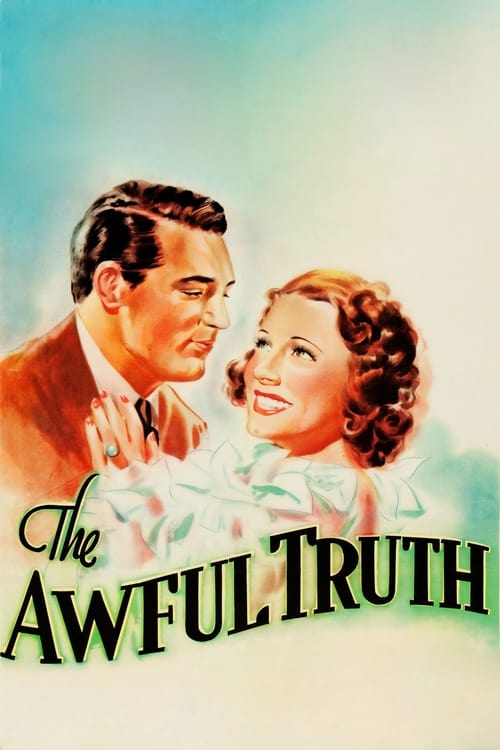
The Awful Truth
1937 · Leo McCarey
For when you need a good laugh and a little romance without a single heavy moment — ideal for a cozy night in, a pick-me-up after a rough week, or converting someone who thinks old movies are stuffy. Total comfort.
What it's about
Jerry and Lucy Warriner, a glossy Manhattan couple, each come home with a flimsy alibi, decide the other must be cheating, and file for divorce — custody of the dog included. With ninety days until the decree is final, they devote themselves to sabotaging each other's rebound romances, discovering in the process that nobody else can keep up with them.
The experience
Pure champagne — fast, silly, and effortlessly light, built on glances, double-takes, and people trying desperately to keep a straight face. It's the rare comedy where you laugh at how a line is timed as much as what it says. You float out of it.
Performances
This is the film that made Cary Grant 'Cary Grant' — the suave exterior forever on the verge of collapsing into flustered slapstick. Irene Dunne matches him beat for beat, funniest when pretending to be scandalous, and the dog steals every scene he's in.
The craft
Leo McCarey directed with a famously loose, improvisatory hand, letting his actors find the jokes in gesture and timing rather than nailing them to the script — and it won him the Academy Award for Best Director. The plot is gossamer-thin on purpose; the craft is all in the rhythm.
Why it matters
The film most often used to define screwball comedy at its peak, and the template for decades of couples who bicker their way back to each other — its DNA is in every remarriage romcom since.
Snapshot
The Awful Truth is the film most often invoked to define screwball comedy at its most effortless, and the picture that finished the work of turning Cary Grant into "Cary Grant." A married couple, Jerry and Lucy Warriner, separate over mutual, largely groundless suspicions of infidelity, file for divorce, and then spend the body of the film sabotaging each other's rebound romances until they admit they would rather quarrel with one another than be comfortable with anyone else. Directed by Leo McCarey for Columbia and released in 1937, it won McCarey the Academy Award for Best Director and earned nominations across most major categories. Its reputation rests not on plot — the plot is thin and frankly secondary — but on tone: a sustained, improvisatory lightness in which dialogue, gesture, and timing carry meaning that the Production Code forbade the script from stating outright. It is the keystone text of what the philosopher Stanley Cavell would later name the "comedy of remarriage."
Industry & production
The film was a Columbia Pictures production, made at a studio still defined in this period by Frank Capra's prestige hits and by a relatively lean, director-friendly operation under Harry Cohn. McCarey arrived with an unusual degree of autonomy for the era, having built a reputation first in silent comedy and then with successes at Paramount. The property itself was well-worn: Arthur Richman's stage comedy The Awful Truth had opened on Broadway in 1922 and had already been filmed twice in the silent and early-sound periods (a 1925 version and a 1929 talkie). By 1937 the bones of the story were familiar studio inventory, which suited McCarey, who treated the script less as a blueprint than as a pretext.
The credited screenplay is by Viña Delmar, but the production is famous precisely for the gap between what was written and what was shot. By multiple accounts — including McCarey's own later recollections, which should be read as self-mythologizing but are broadly corroborated — the director worked loosely, arriving with material developed that morning, building gags on the set, and inviting his actors to discover scenes in rehearsal. The most repeated anecdote is that Cary Grant, accustomed to conventional preparation and rattled by the apparent chaos, tried to get out of the picture, at one point reportedly offering to trade roles with Ralph Bellamy or to buy his way out of the assignment. The chaos was, in fact, McCarey's method, and the friction it produced is visible on screen as a kind of nervous spontaneity. As with many such production legends, the precise allocation of credit and the degree of true improvisation are impossible to fix exactly; the documentary record here is anecdotal rather than archival.
Technology
The Awful Truth is, technologically, a mature studio sound film of the late 1930s and makes no claim to innovation in apparatus. It was shot on standard 35mm black-and-white stock with the orthochromatic-to-panchromatic glossy look that Columbia's camera department had refined, and recorded with the by-then-stable optical sound systems of the period. There is no special-effects ambition, no process-heavy spectacle. What the film does exploit is the everyday consumer technology of its moment as comic and dramatic furniture: the telephone, which structures several scenes of cross-purpose and eavesdropping; the radio and the phonograph; and the period's fascination with broadcast and recorded sound generally. The technology that matters in The Awful Truth is domestic and social rather than cinematic.
Technique
Cinematography
The film was photographed by Joseph Walker, Columbia's premier cinematographer and Capra's frequent collaborator, and it bears his signature of unfussy elegance. Walker's lighting flatters Irene Dunne and Grant without calling attention to itself; the visual register is bright, high-key, and clean, appropriate to comedy. Crucially, the camerawork is self-effacing in service of performance. Walker and McCarey favor compositions that keep two or three actors in frame together so that reactions can play continuously, and they resist the temptation to chop comic exchanges into aggressive close-up patterns. The camera's job here is to watch, steadily and at the right distance, while the actors do the work.
Editing
Al Clark's editing (the picture was nominated for its film editing) embodies a comic principle that runs counter to later, faster styles: the cut that waits. McCarey's comedy depends on holding a shot a beat past the line so that the reaction, the double-take, or the embarrassed pause can land. The cutting tends to preserve the integrity of a performed moment rather than to manufacture rhythm in the cutting room. Where the film does cut briskly, it is usually to set up a structural rhyme — the parallel humiliations Jerry and Lucy inflict on each other — rather than to accelerate a gag. The editing's restraint is its sophistication.
Mise-en-scène / staging
This is the level at which McCarey's genius operates. Trained in the physical, space-driven comedy of the Hal Roach lot — he was instrumental in shaping the Laurel and Hardy partnership — McCarey stages domestic interiors as arenas in which bodies, doors, and objects do narrative work. The film is full of staging built around thresholds: the connecting door at the climax, doorways through which the wrong person enters at the wrong moment, the literal and figurative spaces between rooms. Props become recurring motifs — the bowler hat, the cuckoo clock with its little Swiss figures that mark the film's beginning and end, the dog's toys. The custody hearing over the family dog, Mr. Smith (played by Skippy, the terrier better known as Asta from the Thin Man films), is staged as a parody courtroom in which the animal "chooses" between his owners. The famous final sequence, in a mountain cabin with a recalcitrant connecting door and the cuckoo-clock figures retiring at last through the same little door, resolves the marriage entirely through spatial metaphor, without a word of explicit reconciliation.
Sound
The soundtrack is not score-driven in the modern sense; there is no continuous symphonic underscore knitting scenes together. Instead the film uses music diegetically and pointedly. The nightclub singer Dixie Belle Lee performs a tune whose skirt-billowing "wind" gag (delivered by a hidden fan) is purely visual-aural comedy, and the number's title joke trades on the topical fame of a recent bestselling novel. Lucy's musical accomplishment and Jerry's lack of one mark class and temperament. Dialogue, however, is the film's primary sound design: overlapping speech, muttered asides, the rhythm of interruption and the comic value of the unsaid. The film's wit lives in delivery, in what Grant does with a hum or Dunne with a feigned-naïve inflection.
Performance
Performance is the film's true medium. Irene Dunne — already established in melodrama and musicals — reveals a gift for sly comic timing and for the broad-when-needed, as in her gleeful impersonation of Jerry's vulgar fictitious sister to wreck his society engagement. Cary Grant consolidates the persona he would carry for two decades: the elegant man perpetually slightly off-balance, capable of pratfall and dignity in the same shot, his confidence always a half-step from collapse. Ralph Bellamy, as the earnest, charmless Oklahoma suitor Dan Leeson, perfected the type of the "wrong man" so completely that the role became shorthand for it. Cecil Cunningham as Aunt Patsy supplies dry counterpoint. The ensemble plays in a register of apparent improvisation that is, in fact, exquisitely controlled.
Narrative & dramatic mode
Dramatically, The Awful Truth is built on subtraction. It opens, unusually, not with a meet-cute but with a marriage already in trouble, and it dispenses with the divorce in its first act so that the real subject — the couple's inability to stay apart — can occupy the rest. The narrative mode is episodic and recursive rather than goal-driven: a series of structurally parallel set pieces in which each spouse intrudes on the other's new courtship. There is no villain and no external obstacle; the obstacle is the couple's own pride. This makes the film a comedy of recognition rather than of overcoming, and it places enormous weight on the climax's task of letting two people admit, without losing face, what the audience has known since the first reel. The Production Code's prohibitions are turned to dramatic advantage: because nothing can be said directly about sex or jealousy, everything must be performed obliquely, which is exactly the film's comic engine.
Genre & cycle
The film sits at the center of the screwball comedy cycle that ran roughly from the mid-1930s into the early 1940s — a cycle launched by It Happened One Night (1934) and populated by Twentieth Century, My Man Godfrey, Bringing Up Baby, His Girl Friday, and others. Screwball's defining traits — verbal velocity, class friction, romantic combat conducted as warfare, and physical comedy fused with sophistication — are all present, but The Awful Truth refines a particular sub-strain. Cavell isolated it as the "comedy of remarriage": a film in which the central couple is not being brought together for the first time but reunited, the divorce functioning as the structural equivalent of the obstacles in older romance. The film's success helped certify the formula, and its pairing of Grant and Dunne was repeated (notably in My Favorite Wife, 1940), as was Grant's broader screwball persona.
Authorship & method
The Awful Truth is, by wide consensus, a director's film, and McCarey is its author in the fullest sense — not through a script he wrote but through a method he imposed. His authorship is a matter of tone and tempo: the willingness to let scenes find themselves, the trust in actors, the comic faith that the best gag is discovered rather than planned. His collaborators were essential to realizing that method: Joseph Walker's photography kept the actors legible and the world handsome; Al Clark's editing protected the performed beat; Viña Delmar's credited screenplay supplied the architecture McCarey then renovated on the floor; and Morris Stoloff oversaw the musical direction at Columbia. But the controlling sensibility — and the through-line to McCarey's other 1937 release, the devastating Make Way for Tomorrow — is the director's. McCarey's celebrated quip on accepting the Oscar, that he had been given it "for the wrong picture," meaning the commercially neglected Make Way for Tomorrow, is the most revealing thing said about his year, and about a comic temperament that always knew how close laughter sat to loss.
Movement / national cinema
The film belongs to classical Hollywood at its zenith: the studio system operating with full command of its craft, its stars, and its genres. It is not affiliated with any vanguard movement; its lineage is internal to American commercial cinema. The relevant tradition is twofold — the Broadway drawing-room comedy from which the source play came, and, more deeply, the American silent slapstick tradition that McCarey carried with him from Roach. The Awful Truth is in this sense a synthesis of high verbal comedy and low physical comedy, a marriage of stage wit and screen pratfall achieved within the institutional norms of the Hollywood studio film.
Era / period
Made in 1937, the film is a Depression-era entertainment that, like much screwball, displaces economic anxiety into the affairs of the well-off. The Warriners are wealthy and idle; their crisis is emotional, not material, and the film offers audiences the pleasure of watching the comfortable make fools of themselves. It is also a fully Code-era film, produced under the strict enforcement regime in place since 1934, and it is exemplary of how the best filmmakers turned censorship into style, smuggling adult content past the Code through innuendo, timing, and the audience's complicity. Its topical jokes — the wind-machine song title, the social-register satire — root it precisely in the later 1930s.
Themes
At its core the film is about trust and the impossibility of proving it — the "awful truth" of the title is never specified, because the truth that matters is not whether anyone was unfaithful but whether the couple can choose each other freely. It is about pride as the real enemy of love, and about marriage as something continuously remade rather than once achieved. Beneath the laughter runs a melancholy strain characteristic of McCarey: the recognition that two people can be perfectly matched and still nearly destroy themselves out of vanity. The recurring cuckoo clock, with its two little figures who only at the very end go in through the same door, states the film's thesis wordlessly — that reconciliation is a matter of finally walking through the same opening at the same time.
Reception, canon & influence
The film was both a critical and popular success on release and was recognized by the Academy with multiple nominations — among them Best Picture, Best Director, Best Actress for Dunne, Best Supporting Actor for Bellamy, the screenplay, and the editing — with McCarey taking the Director award, the picture's sole Oscar win. (Specific box-office figures should be treated cautiously, as period grosses are unreliably documented; the film's commercial success is well attested in general terms but exact numbers are not.)
Its backward lines of influence run to the Roach-school silent comedy that shaped McCarey's staging, to the 1922 Richman stage play and its prior screen adaptations, and to the already-running screwball cycle that established the genre's grammar. Its forward influence is large. It fixed the Grant comic persona that Bringing Up Baby, His Girl Friday, and Holiday would all draw on; it reunited Grant and Dunne in My Favorite Wife; and it made Ralph Bellamy's "other man" a durable type. Most consequentially for criticism, it became the touchstone of Stanley Cavell's Pursuits of Happiness: The Hollywood Comedy of Remarriage (1981), which gave the film a central place in the philosophical study of American film and secured its standing in the academic canon. It is routinely cited in histories of the genre as the purest demonstration of what screwball could do — and a model of directorial trust in performance whose echoes persist in romantic comedy to this day. The film has since been preserved in the U.S. National Film Registry as a work of enduring cultural significance.
A Deleuzian reading
Two little Swiss figures live in the cuckoo clock that frames the film.
The full Deleuzian reading of The Awful Truth →
Reception
No rescue story needed — it was a smash in 1937, earning six Oscar nominations and winning Leo McCarey Best Director. If anything it's the film that made 'Cary Grant' as we know him: the persona snapped into focus here and never left.
How The Awful Truth was received, from release to now →
Influences: the films it descends from and the films it influenced
- Duck Soup (1933) — McCarey's own Marx Brothers feature where he refined his method of letting actors discover gags on the floor rather than executing a locked script — the same improvisatory trust he imposed on Grant and Dunne.
- The Marriage Circle (1924) — Established the comedy of marital jealousy played through doorways, glances, and ellipsis, the 'Lubitsch touch' of letting the audience infer the indiscretion — McCarey inherits this threshold staging and the cut that withholds.
- Trouble in Paradise (1932) — Modeled the elegant two-shot duet of equals trading wit, with recurring props (the stolen purse) carrying narrative — a template for the dog Mr. Smith and the bowler hat as recursive motifs.
- It Happened One Night (1934) — The Columbia screwball template shot by the same cinematographer Joseph Walker, whose clean, actor-legible lighting and the 'Walls of Jericho' prop gambit prefigure Walker's work and the prop-motif staging here.
- Twentieth Century (1934) — Set the screwball tempo of warring ex-partners whose love expresses itself as combat, fixing the genre grammar of accelerating verbal duels that McCarey then slowed down to let beats breathe.
- My Favorite Wife (1940) — Produced and substantially shaped by McCarey, it directly reunites the Grant–Dunne pairing and re-runs the remarriage structure of a returned spouse disrupting a new engagement (Bellamy-type rival included).
- Bringing Up Baby (1938) — Builds its entire comic engine on the flustered, double-taking Grant persona that The Awful Truth had just crystallized, extending the discovered-gag physicality McCarey coaxed out of him.
- Holiday (1938) — Deploys the same Grant comic-acrobatic persona and the comedy-of-recognition arc in which a couple must re-see each other's true natures, drawing directly on Grant's newly minted screwball type.
- His Girl Friday (1940) — Pushes The Awful Truth's overlapping, interruptive dialogue to its limit and reuses the remarriage scaffold — Grant's ex sabotaging her engagement to the dull Bellamy 'other man' — lifting Bellamy's type wholesale.
- The Philadelphia Story (1940) — A canonical comedy of remarriage in Cavell's sense, structured on the same recognition that the divorced couple belongs together, with Grant playing the knowing ex who orchestrates the reunion.
- The Lady Eve (1941) — Extends the recursive-episodic structure of a couple meeting, splitting, and re-courting in disguise, with comedy generated by recognition deferred — Sturges sharpening McCarey's gag-discovery into verbal architecture.
- Adam's Rib (1949) — Carries the remarriage comedy forward into the postwar era — a married pair as combative equals in sustained two-shot duets, the love-as-argument grammar The Awful Truth perfected.
- The Palm Beach Story (1942) — A divorce-and-reunion farce that inherits the remarriage plot and the recurring-prop, episodic-recursive construction, ending on the recognition that the estranged couple cannot be apart.
- Pillow Talk (1959) — Translates the antagonists-who-belong-together dynamic and the deceptive-courtship recognition arc into the late-50s romantic comedy, the durable rom-com template whose lineage McCarey's film anchors.
- A Lesson in Love (1954) — McCarey's remarriage comedy template — couple separates over mutual suspicion, encounters comic third parties, reunites through admission of mutual need — provides the structural skeleton that Bergman's flashback intercutting fills with counter-evidence against the protagonist's self-serving account.
- Annie Hall (1977) — Supplies the verbal-sparring, divorce-comedy ambivalence of classical Hollywood that Allen both inherits and inverts into anti-reconciliation.
- Anyone but You (2023) — The comedy-of-remarriage prototype where staged hostility performs as a mask over desire — the 'hostility-as-mask' template the film runs on.
- Make Way for Tomorrow (1937) — McCarey's same-year drama, governed by the identical authorial method — scenes that 'find themselves,' performance protected by patient editing — proving the comic and the devastating came from one tonal sensibility.
- My Man Godfrey (1936) — A contemporaneous screwball built, like McCarey's, on a loosely improvised set and a director trusting performers to find the scene, sharing the Depression-screwball milieu and the warring-class-couple dynamic.
- The Thin Man (1934) — Extends the marriage-of-equals comedy through McCarey's loosely-rehearsed, improvisational shooting — the same on-set 'fizz' method Powell and Loy had pioneered.
Similar films
- The Philadelphia Story (1940) — influence & lineage
- Bringing Up Baby (1938) — influence & lineage
- His Girl Friday (1940) — influence & lineage
- My Man Godfrey (1936) — influence & lineage
- Duck Soup (1933) — influence & lineage
- It Happened One Night (1934) — influence & lineage
- The Palm Beach Story (1942) — influence & lineage
- Holiday (1938) — influence & lineage