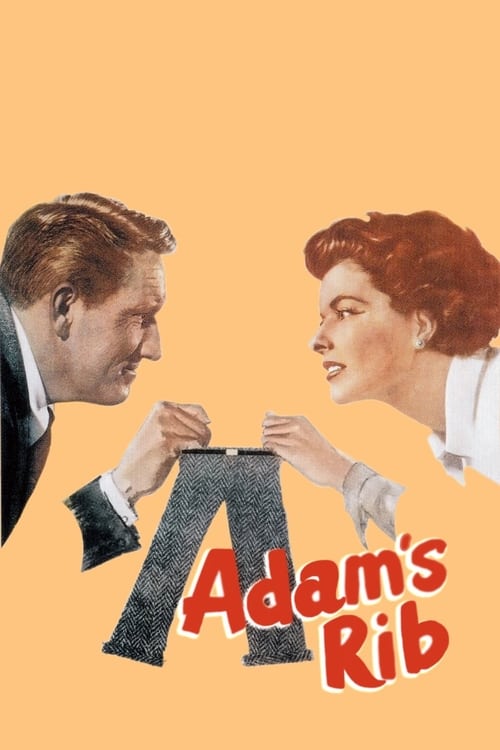
Adam's Rib
1949 · George Cukor
For a smart, cozy classic-movie night — when you want witty grown-ups sparring and flirting in equal measure. Comfort viewing with brains.
What it's about
Adam and Amanda are happily married Manhattan lawyers — until a woman is arrested for shooting at her philandering husband and the two of them end up on opposite sides of her trial, he prosecuting, she defending. The case becomes a public argument about whether the law treats men and women equally, and the argument follows them home to the dinner table.
The experience
Fast, sparkling, and genuinely funny — banter fired at screwball speed with a surprisingly sharp point underneath. It's the rare comedy that's both a delight and an actual debate.
Performances
Spencer Tracy and Katharine Hepburn at the peak of their screen partnership, their chemistry making every skirmish land — and Judy Holliday, in the supporting role that launched her career, walking off with entire scenes.
The craft
Garson Kanin and Ruth Gordon's script is one of the sharpest Hollywood ever produced, and George Cukor directs the crossfire with invisible ease, giving the actors room to play off each other in long, live-feeling takes.
Why it matters
A benchmark of the battle-of-the-sexes comedy whose courtroom argument about equality still reads as ahead of its time — and the film that made Judy Holliday a star.
Snapshot
Adam's Rib is the wittiest film to emerge from the Tracy-Hepburn screen partnership and one of the most incisive comedies Hollywood produced in the classical era. Written by Garson Kanin and Ruth Gordon, it sets a husband-and-wife legal team against each other in a attempted-murder trial — a structural conceit that allows the film to argue, simultaneously, a case about gender equality and a case about marriage itself. The film is at once a courtroom comedy, a screwball battle-of-the-sexes, and a piece of genuine social argument, all conducted at high speed and with considerable intelligence. It introduced Judy Holliday to mass audiences in a supporting role so explosive it effectively secured her the lead in Born Yesterday (1950). By 1949 it had already entered the canon of what American studio comedy could accomplish; it has never really left.
Industry & production
Adam's Rib was an MGM production, the sixth feature to pair Spencer Tracy and Katharine Hepburn on screen. The pair had first been teamed in Woman of the Year (1942), and each subsequent collaboration confirmed their commercial reliability and the public appetite for their particular chemistry. Producer Lawrence Weingarten, an MGM veteran whose career extended back to the silent era, shepherded the project with a relatively modest budget appropriate to a dialogue-driven comedy of interiors — the film's production values are handsome without being spectacular.
The screenplay originated with Garson Kanin and Ruth Gordon, who were themselves a married couple and who reportedly drew loose inspiration from a real New York legal case involving lawyers Dorothy and William Whitney. The parallels to their own partnership as creative collaborators gave the material an autobiographical warmth; Kanin and Gordon understood from the inside how a professional marriage could become a site of productive, potentially destabilizing contest. The script went through development at MGM with Cukor attached early, and Tracy and Hepburn's participation was never seriously in doubt. The project arrived at a moment of postwar reflection on gender roles — women who had entered the workforce during the war years and then faced social pressure to retreat from it — and the film's feminist thrust, however comedic in register, was calibrated to that cultural moment.
Technology
Adam's Rib was shot in the standard MGM black-and-white format of the period, using the studio's well-maintained 35mm infrastructure. There was no particular technological novelty in the production. The choice of black-and-white was unremarkable for a comedy of this budget and period, though MGM's monochrome work was consistently polished. No widescreen format was yet in use — that transition would arrive across the industry in the early 1950s. The film makes no fetish of technical modernity; its investments are entirely in script, performance, and direction.
Technique
Cinematography
The film was photographed by George J. Folsey, one of MGM's reliable house cinematographers, whose clean, unfussy approach suited the material. Folsey lit for legibility and for face — Adam's Rib is fundamentally an actors' film, and the cinematography keeps the screen clear for performance, withholding expressionistic shadow or elaborate composition. Close-ups of Hepburn and Tracy during courtroom exchanges allow the audience to read every flicker of amusement or irritation, and the framing of their domestic scenes at the Bonner apartment gives a sense of warmth and familiarity. A notable exception is the brief montage sequence in which Amanda presents her parade of accomplished women to the jury: a chemist, an acrobat, a strongwoman. Here the cutting briefly takes on something of a newsreel or documentary briskness, emphasizing competence over glamour — an effective tonal shift within the film's predominantly smooth visual register.
Editing
George Boemler edited the film with the economy and speed characteristic of MGM comedy. The courtroom sequences depend on precise rhythmic cutting between lawyer and witness, prosecution and defense, reaction and response; Boemler never lets the pace slacken into the staginess that can afflict filmed courtroom drama. The editing is most expressive during the argument scenes between Adam and Amanda at home, where cut-and-return patterns underscore the adversarial dynamic without ever making the marriage feel genuinely cold.
Mise-en-scène / staging
Cukor's craft here is the craft of intelligent blocking in limited space, and it is practiced with consummate skill. The Bonner apartment and the courtroom are the film's two primary environments, and Cukor uses each to articulate the film's structural conceit: what happens in one necessarily mirrors and threatens what happens in the other. His direction of actors in two-shots rewards extended analysis. Tracy and Hepburn are frequently framed together in ways that suggest equality — side by side, eye to eye — and the film disrupts this geometry precisely when the plot requires it to. The famous final scene, in which Adam manufactures tears to win Amanda back and then admits he faked them, is staged with deceptive simplicity: a close two-shot, Tracy's damp eyes, Hepburn's barely suppressed recognition that his performance confirms her entire courtroom argument about the performativity of gender. It is a small scene that contains the whole film.
Sound
The dialogue-driven nature of the screenplay means that sound design is largely a question of recording quality and verbal clarity, and Adam's Rib delivers both without calling attention to itself. The film's most notable sound contribution is Cole Porter's song "Farewell, Amanda," performed diegetically by David Wayne as the neighbor Kip Lurie, accompanying himself on guitar. Porter reportedly wrote the song as a personal favor to the production. Its wry, slightly arch tone — a mock-lament at losing Amanda to her husband — fits Kip's character precisely and adds a layer of sardonic musical commentary. The orchestral underscore throughout the film is functional and unobtrusive; detailed attribution of its composition falls outside what the record readily confirms, and the scholarly literature has tended to focus on Porter's contribution rather than the background score.
Performance
This is where Adam's Rib earns its permanent place in cinema. Tracy and Hepburn had refined their screen dynamic across five previous films, and here it reaches its most supple expression. Both actors were technique-forward in different ways — Tracy was famously an instinctive naturalist who distrusted overt "acting"; Hepburn was more theatrical, more willing to signal intelligence and calculation through visible physical comedy. The film scripts this contrast directly: Amanda performs for jury and audience alike, deploying tears, costume changes, and staged demonstration with theatrical aplomb; Adam is embarrassed by display, which is precisely his limitation and, the film argues, a gendered limitation. The dynamic between Tracy's controlled discomfort and Hepburn's demonstrative relish generates the film's central energy.
Judy Holliday's Doris Attinger is the revelation. Playing a dull-witted, loyal, unironic woman who shot her cheating husband in what she regards as a completely reasonable response to provocation, Holliday delivers a comic performance of extraordinary precision. Her timing is so exact and her characterization so internally consistent that she steals scenes from Tracy and Hepburn without appearing to compete with them. The performance is at once broadly funny and quietly sympathetic — we never doubt that Doris is telling the truth, and Holliday never condescends to her. Tom Ewell as the hapless Warren Attinger and David Wayne as Kip offer solid support, with Wayne's Kip navigating a characterization that, by contemporary standards, reads as sexually ambiguous in ways the film's subtextual coding would have recognized and the Production Code would have policed.
Narrative & dramatic mode
The film's structural elegance is its central achievement. The shooting of Warren Attinger by his wife Doris provides a case; Adam and Amanda, who have witnessed the arrest, find themselves on opposite sides of it. The courtroom narrative and the domestic narrative are mapped onto each other so precisely that the film operates as a kind of Euclidean proof: argue the case and you argue the marriage; win the case and you risk losing the marriage; concede the case and you confirm the argument. Neither party can win cleanly.
The film uses comedy throughout as a vehicle for genuine argument. The line between funny and serious is tested most directly in the scene where Amanda brings a female bodybuilder into the courtroom and has her lift Adam overhead — an inversion of the usual power dynamic that humiliates Adam personally and makes Amanda's legal point simultaneously. The scene is farcical and pointed in equal measure. Cukor, Kanin, and Gordon never use comic excess to evacuate the argument; they use it to dramatize it.
Genre & cycle
Adam's Rib belongs to the tradition of the screwball comedy, but it arrives at a late stage in that cycle and represents its most intellectualized refinement. The canonical screwball comedies of the 1930s — It Happened One Night (1934), Bringing Up Baby (1938), His Girl Friday (1940) — had established the genre's grammar: fast dialogue, gender antagonism as erotic energy, the disruption of class or professional hierarchy by comic chaos. By 1949 the pure screwball cycle had dissipated, and Adam's Rib represents something more deliberate and self-aware: a comedy that knows its genre and uses that knowledge argumentatively. The battle of the sexes is no longer merely metaphorical; it is the film's explicit subject matter, articulated through formal legal argument.
The film also belongs to the cycle of Tracy-Hepburn collaborations that constituted a specific MGM sub-genre across the 1940s and 1950s — films organized around the idea of two exceptional individuals trying to accommodate each other. Pat and Mike (1952), written again by Kanin and Gordon, would revisit similar territory.
Authorship & method
George Cukor had been labeled a "woman's director" since the early 1930s — a designation that functioned both as recognition of his skill with female performers and, in the culture of classical Hollywood, as a backhanded slight. Adam's Rib demands that the label be reconsidered and complicated. Cukor directs Tracy and Hepburn with equal attentiveness; if Amanda Bonner gets slightly more of the film's sympathetic energy, it is because the screenplay gives her the stronger argument, not because Cukor tilts the camera. His method was fundamentally one of enabling performance within carefully prepared spatial arrangements. He rehearsed extensively, worked closely with writers, and insisted on the kind of controlled set environment in which actors could take risks. His long associations — with Hepburn particularly, but also with actors like Judy Holliday whom he would direct again in Born Yesterday — were sustained by mutual trust and technical respect.
Garson Kanin and Ruth Gordon as a writing team brought an insider perspective on creative partnership to the material, and their screenplay is one of the most tightly constructed comedies in the MGM catalog. Every scene advances both the courtroom argument and the domestic argument simultaneously; there is almost no wasted motion. Kanin had directed films himself, which may account for the unusually cinematic quality of the stage directions and the precision with which scenes are conceived.
Movement / national cinema
Adam's Rib is a product of the classical Hollywood studio system at its most refined, and specifically of MGM's comedic tradition. It connects to no significant movement in world cinema beyond the mainstream American commercial tradition. Internationally it was received as representative of Hollywood sophistication — the French critical tradition, which was already reappraising Hollywood genre cinema in the late 1940s, found in films like Adam's Rib evidence that the American commercial cinema was capable of genuine intelligence. The auteurist critics of Cahiers du cinéma were less interested in Cukor than in directors whose visual style was more pronounced, but the Kanin-Gordon screenplay would have been legible to a French critical sensibility oriented toward the text.
Era / period
1949 is a threshold moment in American cinema: the studio system was under pressure from the Paramount decrees (1948), television was beginning its encroachment on cinema attendance, and the postwar social settlement was being contested on multiple fronts including gender. Adam's Rib registers the gender question acutely. The Doris Attinger case — a woman who shoots her husband when he cheats and cannot understand why this is considered criminal — is deliberately chosen as a case in which the law and ordinary moral intuition are in tension, and the film uses that tension to expose what Amanda calls "the unwritten law" that holds women to a different standard than men. The film does not resolve this tension so much as dramatize it comedically; the ending restores the marriage rather than overturning the legal order. But within the restored marriage there is an understood renegotiation, and the film's closing wink — Adam's admission that he faked the tears — ensures that no one in the audience believes the status quo has simply been reaffirmed.
Themes
The film's central theme is the double standard, defined as the application of different moral and legal criteria to identical behaviors depending on the actor's gender. Amanda Bonner's defense rests on the claim that a man who shot his wife's lover would face a different reception — legally, socially, popularly — than Doris Attinger faces. This is not a sentimental argument; it is a structural one about how law functions in a gendered society. The film takes the argument seriously enough to win it, at least in the court of audience sympathy if not the court of record.
Surrounding this central theme is an inquiry into performance and authenticity. Both the law (adversarial argument, theatrical presentation to a jury) and domestic life (flirtation, jealousy, emotional manipulation) require performance. Amanda is better at performance than Adam, and the film frames this not as her failing but as her competence. Adam's discomfort with theatrical display is his blind spot. The crying scene crystallizes this: when Adam deploys tears strategically and then admits it, he inadvertently proves Amanda's case — that emotional performance is a learned skill, not a biological destiny, and that its gendered attribution is therefore a social construction rather than a natural fact.
The film also thinks about the limits of argument. There are moments when the Bonners' professional precision damages their intimacy — when being right becomes more important than being together. The comedy acknowledges this risk without sentimentalizing it away.
Reception, canon & influence
Adam's Rib was a commercial and critical success on its release. Contemporary reviewers recognized it as one of the strongest entries in the Tracy-Hepburn cycle and praised the screenplay in particular. Cukor's direction was more often treated as invisible enablement than as active creation — a measure of how well it worked, and of the critical blind spots of the period.
The film draws backward on a rich tradition. The screwball comedies of the 1930s are the most direct inheritance, and Howard Hawks's His Girl Friday (1940) — which had already made the newspaper office a site of gender competition and professional equality — is the most visible precursor. More distantly, the film inherits the theatrical comedy of manners tradition: the battle of the sexes as a form goes back to Restoration comedy, and the Bonner marriage has a Beatrice-and-Benedick quality that Kanin and Gordon would certainly have been aware of. The courtroom comedy has its own stage ancestry as well.
Its forward influence has been substantial. Most directly, it launched Judy Holliday's Hollywood career: Cukor would direct her in Born Yesterday (1950), for which she won the Academy Award for Best Actress. The film established a template for intelligent romantic comedy in which the protagonists are professional equals, a template that would be revisited repeatedly — in The Marrying Kind (1952, also Cukor and Holliday), in various 1980s comedies of professional partnership and gender conflict, and arguably in the contemporary rom-com tradition that insists on its female protagonist having a defined professional identity. The film's argument about the double standard has remained current in ways that much of the surrounding culture has not; it is regularly taught in courses on gender and film precisely because its formal comedy does not obscure but rather advances a serious political claim.
The Tracy-Hepburn partnership as a cultural phenomenon — the idea of a witty, unresolvable, mutually respectful combat between equals as the proper form of romantic love — owes more to Adam's Rib than to any other single film. It is their best work together, and one of the best American comedies of the classical era.
A Deleuzian reading
Watch Spencer Tracy cry.
The full Deleuzian reading of Adam's Rib →
Reception
A hit on release and one of the most warmly reviewed of the Tracy–Hepburn pictures, it has only climbed since — now a National Film Registry title and a fixture on lists of the greatest American comedies, routinely called the best of their nine films together.
How Adam's Rib was received, from release to now →
Influences: the films it descends from and the films it influenced
- His Girl Friday (1940) — Rapid overlapping dialogue as the formal mechanism for staging professional gender equality — both protagonists talk through each other simultaneously as a sign of competitive intimacy — a technique Cukor inherits for the Bonner marriage's verbal combat.
- The Awful Truth (1937) — Remarriage comedy in which legal-divorce proceedings become the comic frame; McCarey stages adversarial legal positions as flirtation, establishing the structural template Adam's Rib mirrors through its parallel courtroom and domestic proceedings.
- The Thin Man (1934) — The husband-wife team as intellectual equals sharing the investigative frame without subordination; Nick and Nora's repartee-as-intimacy pioneered the equality two-shot that the Tracy-Hepburn cycle inherits.
- Woman of the Year (1942) — Established the Tracy-Hepburn equality two-shot as a formal unit; professional-competence rivalry framed as courtship, with the woman's superior expertise generating comic and erotic tension that Adam's Rib inherits and deepens.
- The Philadelphia Story (1940) — Cukor's first major Hepburn collaboration; his rehearsal-intensive method of staging confined-interior comedy with multiple speaking characters sharing equal screen weight is carried directly into Adam's Rib.
- The Lady Eve (1941) — Gender performance-as-theatrical-disguise as the film's central formal argument; the woman's superior performative skill made visible through staging anticipates Adam's Rib's performance/naturalist-vs-theatrical dialectic.
- Bringing Up Baby (1938) — Screwball's foundational rhythm: the woman's uncontrollable disruptive energy systematically dismantling the man's professional control beat by beat — the escalation structure Adam's Rib refines and politicizes.
- Holiday (1938) — The Cukor–Hepburn working method matured — extensive rehearsal, shooting in sequence, then parking the camera for whole scenes in unbroken two-shot so the comedy arrives through performance timing rather than cutting.
- Born Yesterday (1950) — Directly launched by Adam's Rib: Holliday's breakthrough in that film led immediately to this; Cukor applies the same naturalist-vs-theatrical performance dialectic with Holliday as lead, refining Doris Attinger's charged naivety into a full protagonist.
- The Marrying Kind (1952) — Cukor and Holliday transpose the parallel marriage/legal-proceeding structure into flashback architecture; a divorce-mediation frame for excavating a marriage's history extends Adam's Rib's cut-and-return editing between institutional and domestic space.
- Pat and Mike (1952) — Cukor returns Tracy and Hepburn to the equality two-shot, transposing their professional competition from law to athletics; the staging method — two adults of equal intelligence occupying the same frame without subordination — is carried over intact.
- It Should Happen to You (1954) — Fourth Cukor-Holliday collaboration; the naturalist-vs-theatrical dialectic is now embedded in public self-promotion as theater, extending Adam's Rib's argument that gender identity is performed for an audience.
- Some Like It Hot (1959) — Gender-as-performance exposed as theatrical construction through sustained cross-dressing; Wilder makes explicit the formal argument Adam's Rib stages through courtroom role-play — that gender behavior is a role rather than a nature.
- Tootsie (1982) — Gender disguise in a professional context systematically demonstrates the double standard Adam's Rib names; Dustin Hoffman's method-actor inhabiting a theatrical role literalizes the naturalist-vs-theatrical performance dialectic at the core of both films.
- A Lesson in Love (1954) — Cukor's professional-couple staging (Tracy/Hepburn) — the husband's wounded professional pride deflated by the wife's superior composure in high-key studio lighting and medium two-shot — is the immediate American prototype for the Björnstrand/Dahlbeck dynamic and its primary unit of marital negotiation.
- My Cousin Vinny (1992) — Fuses sparring-couple romantic comedy with genuine trial procedure, so the legal mechanics and the relationship banter advance together — the Pesci/Tomei dynamic descends directly from this Tracy/Hepburn courtroom marriage.
- How to Lose a Guy in 10 Days (2003) — Refines the two-professionals-litigating-gender-war form, where a private relationship becomes a public contest of wits, each partner performing to win a point off the other.
- Pillow Talk (1959) — Late screwball with professional-equals structure; split-screen telephone staging formally echoes the equality two-shot by placing both protagonists in mirrored frames, extending Adam's Rib's staging/mirrored-environments facet into CinemaScope comedy.
- Broadcast News (1987) — Professional-equals romantic comedy where the woman's technical competence exceeds the man's charm; Holly Hunter's performance — private emotion in controlled bursts within professional composure — extends the naturalist-vs-theatrical dialectic into the television workplace.
Similar films
- The Philadelphia Story (1940) — influence & lineage
- Some Like It Hot (1959) — influence & lineage
- Bringing Up Baby (1938) — influence & lineage
- His Girl Friday (1940) — influence & lineage
- Tootsie (1982) — influence & lineage
- The Lady Eve (1941) — influence & lineage
- The Awful Truth (1937) — influence & lineage
- Anatomy of a Murder (1959) — shared sensibility