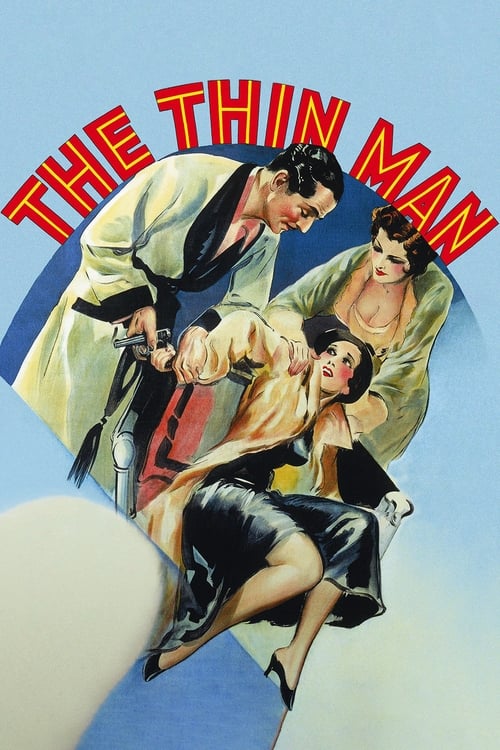
The Thin Man
1934 · W.S. Van Dyke
For a cozy night in when you want pure charm and zero stress — comfort viewing of the highest order, best with a drink and someone whose company you like.
What it's about
Nick Charles, a happily retired detective, and his heiress wife Nora get pulled into the search for a missing inventor — much against the wishes of Nick's cocktail schedule. With their wire fox terrier Asta in tow, they banter their way through parties, police, and a whole family of suspects, nearly getting killed for their trouble.
The experience
Fast, fizzy, and effortlessly funny — the mystery hums along nicely, but the real pleasure is eavesdropping on the most fun marriage in movies. It goes down like one of Nick's martinis.
Performances
William Powell and Myrna Loy, matched quip for quip and martini for martini — timing so relaxed it feels like conversation overheard at the best party in town. They made married flirtation a screen art form.
The craft
W.S. 'One-Take Woody' Van Dyke shot this Dashiell Hammett adaptation in roughly two weeks, and the speed shows in the best way: performances with the fizz still in them, dialogue tossed off rather than delivered. The gather-all-the-suspects dinner-party finale was handled so well it became a genre convention.
Why it matters
Six Oscar nominations, five sequels, a dog who became a star, and the template for every bantering screen couple since — a marriage shown as fun, flirtatious, and between equals, right as Hollywood's Production Code was clamping down on nearly everything else.
William Powell and Myrna Loy's Nick and Nora Charles — retired detective and heiress wife, matched martini for martini and quip for quip — invented the template for every bantering screen couple since. W.S. 'One-Take Woody' Van Dyke shot this Dashiell Hammett adaptation in roughly two weeks on MGM's dime, and the speed shows in the best way: performances with the fizz still in them, dialogue tossed off like conversation overheard at the best party in town. The missing-inventor mystery is handled with genuine craft — the dinner-party denouement became an instant convention — but the revolution was tonal: a marriage depicted as fun, flirtatious, and between equals, arriving just as the Production Code clamped down on nearly everything else. Six Oscar nominations, five sequels, and a wire fox terrier named Asta who became a star in his own right followed. Loy, forever after called 'the perfect wife,' preferred to point out that Nora was never merely a wife: she's the one who wants in on the case.
Reception
MGM treated it as a modest quickie — shot in a couple of weeks on a B-picture schedule — and it became a surprise smash, six Oscar nominations and five sequels later. Ninety years on it's less 'classic mystery' than the eternally rewatchable template for every bantering-couple detective story since.
How The Thin Man was received, from release to now →
Influences: the films it descends from and the films it influenced
- The Kennel Murder Case (1933) — William Powell perfected the debonair amateur sleuth (Philo Vance) — deductive flair delivered with cocktail-hour poise — the persona he carried intact into Nick Charles a year later.
- Trouble in Paradise (1932) — Set the pre-Code template of the sexually knowing, verbally sparring elegant couple whose romance is conducted almost entirely as innuendo-laced wordplay rather than sentiment.
- Manhattan Melodrama (1934) — The immediate proving ground — Van Dyke first paired Powell and Loy here, clocked their easy rapport, and reused the same director-star trust and fast shooting method on The Thin Man weeks later.
- The Front Page (1931) — Pioneered the machine-gun, overlapping newspaper-room patter from which Thin Man's rapid-fire quip-trading between Nick and Nora descends.
- Red Dust (1932) — Source of 'One-Take Woody' Van Dyke's unfussy quick-shoot method with Loy — minimal rehearsal preserving spontaneity — which produced Thin Man's improvisational fizz on a two-week schedule.
- After the Thin Man (1936) — The direct franchise continuation refines the gather-the-suspects dinner-party denouement and the domesticated married-detective comedy into a repeatable formula.
- Star of Midnight (1935) — RKO's near-instant clone: Powell again as a suave sleuth trading quips with a glamorous partner (Ginger Rogers) over cocktails, lifting the detective-couple template wholesale.
- The Ex-Mrs. Bradford (1936) — Powell as an amateur detective bantering his way through a case with a witty wife (Jean Arthur) — a beat-for-beat replication of the Nick-and-Nora sleuthing dynamic.
- His Girl Friday (1940) — Pushes the overlapping-dialogue, sparring-equals rhythm to its apex — romance staged as verbal combat between professionals who are each other's match.
- Adam's Rib (1949) — Tracy and Hepburn as sparring married professionals arguing as intellectual equals — the postwar heir to the sophisticated marriage-of-equals comedy Nick and Nora inaugurated.
- Charade (1963) — Welds romantic banter to a whodunit within elegant suspense — the Nick-and-Nora tone of murder-as-flirtation transposed to Technicolor Paris.
- McMillan & Wife (1971) — Formalizes the married-sleuths-with-repartee template for television (as Hart to Hart, Remington Steele and Moonlighting would too), running crime plots on domestic-comedy chemistry.
- Knives Out (2019) — Revives the parlor/dinner-party denouement — detective assembling every suspect for the reveal — and the whodunit-played-as-comedy-of-manners that The Thin Man popularized for the screen.
- My Man Godfrey (1936) — Fixed Powell's signature register — unflappable underplaying, throwaway line readings, comedy generated by refusing to react — which Godfrey deploys as the fixed point against four escalating performance styles.
- It Happened One Night (1934) — Codified screwball's bickering-equals dynamic and class-crossing banter months earlier, the comic engine The Thin Man welded onto a murder plot.
- The Awful Truth (1937) — Extends the marriage-of-equals comedy through McCarey's loosely-rehearsed, improvisational shooting — the same on-set 'fizz' method Powell and Loy had pioneered.
- The Maltese Falcon (1941) — The other pole of Hammett screen adaptation — the same author's terse, clipped dialogue steered toward noir menace where The Thin Man steered it toward comedy.
Similar films
- Trouble in Paradise (1932) — influence & lineage
- The Maltese Falcon (1941) — influence & lineage
- The Awful Truth (1937) — influence & lineage
- Charade (1963) — influence & lineage
- Double Indemnity (1944) — shared sensibility
- Murder, My Sweet (1944) — shared sensibility
- Laura (1944) — shared sensibility
- The 39 Steps (1935) — shared sensibility