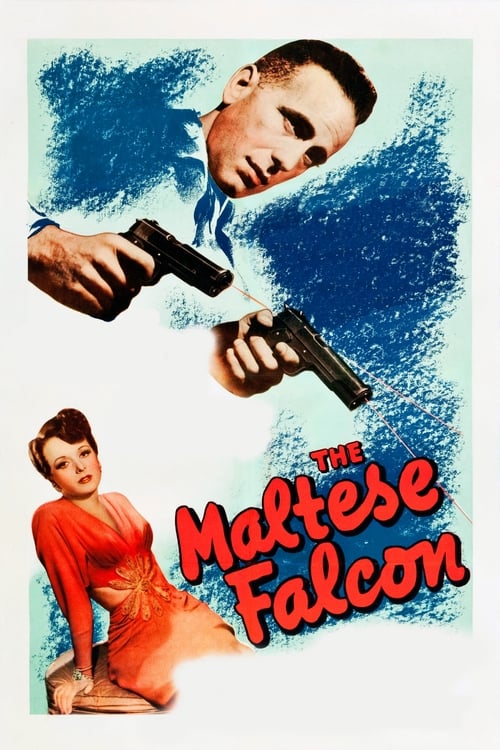
The Maltese Falcon
1941 · John Huston
For a rainy night when you want to feel sharp — whiskey-and-shadows atmosphere, crackling talk, a mystery that plays fair. An absolute comfort watch for anyone who loves a good scheme.
What it's about
San Francisco private eye Sam Spade takes on a new client whose story doesn't add up, and within a day he's tangled with a beautiful liar and a trio of eccentric criminals — all hunting a priceless jeweled statuette. Everyone is lying to everyone, and Spade has to out-think the room to stay alive and out of jail.
The experience
Fast, hard, and mordantly funny — the dialogue snaps like a card trick and the double-crosses keep you leaning forward. It's cynical to the bone yet a total pleasure, the kind of film where watching smart people lie to each other is the entertainment.
Performances
Humphrey Bogart invents his screen persona here — tough, amused, morally slippery — while Sydney Greenstreet (in his film debut) and Peter Lorre make deliciously silky villains.
The craft
John Huston's directorial debut is astonishingly assured: a tight script carved straight from Dashiell Hammett's novel, low-angle compositions, and pools of shadow that gave American crime cinema its visual grammar for the next fifteen years. Lean at 101 minutes, not a wasted scene.
Why it matters
Widely cited as the film that launched American film noir, it made Bogart a star and Huston a major director in a single stroke.
Snapshot
John Huston's directorial debut is the film most often cited as the opening salvo of American film noir—a lean, mordant adaptation of Dashiell Hammett's 1930 novel in which private detective Sam Spade navigates a labyrinth of greed, betrayal, and false identity in pursuit of a jewel-encrusted statuette that turns out to be a fake. Running 101 minutes on a modest Warner Bros. budget, it introduced Humphrey Bogart to the archetype that would define his stardom, established a visual grammar of shadows and menace that would dominate American crime cinema for the next fifteen years, and demonstrated—almost immediately upon release—that a first-time director working in close fidelity to a literary source could produce something more formally rigorous than most seasoned studio craftsmen were managing. Nominated for three Academy Awards, including Best Picture, it is now ranked among the handful of films that unambiguously altered the trajectory of Hollywood genre.
Industry & production
Warner Bros. had already adapted Hammett's novel twice: Roy Del Ruth's 1931 version, a pre-Code picture starring Ricardo Cortez, and William Dieterle's heavily disguised 1936 remake Satan Met a Lady, with Warren William. Neither had distinguished itself, and the property sat in the studio's library as routine inventory when Huston—then one of Warner's most trusted contract screenwriters, responsible in whole or part for Jezebel, Juarez, Dr. Ehrlich's Magic Bullet, and High Sierra—asked to direct. Producer Henry Blanke and executive producer Hal B. Wallis backed the assignment; the modest scale of the project made it a safe wager on an unproven director.
George Raft, the studio's preferred tough-guy star, famously declined the role of Spade on the grounds that working with a first-time director was beneath him—a miscalculation that handed Bogart the part and arguably handed him his career. Sydney Greenstreet, cast as the corpulent schemer Kasper Gutman, had never appeared in a film before; he was sixty-one years old and came to the project from the Broadway stage, making his screen debut one of the most auspicious in Hollywood history. Peter Lorre, already established in American pictures after M and Mad Love, brought an unsettling foreignness to the fey Joel Cairo. Elisha Cook Jr. completed the menagerie as the hapless gunsel Wilmer. The ensemble chemistry—conspiratorial, theatrically charged, mutually predatory—was not accidental. Huston rehearsed his cast extensively, drilling the overlapping rhythms of the dialogue scenes until the actors could sustain extended takes with precision.
Technology
The film was shot entirely on Warner Bros. studio soundstages, which suited both the budget and Huston's approach. Arthur Edeson, the cinematographer, had been working at a high level since the silent era and brought recent experience on Frankenstein (1931) and All Quiet on the Western Front (1930) to bear on the film's visual texture. Edeson and Huston worked together from pre-production storyboards—Huston's preparation was meticulous by any standard, and he arrived on set with shot lists that kept the production moving efficiently inside a tight schedule.
No cutting-edge optical process or special-effects technique distinguishes the film at the level of hardware. What is notable technologically is the disciplined use of standard studio apparatus: arc lighting, constructed interiors with lowered ceilings that permitted low-angle shooting without exposing the rig above, and lenses chosen to exaggerate spatial relationships within cramped rooms. The period's growing comfort with faster film stocks and refined incandescent lighting systems gave Edeson the latitude to push contrasts into near-expressionist territory without losing detail in the shadows.
Technique
Cinematography
Edeson's work on The Maltese Falcon sits at a productive intersection between the studio house style and the influence of German Expressionism that had been filtering into Hollywood since the late 1920s. Canted angles, deep-focus compositions that trap characters within layered planes of décor, and high-contrast pools of light carved out of dense shadow characterize the hotel-room interiors where most of the film's drama unfolds. Low-angle shots—placing the camera below eye level to loom the performers against ceilings and walls—are used judiciously rather than reflexively; when Gutman fills the frame from below, the angle literalizes his domination without tipping into caricature. The visual treatment refuses the clean, flat brightness of standard studio practice without fully committing to chiaroscuro abstraction; it occupies a middle register that feels both everyday and slightly wrong, which is precisely the tonal register Hammett's prose had staked out a decade earlier.
Editing
Thomas Richards's editing is unshowy and functional, supporting the film's verbal density rather than competing with it. The pacing trusts dialogue—scenes run long by genre standards because the exposition is complex and Huston understood that the peculiar pleasure of hard-boiled narrative lies in the texture of talk, not in velocity of event. Cuts are made on action or on the rhythm of exchange; there is little of the expressive montage that characterized the Warner Bros. crime pictures of the early 1930s. The restraint is deliberate: where the gangster film built meaning through kinetic collision of images, The Maltese Falcon builds meaning through the sustained pressure of people talking in rooms.
Mise-en-scène / staging
The staging throughout is dense and territorial. Characters crowd each other in the frame, dominate one another's sightlines, advance into close-up through camera movement rather than cutting. The hotel suite in which Gutman explains the history of the bird is staged as a kind of performance within the performance: Greenstreet orbits Bogart, filling and evacuating space, and the blocking makes the scene feel like a seduction and an interrogation simultaneously. Huston's instinct—derived partly from his theatrical sources, partly from his close reading of Hammett—was to treat every scene as a contest for physical and psychological territory, and the mise-en-scène encodes that contest spatially. The famous final image of Brigid O'Shaughnessy descending in the elevator cage, framed like a soul descending into darkness, is among the most cited pieces of studio-era compositional symbolism for good reason: it is utterly simple and utterly deliberate.
Sound
The sound design is conventional by 1941 standards, and the film owes nothing to acoustic innovation. What is notable is the quality of the dialogue recording, which preserves the precise rhythmic textures of Hammett's exchanges—Bogart's clipped terseness against Greenstreet's fat, expansive periods, Lorre's sibilant hesitations. Adolph Deutsch composed the score, which functions largely as atmospheric punctuation and is less remarked upon than the visual texture of the film. The record on Huston's specific relationship with Deutsch during production is thin; the music is serviceable rather than distinguished and does not function as an independent expressive layer in the way Herrmann's later noir scores would.
Performance
Bogart's Sam Spade is the film's center of gravity and remains one of the defining performances in American screen acting—not because it is especially naturalistic by contemporary standards, but because it found the precise register for translating hard-boiled literary affect into camera-legible behavior. Spade's opacity is the point: the audience is never quite certain whether he believes Brigid or is playing her, whether his morality is genuine or professionally calculated. Bogart held the ambiguity without indicating it, trusting the audience to sit inside uncertainty. Greenstreet, operating without a single prior screen credit, delivered a performance of extraordinary assurance; his Gutman is jovial, brilliant, and completely remorseless, and the character's warmth makes him more frightening than conventional villainy would permit. Mary Astor's Brigid O'Shaughnessy is the film's most formally demanding performance—she must be genuinely moving and demonstrably false at the same time—and Astor manages it through a quality of visible calculation behind apparent feeling.
Narrative & dramatic mode
The Maltese Falcon operates as a delayed and partial revelation: information is withheld not through authorial manipulation but because the protagonist does not have it. Spade's investigation never fully resolves the mystery of who killed Miles Archer; what it resolves is the moral question of what Spade will do with what he finds. The film is, at its core, an ethics drama wearing detective-fiction clothing. The MacGuffin—Hitchcock's term, though Hammett arrived at the device independently—is taken to its logical extreme: the bird for which everyone sacrifices is worthless, a fake, and the film ends on the image of lead painted to look like something else. The narrative structure thus performs its own theme, and the final line ("the stuff that dreams are made of") transforms a Shakespeare misquote into something closer to a thesis statement.
Genre & cycle
Whether The Maltese Falcon is the "first" film noir depends entirely on the definition brought to the term, and scholars have contested priority vigorously—some arguments favor earlier pictures (Stranger on the Third Floor, 1940; various pre-Code Warner Bros. thrillers), and the French critics who coined the term retroactively applied it to a cycle already underway when they wrote in 1946. What is not contested is that the film established or consolidated the key coordinates: the morally compromised detective, the deceitful woman, the quest MacGuffin, the claustrophobic urban interior, the visual atmosphere of shadow and threat, the tone of weary cynicism operating within a recognizable genre framework. Whatever one calls it, the film defined a template that subsequent American crime cinema—from Double Indemnity to Out of the Past to Touch of Evil—would work against, within, or beyond for at least three decades. It also represents the maturation of the hard-boiled detective film as a distinct subgenre, building on the Philo Vance pictures and earlier B-grade shamus fare while elevating the material to A-picture prestige.
Authorship & method
Huston's method on this film was to type up scenes from Hammett's novel largely verbatim and distribute them as a script—a compression of the adaptation process that reflected both his reverence for the source and his pragmatic speed. (The degree to which his script is a straight transcription versus a selective restructuring is somewhat overstated in popular accounts; he did make meaningful structural choices, condensing the novel's early sections and sharpening the final confrontation.) His directorial debut thus announced a career-long tendency: Huston as adapter and interpreter rather than auteur in the originating sense, a director whose authority was expressed through fidelity and selection rather than through the imposition of a personal mythological system.
Arthur Edeson as cinematographer, though his contribution is essential to the film's visual identity, left limited documentary testimony about his working relationship with Huston; the specifics of their collaboration are largely reconstructible from the film itself and from Huston's subsequent memoir An Open Book, where the broad outlines of Huston's pre-production method are confirmed. Thomas Richards as editor and Adolph Deutsch as composer were skilled studio professionals whose work serves the film without particularly foregrounding individual expression.
Movement / national cinema
The Maltese Falcon is a product of the classical Hollywood studio system at its most confident—a Warner Bros. house picture, made on contract, within the conventions of genre production. Yet it carries the imprint of émigré influence: the expressionist visual grammar that shaped Edeson's lighting owes a debt to the German directors and cinematographers who arrived in Hollywood during the 1930s, and the cultural milieu that produced hard-boiled fiction—urban, disillusioned, suspicious of official narrative—was itself partly a response to the same historical pressures that produced German and French poetic realism. The film is not a work of European art cinema, but its visual and tonal character cannot be understood without the transatlantic traffic of aesthetic ideas that Hollywood's émigré community made possible.
Era / period
Released in October 1941, two months before the United States entered the Second World War, the film arrives at the end of an era without knowing it. The pre-war anxiety that critics have sometimes read into its atmosphere of universal untrustworthiness is not programmatic—Hammett's novel predates it by eleven years—but the timing is historically suggestive. The film's commercial and critical success coincided with the mobilization of American culture around the war effort, and the hard-boiled sensibility it helped establish would spend the war years coding male toughness as both desirable and morally compromised, a tension that post-war noir would inherit and deepen.
Themes
The film's central concern is the impossibility of pure motivation: everyone in Spade's world, including Spade, is pursuing something under cover of something else. The quest for the Falcon literalizes this: the object of universal desire is hollow. Hammett's secular determinism—his sense that human beings are organized around self-interest and that no one is to be trusted, including the narrator—is translated directly into the film's structure of unreliable statement and countermanded claim. Loyalty, the film's apparent moral currency, is shown to operate as a professional code rather than an emotional commitment: Spade turns Brigid in not because he stops loving her but because the code demands it, and the grimness of the final scene derives from Bogart playing the moment as a man paying a debt he would rather not owe.
Reception, canon & influence
Critical reception in 1941 was strong: reviewers recognized an unusual quality of ambition and execution in a genre film. The Academy nominated it for Best Picture, Best Supporting Actor (Greenstreet, in a remarkable debut acknowledgment), and Best Adapted Screenplay. It did not win in any category—1941's competition included Citizen Kane and How Green Was My Valley—but the nominations confirmed its prestige standing.
The influences on the film run backward through Hammett's novel (the primary source), through the expressionist visual traditions that Edeson absorbed from German cinema, through the Warner Bros. crime cycle of the early 1930s that had established Bogart as a presence and the urban underworld as studio property. The 1931 adaptation is more a formal precursor than an aesthetic model; Huston seems largely to have returned to the novel directly.
Looking forward, the film's influence is difficult to overstate. It provided the template—visual, tonal, characterological, narrative—that defined film noir as a coherent cycle: the private investigator as morally compromised everyman, the woman as simultaneous object of desire and agent of destruction, the MacGuffin as structuring absence, the urban interior as a world from which the horizon has been removed. Double Indemnity (1944), The Big Sleep (1946), Out of the Past (1947), and Touch of Evil (1958) all inhabit the space the film cleared. Roman Polanski's Chinatown (1974), the most sustained neo-noir revision, takes the Spade archetype and denies it the professional resolution that Huston allowed Bogart; the difference is precisely Polanski's diagnosis of where the earlier film stops short.
Humphrey Bogart's performance inaugurated the star persona that would carry through Casablanca, To Have and Have Not, and The Big Sleep, making Sam Spade not simply a character but a model of screen masculinity—detached, capable, operating by a private ethical code whose exact content remains permanently elusive. Sydney Greenstreet and Peter Lorre became the defining screen villains of the 1940s, so thoroughly identified with this film and its immediate successors that their work is now inseparable from the cultural memory of the era.
The film entered canonical status gradually, consolidated by the French critics who codified film noir as a category and by the American popular culture that made Bogart into an icon in the 1950s and 1960s. It sits on the AFI top-100 lists, is a fixture of university film courses, and remains in continuous circulation as both entertainment and scholarly subject. Its position at or near the origin of film noir—contested as that position must be—ensures its centrality to any serious account of what American genre cinema accomplished in the decade of its maturity.
A Deleuzian reading
The bird comes wrapped in newspaper and excelsior, and Gutman can't get it open fast enough.
The full Deleuzian reading of The Maltese Falcon →
Reception
No reappraisal needed — it was a hit and an Oscar Best Picture nominee in 1941, and it's only grown since, now routinely credited as the film that kicked off the noir cycle. The twist: it was the THIRD adaptation of Hammett's novel in a decade, and the only one anyone remembers.
How The Maltese Falcon was received, from release to now →
Influences: the films it descends from and the films it influenced
- The Cabinet of Dr. Caligari (1920) — The distorted interiors, shadow-cast diagonals, and canted-frame compositions of German Expressionism—Wiene's foundational text—provided the visual grammar filtering into Hollywood via émigré cinematographers and directly informing Edeson's approach of turning ordinary studio rooms into psychologically unstable spaces.
- Frankenstein (1931) — Arthur Edeson, Falcon's director of photography, developed his signature high-contrast shadow technique on this film—carving human figures from near-total darkness with hard arc lamps—and carried the identical lighting vocabulary into the Warner Bros. soundstage interiors of Falcon nine years later.
- M (1931) — Peter Lorre reprised his technique, developed under Lang, of building menace through physical insinuation and internalized anxiety rather than aggression; Huston cast him specifically to import this performance mode—and its staging demand that actors accommodate subtle behavioral registers—into the ensemble of predators surrounding Spade.
- The 39 Steps (1935) — Hitchcock codified the MacGuffin—a pursued object whose actual content is structurally irrelevant—as a narrative engine; Huston deployed the identical formula with the bird statuette, whose ultimate worthlessness retroactively empties the entire plot, a specific narrative device directly traceable to Hitchcock's method.
- High Sierra (1941) — Huston's own screenplay for Walsh's film developed the Bogart persona—an aging professional with a private code of honor in a world without one—and the overlapping, elliptical dialogue rhythms that Huston then imported wholesale into Falcon, his directorial debut produced within the same production year.
- The Long Voyage Home (1940) — Carries the low-key chiaroscuro and enclosed-interior menace across the threshold into the noir decade the film is credited with anticipating.
- Double Indemnity (1944) — Wilder systematized Falcon's chiaroscuro into the venetian-blind shadow motif—bars of light and darkness falling across figures to literalize moral entrapment—extrapolating Edeson's controlled hard-lighting technique into the explicit pictorial metaphor that became film noir's most recognizable visual signature.
- Laura (1944) — Preminger adopted Falcon's territorial staging method—building menace through spatial encroachment via camera movement rather than cuts, figures advancing into close-up by dolly—and applied it to a structurally identical ensemble of obsessive men pursuing a MacGuffin-as-fetish-object whose value is entirely projected desire.
- The Big Sleep (1946) — Hawks pushed Falcon's model of dialogue-as-primary-action—the detective scene as elaborate verbal duel where information transfer is secondary to the texture of talk—to its logical extreme, producing a film whose narrative deliberately resists clarification so as not to interrupt the dialogue rhythm Huston had established as the genre's affective core.
- The Killers (1946) — Siodmak's émigré Expressionist cinematography (Woody Bredell) extended Falcon's systematic use of low-angle framing to signify inescapable menace, while the ensemble-of-doomed-men structure and retrospective unspooling of a MacGuffin through interlocking testimonies mirror Huston's narrative architecture directly.
- The Treasure of the Sierra Madre (1948) — Huston's own formal extension of Falcon: identical territorial staging of an all-male ensemble whose alliance corrodes under greed, the same extended dialogue-pacing that builds character through verbal texture rather than event, and a MacGuffin (gold dust) that literally dissolves—Huston's most direct elaboration of his debut's structural logic.
- The Third Man (1949) — Robert Krasker's Oscar-winning cinematography extended Falcon's expressionist chiaroscuro into extreme oblique angles and wide-angle distortion shot on location rubble, while the MacGuffin (penicillin) and the morally compromised protagonist navigating a network of false allies directly inherit Huston's narrative template of hollow desire.
- Touch of Evil (1958) — Welles extended Falcon's deep-focus, low-angle visual grammar to baroque excess, pushing Edeson's technique of using wide-angle lenses in cramped constructed interiors to spatially distort rooms and loom figures into a sustained expressionistic assault that treats the visual strategy as the film's primary expressive register.
- Chinatown (1974) — Polanski reconstructed Falcon's structural climax—the detective sacrificing the woman he loves to enforce his private code, generating tragic irony rather than resolution—as the keystone of his own neo-noir, while deploying the same theatrical ensemble of corrupt figures whose false alliances the detective systematically uncovers but cannot dismantle.
- Casablanca (1943) — Edeson photographed this Warner Bros. production using the same chiaroscuro vocabulary he brought to Casablanca, while Bogart established here the specific performance mode Rick inherits: affectless surface deployed as armor for residual sentiment, a cultivated cynicism the plot systematically unmasks as a moral position rather than moral absence.
- L.A. Confidential (1997) — Arthur Edeson's high-contrast portraiture lighting renders each male archetype as a social performance — the convention of using close illumination to morally distinguish three incompatible investigators that Hanson inherits for Exley, White, and Vincennes.
- Key Largo (1948) — Huston's debut established his ensemble staging method: precise eyeline matches and actor positioning within confined rooms make dominance hierarchies legible without expository dialogue — the same spatial grammar he imports into Key Largo's hotel bar confrontations.
- The Asphalt Jungle (1950) — Huston's own precedent for staging an ensemble of dangerous professionals in tight medium-shot conversation, relying on actor positioning, eye-line cuts, and withheld reaction rather than camera movement to encode hierarchy and concealed motive.
- Citizen Kane (1941) — Welles and Toland developed deep-focus staging as a systematic compositional philosophy—foregrounding objects and figures in the same sharp plane as distant characters to trap actors within their environments—in the same production season as Edeson and Huston, making both films simultaneous crystallizations of the same emerging visual doctrine rather than one influencing the other.
- The Glass Key (1942) — The second Hammett adaptation within a year shares Falcon's dialogue-dense, stage-like pacing because both derive from Hammett's construction of scenes as pure verbal duels; both films trust prolonged exchange over visual action to build tension, a technique specific to Hammett's prose style rather than any studio convention.
- Out of the Past (1947) — The hardboiled detective idiom of Hammett — terse, distrustful epigrammatic dialogue as a weapon and the duplicitous woman — codifies the verbal style Mitchum's Jeff inherits.
- The Thin Man (1934) — The other pole of Hammett screen adaptation — the same author's terse, clipped dialogue steered toward noir menace where The Thin Man steered it toward comedy.
Similar films
- The Big Sleep (1946) — influence & lineage
- The Treasure of the Sierra Madre (1948) — influence & lineage
- High Sierra (1941) — influence & lineage
- Chinatown (1974) — influence & lineage
- Double Indemnity (1944) — influence & lineage
- The 39 Steps (1935) — influence & lineage
- Citizen Kane (1941) — influence & lineage
- The Asphalt Jungle (1950) — shared sensibility
All the films related to The Maltese Falcon →