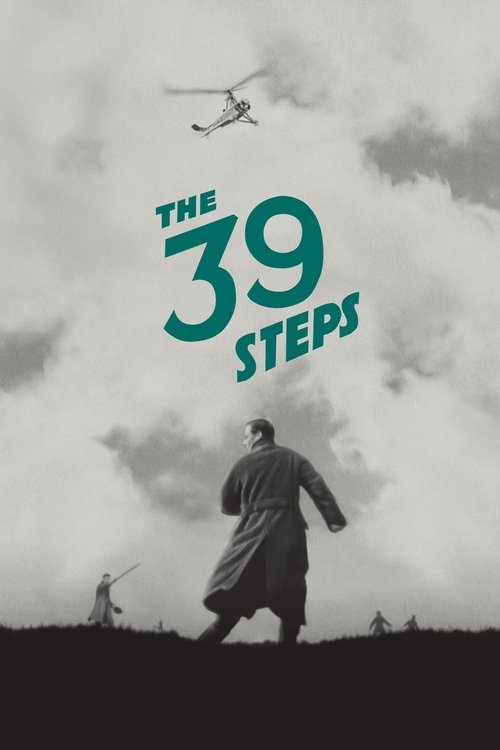
The 39 Steps
1935 · Alfred Hitchcock
For a light, stylish night in when you want to be entertained without being wrecked — pure comfort viewing with real craft behind it. Perfect entry point if you've never watched an old black-and-white thriller.
What it's about
An ordinary man's evening at a London music hall ends with a glamorous spy dead in his flat and the police convinced he killed her. To clear his name, Richard Hannay bolts for Scotland, hunted by both Scotland Yard and the enemy spy ring she was tracking — and ends up handcuffed to a woman who wants nothing to do with him. It's a chase, a mystery, and a screwball courtship all at once.
The experience
Brisk, witty, and endlessly charming — 86 minutes with zero fat, swinging from suspense to flirtatious comedy without missing a beat. It's the rare thriller that leaves you grinning.
Performances
Robert Donat makes wrongly-accused look effortless — dry, unflappable, impossibly likable — and his handcuffed sparring with Madeleine Carroll is one of the great early screen pairings.
The craft
Hitchcock's economy here is the whole show: every scene advances the chase, every transition is a small trick, and set pieces move from sleeper trains to Highland moors to a music hall with total confidence. It's a masterclass in how much story you can tell in under ninety minutes.
Why it matters
This is where Hitchcock perfected the wrong-man-on-the-run formula he'd rework for decades, and it set the template for virtually every innocent-fugitive thriller that followed.
Snapshot
The 39 Steps is the film in which Alfred Hitchcock fully crystallized the form that would define his career: the innocent man wrongly accused, hurled across a hostile landscape, pursued simultaneously by the police and by the conspiracy whose secret he has accidentally brushed against. Adapted loosely from John Buchan's 1915 adventure novel, it strips the source to its skeleton and rebuilds it as a propulsive double chase laced with sexual comedy, set against a Scotland of moors, sleeper trains, and music halls. Robert Donat's Richard Hannay flees a London murder he did not commit toward an enemy spy ring known only by a cryptic phrase; Madeleine Carroll's Pamela is shackled to him, literally and against her will, until antagonism curdles into attraction. Compact (roughly 86 minutes), witty, and ruthlessly economical, the film became the template for the Hitchcock thriller and, through it, for a century of spy and wrong-man pictures.
Industry & production
The film was produced by Gaumont-British Picture Corporation, the most ambitious British studio of the period, under the production chief Michael Balcon, with Ivor Montagu serving as associate producer. It was shot at Gaumont-British's Lime Grove studios in Shepherd's Bush, the moor-and-Highland exteriors largely recreated or supplemented in-studio with location and second-unit material rather than shot on extensive Scottish locations — a standard economy of British studio practice in the mid-1930s.
The production sits at the center of what is often called Hitchcock's British "thriller sextet," the run of films — The Man Who Knew Too Much (1934), The 39 Steps (1935), Secret Agent (1936), Sabotage (1936), Young and Innocent (1937), and The Lady Vanishes (1938) — that established him internationally and led directly to David O. Selznick's Hollywood contract. The 39 Steps followed the success of the first Man Who Knew Too Much and is generally regarded as the moment Hitchcock's signature became fully legible. Balcon, who had given Hitchcock his first directing assignments in the 1920s, provided a stable and resourceful studio environment, while Montagu — a film theorist, editor, and political radical — was a sympathetic collaborator on this and several neighboring films.
Casting Robert Donat, a major and bankable star with matinee-idol appeal and a light comic touch, gave the picture commercial weight; pairing him with Madeleine Carroll, then one of British cinema's most glamorous leading women, supplied the cool, blonde, initially hostile heroine type that would recur throughout Hitchcock's work.
Technology
The 39 Steps is a black-and-white sound film made when synchronized sound was less than a decade old in commercial cinema and still shaping directorial style. Hitchcock, who had directed Britain's first significant sound feature (Blackmail, 1929), was by 1935 thinking inventively about sound as an expressive rather than merely reproductive tool. The picture was made with the studio-bound apparatus of the period — large, relatively immobile sound cameras, recorded music supervised in-house — and the celebrated montage and sound bridges are achievements wrung from those constraints rather than from new equipment. Special effects and process work (back-projection for train and travel sequences, miniatures and matte work for the Scottish landscape and the Forth Bridge) are deployed unobtrusively, a hallmark of Gaumont-British's technical department.
Technique
Cinematography
Bernard Knowles photographed the film, and his work balances crisp studio interiors with atmospheric near-expressionist passages: the murdered spy lurching toward Hannay in shadow, the lamplit crofter's cottage, the fog and torchlight of the manhunt. The camera is mobile and purposeful, with Hitchcock favoring expressive framings — high angles that isolate the fleeing Hannay against open moorland, tight two-shots that trap Donat and Carroll within a single frame once they are handcuffed. The visual storytelling consistently privileges point of view and information control: we are shown what Hannay sees, and crucially what he does not yet understand, so that suspense is built through the gap between audience knowledge and character knowledge.
Editing
Edited by Derek N. Twist, the film is a textbook of compression and the suspense cut. Its most famous gesture is a sound-and-image bridge: a landlady discovers the dead body and opens her mouth to scream, and her scream is replaced — match-cut — by the shriek of a train whistle as the Flying Scotsman bears Hannay north. The transition fuses two scenes, advances the plot by hundreds of miles in a single frame, and converts horror into momentum. Throughout, Twist and Hitchcock elide everything inessential; the narrative moves in clean set-piece blocks, each handing off to the next with minimal connective tissue. The pace is brisk by any era's standard and startlingly so for 1935.
Mise-en-scène / staging
The film is structured as a series of self-contained set pieces, each a small theatrical event: the opening music hall with Mr. Memory; the murder in Hannay's flat; the train and the Forth Bridge; the crofter's cottage; the false sanctuary of Professor Jordan's house; the political meeting where Hannay, mistaken for the guest speaker, improvises a rousing empty oration; the handcuffed flight to the country inn; and the return to the music hall for the revelation. Hitchcock stages each for maximum irony and economy, repeatedly placing his fugitive in public, exposed situations — a crowded train, a podium, a hotel lobby — where the threat of discovery is woven into ordinary social ritual.
Sound
Beyond the famous scream-to-whistle cut, Hitchcock uses sound for structural irony and motif. The recurring musical phrase that Hannay cannot place — the tune lodged in his head — is eventually revealed as the literal carrier of the plot's secret, an elegant marriage of sound design and storytelling. Dialogue, sharpened by Ian Hay's contributions, crackles with double meaning, particularly in the bantering, innuendo-laced exchanges between the shackled couple. Music director Louis Levy oversaw the score in the Gaumont-British house style.
Performance
Robert Donat's Hannay is the engine of the film's tone: unflappable, ironic, charming under pressure, he treats mortal danger with a raised eyebrow, and that lightness is precisely what makes the suspense bearable and the romance plausible. Madeleine Carroll's Pamela moves from icy hostility to reluctant complicity with controlled wit, establishing the "cool blonde" archetype Hitchcock would pursue for decades. The supporting cast is unusually rich: Lucie Mannheim as the doomed spy Annabella Smith; Godfrey Tearle as the urbane, fatally respectable Professor Jordan, whose missing finger is the film's quiet signature of menace; Peggy Ashcroft, in a brief and affecting turn as the lonely crofter's wife; John Laurie as her grim, jealous husband; and Wylie Watson as Mr. Memory, the music-hall performer whose compulsion to answer any question drives the climax.
Narrative & dramatic mode
The film operates as a "double chase": Hannay is pursued by the police, who believe him a murderer, and by the spy ring, who know he is not. This structure — the protagonist squeezed between two pursuers, unable to seek help from the authorities — is the dramatic discovery that organizes much of Hitchcock's later work. The secret the spies are stealing is a classic instance of what Hitchcock would later call the MacGuffin: a set of stolen technical specifications whose precise nature scarcely matters, present only to set the characters in motion. The dramatic mode braids suspense, romance, and comedy with a confidence that keeps all three in continuous play; danger and flirtation occupy the same scenes, most memorably during the handcuffed sequence at the inn.
Genre & cycle
The 39 Steps belongs to the spy-thriller and chase-melodrama traditions, but its lasting contribution was to fuse the espionage adventure with romantic comedy and to do so at a relentless tempo. Within Hitchcock's own filmography it is the keystone of the mid-1930s British thrillers; within the broader genre it codified the "innocent man on the run" picture as a distinct cycle. Buchan's brand of clubland adventure — the capable gentleman amateur thrown into intrigue — is reshaped by Hitchcock into something faster, funnier, and more psychologically modern, with the heroine elevated from the novel's near-absence into a co-lead.
Authorship & method
The film is a paradigmatic Hitchcock production, but it was built by a tight creative team. Charles Bennett wrote the screenplay (with Ian Hay credited for dialogue), and Bennett's collaboration across several of the British thrillers was central to developing the chase-and-suspense architecture; the adaptation freely departs from Buchan, inventing the Pamela romance, the handcuffs, Mr. Memory, and the music-hall frame. Alma Reville, Hitchcock's wife and lifelong creative partner, contributed to the continuity and adaptation, as she did throughout his career. Cinematographer Bernard Knowles, editor Derek N. Twist, and art directors Otto Werndorff and Albert Jullion realized the look; musical director Louis Levy supervised the score. Hitchcock's method here shows his characteristic pre-visualization and his treatment of the screenplay as an instrument for engineering audience emotion — the set pieces designed first, the connective plot bent to serve them.
A famous anecdote holds that Hitchcock handcuffed Donat and Carroll together on set and pretended to have mislaid the key, forcing an intimacy that warmed their on-screen rapport. The story is frequently retold but rests on uncertain authority and should be treated as legend rather than documented fact. What is verifiable is the result: the handcuffed scenes are among the most charged in 1930s British cinema. Mr. Memory, likewise, is widely said to have been inspired by the real music-hall mnemonist "Datas" (W. J. M. Bottle); this attribution is commonly accepted, though the precise extent of the model is not firmly documented.
Movement / national cinema
The film is a flagship of 1930s British studio cinema and of Gaumont-British's drive to make pictures that could compete in the American market. It demonstrates how a national industry, working with limited resources against Hollywood's scale, could produce work of international stature through wit, pace, and directorial ingenuity rather than spectacle. Hitchcock absorbs lessons from German Expressionism (filtered through his 1920s apprenticeship at UFA-adjacent productions) and from Soviet montage theory — Montagu was a conduit for the latter — while remaining distinctly, knowingly British in its humor, class observation, and sense of landscape.
Era / period
Made in 1935, the film is a product of the mid-1930s, a moment of rising European anxiety in which espionage and foreign conspiracy carried real cultural charge, though the film keeps its politics deliberately abstract — the enemy power is unnamed and the stolen secret generic. It belongs to the maturing sound era, when filmmakers had moved past the initial stiffness of early talkies and were exploiting sound creatively. It also reflects a transitional moment in Hitchcock's own arc, the cusp between his British formation and the Hollywood career that lay four years ahead.
Themes
The dominant theme is the precariousness of innocence: an ordinary man's identity and freedom collapse in an instant, and the institutions meant to protect him (the police) become his hunters. Closely linked is the motif of doubling and deception — respectable surfaces concealing treachery (Professor Jordan), strangers who may be allies or enemies, a man forced to perform false identities to survive. The handcuff sequence literalizes a recurring Hitchcock interest in bondage, control, and the coercive proximity of the sexes, as antagonism is forced into intimacy. Running beneath it all is a theme of knowledge as danger and as compulsion — embodied finally in Mr. Memory, who is destroyed by his own inability not to answer, knowledge spilling out of him against his interest.
Reception, canon & influence
The 39 Steps was a critical and commercial success on release and rapidly entered the canon of British cinema; it is routinely cited among the finest British films and among Hitchcock's best work of any period, frequently appearing on retrospective best-of lists in subsequent decades. (Specific contemporary box-office figures are not something I can cite reliably, and I won't invent them.)
Looking backward, the film draws on Buchan's clubland-adventure tradition, on Expressionist lighting and Soviet montage as absorbed in Hitchcock's apprenticeship, and on the British music-hall culture that frames its opening and close. Looking forward, its influence is enormous. It established the "wrong man" double-chase structure Hitchcock would return to repeatedly — Young and Innocent, Saboteur, and above all North by Northwest (1959), which is in many respects a Technicolor, Hollywood-scaled reworking of The 39 Steps, complete with the falsely accused everyman, the antagonistic blonde, and the cross-country flight. Beyond Hitchcock, the film's DNA runs through the entire postwar spy-thriller boom, including the James Bond cycle, and through countless chase narratives that pit a lone protagonist against both criminals and the law. Buchan's novel has been adapted for the screen several times since, but Hitchcock's version remains the definitive one, and its set pieces — the scream-into-whistle cut, the handcuffed lovers, the man who knows too much undone by what he cannot help knowing — are permanent fixtures of film history.
A Deleuzian reading
The landlady opens her mouth to scream, and what comes out is a train whistle.
The full Deleuzian reading of The 39 Steps →
Reception
A smash hit on release and instantly acclaimed, it never needed rescuing — it's spent ninety years as the consensus pick for the best of Hitchcock's British period, the film where 'Hitchcockian' first fully clicked into place.
How The 39 Steps was received, from release to now →
Influences: the films it descends from and the films it influenced
- Dr. Mabuse, the Gambler (1922) — Lang's master-criminal conspiracy plotting and the expressionist use of shadow and disorienting space to signal a hidden controlling network — absorbed by Hitchcock into the unseen spy-ring 'organisation' and the chiaroscuro of the moorland farmhouse.
- The Lodger: A Story of the London Fog (1927) — Hitchcock's own first 'wrong man' film, where an innocent is presumed guilty and the camera withholds and doles out information to manipulate audience suspicion — the template of precarious innocence he refines in The 39 Steps.
- Battleship Potemkin (1925) — Soviet montage's collision editing and compression of time through cuts — the method behind the famous match-cut from the landlady's scream to the train whistle, where graphic and aural rhyme bridges scenes.
- Metropolis (1927) — German Expressionist lighting and set design — looming shadows and stylized architecture — that Hitchcock carried from his UFA apprenticeship into the expressionist key-lighting of the Scottish interiors.
- Blackmail (1929) — Hitchcock's pioneering use of the sound-bridge and subjective sound (the 'knife' word distortion) as a plot-active device — directly anticipating the scream-to-whistle sound transition and motif-as-plot logic of The 39 Steps.
- Spies (1928) — Hitchcock adopts Spies' structural device of the ordinary civilian drawn into a professional espionage network he cannot decode, retaining the cross-cutting suspense mechanics while shifting tonal register from Lang's grim mechanicism to ironic comedy-of-errors lightness.
- Young and Innocent (1937) — A direct reworking of the wrong-man double-chase: a falsely accused man fleeing both police and criminals while handcuffed by circumstance to a reluctant woman who becomes his ally.
- The Lady Vanishes (1938) — Extends the British-studio chase thriller with a MacGuffin (Miss Froy / the coded tune as motif-as-plot) carried across a confined transit setting, perfecting the comedy-suspense tone of The 39 Steps.
- Saboteur (1942) — The Hollywood transplant of the wrong-man cross-country flight, with an innocent man handcuffed to a skeptical blonde and a public-monument set-piece climax inherited from the British formula.
- Notorious (1946) — Refines the spy-thriller MacGuffin and the cool-blonde-as-romantic-antagonist while perfecting POV information-control, where suspense is generated by what the audience and characters do and don't know.
- North by Northwest (1959) — The explicit Technicolor, Hollywood-scaled remake — falsely accused everyman, antagonistic blonde, MacGuffin, and a coast-to-coast double chase built entirely from sequential set pieces.
- The Third Man (1949) — Inherits the expressionist-lighting espionage thriller and motif-as-plot (the zither theme) within a paranoid conspiracy, extending Hitchcock's British-cinema integration of German visual style.
- Dr. No (1962) — Launches the Bond cycle directly downstream of the spy-thriller set-piece structure, the urbane hero against a hidden 'organization,' and the MacGuffin-driven episodic chase Hitchcock standardized.
- Three Days of the Condor (1975) — The paranoid wrong-man thriller updated — an ordinary man hunted by both his own agency and assassins, forming an uneasy alliance with a woman, structured as a continuous flight under suspicion.
- The Bourne Identity (2002) — Carries the double-chase architecture and precarious-innocence premise into modern action, with a protagonist pursued by state and criminal forces and a reluctant female companion drawn into the flight.
- Hanna (2011) — Extends the propulsive set-piece-structured chase with motif-as-plot scoring, where a single hunted figure crosses landscapes pursued by an unseen organization — the kinetic descendant of Hitchcock's compression.
- To Catch a Thief (1955) — Hitchcock's own prototype for the McGuffin-subordinated thriller in which the object of pursuit recedes behind the romantic chase: the wrongly-accused man using improvised disguise alongside a hostile woman who becomes an ally is the structural core To Catch a Thief refines into Riviera glamour.
- Rear Window (1954) — Establishes the hybrid thriller-as-romantic-comedy structure — two strangers whose sexual antagonism resolves through shared danger — that John Michael Hayes formalized as the Jeff–Lisa courtship subplot, converting Woolrich's solitary male narrator into a man whose refusal to commit is dramatized through the investigation itself.
- The Man Who Knew Too Much (1934) — The immediately preceding Bennett-scripted thriller establishing the set-piece-first architecture and the ordinary person plunged into an espionage conspiracy, with suspense engineered around a public-spectacle climax.
- Secret Agent (1936) — Another Charles Bennett spy thriller from the same British cycle, extending the antagonistic-romance pairing and morally compromised espionage with the same set-piece construction.
- Sabotage (1936) — Bennett-scripted thriller deepening Hitchcock's suspense-through-information-control, where the audience knows more than the characters — the formal principle The 39 Steps codified.
- High Anxiety (1977) — Foundational template of the falsely-accused man on the run that Brooks's narrative skeleton imitates, the prototype Hitchcock thriller-chase architecture being parodied.
Similar films
- The Lady Vanishes (1938) — influence & lineage
- North by Northwest (1959) — influence & lineage
- Notorious (1946) — influence & lineage
- The Third Man (1949) — influence & lineage
- Frenzy (1972) — shared sensibility
- Strangers on a Train (1951) — shared sensibility
- Charade (1963) — shared sensibility
- Dial M for Murder (1954) — shared sensibility
All the films related to The 39 Steps →