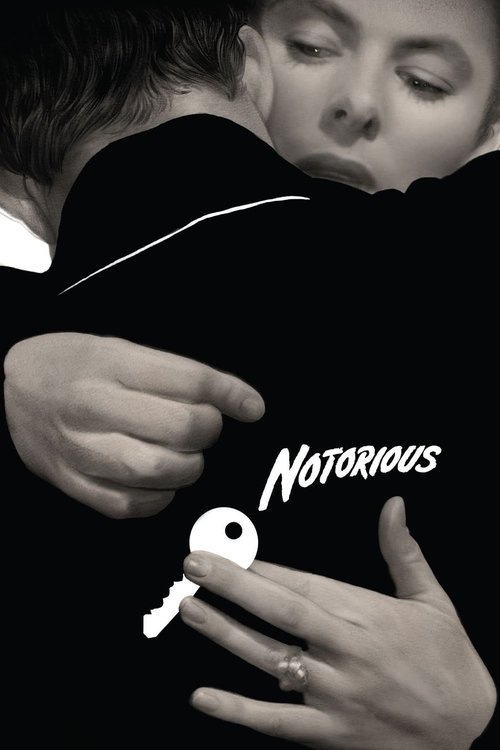
Notorious
1946 · Alfred Hitchcock
For when you want a classic that's more than comfort — a smoldering, grown-up romance wrapped in a thriller, perfect for a serious movie night when you want to feel something sharp.
What it's about
After her father is convicted as a Nazi agent, a hard-living American woman is recruited by a U.S. operative to infiltrate a circle of German exiles in postwar Rio de Janeiro. The assignment: win the affection of one of the ring's leaders. The problem: she and her handler have fallen in love, and the mission requires him to hand her to another man — a love story and a spy story locked in the same slow squeeze.
The experience
Romantic and cruel at once — the suspense tightens scene by scene, but what really gets you is watching two people wound each other out of pride while the danger closes in. Elegant, adult, and quietly devastating.
Performances
Ingrid Bergman is extraordinary as a woman risking everything for a man too proud to ask her not to — brittle, brave, and heartbreaking — while Cary Grant plays against his charm as the cold, jealous handler. Claude Rains makes the Nazi target unsettlingly sympathetic, which is exactly what makes the film hurt.
The craft
Hitchcock builds suspense out of the smallest objects — a key, a cup of coffee, a wine cellar — and stages some of the most famous camera moves of the 1940s, including a crane shot that glides from a crowded ballroom down to a single clenched hand. The romance is filmed with a sustained intimacy that was daring for its time.
Why it matters
Widely considered the moment Hitchcock's popular craft and emotional depth fully fused, it set the template for the espionage romance where the mission and the love affair poison each other.
Snapshot
Notorious is the tautest of Alfred Hitchcock's 1940s American films and, for many, the first work in which his commercial craft and his deepest preoccupations fuse without compromise. A spy melodrama set largely in postwar Rio de Janeiro, it follows Alicia Huberman (Ingrid Bergman), the dissolute American daughter of a convicted Nazi agent, who is recruited by the laconic U.S. operative T.R. Devlin (Cary Grant) to infiltrate a ring of German émigrés led by Alexander Sebastian (Claude Rains). The espionage plot — Sebastian and his associates are concealing uranium ore in wine bottles — is, by Hitchcock's own later account, a near-arbitrary pretext. The film's true subject is the love between Devlin and Alicia, a romance the mission itself corrupts: Devlin, jealous and ashamed, allows the woman he loves to be married into mortal danger, and his rescue of her in the final reel is also an act of penance. Compact, almost chamber-like in its concentration on four or five faces, Notorious is built on a chain of celebrated set pieces and on a moral situation of unusual adult bleakness for a Hollywood film of its moment.
Industry & production
The project began under David O. Selznick, to whom both Hitchcock and Bergman were under contract. Hitchcock and screenwriter Ben Hecht developed the story — its remote germ is John Taintor Foote's short story "The Song of the Dragon" — through 1944–45, evolving it away from a more conventional spy tale toward the charged triangle that survives. Selznick, increasingly absorbed in his own epic Duel in the Sun and wary of the uranium premise, ultimately sold the entire package — script, director, and the two stars — to RKO Radio Pictures, reportedly for a substantial cash sum plus a share of the profits. The arrangement gave Hitchcock unusual latitude; Notorious was produced under his own supervision at RKO and is often cited as a film on which he enjoyed something close to the autonomy he craved.
Production took place largely on RKO soundstages, with Rio rendered through a combination of second-unit and stock footage, process photography, and studio reconstruction rather than location shooting of the principals. The Production Code shaped the film at its most famous points: the screenplay had to negotiate a heroine introduced as promiscuous and a plot that asks her, in effect, to sell herself to the state, and Hecht's dialogue threads these implications with calculated indirection. Precise budget and box-office figures vary across sources and should be treated with caution, but the film was a clear critical and commercial success and consolidated Hitchcock's standing as a bankable Hollywood auteur.
Technology
Notorious is a black-and-white film made with the standard studio apparatus of its day, and its technical reputation rests less on novel equipment than on the audacious deployment of conventional tools. The signal instance is the descending crane shot in the party sequence: the camera begins high above the grand staircase hall, surveying the whole crowded space, and travels down and in to end on an extreme close-up of a single cellar key clutched in Alicia's hand. The shot required a large camera crane and meticulous coordination of focus and movement, and it stands as a textbook demonstration of how scale of framing can carry narrative information — the entire social world of the party narrowing, in one unbroken gesture, to the small stolen object on which the suspense turns. The film also leans on rear projection and optical work for its Rio exteriors and travel imagery, the ordinary illusionism of the period, used unobtrusively.
Technique
Cinematography
Ted Tetzlaff, himself a director as well as a veteran cinematographer, shot Notorious, and his work is among the most expressive in Hitchcock's American period. The visual scheme is one of pointed subjectivity and shifting power. Tetzlaff and Hitchcock repeatedly photograph from inside a character's disorientation — most famously in the morning-after shot in which a hungover Alicia sees Devlin upside-down in her doorway, the camera rotating to right him as he advances. Glasses, cups, bottles, and keys are isolated in large foreground close-ups that lend domestic objects the weight of weapons. The party crane shot is the bravura culmination of a style that throughout privileges the meaningful detail and the watching face; low-key lighting and looming shadow give the Sebastian mansion the menace of a trap closing.
Editing
Cut by Theron Warth, Notorious is a model of suspense construction through editing economy. Hitchcock builds dread by controlling exactly what the audience knows and when. The wine-cellar sequence at the party intercuts the dwindling champagne upstairs — each emptied bottle a tick of the clock that will send Sebastian to the cellar — against Devlin and Alicia's covert search below, the parallel cutting tightening the screw. Likewise the poisoning is disclosed to the viewer through editing and framing before Alicia grasps it, converting her ignorance into agony for us. The final descent of the staircase, with Sebastian's confederates watching, is paced to make every step an event.
Mise-en-scène / staging
The film's spaces are dramatized as zones of surveillance and confinement. Sebastian's mansion, dominated by his possessive mother (Leopoldine Konstantin), is a household in which Alicia is steadily watched, and Hitchcock stages the marriage as a kind of imprisonment — the famous business of the cellar key being the one object that can betray her. Hitchcock's signature use of recurring motifs runs throughout: keys, bottles, and the poisoned coffee cup organize the action as a system of objects. The staircase, the cellar, and the bedroom become a moral geography, the descent of the final scene literalizing both rescue and the lovers' fall back toward each other.
Sound
Roy Webb's score underpins the romance and the suspense without calling undue attention to itself, swelling beneath the love scenes and tautening in the thriller passages in the idiom of mid-1940s studio scoring. More striking is Hitchcock's use of the human voice and of pointed silence. The celebrated extended embrace between Grant and Bergman is played over a low, continuous murmur of dialogue — the lovers talking of dinner and telephone calls even as they cling together — so that intimacy is carried by the tone and proximity of the voices rather than by music. Detailed documentation of the soundtrack's technical production is comparatively thin in the standard literature.
Performance
The acting is central to the film's adult seriousness. Bergman gives one of her finest performances, charting Alicia from brittle self-loathing through tenderness to near-fatal exhaustion, and risking real unsympathetic edges. Grant, cast against his charm, makes Devlin cold, withholding, and at times cruel — a romantic lead whose jealousy nearly kills the woman he loves — and the performance's restraint is the source of its disquiet. Claude Rains, in a role that earned wide admiration, makes Sebastian neither a caricatured villain nor a fool but a genuinely loving, vulnerable man, so that the audience's sympathies are uncomfortably divided. Konstantin, as the implacable mother, supplies a chillingly composed antagonist. The four-way play of love, suspicion, and pity among these figures is what lifts the film above its genre.
Narrative & dramatic mode
Notorious operates in the mode of romantic melodrama disguised as espionage thriller. Its dramatic engine is not primarily the question of whether the Nazis will be exposed but whether Devlin and Alicia can overcome the suspicion and shame that the mission breeds between them. Hitchcock structures the film around dramatic irony — the audience repeatedly knows of danger before the characters do — and around objects that concentrate meaning. The screenplay withholds the lovers' reconciliation until the last possible moment, and even the climactic rescue is shadowed: Devlin saves Alicia but coldly abandons Sebastian to his comrades' vengeance, an ending that satisfies romantically while leaving a residue of moral unease. The "uranium in the wine bottles" plot is the clearest example of what Hitchcock would later, in conversation with François Truffaut, formalize as the MacGuffin: the thing the characters care about and the audience need not.
Genre & cycle
The film sits at the intersection of the espionage thriller, the woman's picture, and the emerging postwar style of film noir. Its low-key photography, fatalistic atmosphere, morally compromised hero, and a heroine defined by a sexual past align it with the noir cycle then crystallizing in Hollywood, even as its lavish romantic apparatus and star pairing keep it within the prestige tradition. As a spy film made on the immediate cusp of the atomic age and the Cold War, it belongs to a wave of late-1940s pictures in which wartime Nazi villainy shades into the anxieties to come; its choice of uranium as the secret, conceived before Hiroshima, gave it an uncanny topicality by the time of release.
Authorship & method
Notorious is a touchstone of Hitchcock authorship — the film in which his thematic signature (the transfer of guilt, the eroticized danger, love bound up with degradation and control) and his formal signature (suspense through editing and point of view, the meaning-laden object, the bravura camera move) operate in concert. His collaboration with Ben Hecht produced a screenplay of unusual psychological frankness for the period, its espionage scaffolding subordinated to the emotional triangle. Ted Tetzlaff's cinematography supplied the subjective camera and the great crane shot; Theron Warth's editing realized the suspense architecture; Roy Webb scored it; the RKO art department under Albert S. D'Agostino and Carroll Clark built the mansion-as-trap. Above all, the film reflects Hitchcock's working method of pre-visualizing in detail and designing each sequence around a controlled disclosure of information to the audience. The MacGuffin principle he later articulated finds in Notorious its purest demonstration.
Movement / national cinema
The film is a product of the Hollywood studio system at its height, made by a British émigré director who had transplanted to America in 1939 and was, by the mid-1940s, fully assimilated into its industrial methods while retaining the suspense craft of his English period. It is not the product of a formal movement, but its noir-inflected visual style connects it to the broader transatlantic current — much of it shaped by European émigrés — that darkened American cinema in the war and postwar years. Its setting in Rio gestures toward the era's "Good Neighbor" interest in Latin America, though the locale functions more as exotic backdrop than as engagement with Brazilian national life.
Era / period
Notorious is a film of the immediate postwar hinge. Conceived during the war with Nazis as its antagonists, released in 1946 into a world reordered by the atomic bomb, it captures a transitional anxiety as one enemy gives way to another. Its preoccupation with hidden uranium, fugitive Nazis regrouping abroad, and clandestine government operations registers the period's mingled exhaustion and new dread. The candor of its sexual situation, meanwhile, reflects a moment when adult themes were being pressed harder against the limits of the Production Code.
Themes
At its core Notorious concerns love tested to the point of cruelty. It asks what it means to prove love through trust, and dramatizes the failure to do so: Devlin's inability to believe in Alicia, and his complicity in her debasement, are the film's true crisis. Allied themes recur throughout Hitchcock — the woman compelled to perform an identity not her own; sexuality entangled with guilt and degradation; the ambiguity of patriotic duty, which here asks a citizen to seduce and deceive in the nation's name. The poisoning plot literalizes the danger of intimacy: love and death are served in the same coffee cup. Surveillance, jealousy, and the suffocating bond between Sebastian and his mother extend the film's portrait of love as a form of possession and control.
Reception, canon & influence
Notorious was warmly received on release and has only grown in stature, now routinely ranked among Hitchcock's finest achievements and among the great Hollywood films of the 1940s; Rains's performance and the romantic pairing of Grant and Bergman drew particular praise. Critical literature has long centered on its formal set pieces — the crane shot, the prolonged embrace, the wine-cellar suspense — and on its moral seriousness.
Looking backward, the film draws on Hitchcock's own English spy thrillers, especially Secret Agent (1936), which had already explored the moral cost of espionage and the queasiness of killing for one's country, and on the broader tradition of his "innocent (or compromised) figure caught in intrigue" pictures. Its candor about its heroine's past and its noir surface connect it to contemporaneous currents in American filmmaking.
Looking forward, Notorious helped define the romantic spy thriller as a form in which the love story carries more weight than the plot, a template visible across decades of the genre. Within Hitchcock's own career it anticipates the obsessive, controlling, redemptive-yet-destructive love of Vertigo (1958) and the glamorous-espionage romance of To Catch a Thief (1955) and North by Northwest (1959), the latter sharing both its leading man and its explicit play with the MacGuffin. The film became a primary reference point in Hitchcock's celebrated book-length interview with François Truffaut, through which its techniques and its MacGuffin concept entered the common vocabulary of film criticism, and its set pieces remain staples of how suspense and point-of-view construction are taught.
A Deleuzian reading
A camera floats high above a crowded party in Rio, looking down on the whole bright social world of the Sebastian mansion — the guests, the champagne, the staircase — and then it begins to descend.
The full Deleuzian reading of Notorious →
Reception
A hit and critically admired on release in 1946, it's since climbed even higher — what was once 'a great Hitchcock thriller' is now routinely called his most perfect film, with Truffaut crowning it the quintessence of his style.
How Notorious was received, from release to now →
Influences: the films it descends from and the films it influenced
- Secret Agent (1936) — First worked out the queasy moral cost of killing for one's country and an agent's reluctant complicity that Hitchcock reworked directly into Alicia's compromised patriotism.
- The 39 Steps (1935) — Established the MacGuffin-driven espionage plot deliberately subordinated to a charged, bickering romantic pairing — the structural template Notorious refines.
- Rebecca (1940) — Pioneered the mansion-as-trap shot with gliding subjective camera through menacing domestic interiors, the spatial grammar of the Sebastian house.
- Suspicion (1941) — The single luminous charged object (the glowing glass of milk) and the wife's anxious subjective POV directly anticipate the poisoned coffee cup framed huge from Alicia's drugged vantage.
- Shadow of a Doubt (1943) — Perfected the transfer-of-guilt theme and the urbane, sympathetic villain nested inside a domestic family space — Sebastian is a more pitiable Uncle Charlie.
- Citizen Kane (1941) — Gregg Toland's RKO low-key deep-focus lighting and the bravura crane descending through the El Rancho skylight prefigure Notorious's famous unbroken crane down to the key in Alicia's hand.
- The Maltese Falcon (1941) — Built a noir narrative entirely around a coveted object that motivates everyone yet matters little in itself — the MacGuffin made literal.
- Casablanca (1942) — Wartime intrigue in which the love triangle is weighted far above the espionage mechanics, the emotion-over-plot balance Notorious brought to its purest form.
- Sabotage (1937) — It formalizes Sabotage's 'suspense is shared superior knowledge' lesson — the cellar key and the ticking dread of discovery — into a sustained set-piece where the viewer knows more than the characters.
- My Man Godfrey (1936) — Tetzlaff carries forward his own opening device: the crane that descends from an establishing altitude into a crowded social space, here the party-to-key shot, there the titles painted on the dump before the camera drops among the men.
- Holiday (1938) — Both of Holiday's signature figures, weaponized: a party crosscut between the reception floor and a private space below it, and a staircase used as an explicit moral gradient in the final descent — plus Grant's acrobatic control reduced to punishing stillness.
- To Catch a Thief (1955) — Reprised the glossy Riviera espionage-romance that foregrounds star chemistry and innuendo-laden dialogue over plot, the glamour mode Notorious launched within Hitchcock's career.
- Vertigo (1958) — Extends Notorious's love-as-possession into full obsession, using subjective POV camera to lock the viewer inside a lover's controlling, redemptive-yet-destructive compulsion.
- North by Northwest (1959) — Shares the leading man and stages the most explicit MacGuffin play of Hitchcock's career, recasting the romantic spy thriller as glamorous chase.
- Charade (1963) — The most accomplished Hitchcock pastiche — a Cary Grant romantic-spy thriller built on a MacGuffin (the hidden money) and continuously shifting trust between the lovers.
- Black Book (2006) — Reworks Alicia's predicament wholesale: a female agent who beds the enemy and is morally degraded by the patriotic mission that sends her into his bed.
- Allied (2016) — WWII spy romance whose suspense turns entirely on doubting a beloved spouse's loyalty, consciously echoing Notorious's making of marital trust into the thriller's mainspring.
- The Man Who Knew Too Much (1956) — The espionage thriller in which a woman's specific physical capability — her access, her social performance, her body under surveillance — is simultaneously the instrument of danger and the means of narrative resolution; the McKenna couple's structure, in which Jo's trained singing voice becomes the literal rescue mechanism, directly inherits this gender-specific agency template.
- Mission: Impossible (1996) — De Palma inherits Hitchcock's suspense-over-surprise contract — the wine-cellar party built on the audience knowing the danger the heroes don't — recast as the rooftop and vault sequences where tension comes from privileged information, not revelation.
- Lust, Caution (2007) — The foundational sexual-espionage template Lust, Caution reworks: a woman is handled by an intelligence apparatus to seduce and marry an enemy target, and the drama lives in the agony of the handler who loves the asset he is prostituting.
- The Nightingale's Prayer (1959) — Supplies the suspense architecture of a woman planted inside the household of the man she means to destroy, her resolve corroded by growing intimacy under the constant dread of exposure.
- The Last Metro (1980) — Generates suspense purely from asymmetric knowledge — a woman performing a public role while the secret is held literally in a cellar — with high-gloss star lighting sculpting the female lead; the withheld-information mechanics Truffaut cataloged in his 1966 interview book and redeploys in a domestic register.
- Gaslight (1944) — The woman imperiled by her own husband inside a gilded, suffocating house — the domestic-gothic menace and woman's-distrust suspense running parallel to Alicia's marriage as surveillance.
- Gilda (1946) — Both films, released within months of each other in 1946, use a woman's body as an instrument deployed by male handlers against a Nazi-adjacent criminal network, and both impose a Production Code reconciliation — the woman redeemed through heterosexual love — onto a story whose actual dramatic logic requires either her destruction or liberation, not her domestication.
- To Have and Have Not (1945) — Ted Tetzlaff's low-angle key-light portraiture grants Bergman the same luminous star-body treatment that Sidney Hickox gives Bacall, while the WWII-resistance-as-backdrop structure converts romantic thriller stakes into political ones through the same mechanism — the woman's sexual agency driving the plot into territory the man is too cynical to enter voluntarily.
- Spellbound (1945) — Immediate Hecht–Hitchcock reunion extending the same craft — subjective camera, guilt and trust between a damaged woman and a withholding man — into a tauter, less schematic form.
- The Stranger (1946) — Same-year companion in the postwar Nazi-fugitive thriller, building suspense from domestic intimacy with a hidden war criminal rather than action.
Similar films
- Vertigo (1958) — influence & lineage · same viewing thread
- Rebecca (1940) — influence & lineage · same viewing thread
- To Catch a Thief (1955) — influence & lineage
- The 39 Steps (1935) — influence & lineage
- North by Northwest (1959) — influence & lineage
- Psycho (1960) — same viewing thread
- Rear Window (1954) — same viewing thread
- Strangers on a Train (1951) — same viewing thread
All the films related to Notorious →
Watch it with: curated runs of related films
- The Golden Age of Suspense — A run of immaculate mid-century crime pictures — Hitchcock plus his sharpest rivals — where guilt, obsession, and dangerous romance are staged in gorgeous black-and-white; watch them close together and the shared DNA of the perfect-murder plot lights up.