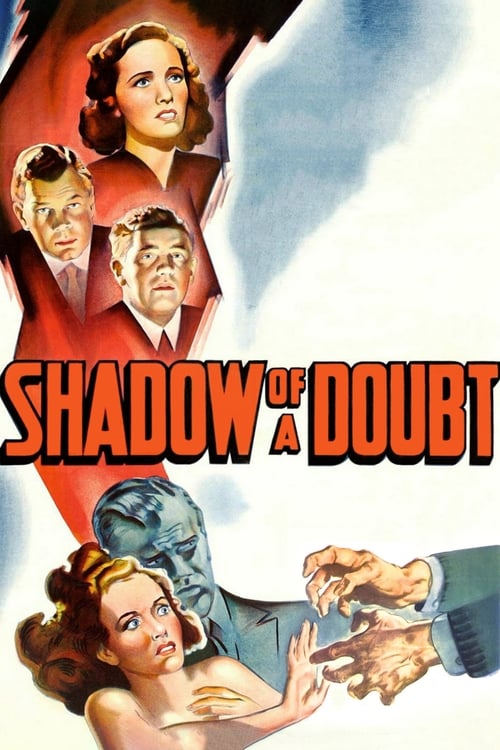
Shadow of a Doubt
1943 · Alfred Hitchcock
For when you want a classy, old-fashioned thriller on a quiet night — suspense that gets under your skin without gore or jump scares. Comfort-food filmmaking with a genuinely dark heart.
What it's about
In sleepy Santa Rosa, California, a restless teenager is thrilled when her charming Uncle Charlie — the man she was named after and idolizes — comes to stay with the family. But small things start to feel wrong: an evasiveness, a torn newspaper, strangers asking questions. Slowly she begins to suspect that the person she loves most may be hiding something monstrous, and that the danger isn't outside her home — it's at the dinner table.
The experience
A slow, delicious tightening of the screws. It plays like warm small-town Americana that curdles scene by scene, and the suspense comes not from shocks but from watching a girl's adoration turn to dread while everyone around her stays oblivious.
Performances
Joseph Cotten is chilling precisely because he's so charming — his Uncle Charlie switches from warmth to menace with a flicker. Teresa Wright matches him as the niece, making her disillusionment feel like a real loss of innocence.
The craft
Hitchcock stages evil at the scale of the family supper and the public library, using doubles, shadows, and everyday spaces to make the ordinary feel threatening. The screenplay — co-written by playwright Thornton Wilder — gives the small town a lived-in texture that makes the darkness land harder.
Why it matters
Hitchcock often called this his personal favorite of his own films, and it set the template for the 'evil comes to Main Street' thriller — the idea that menace lives inside the wholesome American home, an idea suspense cinema has mined ever since.
Snapshot
A sophisticated murderer arrives in a sunlit California town to visit his adoring family. His niece—who shares his name and, she once believed, his soul—slowly recognizes him for what he is. Shadow of a Doubt is the film Alfred Hitchcock most frequently cited as his personal favorite, and the claim is credible: no other picture in his career sits so calmly inside the skin of ordinary American life while concealing such ugliness beneath it. Where his British thrillers tended toward the picturesque and his later Hollywood spectacles toward the monumental, this film works at the scale of the dining-room table, the public library, the family supper. Its genius is that the threat is not imported from some exotic elsewhere—it arrives through the front door, is embraced, and must be expelled by someone who loved it.
Industry & production
Universal Pictures produced Shadow of a Doubt under the independent banner of Jack H. Skirball, with Hitchcock directing on a loan arrangement. The studio was not then the prestige address it would later become, and the modest production context suited Hitchcock's intentions: he wanted something that felt lived-in and unglamorous. Principal photography took place partly on location in Santa Rosa, California—a genuine small city in Sonoma County rather than a studio back-lot facsimile—which was an unusual logistical commitment for the era. The town's actual train station, storefronts, and residential streets appear throughout, grounding the film's central irony in documentary-textured space.
The screenplay went through a notable collaborative process. Hitchcock engaged Thornton Wilder, then at the height of his reputation as the playwright of Our Town (1938) and The Skin of Our Teeth (1942), to work on the script alongside Sally Benson (later known for Meet Me in St. Louis) and Hitchcock's wife and longtime creative partner Alma Reville. Wilder's contribution is legible in the film's affectionate, unsentimental portrait of American provincial life—the Newton family household operates with the same mythic-mundane quality as Grover's Corners, and the disruption Uncle Charlie introduces is similarly an intrusion of mortality into willed innocence. The collaboration was by most accounts collegial, though the proportional credit each writer deserves for specific scenes is not fully established in the surviving record.
The film was released in January 1943, during the United States' second year of active participation in World War II. The home-front context—absent fathers, anxious mothers, a culture simultaneously celebrating and interrogating the American domestic ideal—permeates the film without being explicitly named.
Technology
Shadow of a Doubt was shot on standard 35mm, with no technical innovations that would have been legible to contemporary audiences. Its visual sophistication is a function of craft rather than equipment novelty. Hitchcock and his cinematographer used both studio-built interiors and authentic on-location settings, requiring the lighting approach to be flexible. The location work demanded natural-light supplementation; the interior scenes allowed more controlled low-key setups. The film's sound design was executed within the conventions of the period: optical soundtracks, studio post-production, no synchronous location sound in the modern sense. Dimitri Tiomkin composed the score using the resources of the studio orchestra, with the pre-existing Franz Lehár waltz The Merry Widow occupying a special structural role that required careful licensing and arrangement decisions.
Technique
Cinematography
Joseph Valentine served as director of photography, working with Hitchcock to construct a visual argument that mirrors the film's thematic one: surfaces that look bright and legible concealing depths that are obscured and dangerous. The Santa Rosa exteriors are photographed with an almost documentary plainness—flat, even light, wide establishing shots that frame the town as the embodiment of civic normalcy. Against this, certain interior scenes deploy a noticeably different register: low-key chiaroscuro, oblique angles, compositions that trap characters in doorframes or shadow them across the face. The transition between these modes tracks Young Charlie's growing knowledge; as her innocence recedes, the visual grammar of noir begins to infiltrate the sunlit suburb.
Two compositions are particularly notable. The early scenes of Uncle Charlie lying on his bed in his Philadelphia rooming house, surrounded by money and cigar smoke, render him in shadow and diagonal lines that telegraph his criminal interiority before any dialogue confirms it. Later, as Young Charlie descends into the public library to read the newspaper account that names the Merry Widow Murderer, the camera closes in on her face while the words seem to swim off the page—a pre-zoom-lens approximation of subjective dissolution that Hitchcock would refine throughout his career.
Editing
Milton Carruth edited the film within the continuity conventions of classical Hollywood, but Hitchcock's influence on the cut was, as was his practice, exercised primarily during scripting and shooting through precise storyboarding. The editing's most notable quality is its management of suspense rhythm: scenes that appear to be domestic comedy (dinner conversations, the bumbling detective's awkward courtship of Emma Newton) are allowed to breathe and develop genuine warmth before the knife of dramatic irony twists. Hitchcock understood that audiences needed to be genuinely fond of these people and their routines for the threat to their disruption to register. The intercutting between Uncle Charlie's charm and his niece's dawning horror becomes progressively more compressed as the film approaches its climax.
Mise-en-scène / staging
The Newton family home is the film's central dramatic instrument. Hitchcock stages the household as a functioning social organism—crowded, overlapping, alive with competing conversations—and then introduces Uncle Charlie as both its organizing principle (everyone defers to him, gathers around him) and its structural poison. The spatial relationship between the two Charlies is persistently constructed through shared frames, mirror compositions, and parallel staging: they sit across from each other, stand at opposite ends of rooms, finish each other's sentences. Their psychic doubling is rendered as literal geometric doubling within the frame.
A key staging decision: Uncle Charlie is almost never shown as frightening in scenes where other family members are present. His menace operates in private exchanges with his niece, or in moments she witnesses without being acknowledged. This restricts the audience's privileged knowledge to align with hers, making her isolation—she cannot warn her family without destroying them—the film's emotional core.
Sound
Tiomkin's use of The Merry Widow Waltz is one of Hitchcock's most elegant deployments of a recurring musical theme. The waltz functions as Uncle Charlie's psychological signature—it appears when he is present, when he is thought of, when his violence is about to manifest. Crucially, it is associated in the narrative with the victims: the wealthy widows whose existence Charlie finds obscene. The music thus carries both his erotic fixation and his contempt simultaneously, and its cheerful, lilting quality makes it progressively more sinister as the film accumulates context. Hitchcock and Tiomkin also deploy silence and ambient sound (the creak of the stairs, the noise of the train) to build tension in sequences that another director might have underscored more conventionally.
Performance
Joseph Cotten's Uncle Charlie is one of the most successfully sustained performances of duplicity in Hollywood cinema. Cotten plays him as genuinely charming—not transparently sinister, not camp—so that the audience can understand exactly why everyone in Santa Rosa falls for him. His monologue at the dinner table, in which he articulates his contempt for women who "are alive when they shouldn't be," is delivered with such controlled passion that it reads simultaneously as a brilliant improvised rant and as the carefully managed self-exposure of a man who can't quite contain his real self.
Teresa Wright's Young Charlie is the structural center and the film's moral intelligence. Wright brings an intelligence and watchfulness to the role that makes the character's investigative evolution credible; she doesn't play naivety early or horror late, but rather a continuous process of reassessment. Patricia Collinge as Emma Newton—the oblivious, loving mother—provides the film's sharpest emotional ache: she is the one person who will never know what happened, and the film honors rather than mocks her.
Narrative & dramatic mode
Shadow of a Doubt is a classical dramatic irony machine: the audience learns Uncle Charlie's guilt early, and the film's pleasure derives from watching the gap between what Young Charlie knows and what she is coming to know. It is also, unusually for Hitchcock, a coming-of-age narrative in a genuine sense. Young Charlie begins the film dissatisfied with Santa Rosa, longing for something more—and she gets it, at the cost of her ability to see her home and family as safe or innocent. Her loss of illusion is the film's real subject. The thriller mechanics are the vehicle; the bildungsroman is the destination.
The film resists both melodrama and cynicism. It does not sentimentalize Young Charlie's ordeal, nor does it propose that surviving it has made her stronger in any simple sense. The final scene—a funeral oration for a man she knows was a murderer—is among the most quietly devastating endings in Hitchcock's career.
Genre & cycle
Shadow of a Doubt occupies a productive generic liminal space. It is a thriller by construction—suspense, a revealed murderer, a detective investigation—but its texture is domestic melodrama and its visual vocabulary alternates between noir and the American small-town film. This generic hybridization is not accidental. The film is explicitly about the false promise of the small-town idyll, and so it imports noir's fatalism and moral corruption into a setting associated with the opposite.
It participates in what critics have identified as the suburban Gothic cycle that would accelerate in American culture through the postwar period: the idea that evil is not foreign or urban or exotic, but domestic, familiar, hidden in the house. This cycle runs through literature (Shirley Jackson) and film (various 1950s melodramas) and would eventually become a defining mode of American horror.
Authorship & method
Hitchcock exercised his characteristic total-cinema approach: by the time shooting began, the film was almost entirely pre-visualized through storyboards, with camera placement and edit points mapped in advance. This allowed him to work with great efficiency on set and to maintain precise control over the film's architecture even while accommodating the improvisational energies of his actors.
Thornton Wilder's contribution to the screenplay was substantive and distinguishable: the specificity of the Newton family dynamics, the density of small-town social texture, the mournful irony of Young Charlie's education all bear his fingerprints. Alma Reville's contribution—as was often the case throughout Hitchcock's career—is underacknowledged in contemporary accounts, though her understanding of story structure and female psychology was a persistent resource for her husband.
Dimitri Tiomkin's score established a collaboration with Hitchcock that would continue through several more films. His instinct for using pre-existing popular music as ironic counterpoint—a technique Hitchcock would later extend brilliantly in other films—is here employed with particular precision.
Movement / national cinema
Shadow of a Doubt belongs to a transitional moment in Hitchcock's filmography: his British period was behind him, but the full flowering of his American style—the glossy Technicolor productions, the elaborate set pieces, the full deployment of the Hollywood star system—was still ahead. The film sits in the space between, drawing on European art cinema's interest in psychological interiority while fully inhabiting the conventions and production infrastructure of Hollywood.
It is also one of the most penetrating films made about American culture by a non-American director. Hitchcock's outsider perspective—affectionate, curious, and ultimately diagnostic—allows him to find what domestic filmmakers may have been too close to see: the performative quality of American optimism, the violence that the myth of the small town requires to be suppressed.
Era / period
The WWII home-front context is not merely background. The film was made at a moment when American culture was engaged in aggressive self-mythologization—Santa Rosa-as-America, the family as the thing being defended—and Hitchcock's film quietly asks what is actually inside the house that the war is supposed to protect. Uncle Charlie's misogyny and his predation on women living off dead husbands' money has been read as a displaced anxiety about the home front itself: the men who were not overseas, the order that was being maintained in their absence, the violence that could not be acknowledged.
Themes
The doppelgänger and the divided self. The two Charlies are explicitly presented as mirrors: she says early in the film that they are like twins. What the film explores is what it means to be the dark half of oneself—and whether recognizing that darkness in another is also a form of recognition in oneself.
The corruption of the domestic. The Newton household is portrayed with genuine warmth; this is not a satirical portrait of bourgeois emptiness. The point is precisely that the home is genuinely good, and that Uncle Charlie is genuinely destroying it by bringing himself into it. Evil here is not systemic but personal and parasitic.
Knowledge as burden. Young Charlie's tragedy is not that she is endangered but that she is educated. She learns something she cannot unlearn and cannot share, and the film understands that this kind of knowledge changes a person permanently.
The complicity of love. The film is interested in how much we are willing to not-see in those we love, and at what point willful blindness becomes moral failure. Emma Newton is the film's uncomfortable question mark in this regard.
Reception, canon & influence
Shadow of a Doubt was received warmly upon release, with contemporary critics recognizing its unusual seriousness and its effective use of American setting. It was not a sensation on the scale of some Hitchcock pictures, but it established itself steadily in critical esteem over the following decades.
Influences on the film (backward): The American Gothic literary tradition—Poe, Hawthorne, the idea that darkness inheres in the domestic and the familiar—is the film's deepest cultural root. Thornton Wilder's Our Town is an almost direct structural antecedent: a small American community, its mythic self-image, and the fragility of that image. The classical Hollywood murder thriller, including certain pre-Code films, provided genre conventions that Hitchcock could both employ and subvert. European Expressionism, particularly its use of shadow and angle to externalize psychological states, informed Joseph Valentine's cinematography.
Legacy and forward influence: The film's influence on the suburban Gothic tradition in American film and literature is difficult to overstate. David Lynch has cited it directly as an influence, and the relationship between Santa Rosa and Twin Peaks—the beautiful surface, the horror underneath, the young woman who sees what no one else will—is unmistakable. Blue Velvet (1986) in particular reads as a conscious reworking: a young person discovers evil at the center of a Norman Rockwell tableau, and the discovery costs them their innocence.
Robin Wood's extended analysis of the film in Hitchcock's Films established the critical framework most subsequent scholarship has engaged with: the two Charlies as a split self, the film's implicit critique of American complacency, the significance of Young Charlie's final positioning as someone who knows the truth but must keep silent. Raymond Durgnat, V.F. Perkins, and a generation of auteurist critics have returned to it repeatedly as evidence that Hitchcock's artistry extended beyond technical virtuosity into genuine moral seriousness.
Within Hitchcock's own filmography, the film established themes and devices he would return to across his career: the protagonist who alone possesses dangerous knowledge, the domestic space as site of threat, the romantic relationship shadowed by the possibility of murder, the ironic use of music. Rear Window (1954), Vertigo (1958), and Psycho (1960) are all, in different registers, elaborations on problems this film was the first to pose with such clarity.
A Deleuzian reading
He slides the ring onto her finger like a sacrament.
The full Deleuzian reading of Shadow of a Doubt →
Reception
Well-reviewed in 1943 but long treated as minor Hitchcock next to the glossier thrillers — now it's widely ranked among his very best, helped by the famous fact that Hitchcock himself repeatedly named it his favorite of his own films.
How Shadow of a Doubt was received, from release to now →
Influences: the films it descends from and the films it influenced
- The Cabinet of Dr. Caligari (1920) — Valentine's chiaroscuro infiltration strategy—shadow encroaching laterally into the Newton household's sunlit domestic spaces whenever Uncle Charlie enters—descends directly from Caligari's Expressionist technique of externalizing psychological menace through geometric shadow and canted framing.
- Sunrise: A Song of Two Humans (1927) — Murnau's visual grammar of the corrupt stranger (the city woman) contaminating the pastoral community through high-contrast lighting establishes the template Hitchcock reworks: darkness infiltrating the idyllic, with the dangerous figure marked by shadow against luminous communal space.
- The Lodger: A Story of the London Fog (1927) — Hitchcock's own prototype for the domestic thriller: a suspected serial killer sheltered within a family home, his romantic attachment to the daughter generating the same erotic-danger doubling that structures Young Charlie's relationship with her uncle—including the landlady's parallel complicity.
- M (1931) — Lang's ambient sound design using Beckert's whistled Grieg motif as a character-identifying leitmotif that surfaces terror within bourgeois normalcy is the direct technical precedent for Tiomkin's deployment of 'The Merry Widow Waltz' as ironic revelation of Uncle Charlie's predatory nature.
- Our Town (1940) — Wilder co-wrote both works; the small American community structured as mythic ideal whose protective illusion is shattered by confrontation with mortality and moral failure is transported directly from his stage play into Santa Rosa, including the young protagonist's mournful bildungsroman loss of the town's sheltering fiction.
- Rebecca (1940) — Hitchcock's immediately preceding film established the domestic Gothic template he refines in Shadow: a heroine whose growing knowledge of her romantic partner's murderous past is staged as an erosion of domestic security from within the house itself, with the female protagonist's investigative interiority rendered through restricted point-of-view.
- Strangers on a Train (1951) — The doppelganger-as-formal-device Shadow introduced—two men as mirrored halves of a divided self, their doubling made structural through naming symmetry—is carried forward as Bruno and Guy, with the innocent protagonist's complicity in the killer's crime extending Shadow's logic of the two Charlies as an inescapable shared identity.
- Rear Window (1954) — The protagonist who alone possesses dangerous knowledge and cannot act on it without destroying his romantic relationship, the lover's disbelief as the dramatic obstacle—Shadow's core restricted dramatic irony architecture—is extended here into the film's entire spatial and voyeuristic logic.
- Vertigo (1958) — Bernard Herrmann's ironic romantic scoring elaborates the Tiomkin leitmotif method: the Madeleine theme implicates Scottie in his own delusion the way the Merry Widow Waltz implicates Uncle Charlie, with music functioning as ironic revelation of a male protagonist's erotic fixation on a figure bound to murder.
- Psycho (1960) — The Bates house as domestic Gothic architecture—dark, maternal, concealing murder in the fruit cellar—descends directly from the Newton home's transformation under Shadow's infiltration lighting; Norman's sustained social performance of normalcy is the most extreme elaboration of Uncle Charlie's charming dinner-table duplicity.
- Blue Velvet (1986) — Lynch has directly cited Shadow of a Doubt as a source: Jeffrey Beaumont's discovery of sadistic violence beneath Lumberton's Rockwell surface replicates Young Charlie's exact bildungsroman trajectory, with Lynch extending Hitchcock's ironic pop-music counterpoint through fetishized Americana and a young protagonist who cannot unknow what he has learned.
- The Stepfather (1987) — The suburban patriarch revealed as serial killer who performs domestic normalcy while the teenage stepdaughter's growing investigative certainty constitutes the film's entire suspense engine—the most literal genre inheritance of Shadow's restricted dramatic irony device, transposed to Reagan-era suburban Gothic with the same one-character-knows structure.
- North by Northwest (1959) — Strategic deployment of silence as menace device: the dinner-table scene where Uncle Charlie's threat coexists with domestic normalcy and no underscoring anticipates NxNW's formal method of letting menace accumulate within socially ordinary spaces — the cocktail party, the auction house — without cuing the audience with music.
- Rope (1948) — Cinematographer Joseph Valentine, later co-DP on Rope, here developed the sustained tracking camera as Hitchcock's psychological instrument — following Charlie in slow drifts that hold on faces rather than cutting away — establishing the mobile choreography Valentine would apply on Rope without the relief of conventional cuts.
- Creepy (2016) — Establishes the domestic-murderer-as-houseguest structure in which the ritual of hospitality disables the protagonist's recognition faculty — Nishino inherits Uncle Charlie's mechanism whereby proximity to the killer produces blindness rather than knowledge.
- Diabolique (1955) — Mundane sadism hidden behind a domestic everyman, with suspense built on the audience knowing the killer's banality before the victim does — Clouzot sharpens this into Paul Meurisse's cold cruelty.
- Woman of the Hour (2024) — Establishes the charming-killer-hiding-in-plain-sight template paired with audience foreknowledge — we and one perceptive woman recognize the predator long before the adoring community does, the exact dramatic engine of the Dating Game sequence.
- Notorious (1946) — Perfected the transfer-of-guilt theme and the urbane, sympathetic villain nested inside a domestic family space — Sebastian is a more pitiable Uncle Charlie.
- Gaslight (1944) — The husband-as-hidden-monster within the Victorian domestic Gothic space, the wife's investigative interiority rendered through sustained closeup performance as she moves from suspicion to certainty while the household closes around her, maps precisely onto Young Charlie's arc—both films deploy the domestic Gothic as a trap that tightens with feminine knowledge.
- Laura (1944) — David Raksin's Laura theme is Shadow's most precise contemporary parallel to Tiomkin's Merry Widow Waltz: both films use a romantic leitmotif as ironic commentary on obsession and murder, deploying the melody to implicate the listener in the romantic delusion the narrative simultaneously exposes as lethal.
- Double Indemnity (1944) — John Seitz's chiaroscuro cinematography and the suburban California domestic setting construct the noir-melodrama hybrid space Shadow inhabits from its Gothic angle—both films place ordinary American architecture under Expressionist shadow to reveal the premeditated violence it conceals, with insurance and domestic routine as cover for murder.
- The Spiral Staircase (1946) — Siodmak deploys the embedded-killer-in-household dramatic irony device with the same architecture: the audience knows the murderer's identity while the female protagonist investigates from within the domestic space, and Nicholas Musuraca's expressionist shadow cinematography traces the same chiaroscuro inheritance as Valentine's work.
- The Stranger (1946) — The defining template — a charming killer concealed in an idyllic town, slowly unmasked by one dogged figure while the audience sits ahead of the innocents in knowledge.
- Le Corbeau (1943) — Same-year study of evil nested inside idealized small-town respectability, dissecting a community's willful denial with the same social-anatomy patience.
- Monsieur Verdoux (1947) — A near-contemporary study of the charming lady-killer preying on widows, whose dinner-table monologues about useless rich women being 'fat, wheezing animals' rhyme with Verdoux's misanthropic anti-capitalist rhetoric.
Similar films
- Rebecca (1940) — influence & lineage
- Rear Window (1954) — influence & lineage
- Psycho (1960) — influence & lineage
- Strangers on a Train (1951) — influence & lineage
- Laura (1944) — influence & lineage
- Double Indemnity (1944) — influence & lineage
- Vertigo (1958) — influence & lineage
- The Birds (1963) — shared sensibility
All the films related to Shadow of a Doubt →