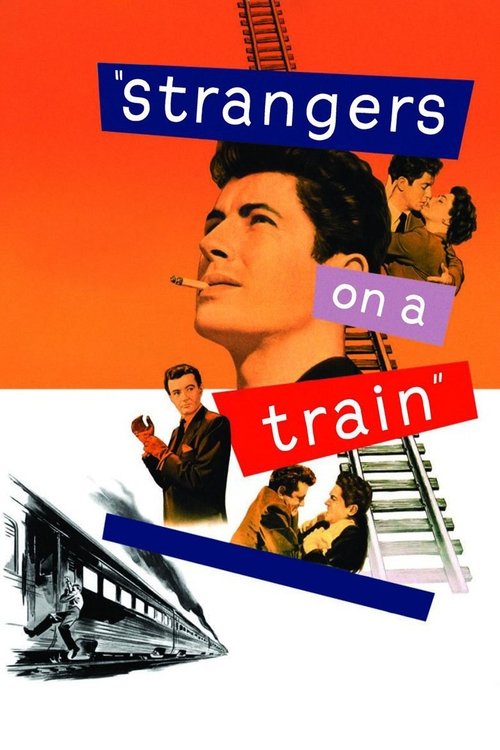
Strangers on a Train
1951 · Alfred Hitchcock
When you're craving classic suspense done to perfection — a film that's both a nail-biter and a pleasure, ideal for converting someone who thinks old movies are slow. Comfort-food thriller with a genuinely dark center.
What it's about
A tennis star with a messy marriage meets a charming stranger on a train who floats a theory: two people with no connection could each commit the other's murder — swap victims, and neither has a motive the police could trace. He treats it as cocktail chatter; the stranger doesn't. What follows is a nightmare of obsession, suspicion, and a man being pulled into someone else's design.
The experience
Wickedly entertaining and steadily suffocating — Hitchcock winds the trap so elegantly you catch yourself grinning even as your stomach knots. It builds to set pieces of almost unbearable, playful tension.
Performances
Robert Walker's Bruno is one of the most unnervingly charismatic villains ever put on screen — silky, needy, and frightening precisely because he's so likable.
The craft
This began Hitchcock's great partnership with cinematographer Robert Burks, and the visual invention is everywhere: doubles and crisscross patterns woven through the frame, a murder reflected in a fallen pair of glasses, a finale staged on a carousel spun out of control. Adapted from Patricia Highsmith's debut novel, it's suspense engineering of the highest order.
Why it matters
A cornerstone of the psychological thriller — its 'swap murders' premise has been borrowed and parodied endlessly, and it kicked off the run of formal experimentation that led into Hitchcock's greatest decade.
Snapshot
One of Alfred Hitchcock's most formally accomplished and psychologically disturbing films, Strangers on a Train concerns the lethal proposition that two strangers might commit the perfect crime by each murdering the other's most-hated person — leaving no traceable motive. Adapted from Patricia Highsmith's debut novel, the film operates simultaneously as a taut thriller and a sustained meditation on guilt, doubling, and the dark double beneath respectable surfaces. It marks the beginning of Hitchcock's defining creative partnership with cinematographer Robert Burks, inaugurates a period of sustained formal experimentation in the director's Warner Bros. years, and contains in Robert Walker's performance one of the most unnervingly charismatic villains in Hollywood cinema. The film has grown steadily in critical estimation since its release and now occupies a central position in the Hitchcock canon, regarded as essential to understanding his mature method.
Industry & production
By 1951 Hitchcock had been working in Hollywood for over a decade, following his emigration from Britain in 1939 under contract to David O. Selznick. After a run of prestige pictures for Selznick and a period of independent production under his own Transatlantic Pictures banner (Rope, 1948; Under Capricorn, 1949), both of which performed disappointingly, Hitchcock was working as a director-for-hire at Warner Bros. in a more commercially constrained context. He acquired the rights to Highsmith's novel himself and brought the project to Warner Bros., giving him unusual leverage over the material while operating within studio infrastructure.
The adaptation posed immediate problems. Highsmith's novel is structurally unusual: Guy Haines does eventually murder Bruno's father, and the book's moral universe is substantially darker and more ambiguous than anything the Production Code would permit. Hitchcock hired Raymond Chandler — then at the height of his literary reputation — to write the screenplay, a collaboration that became one of Hollywood's most famously dysfunctional. The two men found each other temperamentally incompatible; Chandler resented Hitchcock's habit of treating the dialogue as almost incidental to the visual conception, and Hitchcock found Chandler's drafts awkward. Chandler later wrote disparagingly about the experience. His drafts were largely set aside. Czenzi Ormonde, a junior staff writer, working from an earlier treatment by Whitfield Cook, produced the screenplay that was actually filmed, with the final credit shared between Chandler and Ormonde. The result moves the darkness of Highsmith's source inward: Guy never kills, the villain is destroyed, and bourgeois order is nominally restored — but the film's visual and dramatic logic keeps implicating the ostensible hero in Bruno's worldview throughout.
Casting was pivotal. Farley Granger, already known to Hitchcock from Rope, was chosen for Guy — a performer whose slightly passivity read as guilt and complicity as much as innocence. Robert Walker, cast as Bruno Anthony, was at the time primarily known as a likable leading man in studio romances. The role transformed his screen identity entirely. Walker brought to Bruno a quality simultaneously charming, manic, and pitiful — a mama's boy and a murderer, a socialite and a monster. He died on August 28, 1951, of respiratory failure following sedative medication, less than three months after the film's June release, at thirty-two. The timing has given his performance an additional retrospective weight: Bruno Anthony became his last completed role.
Patricia Hitchcock, the director's daughter, appears as Barbara Morton, Anne's bespectacled sister — a performance chosen for its function in one of the film's most unsettling sequences. Leo G. Carroll, a Hitchcock regular, plays Senator Morton.
Technology
Strangers on a Train was shot in black and white at a time when Technicolor had become a significant prestige option for major Hollywood productions. The choice was not nostalgic but strategic: black and white suited the film's expressionistic shadow-play and its narrative dependence on contrast — light/dark, moral/amoral, respectable/psychopathic. The film was shot on location in part at the actual Forest Hills tennis stadium in Queens, New York, and at Farley Granger's request, at the real Danbury, Connecticut fairgrounds for the amusement park sequences. The carousel sequences in particular required the construction of a platform carousel capable of being photographed at speed, with stunts performed under genuinely hazardous conditions during the climactic fight. Hitchcock staged the finale on a carousel set running at full and then accelerating speed; the stunt performers and principals were reportedly in genuine danger. An operator was actually knocked from the carousel during filming.
Technique
Cinematography
Strangers on a Train inaugurated the most important cinematographic partnership of Hitchcock's American career. Robert Burks, previously a camera operator and effects specialist at Warner Bros., became Hitchcock's director of photography here and remained so through The Wrong Man (1956) and beyond, his collaboration spanning some of Hitchcock's most formally adventurous work. Burks brought a sensitivity to high-contrast black-and-white that matched Hitchcock's expressionist instincts without tipping into pastiche.
The film's visual grammar is structured around crossing and symmetry. The opening sequence — arguably one of the most precisely conceived openings in Hitchcock's filmography — establishes the two protagonists before their faces are seen, through the geometry of their shoes and legs moving toward each other across a train platform. Bruno's black-and-white co-respondent shoes (flamboyant, predatory) contrast with Guy's plain leather oxfords (conventional, bourgeois), and the lines of travel converge at the moment of their fateful meeting. The criss-cross motif — Bruno's own word for his scheme — recurs throughout: train tracks crossing, the tennis court net's grid, the wrought-iron fence of the Morton house casting prison-bar shadows.
The murder of Miriam is the film's most celebrated sequence. Bruno strangles her in darkness beside a fairground lake. Hitchcock photographs the killing not directly but in reflection — in the lens of Miriam's thick-framed glasses, which have fallen to the ground. The distorted, fisheye image of the strangulation rendered in glass is simultaneously beautiful and horrifying, abstracted from direct identification with the victim in a way that places the viewer in an uncomfortable position of spectatorship.
Editing
William H. Ziegler edited the film. The cross-cutting between Guy's tennis match and Bruno's progress through the fairground to retrieve the incriminating cigarette lighter is the film's most formally demanding editorial sequence. Hitchcock builds suspense through rigorous parallel editing: Guy must finish his match and reach the fairground before Bruno retrieves the lighter from the drain into which it has fallen. The rhythm of the cutting accelerates as the sequences converge. The contrast between the sunlit, genteel world of the tennis stadium and the shadowed, seedy environs of the fairground is not merely spatial but moral, and Ziegler's editing makes the audience feel the compressing vice of Guy's complicity.
The carousel finale similarly deploys accelerating montage under conditions of near-chaos, with the machine spinning out of control and the combatants locked together — the mechanical world running at a speed that overwhelms human agency.
Mise-en-scène / staging
Hitchcock's storyboarding practice, well documented by his collaborators, means the staging of Strangers on a Train was largely determined before shooting began. The party sequence at the Morton house demonstrates his compositional authority: Bruno's arrival among Washington socialites is filmed with an awareness of volume and depth that isolates him from the crowd, and when he begins to strangle a woman at the party — in a game, losing himself momentarily in the fantasy — Patricia Hitchcock's Barbara Morton, wearing glasses identical to Miriam's, enters his sightline, and Bruno freezes. The staging makes his psychology legible in space.
The shadow of Bruno cast against the staircase of Guy's house, looming and distorted — a dark doppelganger in expressionist chiaroscuro — is among the film's most iconic images, directly invoking the German Expressionist tradition Hitchcock absorbed during his early career.
Sound
Dimitri Tiomkin composed the score, maintaining the bombastic, rhythmically urgent style he brought to many Hitchcock collaborations of this period. The fairground and carousel sequences are underscored with a music that deliberately blurs the festive and the menacing — band music gone wrong, the sound of pleasure made sinister. Tiomkin's work here is perhaps less integrated into the film's texture than Bernard Herrmann's later scores for Hitchcock, but the carousel sequence in particular uses accelerating music to dramatize the mechanism's runaway momentum.
Performance
Walker's Bruno Anthony is a performance of sustained charismatic menace that has influenced how Hollywood constructs the charming villain. His physicality — the slightly too-eager lean forward, the boyish grin at the wrong moments — makes Bruno simultaneously pathetic and threatening. The film's moral and dramatic ambiguity depends on how much Guy's passivity resembles complicity; Granger's more opaque performance has been critically debated, with some reading it as a limitation and others as precisely what the film requires: a man whose visible discomfort with Bruno's plan is undermined by his failure to act decisively against it.
Narrative & dramatic mode
The film operates as a classic Hitchcockian transfer of guilt: Guy, by failing to report Bruno's proposition and then by his momentary (and unexpressed) wish that Miriam were dead, is implicated in a murder he did not commit and arguably could not have prevented. This structure — the ostensibly innocent protagonist drawn into the orbit of guilt — recurs across Hitchcock's work, from The Lodger (1927) through North by Northwest (1959). What is distinctive in Strangers on a Train is the degree to which the film sustains the possibility that Guy is not innocent in any morally meaningful sense.
The dramatic irony is total: the audience knows what Guy knows before any other character does, and the film uses this knowledge to create a sustained anxiety about whether and when he will speak. His silence — maintained through the film's second act — functions as a form of collaboration.
Genre & cycle
The film sits at the intersection of the classical Hollywood thriller and the emerging psychological crime film of the late 1940s and early 1950s. It is adjacent to film noir without being wholly of it: the visual style (expressionist shadow, moral ambiguity, a femme-adjacent villain) overlaps with noir conventions, but the social world is upper-middle-class and the plot lacks noir's characteristic fatalism. The film is better understood as a precursor to what would become the psychological thriller as a distinct genre — closer in spirit to Vertigo (1958) or Psycho (1960) than to Double Indemnity (1944). Patricia Highsmith's source novel belongs to a tradition of domestic psychological crime fiction — crime that originates not from poverty or greed but from pathology and social malaise — that would become central to literary and cinematic culture in subsequent decades.
Authorship & method
Hitchcock's authorial control over Strangers on a Train is legible at every level. The storyboard-driven production, the deliberate casting against Granger's ingenu likability, the elevation of Burks from technician to creative collaborator — all reflect a director with a highly developed conception of the film as a total visual and dramatic system. His method was confrontationally auteurist in practice: the screenplay existed to provide a structure for images Hitchcock had largely pre-conceived, and the notorious failure of the Chandler collaboration reflects the degree to which the dialogue was, in his conception, secondary to the visual argument. The casting of his own daughter in a plot-critical role is characteristic of Hitchcock's tendency to embed the personal in the mechanical.
Movement / national cinema
Hitchcock occupies an unusual position in American cinema: a British director so thoroughly assimilated into Hollywood that his films are rarely discussed in terms of British national cinema, yet whose formative influences — German Expressionism encountered during his early career, the poetic realism he observed in French cinema, the British documentary tradition — are legible throughout. By 1951 he was at the midpoint of his American career, having shed the explicit Britishness of his Gaumont and early Selznick work and developed a style that was at once quintessentially Hollywood in its production values and distinctly personal in its preoccupations.
Era / period
The film belongs to the early 1950s phase of Hollywood in which the studio system was beginning to fragment — the Paramount decrees had dissolved vertical integration, television was competing for audiences, and the Production Code was under increasing strain. Hitchcock's position as an independent filmmaker working within the studio system on individual-picture deals was itself a product of this transition. The film's dark psychological undertow, its implication that respectable surfaces conceal violent desires, and its discomfort with the wholesome resolution it nominally delivers all register, however obliquely, the anxieties of an era in which American social consensus was being renegotiated.
Themes
The double or doppelganger is the film's organizing thematic principle. Bruno is not merely Guy's nemesis but his shadow self — the id to Guy's superego, the man who acts on desires (the wish that Miriam were dead, the wish to escape his circumstances) that Guy refuses to consciously acknowledge. The film has attracted extensive analysis from critics noting the homoerotic charge of the Bruno-Guy relationship: Bruno is more invested in Guy than in any plausible criminal scheme, and the intensity of his pursuit has the quality of an obsession that the film never names. Robin Wood's influential reading of Hitchcock's work as organized around repression and the return of the repressed finds particularly rich material here.
Guilt as contagion — the idea that proximity to a crime, or even an unexpressed wish, can morally contaminate the innocent — runs through the film and connects it to Shadow of a Doubt (1943), Rope, and Vertigo. The lighter is the film's central prop-symbol: a gift from Guy to Bruno, it passes between them as an emblem of complicity and evidence of implication.
Reception, canon & influence
The film performed well commercially on its release and received positive reviews, though its critical elevation to the first rank of Hitchcock's work came gradually, as the broader revaluation of Hitchcock's oeuvre — accelerated by the French New Wave critics' championing of him as an auteur, and consolidated in the Anglophone world by Robin Wood's Hitchcock's Films (1965) — took hold. François Truffaut's landmark interview-book with Hitchcock (Hitchcock/Truffaut, 1966) discusses the film in terms that established many subsequent critical frameworks for its analysis.
Looking backward, the film draws on the German Expressionist tradition Hitchcock encountered during his formative years — the shadow-play, the doubling, the architecture of menace — and on the literary tradition of the doppelganger (Dostoevsky, Stevenson, Poe). Highsmith's novel itself brought to crime fiction a moral seriousness and psychological acuity that distinguished it from the genre conventions of the day.
Looking forward, the film's influence is pervasive. It established the charming sociopath as a stock figure of Hollywood thrillers; Bruno Anthony is a recognizable ancestor of Hannibal Lecter, Tom Ripley (in the various Highsmith adaptations), and numerous subsequent cinematic villains who combine social grace with pathology. The "stranger exchange" plot has been explicitly referenced and reworked — most notably in Danny DeVito's Throw Momma from the Train (1987), a comedic homage. The cross-cutting tennis/fairground sequence has been widely cited as a model of parallel editing in suspense. The murder-in-the-glasses shot remains a touchstone of film pedagogy.
Robert Walker's death shortly after the film's release foreclosed the career that the performance promised. What survives is a performance of such uncanny precision and disturbing warmth that it continues to make Strangers on a Train feel, decades later, like an encounter with something genuinely unresolved.
A Deleuzian reading
Two pairs of shoes.
The full Deleuzian reading of Strangers on a Train →
Reception
In 1951 it landed as a return to form after a rough patch of Hitchcock flops (Under Capricorn, Stage Fright), with solid but not rapturous reviews. Now it's undisputed top-shelf Hitchcock — the film that kicked off his legendary 1950s run.
How Strangers on a Train was received, from release to now →
Influences: the films it descends from and the films it influenced
- The Cabinet of Dr. Caligari (1920) — The expressionist chiaroscuro grammar — raking shadows and angular high-contrast frames as visual register for psychological disturbance — that Robert Burks adapted for Hitchcock descends from this film; the Cesare figure, a somnambulist who executes murders on another's behalf, is a direct prototype for Bruno Anthony's role as would-be agent of Guy's unspoken dark impulse.
- Sunrise: A Song of Two Humans (1927) — Murnau's marsh-fog sequence — in which the City Woman seductively proposes murdering an innocent spouse, framed in silhouette and shadow — establishes the visual and dramatic grammar of the corrupting dark compact between strangers that Hitchcock directly inherits for Bruno's train-compartment proposition.
- M (1931) — Lang's technique of tracking a psychopathic murderer through parallel investigative cross-cutting while building audience sympathy for the killer — generating fascination rather than simple repulsion — is the structure Hitchcock deploys to make Bruno compelling; the expressionist German grammar of menace channeled through an urban American surface is also directly inherited.
- The 39 Steps (1935) — Hitchcock's own invention of the parallel-pursuit editing grammar — the wrongly implicated innocent man tracked by police while the real criminal network closes in — provides the structural template that Strangers on a Train darkens by making Guy morally complicit rather than simply innocent, converting the chase grammar into an engine of guilt.
- Shadow of a Doubt (1943) — The uncle-murderer as psychic double to his niece — charismatic surface concealing psychopathic depths, the protagonist gradually recognizing her own attraction to what she fears — is the immediate template for Guy and Bruno's doubling dynamic, with the family pair transposed to two male strangers whose bond is equally intimate and destructive.
- Double Indemnity (1944) — Wilder's murder-pact structure — two parties mutually implicated from a single encounter, the audience given dramatic irony from the outset — is the closest noir narrative template Hitchcock adapts, substituting Highsmith's psychological doubling for Cain's hard-boiled mechanics while retaining the shared-guilt architecture that makes neither party fully innocent.
- Rope (1948) — Farley Granger's first Hitchcock role as the passively complicit accomplice establishes the performance template he carries directly into Strangers on a Train; Brandon Shaw is Bruno Anthony's immediate dramatic prototype — the charismatic intellectual who treats murder as a philosophical game — making Rope the contained laboratory experiment that the later film refines with restored parallel editing.
- The Lady Vanishes (1938) — Reuses the dining car as the room where a stranger's chatter becomes a binding contract, and closes with the carousel brawl cut on continuous movement in a confined moving space — the mature version of the compartment fight assembled by Roome and Dearing.
- Rear Window (1954) — Robert Burks continuing the DP partnership inaugurated here; the telephoto-lens observation of suspected murder is the structural extension of Miriam's fallen spectacles — both films organize their violence around mediated, distanced witnessing that implicates the passive protagonist in the violence he watches without acting to prevent.
- Vertigo (1958) — Burks at the peak of the Hitchcock collaboration; the doubling theme fully elaborated through Madeleine and Judy as manufactured halves of one woman; Scottie's complicit passivity converted to active guilt — Strangers on a Train's transfer-of-guilt logic carried to its terminus, where the nominally innocent hero becomes the direct instrument of the woman's death.
- Peeping Tom (1960) — Powell's killer forces victims to see their own terror reflected in a mirror mounted on his camera at the moment of death — the reflected-murder device Hitchcock established in Miriam's spectacles expanded into a structural principle, making the mediated image of violence the film's explicit subject rather than its most disturbing single technique.
- Psycho (1960) — Norman Bates is the logical extension of Bruno Anthony — charming, mother-fixated, simultaneously pitiable and monstrous — and the transfer-of-audience-guilt mechanics (the viewer roots for Norman to successfully conceal Marion's murder) directly extend Hitchcock's technique of implicating the audience in Bruno's delight and Guy's passivity.
- The American Friend (1977) — Wenders's Highsmith adaptation (Ripley's Game) inherits and extends the crisscross-compact structure — a charismatic criminal implicating an innocent man in murder through accumulated obligation — that Hitchcock's Production Code version was forced to moralize; Wenders restores Highsmith's full corrupting arc and makes explicit the transfer-of-guilt logic Strangers on a Train could only imply through visual rhyme.
- Misericordia (2024) — From Highsmith's premise, perfects the engineering of audience complicity with the wrongdoer, transferring guilt so that the viewer roots for the cover-up to hold.
- To Catch a Thief (1955) — Robert Burks's debut as Hitchcock's cinematographer, establishing the compositional vocabulary—deep focus, reflective surfaces, figure-ground staging—that Burks would translate from high-contrast black-and-white into the color-saturated VistaVision grammar of To Catch a Thief.
- Marnie (1964) — Robert Burks' debut as Hitchcock's DP establishes the shadow-bar enclosure visual syntax — geometric shadow grids and striped reflections trapping characters within the frame — that recurs throughout Marnie as an architectural figure for psychological entrapment.
- Dial M for Murder (1954) — Inaugurated Hitchcock's decade-long collaboration with DP Robert Burks; the low-angle menace compositions, precise interior lighting, and the prolonged strangling sequence's physical staging that Burks developed here carry directly into Dial M's murder-attempt cinematography.
- Us (2019) — Hitchcock structures the double as completion-by-opposition — each man holds what the other wants, their crimes completing each other — establishing the grammar of the mirror-self as necessary antagonist that Peele literalizes in Red's underground inversion of Adelaide's entire life trajectory.
- The Player (1992) — Supplies the Highsmith sympathetic-murderer architecture — Tolkin's cold guilt-thriller spine of a protagonist who kills and is psychologically stalked rather than legally caught.
- Cape Fear (1962) — The affable psychopath who torments a respectable man while staying maddeningly within social and legal bounds prefigures Cady's 'menace within the law.'
- The Third Man (1949) — Anton Karas's zither score performs the same sinister-festive inversion as Hitchcock's fairground sequences — whimsical melody turned menacing as moral corruption accumulates — while Robert Krasker's sewer-set expressionist chiaroscuro runs in parallel to Burks's amusement-park shadow-work; both films build the postwar psychological thriller around a charismatic villain whose charm is revealed through nocturnal geometry.
- Les Diaboliques (1955) — Clouzot's murder conspiracy uses the same sinister-festive inversion — a school's domestic routine as backdrop to a plotted killing — and sustained parallel-cutting between the conspirators' dread and the institution's normalcy that Hitchcock deploys between Bruno's fairground mission and Guy's tennis match; the definitive contemporaneous French parallel to Strangers in the psychological-thriller genre.
- The Night of the Hunter (1955) — Laughton's expressionist chiaroscuro river sequences and the sinister-festive grammar of Robert Mitchum's hymn-singing villain — sacred melody turned threatening, social charm masking psychopathy — directly parallel Bruno Anthony's fairground performance; both films exploit the technique of making the charismatic villain's performed pleasure the precise vehicle for menace.
- The Wrong Man (1956) — The clearest prior statement of Hitchcock's 'transfer of guilt' — an innocent man made to bear another's crime — which The Wrong Man renders literal through the near-identical double who committed the robberies.
Similar films
- Rear Window (1954) — influence & lineage · same viewing thread
- Psycho (1960) — influence & lineage · same viewing thread
- Vertigo (1958) — influence & lineage · same viewing thread
- Double Indemnity (1944) — influence & lineage · same viewing thread
- Diabolique (1955) — influence & lineage · same viewing thread
- Rope (1948) — influence & lineage
- The 39 Steps (1935) — influence & lineage
- Shadow of a Doubt (1943) — influence & lineage
All the films related to Strangers on a Train →
Watch it with: curated runs of related films
- The Golden Age of Suspense — A run of immaculate mid-century crime pictures — Hitchcock plus his sharpest rivals — where guilt, obsession, and dangerous romance are staged in gorgeous black-and-white; watch them close together and the shared DNA of the perfect-murder plot lights up.