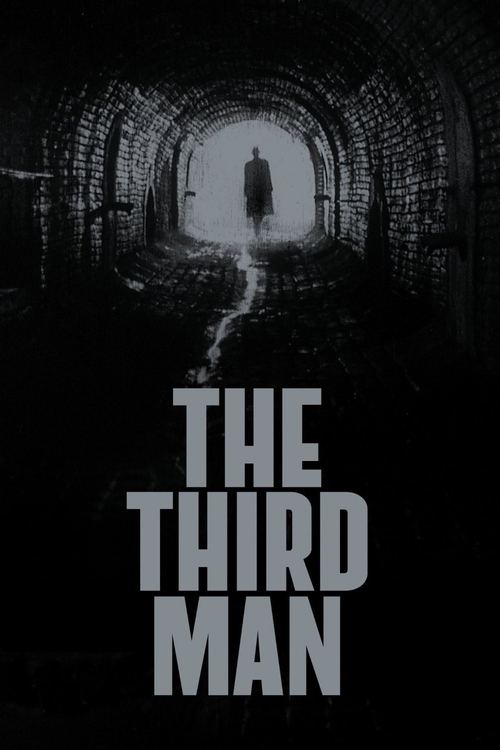
The Third Man
1949 · Carol Reed
For when you want to sink into atmosphere — a rainy-night film, ideal when you're in the mood for intrigue and beautiful black-and-white shadows rather than action. Rewards your full attention.
What it's about
A broke American writer of pulp Westerns arrives in postwar Vienna — a bombed-out city carved up between four occupying armies — to take a job from his oldest friend, and lands just in time for the friend's funeral. The official story of the death doesn't add up, so he starts pulling threads: a witness who mentions a mysterious 'third man' at the scene, a British major who wants him gone, and his friend's grieving lover, whom he can't help falling for. The deeper he digs, the uglier the city's black-market underworld gets.
The experience
Moody, witty, and endlessly atmospheric — a mystery that glides on shadows, rubble, and one of the most instantly recognizable musical themes in movies. It's romantic and cynical at the same time, and the ending lingers for days.
Performances
Joseph Cotten is perfect as the naive American in over his head, and Orson Welles delivers one of cinema's great supporting turns — limited screen time, unforgettable presence, including a speech people still quote.
The craft
Carol Reed shoots ruined Vienna with tilted angles and looming shadows, turning the city itself into a character; the cinematography of its wet cobblestones and sewer tunnels is legendary. Anton Karas's solo zither score — jaunty music laid over dark material — is one of film's boldest and most famous musical choices.
Why it matters
One of the defining works of postwar cinema, it codified a visual language for shadowy urban thrillers that filmmakers still borrow, and it regularly tops lists of the greatest British films ever made.
Snapshot
A naive American pulp novelist arrives in four-power-occupied Vienna to visit a childhood friend and finds himself investigating the friend's apparent death — and the ghost of a man who turns out to be still alive, running a lethal black-market penicillin racket. Carol Reed's film is one of the defining works of postwar cinema: a thriller that uses its ruined city as moral landscape, its tilted camera as epistemological argument, and a zither played by a Viennese café musician as one of the most immediately recognizable scores in film history. The Third Man is simultaneously a British genre picture, a meditation on American innocence colliding with European corruption, and a technical masterpiece that codified a visual grammar still in use decades later.
Industry & production
The film emerged from an unusual transatlantic partnership. Alexander Korda's London Films provided British financing and production infrastructure; David O. Selznick supplied American distribution and several cast members from his contract roster, most importantly Joseph Cotten. Graham Greene wrote both the screenplay and a companion novella — the prose work was composed largely as a structural exercise to develop the story before committing to script form, and was published alongside the film's release rather than preceding it. Reed and Greene collaborated closely throughout, though their working relationship involved persistent creative friction with Selznick, who lobbied for a more conventionally romantic resolution and, reportedly, for a different star in the role of Harry Lime. Reed's insistence on casting Orson Welles — at the time commercially diminished and not Selznick's first choice — proved one of the canniest decisions in the film's production history. Principal photography took place largely on location in Vienna in 1948, making extensive use of the city's bombed-out Innere Stadt, its bombed-out Josefstadt district, and, crucially, its actual sewage system beneath the Ringstraße.
The production logistics of postwar Vienna were considerable. The city remained divided into four occupation zones — American, British, French, and Soviet — each controlled by a different Allied power, with the central first district administered jointly. Reed and his crew navigated these zones deliberately, embedding the political geography into the spatial logic of the thriller. The penicillin plot turns on the exploitation of hospital stocks in the Soviet sector, and the film's climactic sewer chase moves literally beneath those administrative borders.
Technology
The Third Man was shot in high-contrast black-and-white on location, a choice that aligned aesthetic ambition with practical necessity: Vienna's ruined streets, wet cobblestones, and deep bomb-damage shadows suited the photographic approach Krasker and Reed developed together. The film makes sophisticated use of fast film stock and available-light supplementation to render nighttime Vienna as a world of ink and silver. Wide-angle lenses, particularly in the sewer sequences, amplify spatial distortion and compress figures against looming walls. The Riesenrad sequence in the Prater uses the enclosed gondola's geometry to strip Harry Lime's monologue of any escape route — the gondola becomes a confessional box with glass walls and the city rotating below.
Technique
Cinematography
Robert Krasker's work on The Third Man is among the most influential cinematographic statements in sound cinema. The film's most famous formal signature — the canted angle, the camera tilted anywhere from fifteen to forty-five degrees off the horizontal — is deployed not randomly but with consistent dramatic logic: the world tips when Holly Martins's moral bearings have been displaced. The technique derives partly from German Expressionist precedent, but Krasker applies it within a realist location context that makes the distortion feel psychological rather than theatrical. Equally important is his control of deep shadow: figures emerge from or dissolve back into darkness, and light sources within the frame — a single streetlamp, a lit window — become structural elements that carve the image rather than merely illuminate it. Krasker won the Academy Award for Best Cinematography, Black-and-White, for this work.
Editing
Oswald Hafenrichter's editing is understated by design, allowing Reed's long takes and Krasker's compositions to breathe. The sewer chase that closes the film is edited with a rhythmic compression that gradually tightens — the geometry of the tunnels and the sound of running water do much of the suspense work, and Hafenrichter's cuts follow the spatial logic Reed and Krasker have established rather than cutting against it. The restraint of the editing amplifies the final sequence's shock: the long, unbroken shot of Anna walking down a bare avenue of trees toward the camera and past Holly without acknowledgment — a single take of roughly forty-five seconds — acquires its devastating force precisely because nothing interrupts it.
Mise-en-scène / staging
Reed's staging consistently subordinates action to environment. Vienna is not backdrop but active protagonist: the city's rubble, its grandiose pre-war architecture pocked with shell damage, its dark doorways and sudden plazas, all determine where characters can move and what they can hide. The discovery of Harry Lime — a cat nudging at his feet in a deep doorway, then his face lit briefly in the dark — is staged as a revelation through space rather than through exposition. The Ferris wheel scene stages its moral argument in physical terms: the two men enclosed together in a gondola high above an indifferent city, the height making Harry's detachment from the figures below literal rather than metaphorical.
Sound
Anton Karas was a Viennese zither player whom Reed encountered performing at a gathering during location work in Vienna. Reed brought him to London to compose and record the entire score solo, an unprecedented commission for a feature-length picture of this scale. The result is one of cinema's great acts of tonal displacement: the zither's bright, slightly nasal timbre belongs to the folk music of a particular central European culture, and its use throughout a postwar thriller creates an ironic counterpoint — the sound of something light and popular playing under images of moral squalor and grief. "The Harry Lime Theme" became an enormous commercial success in both Britain and the United States, turning a piece of incidental film music into a free-standing popular hit. The score also serves a structural function: Karas's single instrument creates a sonic consistency that binds the film's varied locations into a unified emotional world.
Performance
Joseph Cotten's Holly Martins is an exercise in calibrated inadequacy — the performance works because Cotten makes Holly's obtuseness sympathetic rather than merely foolish. Alida Valli's Anna Schmidt is the film's moral anchor and its most complex figure: her loyalty to Harry, sustained in full knowledge of his crimes, is not romanticized but rendered as a kind of willed refusal of the Allied moral framework that condemns him, and Valli plays this resistance with absolute stillness. Trevor Howard's Major Calloway is efficient, unsentimental authority — the British officer who turns out to be the most honest voice in the film. Welles appears for barely twenty minutes of screen time and yet achieves a gravitational dominance that has made Harry Lime one of cinema's defining minor roles: he plays the charm without softening the monstrousness, and the famous cuckoo clock speech — which Welles wrote himself, with Greene's subsequent acknowledgment — encapsulates a post-Enlightenment nihilism in three sentences.
Narrative & dramatic mode
The Third Man is structured as a disillusionment narrative driven by delayed revelation. Holly Martins arrives believing in Harry Lime; the film's plot is the systematic destruction of that belief. The "third man" of the title — the unidentified figure present at the scene of Harry's death — functions as a narrative enigma whose resolution (Harry is the third man; Harry faked his death) inverts the mystery genre's usual movement from ignorance toward justice. The more Holly learns, the less his moral categories apply: the man he has come to mourn is a murderer of children; the woman he loves is loyal to the murderer; the Allied authority that demands his cooperation is both right and repellent. The ending refuses conventional resolution. Anna walks past Holly without a glance. Holly watches, and there is nothing to do.
Genre & cycle
The film belongs to the postwar British thriller tradition and to the broader transatlantic noir cycle, though it sits uneasily in both. It lacks the fatalistic urban cynicism of the American noir cycle — Holly is not a hardboiled protagonist but an earnest naif, and the femme fatale logic is largely absent — and its European setting and literary screenplay give it a specific gravity distinguishable from the studio-system noir product being made in Hollywood simultaneously. Reed's earlier Odd Man Out (1947) established a template for the morally compromised pursuit narrative in a bombed-out urban setting; The Third Man refines and internationalizes that template. In retrospect, the film also anticipates the Cold War espionage thriller, establishing many of the genre's conventions — divided city, ideological ambiguity, compromised loyalties, institutional authority that is simultaneously necessary and morally tainted — before the cycle fully crystallized.
Authorship & method
Carol Reed is the presiding intelligence, but The Third Man is a work of genuine multiple authorship in which each key collaborator made contributions that are structurally irreplaceable. Greene provided not just the story and screenplay but a specifically Catholic moral vision — the world fallen, grace absent, loyalty and corruption inextricably tangled — that shapes the film's thematic architecture. Krasker's visual approach is inseparable from the film's meaning: the canted angles are not decoration but argument. Karas's score is not accompaniment but counterpoint that shifts the emotional register of every sequence it touches. Welles reshaped his own role, most significantly in the cuckoo clock speech, which is Harry Lime's entire philosophy in miniature and the film's intellectual climax. Reed's specific contribution is the synthesis — the ability to hold these strong individual elements in balance and impose on them a consistent tone, which is melancholic, ironic, and visually ruthless.
Movement / national cinema
The Third Man is a British production in the most formal sense, but its national identity is genuinely hybrid. Its stars are American; its setting is Austrian; its visual grammar draws on German Expressionism, French poetic realism, and the Italian neorealist location aesthetic emerging contemporaneously. The film is often cited in histories of British cinema as the apex of a brief postwar moment in which British filmmakers — Reed, David Lean, Powell and Pressburger — achieved international canonical status. Yet it transcends any neat national categorization. Its occupied Vienna is a Europe that has passed through catastrophe and not emerged morally intact, and the film's refusal of American narrative comfort (Holly does not get Anna; Harry is not redeemed) is a European posture regardless of production geography.
Era / period
The film is saturated with the specific texture of the immediate postwar moment: rubble, black markets, displaced persons, the grotesque proximity of pre-war grandeur and wartime destruction. The four-power occupation of Vienna provides a political geography unique to 1945–1955 that could not be replicated in another setting or period. Harry Lime's penicillin racket — diluting hospital stocks, causing brain damage and death in children — is not a generic evil but a specific exploitation of wartime scarcity and the breakdown of civic infrastructure, and the film situates it precisely in the context of Allied occupation administration and Soviet-zone black markets. The Third Man is, among other things, a primary document of how postwar Europe looked and felt to observers in 1948–49.
Themes
The film's central preoccupation is the cost of loyalty to a person whose moral reality you have refused to see. Holly's attachment to Harry is explicitly linked to a boyhood friendship that has survived into adult life as a kind of willed myth; the film is the destruction of that myth. Alongside this runs a sustained interrogation of American innocence as a form of moral evasion: Holly writes Westerns — genres premised on legible moral categories, good men and bad men, clean resolutions — and he is systematically stripped of the cognitive tools those genres provide. Harry Lime's cuckoo clock speech formulates the film's darkest theme: that bourgeois civilization requires atrocity to sustain itself, and that the atrocity is merely less visible in peacetime. The film does not endorse this view — it gives it to a murderer — but it does not dismiss it either.
Reception, canon & influence
Critical reception. The Third Man won the Grand Prix at the 1949 Cannes Film Festival and was received in both Britain and the United States as a major achievement. British critics praised Reed's direction and Krasker's photography; American reviewers were frequently struck by Welles's performance, which overshadowed his limited screen time. The film's reputation has never significantly declined: it appeared at or near the top of successive Sight & Sound polls and was voted the greatest British film of the twentieth century in the British Film Institute's 1999 poll.
Influences on the film (backward). German Expressionism — particularly the visual syntax of F.W. Murnau and G.W. Pabst — is the primary visual antecedent for the canted angles and deep shadow. Carol Reed's own Odd Man Out established the template of the morally compromised figure pursued through a ruined urban landscape. The literary tradition behind Greene's screenplay includes the Catholic existentialism of François Mauriac and the morally ambiguous thriller structures of Eric Ambler. The Italian neorealist practice of location shooting in actual bombed-out environments — Rossellini's Germany Year Zero (1948) was made in Berlin rubble the year before Reed shot in Vienna — provides a realist counterweight to the Expressionist formal elements.
Legacy (forward). The film's influence radiates in multiple directions. Its visual language — tilted angles, high-contrast location photography, the wet street reflecting a single light source — became foundational to the Cold War thriller aesthetic and recurs throughout the espionage cycle from the early 1960s onward. The Harry Lime character established a template for the charismatic villain of limited screen time whose moral philosophy the film both dramatizes and condemns — a structure that can be traced through figures in the spy and crime genres for decades. The final shot of Anna walking past Holly without acknowledgment is among the most cited images in teaching on film endings: it demonstrated that a popular genre film could refuse the resolution its audience expected and produce not dissatisfaction but a more lasting emotional impact. Anton Karas's zither score opened a space for folk and non-orchestral scoring in prestige productions that subsequent composers would exploit. More broadly, the film is one of the models for what the international literary thriller — as opposed to the pulp thriller — could do when directed with visual ambition: it demonstrated that Greene's morally complex fictional world could be rendered cinematically without reduction, and that European location shooting could be aesthetically purposeful rather than merely documentary.
A Deleuzian reading
A cat noses at something in a black doorway.
The full Deleuzian reading of The Third Man →
Reception
No rediscovery story needed — it won the Grand Prix at Cannes in 1949 and has basically never left the pantheon since, with the BFI crowning it the greatest British film of all time in its 1999 poll.
How The Third Man was received, from release to now →
Influences: the films it descends from and the films it influenced
- The Cabinet of Dr. Caligari (1920) — Krasker's canted angles descend directly from Expressionist set design that used architectural tilt to externalize psychological disorientation; Reed transplants this theatrical device into real-world location photography, making the tilt feel earned rather than stylized.
- M (1931) — Lang uses Berlin's actual sewers, cellars, and labyrinthine urban underbelly as the criminal network's natural habitat, directly prefiguring Reed's sewer climax and the principle that a city's physical infrastructure is its moral architecture.
- Double Indemnity (1944) — John Seitz's systematic high-contrast lighting — inky blacks, single-source practical lamps carving faces from darkness — codified the noir visual grammar Krasker inherits and extends using Vienna's bomb-damaged facades and wet cobblestones.
- Citizen Kane (1941) — Gregg Toland's deep-focus wide-angle cinematography distorting villainous figures in low-angle close-up was the precise technical model Krasker developed into The Third Man's visual language; Reed cast Welles knowing this physical grammar was already embedded in how the actor's body occupied a frame.
- Odd Man Out (1947) — Reed's own film established his method of using a politically divided city's actual geography — Belfast's streets, rooftops, and back alleys — as a progressively closing trap for a hunted figure, transferring the technique wholesale to Vienna two years later.
- The Fallen Idol (1948) — Reed and Greene's immediate collaboration precursor: the two developed their shared method of building moral complexity through a naive observer's partial understanding, using a spatially confined environment as active protagonist — the structural template for Holly Martins in Vienna.
- Casablanca (1943) — Anton Karas's zither is deployed exactly as Steiner deploys 'As Time Goes By' — a single diegetic melodic motif whose repetition and variation define a character's moral aura and the film's emotional atmosphere; Robert Krasker's Oscar-winning expressionist chiaroscuro extends Casablanca's shadow-pool lighting to its postwar extreme in the Viennese sewers.
- Brief Encounter (1945) — Robert Krasker, Brief Encounter's director of photography, transports his chiaroscuro methodology directly — deep shadows, canted framings, atmospheric texture (fog-filled Viennese rubble substituting for Lancashire steam) functioning as psychological environment — and wins the Academy Award for doing so.
- The Maltese Falcon (1941) — Robert Krasker's Oscar-winning cinematography extended Falcon's expressionist chiaroscuro into extreme oblique angles and wide-angle distortion shot on location rubble, while the MacGuffin (penicillin) and the morally compromised protagonist navigating a network of false allies directly inherit Huston's narrative template of hollow desire.
- Dr. Mabuse, the Gambler (1922) — Reed and cinematographer Robert Krasker deploy the Mabuse visual grammar — tilted angles, extreme chiaroscuro, the criminal revealed in fragments of light — in the Viennese sewers, and construct Harry Lime as the same structural type: a charming figure whose social surface conceals a criminal network that warps the city around it.
- The 39 Steps (1935) — Inherits the expressionist-lighting espionage thriller and motif-as-plot (the zither theme) within a paranoid conspiracy, extending Hitchcock's British-cinema integration of German visual style.
- The Stranger (1946) — Extends the postwar Expressionist-noir manhunt with canted angles and a vertical mechanical set-piece (the Ferris wheel), with Welles himself now cast as the hunted.
- Touch of Evil (1958) — Welles translates into his directing the visual grammar absorbed from playing Harry Lime: extreme wide-angle distortion of faces in close-up, systematic canted angles, elaborate long-take staging, and a corrupt underworld beneath a border town's surface — the Third Man's formal vocabulary reassembled by one of its own subjects.
- The Ipcress File (1965) — Otto Heller deploys Dutch tilts as systematically and deliberately as Krasker throughout, specifically to render institutional disorientation in Cold War espionage — the most explicit cinematographic inheritance of The Third Man's canted-angle grammar applied to the same genre territory.
- The Spy Who Came in from the Cold (1965) — Oswald Morris shot in high-contrast monochrome expressly to invoke The Third Man's visual register, and the film's structural inversion — the idealist discovers his mission was a cover for the assassination of the man he was supposed to protect — directly inherits Greene's Cold War moral geometry.
- Once Upon a Time in the West (1968) — Ennio Morricone assigns each character a solo instrumental theme — harmonica, electric guitar — used as ironic counterpoint to their screen presence, extending Anton Karas's structural principle of a single non-orchestral instrument that simultaneously comments on and undermines the dramatic action rather than scoring it.
- Chinatown (1974) — Polanski structures the inverted mystery identically: the investigator discovers he has been manipulated as a tool, the villain escapes entirely, the innocent dies, and the genre's consolation is refused; Polanski has cited The Third Man as the direct structural model for this ending's refusal of resolution.
- The American Friend (1977) — Wenders reverses The Third Man's cultural axis — an American (Ripley) corrupts a European (Zimmermann) rather than the reverse — while replicating its formal method: Bobby Müller's deep-shadow location cinematography, a figure moving through a city whose geography maps its moral condition, an innocent drawn into a criminal network by a charismatic transatlantic villain.
- Twelve Monkeys (1995) — Robert Krasker's low-angle wide-lens distortion of postwar urban architecture as a grammar of moral instability — every tilted Vienna sewer a space that feels physically off-true — is the prototype for the institutional expressionism Pratt applies to Gilliam's confinement spaces.
- The Man Who Knew Too Much (1956) — The foreign city as a labyrinth of spatial paranoia — unfamiliar architecture, disorienting crowd scenes, an innocent abroad who cannot read the geography — and Anton Karas's diegetic-inflected zither score as an emotional anchor to the thriller's geography establish the template Hitchcock deploys in Marrakech, where the Djemaa el-Fna market functions as the same instrument of American disorientation.
- The Lives of Others (2006) — Reed and Robert Krasker photograph Vienna's occupation zones as moral geography encoded in depth of field and Dutch angles, with a divided city's architecture representing distinct ethical registers — the formal model for The Lives of Others' use of attic-versus-apartment as a spatial diagram of complicity and conscience.
- The Manchurian Candidate (1962) — Reed and Robert Krasker's systematic use of canted low-angle compositions to transform figures of authority into monumental, slightly inhuman presences is the direct visual grammar Lindon adapts for the shots that make Angela Lansbury's Eleanor Iselin tower over subordinate men.
- Elevator to the Gallows (1958) — Robert Krasker's chiaroscuro night-location cinematography — deep shadows sourced from practical street lamps, wet-pavement reflections, tight framing in actual Vienna streets and sewers — is the visual grammar of guilt and entrapment that Decaë knew and adapted, substituting documentary looseness for Krasker's expressionist tilt.
- Ashes and Diamonds (1958) — Robert Krasker's expressionist black-and-white photography—post-war European rubble rendered in oblique angles and deep shadow—is the immediate visual prototype for Wójcik's hotel-noir cinematography, translating the Vienna sewers into the Polish hotel corridor.
- Rome, Open City (1945) — Rossellini established contemporaneously that a devastated occupied city shot with available-light location photography could function simultaneously as documentary setting and moral argument; Reed adapted this neorealist grammar — ruins as ethical landscape — directly into the thriller genre.
- Night and the City (1950) — Max Greene photographed nocturnal London in the same high-contrast wet-cobblestone aesthetic Krasker invented for Vienna, released the year after; the film explicitly extends The Third Man's visual language of city-as-predator into a parallel underworld narrative.
- Le Samouraï (1967) — Henri Decaë's high-contrast location photography of Paris as a geometrically precise underworld and Melville's staging of the city's actual spaces as an inescapable trap parallel Reed's use of Vienna; the caged bird's repeated melodic phrase functions as ironic solo-instrument counterpoint in the Karas mode.
- Strangers on a Train (1951) — Anton Karas's zither score performs the same sinister-festive inversion as Hitchcock's fairground sequences — whimsical melody turned menacing as moral corruption accumulates — while Robert Krasker's sewer-set expressionist chiaroscuro runs in parallel to Burks's amusement-park shadow-work; both films build the postwar psychological thriller around a charismatic villain whose charm is revealed through nocturnal geometry.
- Oliver Twist (1948) — Krasker pushes the same vocabulary to its extreme: canted low angles that inflate adults into threats, streets lit as chiaroscuro traps, and figures framed through arches, railings and grilles — obstructed framing as the dominant compositional logic.
Similar films
- Touch of Evil (1958) — influence & lineage · same viewing thread · often watched together
- M (1931) — influence & lineage · same viewing thread · often watched together
- Chinatown (1974) — influence & lineage · often watched together
- Odd Man Out (1947) — influence & lineage
- The Spy Who Came In from the Cold (1965) — influence & lineage
- The Fallen Idol (1948) — influence & lineage
- Night and the City (1950) — influence & lineage · same viewing thread
- Mr. Arkadin (1955) — same viewing thread
All the films related to The Third Man →
Watch it with: curated runs of related films
- The Long Shadow of M — A run from Lang's Weimar crime films through their noir and neo-noir children — killers, con men, masterminds, and manhunts — where you can watch expressionist menace mutate step by step into the modern thriller.