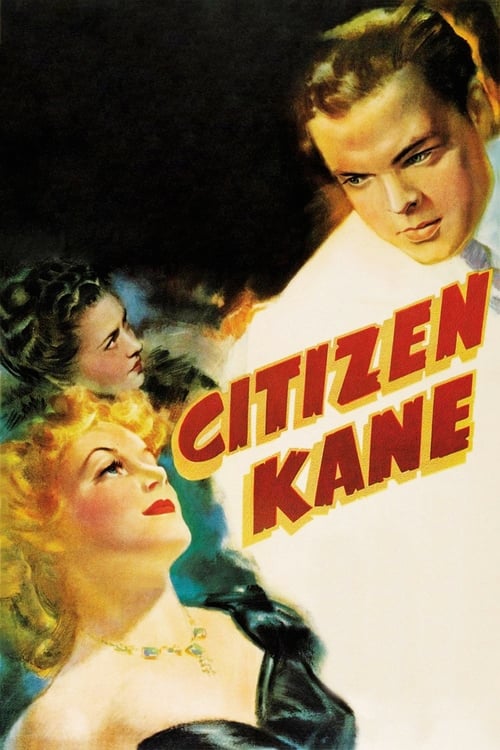
Citizen Kane
1941 · Orson Welles
For when you want to finally see what the fuss is about and discover it's actually a blast — a film to argue about afterward, best with your full attention and no phone.
What it's about
A newspaper tycoon dies alone in his unfinished palace, his last word — 'Rosebud' — a riddle no one can explain. A reporter sets out to crack it, interviewing the people who knew Charles Foster Kane best, and their conflicting memories assemble the life of a man who had everything money could buy: a boy taken from his mother, an idealist turned demagogue, a husband, a friend, a colossal American failure.
The experience
Faster, funnier, and more entertaining than its homework reputation suggests — it moves like a thriller, plays like a puzzle, and lands like a tragedy. You spend the film piecing a man together and end up moved by how little the pieces explain.
Performances
Orson Welles, at twenty-five, plays Kane from brash young man to hollowed-out old tyrant with total command; Joseph Cotten and Everett Sloane, part of Welles's Mercury company, give the recollections their sting and their warmth.
The craft
Its deep-focus photography — whole rooms in razor-sharp perspective, ceilings visible, figures dwarfed by their own possessions — rewrote what a Hollywood film could look like, and its fractured, multiple-narrator structure rewrote how one could be told. The makeup, sound design, and time-jumping edits still feel audacious. A big screen makes those cavernous compositions hit properly.
Why it matters
A commercial disappointment on release — and the target of a suppression campaign by the press baron it evoked — it was later rediscovered and spent half a century atop critics' lists as the consensus greatest film ever made, the debut every ambitious filmmaker measures against.
Snapshot
Citizen Kane is the debut feature of Orson Welles, produced by Mercury Productions for RKO Radio Pictures and released in May 1941. The film follows newspaper magnate Charles Foster Kane from his boyhood dispossession in the Colorado snow to his death in the glass-and-marble solitude of Xanadu — a trajectory narrated not chronologically but through the fractured recollections of five people who knew him, assembled by a reporter assigned to crack the mystery of Kane's dying word: "Rosebud." The film did not find a large audience on original release and generated significant political hostility from the newspaper empire of William Randolph Hearst, whom Kane's character conspicuously evoked. Over the following decades, through the advocacy of the Cahiers du Cinéma critics and the theoretical writings of André Bazin, the film was reappraised as the central exhibit in arguments about cinematic style and authorship. From 1962 to 2012, Citizen Kane occupied the top position in the Sight & Sound decennial critics' poll — the longest consecutive run of any title — before being displaced by Alfred Hitchcock's Vertigo. Its technical ambitions, narrative architecture, and the circumstances of its creation by a twenty-five-year-old first-time director with unprecedented contractual autonomy made it an enduring reference point for discussions of what cinema can do.
Industry & production
Orson Welles arrived in Hollywood in 1939 on terms almost without precedent: RKO, seeking prestige and willing to gamble on unconventional talent, offered him a two-picture deal that included producing, directing, writing, and acting — and, crucially, the right of final cut. Welles brought with him the core of the Mercury Theatre company, the New York ensemble he had founded with John Houseman in 1937 and had made nationally famous through the Mercury Theatre on the Air radio broadcasts, including the notorious 1938 adaptation of H.G. Wells's The War of the Worlds. After abandoned projects — including an adaptation of Joseph Conrad's Heart of Darkness that Welles intended to shoot entirely from the protagonist's point of view — the company settled on an original story developed with the veteran screenwriter Herman J. Mankiewicz.
The production was housed at RKO's Gower Street lot. Cinematographer Gregg Toland, whose contract with Samuel Goldwyn allowed him to loan himself to other studios, either approached Welles or was sought out by him — accounts vary — and became the film's director of photography. Welles, with no prior film experience, has described benefiting from Toland's technical mentorship; Toland, for his part, saw in Welles an opportunity to push further the depth-of-field experiments he had been conducting through the late 1930s. Art direction was credited to Van Nest Polglase, head of RKO's art department, with the more detailed design work carried out by Perry Ferguson, who engineered the exceptional ceilinged sets the film's visual scheme required.
Hearst's effort to suppress the film was substantial. His newspapers refused to carry advertising for RKO's entire output. There were reports — their precise details remain contested — of pressure to have the negative purchased and destroyed; Louis B. Mayer's name has been attached to such an offer in various accounts, though the record is not conclusive. Theater chains in many markets were reluctant to antagonize Hearst, limiting the film's reach. The film received nine Academy Award nominations, including Best Picture, Best Director, and Best Actor, but won only one: Best Original Screenplay, shared by Welles and Mankiewicz. The ceremony was marked by audible booing when the film's nominations were announced.
Technology
The film's signature technical achievement is the systematic use of deep focus — sharp definition maintained simultaneously across near, middle, and far planes — at a time when Hollywood convention favored shallow-focus photography that isolated subjects from their backgrounds. Toland achieved this through a combination of techniques: very wide-angle lenses (primarily in the 24–28mm range), small apertures that maximized depth of field, the Kodak Super-XX high-speed film emulsion, and powerfully lit arc lamps, much of the illumination concealed within the sets themselves. Toland also employed lens coatings to minimize flare at small apertures — a technology still relatively new in 1941.
The requirement to shoot from floor level and below made it necessary to build sets with actual ceilings, a significant departure from the open-topped sets that dominated Hollywood construction and allowed overhead lighting. Sound recording, handled by Bailey Fesler and James G. Stewart, deployed techniques drawn from Welles's radio practice, including overlapping and multi-track dialogue recording that gave crowd and party scenes an unusual naturalistic density. Matte paintings, glass shots, and optical compositing extended sets and created the scale of Xanadu without the cost of full construction. The "News on the March" newsreel sequence opening the investigation was deliberately degraded in processing to simulate aged documentary footage — an early instance of manufactured archival texture.
Technique
Cinematography
Toland and Welles used extreme depth of field not merely as technical display but as a dramatic and interpretive instrument. The most cited example is the scene in which young Charles Kane plays in the snow beyond a window while his mother, guardian, and father negotiate his future in the foreground: all three planes are equally sharp, and the viewer must distribute attention across them, reading the scene's emotional geometry without editorial direction. Bazin would later theorize this as preserving the ambiguity of reality against the selecting violence of the cut — a formulation that made Kane central to his ontological account of cinema. Long takes hold simultaneous actions in the same frame; movement by a character reveals or conceals relationships rather than being underscored by cutting.
Wide-angle lenses impart characteristic spatial distortion: foreground objects loom, depth stretches behind them. Welles and Toland exploited this for psychological effect, making Kane's surroundings simultaneously grandiose and imprisoning. Low-angle framing places Kane repeatedly against ceilings, against skies, against architectural weight — he reads as powerful and oppressed at once. The film's aging of Kane across decades was achieved partly through makeup and partly through lighting strategies that carved the same face differently as the character's power and isolation hardened.
Editing
Robert Wise edited the film, with some work by Mark Robson; Wise would later direct West Side Story (1961) and The Sound of Music (1965). The editing is notable both for its innovations and for its restraint in service of Toland's long-take compositions. Where classical Hollywood continuity editing breaks scenes into coverage — establishing shot, medium, close-up, reaction — Welles and Wise frequently held in a single wide composition, using character movement, focal depth, and blocking to generate the narrative information that cutting would otherwise supply.
The film's most compressed sequence — the breakfast table montage in which Kane's first marriage deteriorates across a series of brief shots, each ellipsing further forward in time — demonstrates the opposite pole: rapid cutting performs years of domestic erosion in minutes, a tour de force of temporal compression that balances the film's otherwise long-form compositional logic. The intercutting of the "News on the March" newsreel with Thompson's investigation establishes the non-linear architecture from the film's opening minutes, conditioning the audience to expect temporal discontinuity as a structural norm.
Mise-en-scène / staging
Mercury Theatre practice — staging for an audience that sees the full picture rather than the selected image — is visible throughout in the density of spatial information. Characters are blocked in depth, their positions in the frame carrying meaning: Kane dwarfs his associates, or is dwarfed in turn by the architecture he has commissioned. The scene in which Kane is reflected in two parallel mirrors, multiplied to infinity, concentrates the film's preoccupation with identity, performance, and unknowability into a single image. Xanadu's great hall is staged to emphasize its deadening scale; a fireplace burns in the distance while Kane and Susan occupy the foreground like figures lost in a mausoleum.
Theatrical lighting — high contrast, shadow-heavy, drawing on both German Expressionist cinema and a Rembrandt-inflected stage tradition — is prevalent without being uniform. Kane is lit from below at moments of threat or monstrousness, isolated in pools of light during scenes of loneliness, silhouetted against windows or lamps. The staging of Susan Alexander's operatic debut draws on theatrical spectacle while systematically humiliating its protagonist through framing choices that reveal the audience's contempt before she has finished singing.
Sound
Welles came to feature film as an accomplished radio director, and the sonic design of Kane reflects this lineage. Overlapping dialogue — characters speaking simultaneously, interrupting, cross-talking — was unusual in 1941 Hollywood and gave scenes a live, unruly texture. Wise's editing frequently uses audio to bridge across cuts: a line of dialogue that begins in one space completes itself in another, pulling the viewer into a new temporal and geographic location before the image has arrived. The radio practice of using sound to carry the burden of narrative transition — a technique of economy and speed — is absorbed into a medium that had not often exploited it so systematically.
Performance
Welles cast the Mercury Theatre company, almost none of whom had prior screen experience, and this collective theatrical background gives the film a consistency of ensemble style. Welles's own performance deploys his enormous physical and vocal presence across a forty-year arc without recourse to the naturalist minimalism that was becoming Hollywood convention; it is large, operatic, and precisely calibrated. Joseph Cotten as Jedediah Leland finds the film's moral register — Leland is Kane's conscience externalized — with an easiness that stands in productive contrast to Welles's grandeur. Agnes Moorehead's brief appearance as Kane's mother is filmed with an austerity consistent with her subsequent reputation as a rigorously controlled character actor. Dorothy Comingore as Susan Alexander carries one of the film's most demanding roles: a woman whose mediocrity is neither her fault nor her defining quality, but who is made to bear both by Kane's compulsion to reshape the world to his need.
Narrative & dramatic mode
The film's narrative architecture is a sustained interrogation of the possibility of knowing another person. Thompson, the reporter assigned to decode "Rosebud," interviews five witnesses; each provides a version of Kane that is partial, inflected by the speaker's relationship to him, and sometimes mutually contradictory. Thompson's face is never clearly shown; he remains a silhouette and a surrogate for the audience rather than a character with a legible perspective. The film's final revelation — that "Rosebud" is the trade name of Kane's childhood sled, consumed in the furnace at Xanadu — is offered to the audience without any character ever knowing it. The film withholds the key piece of information from the very investigation it depicts, suggesting that the mystery of a person cannot be unlocked by the retrieval of a single originary wound, even if that wound is real.
The flashback had been a narrative device in Hollywood film since the silent era, but its use here as a structural principle — rather than an expository convenience — marks a different ambition. The multiple retrospective narrators, non-linear chronology, and investigation that fails to fully explain its subject were not invented by Citizen Kane, but the film's deployment of this architecture within a major studio production of considerable scale and cultural prestige gave it a demonstrably wide influence on subsequent narrative filmmaking.
Genre & cycle
Kane does not fit cleanly into any single genre, a quality that has complicated its classification and contributed to its canonical utility. Its closest generic affiliations are with the biographical picture, which Hollywood had been producing with commercial success since the early sound period — though Kane's subject is fictitious and the film is explicitly hostile to the hagiographic mode that dominated the form. The investigative frame places it adjacent to the newspaper picture, a popular genre of the 1930s. The film's retrospective structure, moral ambiguity, and expressionist visual strategies anticipate and partly constitute film noir, which would consolidate as a recognizable cycle in the following years. Kane shares with proto-noir the flashback narration, the morally compromised protagonist, and the sense of a past that poisons the present. Its generic hybridity has been part of its analytical usefulness: it can be read through multiple frameworks simultaneously without being exhausted by any.
Authorship & method
The question of authorship in Citizen Kane has been more publicly and acrimoniously debated than for almost any other Hollywood film. The screenplay was developed by Welles and Herman J. Mankiewicz — a prolific Hollywood writer with credits including Marx Brothers pictures and a wide circle of New York journalistic connections that gave him access to Hearst-world anecdote. Pauline Kael's influential 1971 essay, published in The New Yorker and subsequently in The Citizen Kane Book, argued that Mankiewicz was the primary creative intelligence behind the screenplay and that Welles's directorial contributions were overstated. This thesis was sharply contested by Peter Bogdanovich, by Welles himself in published interviews, and most systematically by the scholar Robert Carringer, whose detailed archival analysis of multiple script drafts found a picture more genuinely collaborative than either the auteurist or the Kael position allowed. The established consensus credits both men with significant contributions while recognizing that the film's visual scheme, structural choices, and interpretive decisions belong principally to Welles in collaboration with Toland.
Toland's contribution is unambiguous and widely acknowledged; Toland himself, in professional trade publications at the time, described the production as a genuine collaborative experiment and credited Welles with an unusual willingness to learn and to take compositional risks. Bernard Herrmann composed the score — his first for a feature film — using a through-composed approach rather than the then-standard modular library of cues. Herrmann deployed leitmotifs ("Rosebud" carries its own musical identity throughout) and integrated tonal color that would define his subsequent career as one of Hollywood's most distinctive composers, particularly in his long association with Alfred Hitchcock. Wise's editorial contribution, less celebrated than Toland's or Herrmann's in the larger authorship debate, shaped the film's rhythm and managed the productive tension between its long-take compositional logic and its moments of concentrated cutting.
Movement / national cinema
Kane belongs to an anomalous position within Hollywood cinema: it is a major studio production that operates according to an aesthetic logic largely alien to the system that financed it. It does not sit within the more neatly defined national cinema traditions of French Poetic Realism, Italian Neorealism, or German Expressionism, though it absorbs elements from all three. Its most direct institutional lineage is the New York avant-garde theatrical world — the Mercury Theatre's project of formally ambitious, politically engaged popular entertainment — transplanted into industrial cinema by the terms of an unusual contract.
The film's influence on the French New Wave, whose future filmmakers wrote about it extensively in the pages of Cahiers du Cinéma through the 1950s, means it has a significant place in the prehistory of that movement even though it is an American commercial film. Bazin's ontological theories of cinema — particularly his arguments about the long take and deep focus as preserving, against the violence of montage, the ambiguity intrinsic to perception — used Kane as a central exhibit, which positioned the film within an aesthetic rather than a national-cinema framework. Its canonical status has been maintained across multiple critical reframings precisely because it does not belong fully to any single tradition.
Era / period
The film arrives in a specific historical moment: the final year of American isolation before Pearl Harbor, within the late studio era's period of confident institutional power, at the close of a decade that saw the consolidation of the sound film and the establishment of genre systems that would dominate commercial cinema for a further generation. Its reflexive concern with media power — Kane is a press magnate who distorts reality through his publications — resonated with New Deal–era anxieties about monopoly, propaganda, and the concentration of information in private hands. That its satirical target was a still-living and politically active press baron gave these concerns an immediate edge that accelerated the film's political difficulties on release.
Within the history of Hollywood filmmaking itself, the film sits at a stylistic threshold: it arrives after the rapid technical maturation of the sound period and before the retrenchment imposed by wartime production constraints and the postwar rise of television.
Themes
Kane's central preoccupation is the relationship between origin and character — the film proposes that Kane's dispossession as a child creates a wound that all his subsequent accumulation and domination cannot fill. "Rosebud" functions as a symbol of the irrecoverable: not merely a childhood object but the moment before self-consciousness, before the division of the self into public performer and private absence. Whether the film endorses this psychologistic reading or ironizes it is a matter of genuine interpretive debate; Thompson explicitly concedes that "Rosebud" does not explain Kane, and the film withholds the revelation from every character in the narrative, suggesting skepticism about the explanatory power of origin stories even as it structures itself around one.
Power and its corruptions; the manufacture of consent and the distortion of reality through media; the loneliness of exceptional ambition; the relationship between love and control; the impossibility of authentic self-knowledge — these themes are organized around a figure whose sympathetic and monstrous qualities are held in uneasy suspension. The film does not adjudicate Kane; it accumulates perspectives. Its formal structure — multiple unreliable narrators — is an enactment of its central theme.
Reception, canon & influence
Influences on the film. German Expressionist cinema — Murnau, Lang — contributed directly to the film's chiaroscuro lighting and its use of architecture as psychological extension of character. Toland's own experiments in depth of field through the late 1930s (Wuthering Heights, The Grapes of Wrath, The Long Voyage Home) provided the technical foundation; his earlier collaborations with William Wyler on Dodsworth (1936) and Dead End (1937) had pushed similar compositional strategies toward narrative purpose. Welles has named John Ford, particularly Stagecoach (1939), as a critical reference — he reportedly screened it repeatedly before beginning production — citing its compositional economy and narrative confidence. The theatrical and radio traditions of the Mercury Theatre, with their use of overlapping sound, non-linear dramaturgies, and political intelligence, are as direct an influence as any film antecedent.
Critical reception. Reviews on release were largely favorable among the press critics who managed to see the film despite Hearst's advertising embargo; the film was widely recognized as formally ambitious. But the combination of the boycott, exhibitor caution, and a public that found the narrative demanding meant the film did not perform commercially as RKO had hoped. Reappraisal came incrementally. In France, Bazin and subsequently the Cahiers critics treated the film as a foundational text. The 1952 Sight & Sound poll ranked it among the top films; by 1962 it had risen to first, a position it held for fifty years. The 2012 poll saw it displaced by Vertigo; the 2022 poll placed Chantal Akerman's Jeanne Dielman (1975) at the summit. These shifts reflect not the film's diminishment but the evolution of the critical frameworks being applied.
Legacy and forward influence. The inventory of Kane's demonstrable forward influence is unusually extensive. Its deep-focus compositional strategy was absorbed into Hollywood practice, though rarely with the same systematic rigor. Its non-linear multi-narrator structure provided a model that became a staple of literary cinema and has been replicated so frequently — in pictures as varied as Rashomon (1950), Nashville (1975), and Pulp Fiction (1994) — as to constitute a recognized narrative grammar. Film noir drew on Kane's retrospective flashback structure, its expressionist lighting, and its moral ambivalence. Welles's own subsequent work — The Magnificent Ambersons (1942), The Lady from Shanghai (1947), Touch of Evil (1958) — can be read as an ongoing dialogue with the ambitions and methods first assembled here. Herrmann's compositional approach shaped Hollywood scoring for a generation, most consequentially in his Hitchcock collaborations. The film's status as a pedagogical object — screened in film schools, analyzed in textbooks, deployed as the primary exhibit in arguments about mise-en-scène, montage, sound design, and authorship — means its influence operates not only through direct stylistic citation but through the formation of generations of filmmakers who learned cinema partly by learning Kane.
A Deleuzian reading
Start with the snow.
The full Deleuzian reading of Citizen Kane →
Reception
A box-office disappointment in 1941 — William Randolph Hearst's papers refused to advertise it and pressured theaters — it was rediscovered after the war (championed by French critics and a 1950s re-release) and topped the Sight & Sound greatest-films poll every decade from 1962 to 2002.
How Citizen Kane was received, from release to now →
Influences: the films it descends from and the films it influenced
- The Cabinet of Dr. Caligari (1920) — German Expressionist architectural staging — sets built as distorted projections of institutional authority — supplies the visual grammar of canted angles and enclosing walls that Welles naturalizes into Kane's ceilinged rooms and upward-looming compositions.
- The Last Laugh (1924) — Murnau's systematic low-angle compositions and subjective camera movement to narrate the social humiliation of a uniformed authority figure codifies the power-as-monumentalism grammar that Toland and Welles systematize into Kane's signature low-angle deep-focus framing.
- Greed (1924) — Von Stroheim's anti-hagiographic portrait of a man obliterated by his own appetites — sustained across epic temporal breadth through location shooting and actual objects — provides the naturalist template for Kane's 'great man destroyed from within' trajectory.
- The Power and the Glory (1933) — Preston Sturges's screenplay constructs the film as a posthumous investigation of a railroad magnate through conflicting flashbacks narrated by his intimates — the direct narrative template for Kane's multiple-retrospective-witness inquiry and withheld-revelation structure.
- His Girl Friday (1940) — Hawks's overlapping, simultaneously-recorded multi-character dialogue — developed through his late-1930s screwball comedies as a technique for naturalistic crowd texture — is the specific sound practice Welles adapted and redirected toward Kane's newsroom and party scenes.
- The Long Voyage Home (1940) — Toland's deep-focus photography for Ford in the months immediately preceding Kane — wide-angle lenses, powerful arc lighting, forced-perspective sets — constitutes the direct technical rehearsal for the depth system he would bring to Kane.
- The Rules of the Game (1939) — Toland's deep-focus long takes that keep foreground and background action simultaneously legible extend Renoir's depth staging into the canonical American form of multi-plane composition.
- The Scarlet Empress (1934) — Toland's deep-focus layered compositions and low-key chiaroscuro, staging meaning across cluttered foreground-to-background planes, extend Sternberg's crowded, sculpted frame.
- The Phantom Carriage (1921) — Generalizes the recursive nested-flashback construction — a life reconstructed out of order through embedded recollections — that Sjöström pioneered as narrative form.
- The Grapes of Wrath (1940) — Toland carried the deep-focus and low-key innovations rehearsed for Ford into their full consummation the next year, where foreground-to-infinity sharpness becomes the film's defining formal device.
- The Roaring Twenties (1939) — Its 'News on the March' opening reel weaponizes the same newsreel-narration-plus-montage device to sketch a life-and-era before the drama proper begins.
- The Magnificent Ambersons (1942) — Welles extends Kane's ceilinged-set deep-focus staging and anti-hagiographic American dynasty portrait, now sustaining longer unbroken takes through period interiors and sharpening the temporal-compression montage passages into an elliptical engine of social decline.
- The Best Years of Our Lives (1946) — Toland's most elaborate post-Kane deployment of deep focus as dramatic instrument — split-focus compositions maintaining three simultaneous planes of action in a single shot — directly carries forward the depth grammar codified in Kane into sustained dramatic application.
- Rashomon (1950) — Kurosawa extends Kane's multiple-retrospective-narrator architecture into a formal principle: four contradicting testimonies with no authoritative resolution, hardening Kane's implication that memory constructs rather than recovers truth into the film's explicit structural argument.
- Lola Montès (1955) — Ophüls applies Kane's anti-hagiographic retrospective framework to a female celebrity's life — a non-linear sequence of framed memories and performed testimonies that subjects the 'great life' narrative to ironic circus spectacle, extending Kane's manufactured-archival-texture strategy through theatrical mise en abyme.
- Touch of Evil (1958) — Welles extends Kane's wide-angle lens distortion and low-angle expressionist staging into a sustained proto-noir visual system, elaborating Kane's depth-blocking principles into the celebrated single-take opening shot and pushing figure-dwarfing architectural framing to its formal limit.
- The Trial (1962) — Welles pushes Kane's wide-angle lens distortion and ceilinged oppressive architecture to their expressionist extreme — cavernous low-angle spaces that reduce the protagonist to institutional insignificance, realizing the spatial logic of power that Kane's Xanadu sequences adumbrated.
- Chinatown (1974) — Polanski inherits Kane's proto-noir architecture of a private investigation that terminates in withheld revelation — here a powerful man's crimes whose exposure serves rather than defeats him — extending Kane's critique of the media-industrial power nexus into explicit civic corruption.
- Anatomy of a Murder (1959) — Welles and Toland's deep-focus compositions — staging figures at radically different depths without cutting — gave Hollywood its syntax for keeping multiple witnesses simultaneously legible in a single frame, the visual logic Preminger deploys in his courtroom group stagings.
- The Untouchables (1987) — Burum's anamorphic deep-focus compositions and low-angle shots inflating institutional architecture directly quote Gregg Toland's visual grammar; De Palma's overhead shots that flatten characters into geometric elements extend Welles's treatment of the frame as pictorial architecture staging moral geometry.
- The Godfather (1972) — Willis's deep-shadow chiaroscuro and frames-within-frames compositional strategy descend directly from Toland's deep-focus work here; the dynastic patriarch whose accumulation of power produces moral dissolution is the structural template Coppola inherits and transposes into an immigrant-crime register.
- The Godfather Part II (1974) — Gregg Toland's deep focus cinematography — objects and faces sharp across all planes, every frame a staged argument about power and spatial hierarchy — is the explicit visual model Willis followed, extending Toland's deep-staging innovation into a color medium with motivated low-key sources.
- Seven Samurai (1954) — Gregg Toland's deep-focus cinematography — maintaining simultaneous sharpness across foreground and background planes to express power relations spatially without camera movement — is the technical model Asakazu Nakai adapted directly for Seven Samurai's village interior compositions.
- The Maltese Falcon (1941) — Huston's debut deploys contemporaneous proto-noir staging — low-angle expressionist compositions, deep-space blocking in enclosed interiors, and a MacGuffin-organized investigative narrative — in parallel development with Kane, establishing the visual and structural conventions of noir that both films jointly inaugurate.
- How Green Was My Valley (1941) — Ford's retrospective first-person voiceover — an aging narrator reconstructing a vanished childhood world — deploys the audio-bridge narration and temporal-compression ellipsis in direct parallel to Kane's retrospective structure, arriving in the same year through convergent narrative thinking.
- The Little Foxes (1941) — Shot the same year by the same cinematographer, Gregg Toland, using the identical wide-angle deep-focus technique with ceilinged sets and figures held in sharp foreground-to-background planes within a single shot.
- Triumph of the Will (1935) — Welles deploys the same low-angle monumentalization and the towering campaign-rally backdrop with the diminished leader before a giant projected image of himself — political-spectacle staging in dialogue with Riefenstahl's grammar.
- The Killers (1964) — The investigation-as-eulogy template: a probe into a dead man assembled from fragmentary, conflicting flashbacks given by interviewed witnesses, the structural backbone Siodmak's 1946 film passed to Siegel.
- Ball of Fire (1941) — Shares the same-year Goldwyn/RKO craft unit — Gregg Toland's deep-focus lensing and Perry Ferguson's art direction — so Ball of Fire's interiors are staged in the identical deep-space photographic language.
- The Music Room (1958) — Chiaroscuro deep-focus interiors of a decaying mansion (Xanadu) plus a flashback/memory structure that emblematizes a great man's isolation — the template for Jalsaghar's ruined room and its retrospective narration.
- Hellzapoppin' (1941) — The contemporaneous target of Hellzapoppin's most pointed parody — the burning 'Rosebud' sled recurs as a running gag, a direct citation of a same-year release.
Similar films
- The Magnificent Ambersons (1942) — influence & lineage
- The Maltese Falcon (1941) — influence & lineage
- The Trial (1962) — influence & lineage
- How Green Was My Valley (1941) — influence & lineage
- It's a Wonderful Life (1946) — often watched together
- Casablanca (1943) — shared sensibility
- Mr. Arkadin (1955) — shared sensibility
- Macbeth (1948) — shared sensibility
All the films related to Citizen Kane →
Film essays and courses that include it
- How Cuts Think: From Soviet Montage to New Hollywood Rhythm
- What the Ear Sees: A Century of Cinematic Sound
- Fade In to Fracture: The Screenplay from Architecture to Anarchy
- The Grammar of Shadow: Black & White Cinema from Caligari to Raging Bull
- Everything in Frame: Deep Focus from Renoir to Tarr
- Out of Order: A Century of Fractured Time
- The Architecture of Forgetting
- The Corrupting Vein: Cinema's Century with Greed
- The Machinery of Greed: Cinema's Anatomy of Capital
- The Crystal and the Trap
- Everything in Focus at Once
- The Sound of the Inside
- The Perfect Protagonist
- The Sin It Can't Stop Admiring
- The Art That Sound Killed at Its Peak