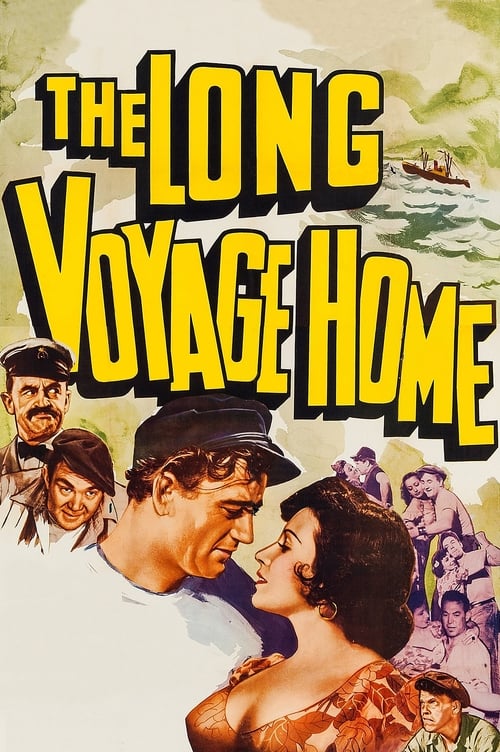
The Long Voyage Home
1940 · John Ford
For a quiet, contemplative night when you want atmosphere over plot — a film to sink into like weather, not race through. It's a gentle challenge: patient viewing that pays off in feeling rather than incident.
What it's about
The crew of a tramp steamer, the Glencairn, hauls a cargo of high explosives across the Atlantic in the early days of World War II, bound for a blacked-out English port. Adapted from four Eugene O'Neill one-act plays, it follows the sailors — drinkers, dreamers, and one young Swede hoping to finally get home to his farm — through the long stretches of waiting, carousing, and dread that make up a voyage. There's no single plot so much as a shared fate: men who can't leave the sea, on a crossing where the war could find them at any hour.
The experience
Slow, moody, and enveloping — closer to a tone poem than an adventure, with long shadowed nights on deck broken by bursts of rowdiness and sudden fear. It leaves you with a melancholy that sneaks up on you, the ache of men who talk about home more than they'll ever reach it.
The craft
Gregg Toland's deep-focus, shadow-heavy cinematography is the star — fog, lamplight, and wet decks composed like paintings, a year before he shot his most famous work. John Ford strips the storytelling down to faces and silences, letting the images carry what dialogue would cheapen. It rewards a dark room and a good screen; this is black-and-white photography at its most expressive.
Why it matters
Made in the middle of Ford's legendary run of late-'30s and early-'40s masterpieces, it stands as his art-film outlier and a showcase for the deep-focus style that would soon reshape Hollywood photography.
Snapshot
The Long Voyage Home is John Ford's brooding, near-plotless study of merchant seamen on a wartime Atlantic crossing — a film that trades incident for atmosphere and character for mood. Produced independently by Walter Wanger and released through United Artists, it distilled four of Eugene O'Neill's early one-act "Glencairn" plays into a single unbroken voyage aboard the tramp steamer SS Glencairn, carrying a cargo of high explosives from the American tropics to a blacked-out English port. It arrived in the middle of Ford's most extraordinary creative run — bracketed by Stagecoach (1939), Young Mr. Lincoln (1939), Drums Along the Mohawk (1939), The Grapes of Wrath (1940), and How Green Was My Valley (1941) — and it is the odd, introspective one out: a chamber piece at sea, shot by Gregg Toland in a deep-focus, high-contrast idiom that would echo forward into Citizen Kane. Nominated for six Academy Awards and admired by O'Neill himself, it remains one of Ford's most stylistically self-conscious and least conventionally dramatic works.
Industry & production
The film was an independent production, financed and produced by Walter Wanger and distributed by United Artists rather than by a vertically integrated studio. This matters: freed from a house style, Ford and his collaborators were able to pursue an unusually austere, uncommercial project — an ensemble drama with no romance, no star vehicle in the conventional sense, and no tidy narrative arc. Ford was at the peak of his prestige following the triple success of 1939, which gave him leverage to make a film driven by artistic ambition more than box-office calculation.
The property was Eugene O'Neill's, and the adaptation combined four short plays O'Neill had written in the mid-1910s about the crew of the Glencairn: The Moon of the Caribbees, In the Zone, Bound East for Cardiff, and The Long Voyage Home. Screenwriter Dudley Nichols — Ford's most important writing collaborator of the period — wove them into a continuous voyage and transposed the setting from the First World War of O'Neill's originals to the Second World War then underway, giving the film an immediate topical charge as it addressed audiences in a Europe already at war and an America still officially neutral.
On the commercial record I should be candid: the film earned strong reviews and Academy recognition, but the surviving accounts indicate it was not a major box-office success, and I will not attach a specific dollar figure to it because the reliable production-accounting record for this independent release is thin. What is well attested is the film's critical standing and its half-dozen Oscar nominations at the ceremony honoring 1940 releases — Best Picture, Best Screenplay, Best Cinematography (Black-and-White), Best Film Editing, Best Original Score, and Best Special Effects — none of which it converted into a win in a year dominated by other pictures.
Technology
The film was made on 35mm black-and-white nitrate stock using the standard Academy-ratio, sound-on-film technology of the late studio era. Its technological interest lies not in novel equipment but in how conventional tools were pushed: Gregg Toland's pursuit of deep focus required very high light levels, fast lenses, and coated optics to hold both foreground and far background in acceptable sharpness — the same experimental program he would carry directly into Citizen Kane the following year. The confined shipboard sets, built on soundstages, allowed precise control of these lighting conditions. Special-effects work — the storm sequence, the torpedo threat, the aerial attack in the English harbor — earned the film its effects nomination and relied on the era's combination of miniatures, matte work, and staged practical elements rather than on any breakthrough process.
Technique
Cinematography
This is, above all, a cinematographer's film. Gregg Toland's photography is the single most celebrated element, and rightly so. He rejected the soft, high-key gloss typical of the period in favor of hard, sculptural, low-key lighting: pools of light and deep wells of shadow, faces half-swallowed by darkness, the ship's rigging and gangways rendered as a cage of black lines. The deep-focus compositions keep planes of action legible at once — a man in the foreground and figures deep in the background of the cramped forecastle held together in a single frame — anticipating the depth staging Toland is now most famous for in Citizen Kane. Toland shot both this film and The Grapes of Wrath for Ford in 1940, and the two constitute a remarkable one-year laboratory in expressive black-and-white before he moved on to Welles. The visual style is frankly expressionistic, closer to the pictorialism of Sternberg or to German shadow-play than to the naturalism of O'Neill's stage originals — a deliberate, almost defiant transformation of the source material's realism into something dreamlike and fatalistic.
Editing
Sherman Todd's editing (also Oscar-nominated) serves the film's unusual rhythm. Because the picture is episodic and mood-driven rather than plot-driven, the cutting favors duration and atmosphere over acceleration. Scenes are allowed to breathe; the camera and the cut linger on faces and on the collective life of the crew. The film's few passages of genuine action — the storm, the fatal accident belowdecks, the shore-leave sequence — are edited for suspense and shock in contrast to the surrounding calm, so that violence erupts out of stillness. The overall structure is a series of self-contained movements strung along the arc of the voyage, and the editing accepts that theatrical, tableau-like construction rather than fighting it.
Mise-en-scène / staging
Ford stages the film as a study in enclosure. The Glencairn is a world of low ceilings, narrow passages, and communal spaces where men are perpetually in one another's company yet fundamentally alone. Ford's habitual gift for the group — the ensemble caught in ritual, drink, song, and idleness — is everywhere, but here it is shadowed by claustrophobia and dread rather than warmed by community. The opening sequence, with women coming aboard in a sultry tropical port, is staged with a heavy, langorous sensuality unusual for Ford; the later shore-leave in the English pub tightens into a trap. Ford visibly relished the maritime material — his own lifelong love of the sea is well documented — and the film carries an authenticity of shipboard behavior and detail.
Sound
Sound is used atmospherically: the creak and groan of the vessel, the wind, the wash of the sea, and, crucially, the songs and shanties that punctuate the crew's life. Music and effects together build the sense of an isolated acoustic world sealed off from land. The relative sparseness of dialogue in long stretches — the film trusts image and sound over speech — is itself a notable choice for an adaptation of a great dramatist of language.
Performance
The ensemble is the star. John Wayne, cast against the emerging Ringo-Kid persona, plays Ole Olsen, a naïve young Swedish sailor, complete with an accent — a genuine stretch that has divided viewers ever since but that reflects Ford's willingness to use Wayne as a soft, boyish figure rather than a hero. Thomas Mitchell (fresh from his Oscar for Ford's Stagecoach) anchors the crew as the boisterous Driscoll. Ian Hunter gives the film's most delicate performance as the secretive, gentlemanly "Smitty," around whom the In the Zone episode of suspicion turns. The Ford stock company is out in force — Barry Fitzgerald, Ward Bond, John Qualen, Arthur Shields, Wilfrid Lawson as the captain, Mildred Natwick in a brief, memorable turn. Performances are pitched between naturalism and a heightened, near-choral theatricality appropriate to the O'Neill source.
Narrative & dramatic mode
The film's most radical feature is its refusal of conventional plot. It is an anti-narrative in the guise of an adventure: a sequence of moods and vignettes bound only by the ship's journey and by a shared, unspoken longing to escape the sea for good. The dramatic mode is elegiac and fatalistic. Individual episodes carry their own small arcs — Smitty's letters and the crew's paranoid suspicion of him; the death of an old sailor belowdecks; Ole's shore-leave and the crew's collective effort to save him from being shanghaied — but there is no overarching protagonist and no resolution beyond the grim circularity implied by the title. "The long voyage home" is precisely the journey that never ends; the men swear they will leave the sea and are pulled back to it. The film belongs to the tradition of the ensemble mood-piece, closer to a tone poem than to a well-made play.
Genre & cycle
Nominally a war and sea drama, the film sits athwart several categories. It is a maritime picture and a literary adaptation of a prestige stage property; it is also, in its 1940 context, part of the cycle of pre-Pearl-Harbor films that engaged obliquely with the European war before American entry, dramatizing the danger to merchant shipping and the human cost of the Atlantic crossing. But it resists the propaganda register: its sympathies are with the exhausted, exploited men of the crew rather than with any national cause, and its mood is closer to tragedy than to mobilization. Within Ford's own filmography it belongs to a small strand of literary-theatrical adaptations and to his recurring fascination with communities of men bound by labor and ritual.
Authorship & method
The film is a nexus of major authorial signatures. John Ford brings his defining preoccupations — community and exile, ritual and loss, the group as both refuge and prison — but channels them into an unusually stylized, un-folksy register. Gregg Toland's cinematography is arguably co-authorial here; the film's expressionist look is as much his statement as Ford's, and its place in Toland's development toward Citizen Kane is a central part of its historical importance. Dudley Nichols, Ford's key screenwriter of the era (they had already made The Informer and Stagecoach together), performed the difficult architectural task of fusing four discrete plays into one continuous film and updating their war. Richard Hageman composed the Oscar-nominated score, and Sherman Todd cut the picture. The source author, Eugene O'Neill, looms over the whole: this is a film made in negotiation with one of the twentieth century's great dramatists, and it is well attested that O'Neill held the adaptation in high regard, reportedly counting it among the screen versions of his work that pleased him most.
Movement / national cinema
This is an American studio-era film, but one that deliberately imports the visual language of European expressionism into Hollywood classical filmmaking — part of the broader mid-century convergence, driven partly by émigré cinematographers and by American experimenters like Toland, that would soon feed directly into film noir. The film thus stands at a hinge: rooted in the Hollywood prestige-adaptation tradition, yet reaching toward the shadowed, pessimistic image-world that noir would inherit in the following decade. Its literary source is quintessentially American — O'Neill's Provincetown-era realism — even as its style looks abroad.
Era / period
The Long Voyage Home is a document of 1940: made as war engulfed Europe and merchant convoys became the lifeline and the front line of the Atlantic, released to an American audience poised on the edge of involvement. Its updating of O'Neill's WWI plays to the current war is the clearest mark of its moment. It is also a product of the tail end of the classical studio system at its most confident, and of Ford's own annus mirabilis, when he could command the resources and the freedom to make a demanding, non-commercial film between more conventional successes.
Themes
The film's governing themes are exile, rootlessness, and the impossibility of return. Its men dream ceaselessly of leaving the sea — of a farm, a home, a family — and the tragedy is that the sea always reclaims them; the "home" of the title is a destination perpetually deferred. Loneliness runs beneath the crew's rough camaraderie: Smitty's guarded secrecy and the paranoia it provokes dramatize how isolation persists even in the closest quarters. Labor and exploitation are constant — these are working men at the mercy of ship-owners, crimps, and war. And death is a quiet, recurring presence, arriving without heroism belowdecks. Over all of it hangs a fatalism that is more O'Neill than Ford, tempered by Ford's characteristic tenderness toward the community of the marginal.
Reception, canon & influence
Critically, the film was well received on release and has retained a strong reputation, particularly among admirers of Ford's more experimental and personal work; its six Academy Award nominations register the industry's respect even though it won none. Its standing among cinephiles rests heavily on Toland's photography and on its status as a comparatively rare Ford art-film.
Influences on the film (backward): its foundation is Eugene O'Neill's Glencairn one-act plays and O'Neill's brand of maritime naturalism; formally, it draws on the chiaroscuro and depth-staging traditions of European expressionist and pictorialist cinematography, and on Ford's own developing ensemble aesthetic from The Informer and Stagecoach.
Legacy (forward): the film's most consequential afterlife is optical. Toland's deep-focus, high-contrast work here is a direct precursor to his celebrated cinematography on Citizen Kane (1941), and the two films are routinely discussed together as evidence of how the depth-and-shadow style entered mainstream American cinema on the eve of film noir. For Ford's own career, the film demonstrated a stylistic range beyond the Western and the folk-Americana with which he is most identified, and it remains a touchstone for anyone tracing the more melancholy, poetic vein of his authorship. Its influence is felt less through direct imitation than through this lineage of the expressive black-and-white image — a line of descent that runs through Kane into the noir decade and beyond.
A Deleuzian reading
The rigging comes down across the deck in a cage of black lines.
The full Deleuzian reading of The Long Voyage Home →
Reception
Critics loved it in 1940 — six Oscar nominations, including Best Picture — but audiences stayed away and it lost money. Today it's the cinephiles' pet Ford: the shadowy, experimental one people rediscover and wonder why nobody talks about.
How The Long Voyage Home was received, from release to now →
How to watch The Long Voyage Home: what to notice on a first viewing
- Notice how much of every frame stays in shadow. Toland lights the ship hard and low, pools of light against deep wells of shadow, faces half swallowed by darkness throughout. The ship feels like it's printing its own darkness onto the men living inside it.
- Watch how many men stay in focus at once. Toland's deep-focus compositions hold a man in the foreground and figures deep in the cramped forecastle sharp in the very same frame. Nobody in the shot gets to be the one important person; everyone stays equally present.
- Listen for how little dialogue this film actually has. Sound carries much of the film through the creak of the vessel, the wind, the wash of the sea, and the crew's own songs. You get to know these men from what surrounds them more than from what they actually say.
- Watch how little space the crew actually has. Ford stages the Glencairn as low ceilings, narrow passages, and communal spaces where men are constantly in each other's company yet fundamentally alone. The closeness of the quarters only makes each man's isolation more visible, not less.
- Watch Wayne play against his usual confident swagger. He plays Ole Olsen, a naive young Swede who has to be looked after by everyone around him, a real stretch from the persona Ford had just built in Stagecoach. He's staged here as someone who needs rescuing, not someone who does the rescuing himself.
The whole guide to watching The Long Voyage Home, with the keys for a rewatch →
Influences: the films it descends from and the films it influenced
- Sunrise (1927) — Murnau's Fox-studio staging in depth and expressionist modeling of light established the pictorialist deep-space grammar Toland high-contrasts into the film's chiaroscuro.
- The Docks of New York (1928) — Sternberg's fog-diffused waterfront chiaroscuro and enclosed dockside demimonde prefigure the film's maritime low-key atmosphere and confined-vessel milieu.
- The Informer (1935) — The first Ford–Nichols fog-bound studio expressionism: symbolic pools of light and a stagebound adaptation method that Nichols reprises to fuse O'Neill's one-acts.
- Mad Love (1935) — Toland's camerawork under Freund pushed deep-focus and Germanic horror lighting he later carries into the ship's holds and shadowed decks.
- Dead End (1937) — Toland's deep-focus staging within one enclosed set—foreground faces sharp against a deep background—rehearses the claustrophobic depth compositions here.
- Wuthering Heights (1939) — The Oscar-winning Toland–Wyler collaboration refined a diffused yet deep, high-contrast monochrome that directly precedes his Ford work.
- Stagecoach (1939) — Ford's confinement of his stock ensemble inside a single moving vessel—the group as microcosm and prison, scripted by Nichols—supplies the dramatic architecture.
- Citizen Kane (1941) — The direct optical heir: Toland extends the deep-focus and low-key, ceilinged interiors first mainstreamed here into his most celebrated statement.
- How Green Was My Valley (1941) — Ford transposes the elegiac enclosed-community mood, chiaroscuro interiors, and exile-nostalgia voice-over into another stylized non-Western memory piece.
- The Little Foxes (1941) — Toland and Wyler push staging-in-depth further, composing action across sharp fore/background planes descended from these deep-focus experiments.
- The Maltese Falcon (1941) — Carries the low-key chiaroscuro and enclosed-interior menace across the threshold into the noir decade the film is credited with anticipating.
- The Magnificent Ambersons (1942) — Welles sustains the deep-focus long take as elegy, using depth staging and shadow to mourn a vanishing world in the Toland-derived idiom.
- They Were Expendable (1945) — Ford returns to elegiac fatalism and men bonded within a doomed maritime group, extending the melancholy, duration-heavy register over acceleration.
- The Best Years of Our Lives (1946) — The culminating Toland–Wyler deep-focus film, staging multiple simultaneous actions in a single sustained frame that this style pioneered.
- Long Day's Journey Into Night (1962) — Extends the O'Neill-adaptation line, using single-house enclosure and duration-over-cutting to honor the dramatist's claustrophobic naturalism on screen.
- Lifeboat (1944) — Ford's O'Neill adaptation fixes a merchant crew as a stratified society bounded by the gunwales, and its long unscored passages carried by water, wind and rigging supply the ambient-score-substitution model.
- Enamorada (1946) — Ford and Toland's low-ceilinged deep-focus groupings, lit from a single practical source so a community reads as one sculptural mass, is the compositional habit Fernández openly appropriated for his church and cantina interiors.
- The Grapes of Wrath (1940) — The same-year Ford–Toland pairing applies identical low-key naturalist chiaroscuro to a folk odyssey, the twin experiment in Ford's poetic monochrome vein.
Similar films
- How Green Was My Valley (1941) — influence & lineage
- The Grapes of Wrath (1940) — influence & lineage
- The Best Years of Our Lives (1946) — influence & lineage
- Long Day's Journey Into Night (1962) — influence & lineage
- Wagon Master (1950) — shared sensibility
- Das Boot (1981) — shared sensibility
- The Emigrants (1971) — shared sensibility
- All Quiet on the Western Front (2022) — shared sensibility