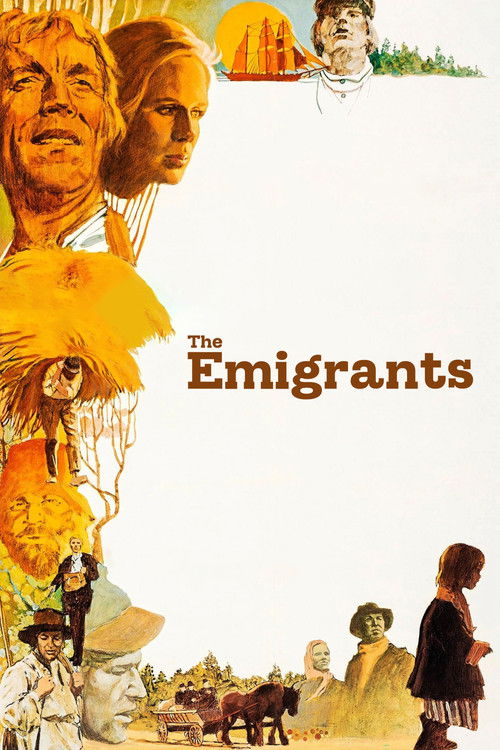
The Emigrants
1971 · Jan Troell
For when you want a long, serious, deeply human epic to sink into on a quiet weekend — patient viewing that repays your attention with real emotional force. If your own family has an immigration story, expect it to hit close.
What it's about
In mid-1800s Sweden, tenant farmers Karl Oskar and Kristina are slowly broken by stony soil, famine, and religious persecution, until the only choice left is to give up everything for the rumor of America. With family and neighbors they endure a squalid, deadly Atlantic crossing and a grueling overland journey toward Minnesota. It's the immigrant story told from the leaving side — what it costs to tear up roots.
The experience
Slow, physical, and monumental — you feel the weight of every season, every mile of the crossing. It's a three-hour epic that earns its length through accumulation: by the end you feel you've lived a piece of these lives.
Performances
Max von Sydow and Liv Ullmann are extraordinary as Karl Oskar and Kristina — a marriage portrayed with such lived-in weariness and devotion that the epic never loses its intimate center.
The craft
Jan Troell shot and edited the film himself, and it shows in its unity: natural light, tactile detail of soil, wood, and sea, and a rhythm that trusts silence. The steerage-passage section is among cinema's great renderings of what an ocean crossing actually was — big-screen material if you get the chance.
Why it matters
One of the rare foreign-language films ever nominated for the Best Picture Oscar, it stands with its companion film The New Land as a defining screen account of the European emigration to America.
Snapshot
The Emigrants (Utvandrarna) is Jan Troell's monumental adaptation of Vilhelm Moberg's beloved novel cycle about the great 19th-century Swedish exodus to America. It follows Karl Oskar Nilsson (Max von Sydow) and his wife Kristina (Liv Ullmann), tenant farmers ground down by stony Småland soil, crop failure, hunger, and the religious intolerance of a rigid state Lutheran order. Together with Karl Oskar's restless younger brother Robert, Kristina's dissenter uncle Danjel, and other neighbors, they abandon everything for the rumored abundance of North America, enduring a squalid and deadly Atlantic crossing and a punishing inland journey before reaching Minnesota. Running roughly three hours and conceived as the first half of a two-part epic completed by The New Land (Nybyggarna, 1972), the film is at once an intimate marriage drama and a sweeping national origin story. It became one of the most internationally honored Swedish films of its era and a defining work of the post-Bergman generation.
Industry & production
The film was produced by Svensk Filmindustri, the dominant force in Swedish cinema, with Bengt Forslund — Troell's long-standing creative partner — serving as producer and co-writer. Adapting Moberg was a prestige undertaking of real cultural weight: the four Emigrants novels (published 1949–1959) are among the most widely read works in modern Swedish literature, a canonical account of the roughly one million–plus Swedes who left for America across the second half of the 19th century. Bringing them to the screen carried something of the responsibility of a national project.
The production was ambitious and unusually protracted for Swedish cinema of the period. Troell and Forslund shot the two films together as a single large campaign, filming on location across the Swedish landscape of Småland and in the United States, including Minnesota, so that the passage from Old World to New would carry documentary authenticity rather than studio approximation. The decision to cast Max von Sydow and Liv Ullmann — both by then internationally recognized largely through Ingmar Bergman's films — gave the project marquee value abroad while grounding it in the most respected acting talent in Scandinavia. The film was released internationally by Warner Bros., which handled its American distribution; that release, staggered across 1971 and 1972, would have consequences for its awards history (see Reception). Precise budget and box-office figures are not something I can reliably cite here, and I will not invent them; what is clear is that the two-film enterprise represented a major commitment of resources by Swedish standards.
Technology
The Emigrants belongs to a moment when lightweight, portable camera and sound equipment had made a supple, location-based naturalism possible for narrative filmmakers, not just documentarians. Troell, who had come up through documentary and short filmmaking, exploited exactly this. Working with available and natural light wherever he could, and with a mobile, often handheld camera, he pursued an image texture closer to observed life than to the controlled sheen of studio production. The technology mattered less as spectacle than as enabler: it allowed a small crew to follow bodies through real weather, real interiors, and real terrain, and to shoot in the cramped, dim conditions — a turf-roofed cottage, a ship's steerage hold — where the drama's physical hardship actually lived. I would be cautious about asserting the exact camera model or film gauge without firm documentation; the salient point is Troell's embrace of portable, low-intervention tools in the service of immediacy.
Technique
Cinematography
Troell photographed the film himself — a defining fact of its craft. As his own cinematographer he could fuse the roles of director and image-maker into a single sensibility, and the result is a photographic style of extraordinary tactility. He favors natural light: the gray, flat luminance of a Swedish winter; candle- and firelight in dark interiors; the pitiless glare of the open sea. The handheld camera lends scenes a searching, present-tense quality, drifting toward faces and hands, catching gesture and labor. Landscape is never mere backdrop but a moral and material force — the meager, rock-strewn fields that starve the Nilssons, the vast indifferent ocean, the green promise of Minnesota. Troell repeatedly isolates physical detail (soil, bread, skin, water) so that the abstraction of "emigration" is rendered as concrete bodily experience.
Editing
Troell also edited the film, completing an authorial control over image and rhythm that is rare in narrative cinema. The cutting is patient and frequently elliptical, willing to hold on process and duration — the slow accretion of hardship, the monotony of the crossing — while eliding conventional connective tissue. Time is compressed and expanded to match lived experience rather than plot mechanics, and the film trusts the accumulation of observed moments to build meaning. That the same person shot and cut the material gives the editing an internal consistency of eye and tempo.
Mise-en-scène / staging
The staging is committed to period and material truth: implements, garments, foodstuffs, and dwellings are handled as working objects, and characters are constantly shown at labor. Troell stages within authentic, often confining spaces — the low cottage, the ship's hold thick with bodies and sickness — so that social and physical pressures are legible in the frame itself. Crowds and communities are composed without theatrical arrangement, favoring a documentary sense of people simply occupying space. The overall effect is anti-picturesque: even beauty is earned through grime and effort.
Sound
The soundtrack privileges the ambient and the diegetic — wind, water, the creak of timber, the murmur of Swedish voices, the noise of shipboard misery. Non-diegetic music is used sparingly, in keeping with the film's naturalism, drawing on folk-tinged textures rather than a lush orchestral commentary. (I am not able to attribute the specific music credits here with confidence and will not guess at them; what can be said securely is that the film resists conventional scoring in favor of restraint.) The privileging of environmental sound reinforces the sense of a world observed rather than dramatized.
Performance
The acting is the film's emotional bedrock. Max von Sydow plays Karl Oskar as a man of stubborn, inarticulate endurance — practical, land-hungry, driven less by dreams than by refusal to be beaten. Liv Ullmann's Kristina is his counterweight: more rooted in home, faith, and belonging, and thus more wounded by uprooting. Ullmann's performance, widely singled out, works through interiority and small physical registers rather than declamation, and it carries the film's tragic undertow. The supporting playing — Eddie Axberg as the America-dreaming Robert among them — extends the naturalist ethos, with performances calibrated to physical reality and social texture rather than star effect.
Narrative & dramatic mode
Structurally the film is an epic of stages: privation in Sweden, the decision to leave, the ocean crossing, the overland passage, arrival. Yet its dramatic mode is intimate and processual rather than incident-driven. Rather than turning on a few large plot beats, it accumulates hardship and hope through observation, and its emotional climaxes emerge from endurance and loss (illness, death, birth) as much as from decision. The register is realist and unsentimental, closer to social and historical fiction than to melodrama, though the marriage of Karl Oskar and Kristina supplies a classical dramatic spine. Because it was made as the first movement of a larger whole, The Emigrants is deliberately open-ended, arriving at Minnesota not as resolution but as threshold — the settling, and its costs, reserved for The New Land.
Genre & cycle
The film sits at an unusual generic intersection: it is period drama and historical epic, but it is also, revealingly, a kind of inverted Western. Where the classic American Western views the frontier from the vantage of the settler already arrived and mythologizes the taming of the land, The Emigrants dramatizes the frontier from the immigrant's point of origin — the European poverty that produced the pioneer, the harrowing journey that preceded the homestead. It is a settlement narrative stripped of triumphalism, attentive to what emigration costs before it rewards. Within Swedish and European cinema it belongs to a cycle of literary-historical adaptations and to the broader realist current of its moment; as a two-film enterprise with The New Land, it forms its own self-contained epic cycle tracing a single family from Old World to New.
Authorship & method
The Emigrants is a near-total expression of Jan Troell's authorship. He directed, photographed, and edited the film, and co-wrote the screenplay with Bengt Forslund — a concentration of roles that makes him one of cinema's most complete auteurs in the literal sense of controlling image, cut, and script. His method, formed in documentary and short filmmaking, prizes patient observation, natural light, handheld intimacy, and fidelity to physical experience over dramatic contrivance. Forslund, as co-writer and producer, was the essential collaborator in shaping Moberg's sprawling novels into filmable structure and in marshaling the production. The source author, Vilhelm Moberg, is a third authorial presence whose research-grounded, deeply humane novels supplied not only plot but the film's ethical seriousness about ordinary people and historical suffering. The lead performers, von Sydow and Ullmann, function almost as co-authors of the film's emotional meaning. On the specific credits for music and other departments I will defer rather than risk misattribution.
Movement / national cinema
Troell emerged, alongside Bo Widerberg, as a leading figure of the generation of Swedish filmmakers who came to prominence in the wake of — and partly in reaction to — Ingmar Bergman. Where Bergman's cinema was chamber-scaled, psychological, and metaphysical, Troell (like Widerberg) turned outward toward social history, landscape, and a documentary-inflected realism. That he drew his two great stars from Bergman's stock company underscores both the continuity and the difference: the same faces, a different world. The Emigrants thus stands as a landmark of a maturing, internationally ambitious Swedish national cinema, one confident enough to translate a foundational national story into a work of world stature.
Era / period
The film depicts mid-19th-century rural Sweden and the emigration that gathered force from the 1840s and 1850s onward — an era of agrarian hardship, land scarcity, and a state Lutheran church whose intolerance of dissenters is dramatized through the persecution of Kristina's uncle Danjel and his followers, who hold forbidden religious gatherings in defiance of laws restricting worship outside the established church. This historical grounding is precise and central: the film treats emigration not as adventure but as the response of the powerless to concrete pressures — hunger, dispossession, and coercion of conscience — within a specific and rigorously reconstructed period.
Themes
Its governing themes are dispossession and the hunger for land; the pull between rootedness and departure, embodied in the contrast between Kristina's attachment to home and Karl Oskar's forward-driving will; faith, both as consolation and as a target of persecution; the dignity and brutality of physical labor; and the human cost of migration — the deaths, illnesses, and severings that shadow every step toward the promised land. Underlying all of it is a meditation on endurance: the film honors ordinary people's capacity to survive, and asks what is lost in the surviving. America functions less as a place than as an idea — a screen for hope onto which poverty projects deliverance — and the film is quietly skeptical about the gap between that idea and its reality, a skepticism its sequel would deepen.
Reception, canon & influence
The Emigrants was received as a major achievement and remains a cornerstone of the Swedish canon and of 1970s international art cinema. Its awards history is distinctive: as Sweden's submission it earned an Academy Award nomination for Best Foreign Language Film for 1971, and then — owing to its staggered American release — it received, at the following year's ceremony, nominations in the general categories, including Best Picture, Best Director for Troell, Best Actress for Liv Ullmann, and Best Adapted Screenplay. This made it one of the rare foreign-language films to break into the Academy's top categories, and one nominated across two consecutive years. It also won the Golden Globe for Best Foreign-Language Foreign Film. Critical acclaim was broad and durable; the film has been championed by major critics as a humane epic of exceptional craft.
Looking backward, the film's deepest influence is literary — Moberg's meticulously researched novels — filtered through Troell's documentary training and the European realist tradition. Looking forward, its legacy runs first through its own immediate continuation, The New Land, with which it forms a complete epic; through Troell's continued career as one of Sweden's most respected directors; and through its stature as a benchmark for the immigrant epic on film, a work later filmmakers and adaptations have measured themselves against (the story was revisited in a 2021 Swedish adaptation). Its aesthetic — natural light, handheld intimacy, landscape as moral force, patient duration — anticipates and parallels a lyrical-naturalist strain in later world cinema; comparisons to filmmakers such as Terrence Malick are commonly drawn on grounds of affinity, and I offer that as critical resonance rather than a documented line of direct influence. What is beyond dispute is that The Emigrants stands as a defining work of post-Bergman Swedish cinema and one of the great screen accounts of migration and its human price.
A Deleuzian reading
Troell keeps going back to hands.
The full Deleuzian reading of The Emigrants →
Reception
A sensation in its day — Golden Globe winner and, rarely for a subtitled film, an Oscar Best Picture nominee — it then drifted out of easy availability for decades until Criterion's 2016 restoration (paired with The New Land) turned it back into a cinephile pilgrimage.
How The Emigrants was received, from release to now →
Influences: the films it descends from and the films it influenced
- The Virgin Spring (1960) — Supplies the acting grammar and Nordic austerity Troell inherits — Max von Sydow's interior stillness and the Sven Nykvist-school faith in unadorned natural light on faces, which Troell adopts and pushes toward documentary rather than allegory.
- The Great Adventure (1953) — The Swedish nature-documentary lineage from which Troell's method literally descends: patient available-light observation of seasons, animals, and rural labor, with landscape recorded as a lived physical fact rather than a backdrop.
- Nanook of the North (1922) — Establishes the processual survival-epic — long, respectful attention to the exact steps of subsistence tasks (building, hunting, clearing) — the same material-authenticity ethic that governs Troell's stump-pulling and rock-strewn Småland fields.
- Earth (1930) — The founding text for landscape-as-moral-force agrarian lyricism, where soil, harvest, and sky carry the ethical weight of peasant lives — a compositional and thematic grammar Troell secularizes into 19th-century Swedish hardship.
- Toni (1935) — Location shooting with non-glamorized faces and real terrain that founded the realist strand feeding neorealism; Troell extends its commitment to filming migrant laborers in actual working environments under natural light.
- America America (1963) — The immigrant-journey epic built as an accretion of hardships toward embarkation, with handheld documentary texture and an unglamorous, endurance-based structure that prefigures Troell's processual march from Sweden to the ship.
- Here Is Your Life (1966) — Troell's own earlier Moberg-era adaptation where he first fused the total-auteur role (shooting, cutting, writing) with elliptical episodic structure and lyrical natural light — the direct workshop for The Emigrants' method.
- City Girl (1930) — Sustains the pastoral-melodrama-meets-naturalism lineage, with a director-photographer working in real landscape and available light to make agrarian labor and migration emotionally legible without theatrical artifice.
- Wagon Master (1950) — Troell operating his own camera and cutting his own footage produces the same ethnography of transit — the crossing rendered as an accumulation of tasks, weather, and illness — with plot subordinated to the physical procedure of getting there.
- The New World (2005) — Extends the same natural-light, handheld immersion in a new-world wilderness where terrain and weather become the film's true subject, and history is felt as physical experience rather than dramatized incident.
- Meek's Cutoff (2010) — The inverted western at its purest — a slow, elliptical, open-ended pioneer trek where survival chores and the indifferent landscape replace gunplay, carrying forward Troell's anti-heroic processual staging of migration.
- Pelle the Conqueror (1987) — The Scandinavian emigration epic that measures itself against Troell — Max von Sydow again anchoring a landscape-bound account of poverty and displacement staged with material authenticity and natural light.
- Heaven's Gate (1980) — An immigrant-settler epic of vast processual scale, shot by Vilmos Zsigmond in smoky natural light, that inherits Troell's inversion of frontier myth into the collective suffering of newcomers on the land.
- The Revenant (2015) — Emmanuel Lubezki's natural-light-only cinematography and grueling on-location survival staging carry Troell's landscape-as-moral-force and material-authenticity to a technical extreme, filming endurance as a physical fact.
- Stroszek (1977) — Troell shot his Swedish-emigration-to-America epic himself on 16mm and blew up to 35mm for theatrical release, embedding documentary texture within a tripartite geographic movement—homeland, sea crossing, American arrival—that is the direct structural precedent for Stroszek's Berlin–Wisconsin–Cherokee arc.
- Train Dreams (2025) — Patient frontier chronicle whose period-accurate manual labor and figures dwarfed by wilderness model the elliptical, life-span sweep of working lives.
- The New Land (1972) — The literal continuation shot in the same campaign with the same crew, cast, and self-photographed handheld naturalism — the second half of one unbroken processual epic of dispossession and settlement.
- The Flight of the Eagle (1982) — Troell again turning landscape into a moral antagonist — the Arctic ice as an unforgiving physical reality — using his signature available-light, endurance-driven staging of men against a hostile environment.
- Days of Heaven (1978) — Shares the lyrical-naturalist idiom of migrant field labor rendered in magic-hour available light, elliptical elision of plot in favor of texture, and landscape that dwarfs and judges its itinerant workers — the affinity most often cited beside Troell.
- The Tree of Wooden Clogs (1978) — Peasant life filmed with non-professionals, seasonal duration, and diegetic-ambient sound, where the dignity of ordinary labor and material detail supplies the drama — the same humane realist ethic as Troell's.
- 1900 (1976) — A historical processual epic of agrarian class hardship built on seasonal duration and landscape, extending the same ambition to render ordinary people's suffering across sweeping historical time.
- Jeremiah Johnson (1972) — Location-realist survival epic whose elliptical time-compression and figures-dwarfed-by-wilderness compositions parallel Stanford's contemplative cutting and Callaghan's small-figure framing.
- The Best Intentions (1992) — A contemporaneous Swedish period chronicle with von Sydow and Ullmann using naturalist landscape photography and novelistic scale to dramatize class and hardship — the same period-realist mode from a parallel hand.
Similar films
- The New Land (1972) — influence & lineage · same viewing thread · often watched together
- Days of Heaven (1978) — influence & lineage
- The Virgin Spring (1960) — influence & lineage
- Godland (2022) — same viewing thread
- Into the Wild (2007) — same viewing thread
- Train Dreams (2025) — same viewing thread
- Paris, Texas (1984) — same viewing thread
- The New World (2005) — influence & lineage · often watched together
All the films related to The Emigrants →
Watch it with: curated runs of related films
- Quiet Lives at the World's Edge — Watch these when you want a life pared down to essentials — someone walking out of society to start from zero, or simply living out their days at the margins.