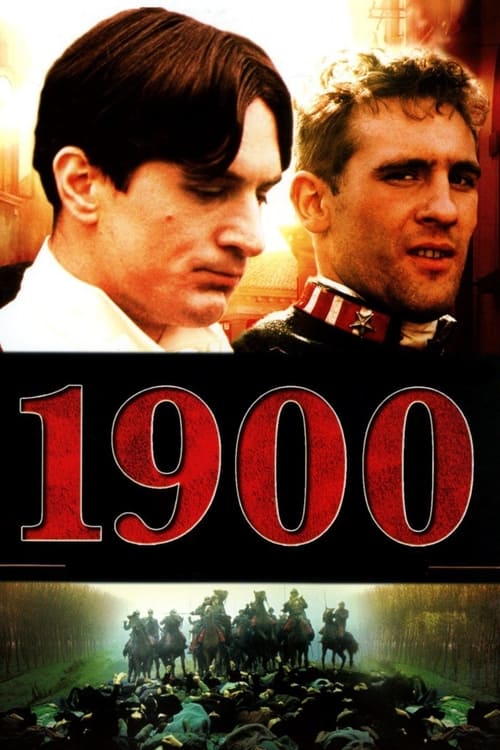
1900
1976 · Bernardo Bertolucci
For when you want to give a whole evening — or a whole day — to a monument: a long, engrossing epic to sink into when a two-hour film feels too small. This is commitment viewing, and the scale is the reward.
What it's about
Two boys are born on the same day on the same Emilian estate — Alfredo, grandson of the landowner, and Olmo, grandson of the peasant patriarch — and their lifelong friendship becomes the thread through which Bertolucci pulls the first half of Italy's twentieth century: the padrone and the peasant, the rise of socialism, the coming of fascism, and the reckoning of the Liberation. It is class struggle told as an epic of one farm, one friendship, and one country.
The experience
A five-hour immersion — sprawling, sensual, brutal, and operatic by turns. It moves like the seasons it depicts, lulling you with pastoral beauty and then shocking you with the violence history brings to the door; it demands stamina and repays it.
Performances
Robert De Niro and Gérard Depardieu, both young and at full force, anchor the film as the landowner's heir and the peasant's son — a genuinely startling pairing of two of the era's greatest actors on opposite sides of a class war.
The craft
Bertolucci mounts it on a Hollywood scale with a European auteur's convictions: vast harvest scenes, decades of period detail, and a camera that treats the Emilian countryside as both paradise and battlefield. It's a film built for the biggest screen you can find, where its frescoes of landscape and labor overwhelm.
Why it matters
One of cinema's most ambitious attempts to fuse popular epic with radical politics, its scale, cost, and battles over cutting made it legendary — a touchstone for every conversation about how far a director can push a historical fresco.
Snapshot
1900 (Italian: Novecento) is Bernardo Bertolucci's five-hour Marxist fresco of Italian history, tracing the twentieth century's first half through the intertwined lives of two men born on the same day on a single Emilian estate: Alfredo Berlinghieri (Robert De Niro), grandson of the landowning padrone, and Olmo Dalcò (Gérard Depardieu), grandson of the peasant patriarch. Framed by the Liberation Day of 25 April 1945 and reaching back to the estate at the turn of the century, the film stages the long conflict of padrone and contadino — master and worker — as both a national epic and an intimate drama of friendship, betrayal, and the rise and fall of fascism. Conceived on a Hollywood scale but rooted in the fields around Parma where Bertolucci grew up, it remains one of the most ambitious attempts by a European auteur to marry the art film to the historical epic, and one of the most contested in its final form.
Industry & production
1900 was produced by Alberto Grimaldi — the producer behind Sergio Leone's later Westerns and Bertolucci's own Last Tango in Paris — through his company PEA, with financing assembled from the three major American studios Paramount, United Artists, and 20th Century Fox, each taking distribution territories. This arrangement gave Bertolucci a European art-cinema production financed at near-Hollywood scale, a rare hybrid for the mid-1970s. Coming directly off the international scandal and commercial success of Last Tango in Paris (1972), Bertolucci commanded the leverage to mount an epic of this size and to cast internationally: De Niro and Depardieu at the film's center, and a supporting ensemble that spanned Hollywood veterans (Burt Lancaster as the aging padrone Alfredo Sr., Sterling Hayden as the peasant patriarch Leo Dalcò), the New Hollywood (Donald Sutherland as the fascist foreman Attila), and Italian and French screen icons (Dominique Sanda, Stefania Sandrelli, Laura Betti, Alida Valli, Romolo Valli).
The production's defining crisis was length. Bertolucci delivered a film of roughly five and a quarter hours, released in Italy and much of Europe in two parts (Atto Primo and Atto Secondo). The American backers, contractually entitled to a film of releasable length, demanded drastic cuts; the ensuing dispute between Bertolucci and Grimaldi became one of the celebrated auteur-versus-financier battles of the decade. A substantially shortened English-language version circulated in North America, while the complete cut — commonly cited at 315 minutes — was gradually restored to international circulation and is now the standard version. Exact budget figures vary across sources and should be treated with caution, but the film was widely reported at the time as among the most expensive productions ever mounted in Europe.
Technology
1900 was shot photochemically on 35mm color negative, in the anamorphic-adjacent widescreen tradition that Storaro and Bertolucci favoured, and finished for conventional theatrical release. Its technological ambition lay less in novel apparatus than in the disciplined orchestration of established tools at scale: large location units working across the full agricultural calendar, extensive crowd choreography, and a color-timing philosophy in which the laboratory grade was treated as an authorial instrument rather than a corrective. The film's most consequential "technology," in effect, is Storaro's systematic control of natural and augmented light across seasons and years of story time — a method the cinematographer pursued through composition, exposure, and printing rather than through any single innovation of camera or stock. Where the historical record on specific equipment is thin, it is safer to describe the film's technical identity through its lighting and color design than to attribute particular hardware.
Technique
Cinematography
Vittorio Storaro's photography is the film's signature achievement and among the central works of his career. Building on his collaboration with Bertolucci on The Conformist (1970) and Last Tango in Paris, Storaro conceived 1900 around the changing light and color of the Emilian countryside, using the agricultural seasons as a chromatic and emotional structure: the golden, dust-laden summers of the peasants' labor; the fogged, desaturated winters; the deep interiors of the padrone's villa. His camera favours slow, weighted movement and painterly wide compositions that place human figures within the landscape and the labor that shapes it, drawing openly on the tradition of nineteenth-century Italian realist painting and on the socially conscious canvases the film itself references. Light in Storaro's scheme carries ideological meaning — the openness of the fields against the shadowed enclosures of privilege and fascist power — and the cinematography sustains this symbolic register across the film's enormous span.
Editing
The film was edited principally by Franco "Kim" Arcalli, Bertolucci's crucial creative partner of the period, with Gabriella Cristiani. Arcalli — who also shares screenwriting credit — was central to Bertolucci's mature style, in which editing is less about narrative economy than about rhythm, association, and the layering of time. The cut of 1900 must hold together a chronicle spanning some forty-five years while sustaining operatic set-pieces and long passages of near-documentary observation of rural work. The bitter post-production fight over the film's length, however, means that "the editing" exists in more than one authorized form; the divergence between the full European cut and the shortened American release is itself part of the film's textual history, and any assessment of its montage should specify which version is under discussion.
Mise-en-scène / staging
Bertolucci stages 1900 as a series of grand tableaux anchored to a single estate — the villa, the aia (farmyard), the fields, the workers' quarters — so that the geography of class is legible in every frame. Collective scenes are choreographed on an epic scale: peasant gatherings, strikes and their suppression, the socialist funerals and red banners, the Liberation Day reckoning. Against these mass compositions Bertolucci sets chamber-scaled domestic and erotic scenes inside the villa, so that the film continually crosses between the public sweep of history and private appetite. The production design and costuming track four decades of change with attention to the material texture of rural life, and the recurring motifs — the land, the seasons, Verdi as the presiding spirit of a dying nineteenth-century Italy — bind the staging into a coherent symbolic world.
Sound
Ennio Morricone's score is a defining element: expansive, folk-inflected, and unafraid of grandeur, it supplies the film with its emotional and rhetorical scale, from pastoral lyricism to martial menace. The film's sound world also foregrounds the diegetic culture of the peasantry and the padrone class, with music functioning as a marker of history and belonging. As with much Italian cinema of the era, the film was post-synchronized, an international cast performing across languages and dubbed in finishing — a norm of the production culture rather than a defect, though it inflects how performances register in different language versions.
Performance
The casting is deliberately dialectical. De Niro's Alfredo is weak, self-deceiving, and finally complicit, a padrone who loves his childhood friend yet cannot renounce his class; Depardieu's Olmo is earthy, physical, and morally anchored in collective struggle. Around them, Sutherland delivers a grotesque, near-expressionist turn as the fascist Attila, whose cruelties (including notoriously brutal acts of violence) render fascism as pathology and spectacle; Laura Betti matches him as Regina. The veterans supply gravity and historical depth — Lancaster's aging landowner and Hayden's peasant grandfather embody the two lineages whose descendants the film will follow. The performances are pitched between naturalism and operatic stylization, consistent with the film's ambition to be at once history painting and human drama.
Narrative & dramatic mode
1900 operates as a dialectical epic. Its governing structure is the parallel biography — two lives, two classes, one estate — organized so that individual fates continually allegorize collective history. The narrative is framed: it opens on Liberation Day 1945 with peasants settling accounts, then loops back to the birth of the two protagonists at the century's dawn and moves forward through the socialist ferment of the early 1900s, the trauma of the First World War, the rise of squadrist fascism in the countryside, the long fascist decades, and the war's end. The dramatic mode fuses melodrama, historical chronicle, and something close to pageant; personal betrayals and reconciliations are made to rhyme with political ruptures. The film's Marxist framework is explicit rather than buried — history is presented as class struggle — and its ending, with the peasants' judgment of the padrone and the persistence of the red flag, has been read both as revolutionary affirmation and as unresolved, deliberately suspended dialectic.
Genre & cycle
The film sits at the intersection of the historical epic, the political film, and the art-cinema chronicle. It belongs to the wave of politically committed Italian cinema of the late 1960s and 1970s that took the nation's confrontation with fascism and class as its subject, alongside directors such as the Taviani brothers, Francesco Rosi, and Elio Petri. As an epic of the land and of generational succession, it can be read against the international cycle of the mid-1970s "big" political-historical films, and against the Hollywood-financed European super-productions of the period. Yet its scale, its five-hour running time, and its refusal of conventional narrative economy place it firmly outside genre convention and inside the auteurist tradition of the maximal art film.
Authorship & method
1900 is a Bertolucci film in the fullest sense — a return to the Emilian landscape of his childhood and to the political-psychological concerns of his earlier work — realized through a tight circle of collaborators. The screenplay is credited to Bernardo Bertolucci with his brother Giuseppe Bertolucci and with Franco Arcalli, whose role as co-writer and editor made him arguably the director's most important creative partner of the era. Vittorio Storaro's cinematography and Ennio Morricone's score are not merely craft contributions but co-authorial voices: Storaro's color-and-light dramaturgy and Morricone's music each carry the film's meaning as much as the script does. Bertolucci's method here extends the fusion he had developed since The Conformist — psychoanalytic and political reading of Italian history, operatic emotion, and a painterly, movement-driven camera — now expanded to epic length. The film is also, biographically, a work of homecoming: the son of a Parmesan poet-intellectual returning to the fields and social world of his origins to render them as history.
Movement / national cinema
The film is a monument of Italian national cinema and of the politically engaged strain that succeeded neorealism. It draws on the neorealist inheritance — the countryside, non-heroic collective life, the moral weight of labor — while transforming it through spectacle and psychoanalytic depth into something neorealism never attempted. It belongs to the generation of Italian auteurs who came of age in the shadow of Pasolini (with whom Bertolucci had worked) and who took the reckoning with Italy's fascist past as a defining project. Financed by American studios yet unmistakably rooted in Emilia-Romagna's specific social history and in Italian visual and musical culture, 1900 embodies the tension of 1970s European art cinema: local, political, and authorial in vision, transnational and industrial in its economics.
Era / period
Two time-frames matter. The film's setting runs from the estate at the turn of the twentieth century — under the shadow of Verdi's death and the end of a certain nineteenth-century Italy — through the First World War, the fascist ventennio, and the Liberation of 1945. Its moment of production, the mid-1970s, is equally legible in the work: the Italy of the "years of lead," of a powerful Communist Party and intense ideological contestation, in which a Marxist historical reckoning had urgent contemporary charge. The film's confidence that history could be narrated as class struggle, and its willingness to end on the persistence of the red flag, are of their period. So too is its industrial situation — the brief window in which a European auteur could command studio financing for a five-hour political epic.
Themes
The film's central theme is the dialectic of class — padrone and contadino — figured through two men bound from birth and divided by property. Around this runs a cluster of related concerns: the land and labor as the ground of history; the seasons and generational succession as a rhythm against which political time moves; fascism understood not as accident but as the violent self-defence of a threatened landowning class, embodied in Attila's sadism; the failures and endurance of solidarity among the peasants; and the intimate, at times homoerotic, bond between Alfredo and Olmo as an image of the impossibility of friendship across class. Verdi presides as a symbol of a passing national culture. Sexuality, cruelty, and politics are continually entangled — a Bertolucci hallmark — so that private desire and public power are never cleanly separable.
Reception, canon & influence
1900 was, from the outset, as much an event as a film, and its reception was shaped by the battle over its length. Critics and audiences encountered it in divergent cuts, and contemporary response was correspondingly divided — awed by the ambition, the Storaro cinematography, and the performances, yet split over the film's ideological explicitness, its violence and sexual content, and the coherence of its enormous structure. Precise contemporary box-office and award particulars vary by source and version, and where the record is uncertain it is better to acknowledge the ambiguity than to assert figures.
Backward, the film draws on a deep inheritance: Italian neorealism's attention to rural collective life; nineteenth-century realist painting and the operatic tradition of Verdi; the historical-materialist reading of Italy that Bertolucci shared with the political cinema of his generation; and his own earlier fusion, in The Conformist, of political history with psychoanalytic style and Storaro's painterly image. Forward, its legacy lies chiefly in the model it offers — and the cautionary tale it embodies — of the maximal auteur epic: the attempt to bend Hollywood-scale resources to an uncompromising political and formal vision. Storaro's seasonal color dramaturgy and Bertolucci's marriage of intimate psychology to historical sweep resonate through the later prestige epic, including Bertolucci's own subsequent international work such as The Last Emperor. As a restored full-length work, 1900 has settled into the canon as a flawed, monumental, indispensable object — one of the boldest efforts to make the art film carry the weight of a nation's century.
A Deleuzian reading
Dust in the summer light over a field outside Parma, and in the dust the bent bodies that raised it.
The full Deleuzian reading of 1900 →
Reception
In 1976 it was a scandal of scale — a five-hour Marxist epic bankrolled by Hollywood money, hacked down for American release after a bitter fight between Bertolucci and the studio, and critics were split between 'monumental' and 'bloated'. The restored full-length version has since been reappraised as one of the great mad epics of the '70s, with Storaro's cinematography and Morricone's score now beyond dispute.
How 1900 was received, from release to now →
Influences: the films it descends from and the films it influenced
- The Conformist (1970) — The template Storaro and Bertolucci expand here: expressionist color-and-light dramaturgy where blue/amber blocking and sweeping crane movement carry the political-psychoanalytic reading, now stretched to epic length.
- Before the Revolution (1964) — Bertolucci's first rendering of Emilian bourgeois class-dialectic through Godardian associative editing and operatic emotion — the same Parma social world 1900 returns to as history.
- La Terra Trema (1948) — Casts real laborers and stages collective agrarian work as class struggle, the neorealist grammar of peasant solidarity 1900 inherits for its farmhand chorus.
- Senso (1954) — Fuses Verdian operatic melodrama with color compositions lifted from 19th-century realist painting, the painterly-historical mode Storaro reworks for 1900's seasonal tableaux.
- The Leopard (1963) — The monumental class-transition epic — aristocracy yielding to a new order across wide painterly tableaux and dance-hall crowd staging — that 1900 answers from the peasants' side.
- Ossessione (1943) — Roots Italian realism in the flat Po Valley landscape and its rural labor, the specific Emilian geography 1900 films as its native terrain.
- Battleship Potemkin (1925) — Dialectical montage and the hand-tinted red flag as ideological color — the associative-rhythmic, agitational editing logic behind 1900's Marxist set-pieces.
- 1860 (1934) — Pioneers the peasant-centered Italian historical epic shot in real countryside with dialect-speaking locals, the populist national-epic form 1900 politicizes.
- The Organizer (1963) — Scales the collective-protagonist drama of peasant and worker solidarity into a historical epic, retaining the individual-vs-mass staging of organized labor confronting its owners.
- The Red and the White (1967) — Stages mass political struggle as choreographed peasant crowds moving through wide landscape in sustained camera movements — the Jancsó tableau absorbed into Storaro's operatic frame, an argued rather than documented transmission.
- The Last Emperor (1987) — Bertolucci and Storaro rescale the same method — seasonal color dramaturgy binding one intimate psychology to a nation's century via framed flashback — into prestige-epic maturity.
- Reds (1981) — Braids intimate biography into a revolutionary historical sweep under Storaro's cinematography, directly extending 1900's marriage of private psychology to political history.
- Heaven's Gate (1980) — The other cautionary maximal-auteur epic of class war — cattle barons versus immigrant labor — staged as Zsigmond's dust-and-lamplight painterly tableaux at ruinous scale.
- Gangs of New York (2002) — Bertolucci's painterly, operatic epic of class and political violence across decades models the long-historical-arc-as-personal-feud structure and the lush Cinecittà-built period mise-en-scène.
- Apocalypse Now (1979) — Storaro applies the identical color-as-meaning lighting system, letting hue and source-light carry ideological argument across a maximal, resource-heavy auteur epic.
- The Tree of Wooden Clogs (1978) — Post-neorealist peasant chronicle acted by real Bergamo farmers and structured by the seasonal agrarian year — the same collective rural rhythm 1900 monumentalizes.
- Days of Heaven (1978) — Renders itinerant farm labor through painterly wide compositions and a season-driven light dramaturgy (magic-hour harvest tableaux) that parallels Storaro's seasonal color argument.
- Once Upon a Time in America (1984) — Morricone's elegiac folk score plus a framed-flashback architecture spanning a life across the century — the same score-as-co-author and parallel-biography structure.
- Padre Padrone (1977) — Post-neorealist parable of Sardinian peasant oppression using dialect, folk sound, and dialectical staging of patriarchal-class power contemporary to 1900.
- Amarcord (1973) — Emilia-Romagna childhood memory staged as folk tableaux against the rise of Fascism — the same regional homecoming and Years-of-Lead reckoning through communal ritual.
- The Emigrants (1971) — A historical processual epic of agrarian class hardship built on seasonal duration and landscape, extending the same ambition to render ordinary people's suffering across sweeping historical time.
Similar films
- The Leopard (1963) — influence & lineage · same viewing thread · often watched together
- The Tree of Wooden Clogs (1978) — influence & lineage · same viewing thread
- The Last Emperor (1987) — influence & lineage
- Once Upon a Time in America (1984) — influence & lineage
- Obsession (1943) — influence & lineage · same viewing thread
- The Conformist (1971) — same viewing thread
- Rocco and His Brothers (1960) — same viewing thread
- Bicycle Thieves (1948) — same viewing thread
All the films related to 1900 →
Watch it with: curated runs of related films
- Neorealism and Its Shadows — Watch these together to see Italy from the ground up — the unemployed, the sharecropped, the compromised — from neorealism's birth to its stylish, sinister heirs.