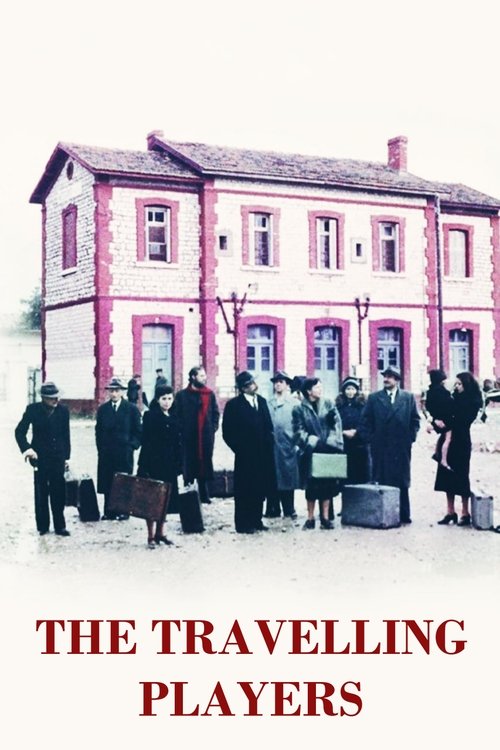
The Travelling Players
1975 · Theo Angelopoulos
For a day when you want cinema as pilgrimage — when you have an entire afternoon, patience, and an appetite for something vast and grave. This is the opposite of comfort viewing, and that's the point.
What it's about
A ragtag theater troupe wanders the Greek countryside from 1939 into the early 1950s, forever trying to perform the same beloved pastoral melodrama and forever being interrupted — by dictatorship, Nazi occupation, civil war, and the reprisals that follow. Within the company, the members carry the names and fates of an ancient Greek royal house, so betrayal and revenge play out backstage while history rolls over everyone. It's the story of a nation told through the people who can never finish their play.
The experience
Slow, hypnotic, and monumental — nearly four hours of long, gliding takes where years can pass inside a single shot. It asks for surrender rather than attention-grabbing, and if you give it that, it becomes a trance: mournful, strange, occasionally shocking, with images that lodge in your memory for good.
The craft
Angelopoulos builds the film almost entirely from extended traveling shots that fold past and present into one continuous movement — a crowd walks down a street and emerges years earlier, without a cut. The muted colors, wintry landscapes, and processional pacing make it one of the most formally audacious epics ever made. See it on the biggest screen you can.
Why it matters
Made in the shadow of the Greek junta, it became the defining work of Greek cinema and one of the towering political films of the 1970s, securing Angelopoulos's place among Europe's great modernist directors.
Snapshot
The Travelling Players (O Thiasos) is the central panel of Theo Angelopoulos's "trilogy of history," a nearly four-hour epic that follows an itinerant theatrical troupe across the most violent decade and a half of modern Greek experience — from the Metaxas dictatorship of 1939, through the Axis occupation, the December 1944 clashes in Athens, the Civil War of 1946–49, and into the right-wing restoration of the early 1950s. The troupe perpetually attempts to stage Golfo the Shepherdess, a beloved 19th-century pastoral melodrama, and is perpetually interrupted by history. Onto these players Angelopoulos maps the house of Atreus: the characters bear the names Agamemnon, Clytemnestra, Electra, Orestes, Aegisthus, Pylades, Chrysothemis, so that the Oresteian cycle of murder, usurpation, and revenge becomes a template for Greek political betrayal. Formally radical — built from roughly eighty shots, some lasting many minutes, with the camera sliding between years inside a single unbroken take — the film is widely regarded as Angelopoulos's masterpiece and one of the supreme achievements of European political modernism. It announced a major director to the world and remains a touchstone for the long-take, time-folding cinema that followed.
Industry & production
The film was made at the hinge of the Greek dictatorship. The colonels' regime that had ruled since 1967 collapsed in July 1974, and The Travelling Players was shot across that rupture, with significant portions filmed while censorship was still a live threat. Angelopoulos has recounted that the production proceeded under cover — the authorities were given a misleading sense of the project's content — and that the subject matter (the Civil War, the persecution of the Left, the role of the British and the monarchy) was precisely the buried history the junta existed to suppress. That a film so directly concerned with the defeated Left could be completed at all reflects both the regime's disintegration and Angelopoulos's tactical discretion.
It was produced largely outside the conventional Greek commercial industry, financed with the involvement of producer Giorgos Papalios, on resources that were modest by any international standard. Reliable budget and box-office figures are not well documented in the English-language record, and I will not invent them; what is clear is that this was an artisanal, low-cost production whose ambition vastly outran its means. The Greek film industry of the period was dominated by studio melodramas and comedies of the "Old Greek Cinema," against which Angelopoulos's austere, politically engaged work defined itself as a deliberate counter-cinema. The film's eventual international circulation — through festivals and the European art-house network — gave Greek cinema a global presence it had rarely enjoyed.
Technology
Technologically the film is conservative by design: 35mm color stock, location shooting, available and naturalistic light, direct human and animal movement rather than elaborate machinery. Its innovations are not in equipment but in the disciplined use of ordinary tools toward extraordinary ends. The decisive technical demand is the sustained, slowly tracking and panning camera, which requires meticulous coordination of actors, extras, vehicles, and environment over long durations — closer to the logistics of live theater or military maneuver than to conventional coverage. Sound was post-synchronized in the standard practice of Greek cinema of the era, which gave Angelopoulos precise control over the relationship between image and voice, song, ambient noise, and silence. The "technology," in effect, is choreography and timing.
Technique
Cinematography
The photography is by Giorgos Arvanitis, Angelopoulos's essential collaborator across most of his career, and The Travelling Players is one of the foundational statements of their shared style. Arvanitis renders provincial Greece in a palette of wet grays, muted earth tones, and diffused winter light — railway platforms, empty squares, hotel lobbies, muddy roads, a gray sea. The camera is patient and mobile, executing long lateral tracks and slow circular pans, frequently completing or approaching a full 360-degree rotation. The signature device is the in-shot temporal dislocation: the camera follows a character along a street, loses them, lingers, and when it recovers the human figures the year has silently changed — a march of one political faction has become a march of another. Time becomes a property of space rather than of cutting. The compositions favor the long shot and the deep field, holding the human body small within landscape and architecture, which both monumentalizes the historical forces at work and refuses the consolations of close-up identification.
Editing
Because the film is constructed from so few shots — on the order of eighty across roughly 230 minutes — editing operates at the level of architecture rather than rhythm. The cut is rare and therefore weighty; meaning accrues within takes through camera movement, blocking, and duration, not through montage juxtaposition. (Crew credits from this period of Greek cinema are not always consistently recorded in English-language sources; the editing labor served the structural logic above all.) The film also abandons chronological montage at the macro level: it moves freely back and forth across the years, returning to motifs and locations, so that the "editing" of history is associative and cyclical, mirroring the Oresteian recurrence the film dramatizes.
Mise-en-scène / staging
Staging is the film's true medium. Angelopoulos thinks in theatrical tableaux: groups arranged across the frame, entrances and exits managed as on a proscenium, the recurring image of the troupe lined up facing the camera. Reality and performance interpenetrate — the players rehearse Golfo in spaces that are simultaneously invaded by soldiers, partisans, or police, and a single location can host a wedding, an execution, and a political rally in turn. The most celebrated set-pieces are choreographic feats: a New Year's gathering in which Royalists and Leftists confront each other through competing songs and dances; the long perambulations through occupied and liberated streets where allegiances shift mid-shot. The proscenium-like framing keeps the spectator at a contemplative distance, a Brechtian stage rather than a window.
Sound
Sound carries much of the film's emotional and historical charge. Period songs do enormous work: rebetiko, partisan and Resistance anthems, royalist and nationalist hymns, popular tunes — each marking a faction, a class, a moment. Music and voice are often deployed contrapuntally against the image. Several of the film's most powerful passages are the direct-address monologues, in which a character turns to the camera and narrates, in unbroken testimony, an episode of imprisonment, betrayal, or massacre — speech doing what the withheld image will not. The original music is credited to Loukianos Kilaidonis, but the score functions less as conventional underscoring than as a curated archive of the period's contested soundtrack.
Performance
Performance is deliberately anti-naturalistic, suspended between character and emblem. The actors — among them Eva Kotamanidou as Electra, in a performance often singled out — embody figures who are at once individuals, members of a theatrical troupe, and mythological archetypes. Emotion is held in reserve; grief and rage are frequently delivered frontally, to the audience, in the testimonial mode, rather than exchanged between characters in shot/reverse-shot intimacy. The ensemble moves as a body, and the recurring image of the troupe walking together — arriving, waiting, dispersing — makes collective endurance itself the central performance.
Narrative & dramatic mode
The dramatic mode is epic in the Brechtian sense: episodic, distanciated, and openly didactic about the mechanisms of history. The narrative is non-linear, looping across roughly 1939–1952 without chronological signposting, so that the spectator must reconstruct the timeline from political and seasonal cues. Three structuring frameworks are braided together: the documentary chronicle of Greek political events; the theatrical frame of the endlessly interrupted Golfo; and the mythic substratum of the Oresteia, in which Aegisthus (a collaborator) murders Agamemnon with Clytemnestra's complicity, and Orestes, returning from the partisan struggle, avenges him. The film never explains these correspondences; it simply lets the modern and the archaic rhyme. The effect is a temporality that is cyclical rather than progressive — history as recurrence and unredeemed repetition.
Genre & cycle
Nominally a historical war drama, the film is better understood as a work of political-modernist art cinema, and specifically as the keystone of Angelopoulos's loose trilogy on twentieth-century Greek history: Days of '36 (1972), which treats the prelude to the Metaxas dictatorship; The Travelling Players (1975), spanning the war and Civil War; and The Hunters (1977), which addresses the unburied memory of the Left in the years afterward. Within the broader landscape it belongs to the international cycle of post-1968 historical-materialist cinema — films that used long duration and reflexive form to interrogate national pasts — and to the venerable tradition of the "theater troupe through history" narrative, here radicalized into national allegory.
Authorship & method
The Travelling Players is an auteur film in the fullest sense: Angelopoulos conceived it, wrote the screenplay, and directed it, and its method is inseparable from his developing philosophy of the sequence shot. His stated aim was to give the spectator the time and the distance to think — to refuse the manipulation of conventional editing and to dignify the viewer as a historical agent rather than a consumer of suspense. His indispensable collaborator was cinematographer Giorgos Arvanitis, whose gray, mobile, deep-focus photography is the visible face of the method. Original music is credited to Loukianos Kilaidonis, integrated with an extensive use of documented period songs. The screenplay is Angelopoulos's own. Across this and the surrounding films he assembled a repertory of performers and craftsmen with whom he refined a recognizable house style; The Travelling Players is where that style reaches first maturity.
Movement / national cinema
The film is the central monument of the "New Greek Cinema" that emerged in the late 1960s and 1970s in opposition both to the commercial studio output and to the dictatorship. More than any other single work, it gave that movement international definition and made Angelopoulos its emblematic figure. It is profoundly, almost militantly national in its material — it presumes and rewards knowledge of Greek political history, popular song, and folk theater — yet it speaks in the international dialect of European modernism, aligning Greece with the formal experiments of contemporaries elsewhere. In doing so it performed a recovery of suppressed national memory: it put on screen, in the immediate aftermath of the junta, the Resistance, the Civil War, and the persecution of the Left that official Greece had spent decades disavowing.
Era / period
Made in 1974–75 at the collapse of the Greek dictatorship, the film is doubly historical: it depicts the 1939–1952 past while speaking urgently to the post-junta present of its making. Its release coincided with the Metapolitefsi, the fraught Greek transition to democracy, when the legitimacy of the Left and the crimes of the Right were freshly contestable public questions. The film's refusal to console, its insistence on cyclical recurrence, reads as a warning issued at exactly the moment a nation was tempted to draw a clean line under its past. It belongs, too, to the mid-1970s international moment when long-form, politically committed art cinema commanded serious critical attention.
Themes
The film's governing themes are the recurrence of political violence and the betrayal of the Left; the entanglement of myth and history, with the Atreid curse figuring an apparently inescapable national fate; and the relationship between performance and reality, art and politics — the troupe's pastoral idyll forever shattered by the world it tries to ignore. Memory and its suppression run throughout, as does the experience of defeat: this is a chronicle written from the standpoint of the losers, the partisans executed, imprisoned, or exiled. Above all the film meditates on time itself — its non-linear, looping construction makes temporality the central subject, history experienced not as a forward march toward redemption but as a wheel of repeated loss.
Reception, canon & influence
Internationally, The Travelling Players was a landmark. It was shown at Cannes in 1975 and received the FIPRESCI prize of the international critics, and it went on to gather major critics' honors across Europe, where it was repeatedly named among the outstanding films of its year. It established Angelopoulos as a director of the first rank and has since been a fixture of "greatest films" canons and of Greek polls that rank it the finest Greek film ever made; precise vote tallies vary by source and I will not fabricate them, but its standing at or near the summit of Greek cinema is uncontested.
Looking backward, the film's influences are clearly legible. Brecht stands behind its epic, distanciated dramaturgy — the direct address, the songs, the refusal of identification. The Hungarian director Miklós Jancsó is the most cited precursor for the choreographed long take, the camera circling groups across open landscape as political power shifts within the frame. The deep, contemplative duration of Kenji Mizoguchi and the broader tradition of the sequence shot inform its patience, while classical Greek tragedy — the Oresteia above all — supplies its mythic architecture. The popular Greek folk-melodrama Golfo the Shepherdess and the indigenous tradition of touring theater give it its native materials.
Looking forward, the film's legacy is large. It is foundational to the international "slow cinema" lineage and to subsequent filmmakers committed to the long take and the folding of time within the shot — its DNA is visible in the work of directors such as Béla Tarr and Hou Hsiao-hsien, and more broadly in any cinema that treats duration as a moral and political instrument. It also set the terms for Angelopoulos's own subsequent career, from The Hunters and Alexander the Great through Landscape in the Mist, Ulysses' Gaze, and Eternity and a Day, all of which extend its meditation on history, borders, and time. For students of political cinema it remains a definitive demonstration that formal radicalism and historical seriousness can be one and the same gesture.
A Deleuzian reading
Start with the shot everyone remembers: the camera drifts down a provincial street behind a knot of marchers, loses them at a corner, waits on the wet gray stone — and when the people return, the banners they carry belong to a different year and a different faction.
The full Deleuzian reading of The Travelling Players →
Reception
Smuggled out to Cannes 1975 (Directors' Fortnight) where it won the FIPRESCI prize, it was instantly hailed as a landmark of political cinema — and its stature has only grown, now routinely voted the greatest Greek film ever made.
How The Travelling Players was received, from release to now →
Influences: the films it descends from and the films it influenced
- The Red and the White (1967) — The model for Angelopoulos's choreographed plan-séquence: a roving camera circling and re-grouping bodies across bare landscape so that political power visibly changes hands within a single uncut take rather than through editing.
- The Round-Up (1966) — Establishes the depersonalized long-shot ensemble where individuals are subordinated to formations of guards and prisoners on an open plain — the anti-psychological staging of history that Angelopoulos transplants to the Greek troupe.
- Ugetsu (1953) — Source of the contemplative crane-and-track sequence shot that lets duration itself carry feeling; Mizoguchi's 'one scene, one shot' patience underwrites Arvanitis's deep-focus mobile takes.
- Sansho the Bailiff (1954) — Provides the elegiac long-shot framing of figures dwarfed by landscape and the refusal to cut into suffering for catharsis, dignifying the spectator's distance.
- History Lessons (1972) — Sibling-in-Brecht: flat anti-naturalist delivery, direct-address recitation of political text, and long static durations that block identification — the distanciation device Angelopoulos uses for his monologues to camera.
- Touch of Evil (1958) — The bravura extended sequence shot with deep-focus staging in depth, demonstrating that an unbroken take can orchestrate multiple planes of action — the deep-focus long-take grammar Arvanitis inherits.
- The Rules of the Game (1939) — Deep-focus theatrical-tableau staging where foreground and background action play simultaneously, and where performers move as if on a stage — the proscenium logic behind Angelopoulos's frontal compositions.
- La Terra Trema (1948) — Long-take, deep-staged realism with non-professional collective protagonists and a folk-melodramatic register turned to political analysis of a community over time.
- The Seventh Seal (1957) — Angelopoulos extends Bergman's fresco-like lateral tableau compositions into extreme form — very long lateral tracking shots holding large groups in painting-derived configurations — developing the method of staging historical figures in the compositional register of their culture's devotional visual art.
- Andrei Rublev (1966) — Angelopoulos extends Rublev's chronicle-episode structure and anti-Eisenstein duration into Greek political history: shots run to ten or more minutes, the camera pans through historical time within a single uncut take, and a theatrical troupe witnesses political upheaval without causal agency — a systematic formal inheritance of Tarkovsky's temporal grammar.
- Gertrud (1964) — Inherits the refusal of conventional coverage, sustaining action in extended slow lateral tracking takes rather than cutting for emphasis.
- The Life of Oharu (1952) — Extends the Mizoguchi long-take-with-lateral-tracking into vast durations that sweep across historical time, using the unbroken observing shot and full-figure distance as the ethical grammar for collective suffering.
- The Hunters (1977) — Directly extends the in-shot temporal dislocation: a corpse from the civil war reactivates the past inside the present frame, the same single-take folding of historical eras pioneered here.
- Landscape in the Mist (1988) — Carries forward the gray deep-focus long shot, the road-as-history motif, and Arvanitis's slow lateral tracking across a depopulated Greek terrain.
- Ulysses' Gaze (1995) — Pushes the looping non-linear shot further — a single take in which the protagonist crosses decades of Balkan history without a cut, the mature form of the temporal-dislocation device.
- A City of Sadness (1989) — Applies the static deep-focus long-take tableau to suppressed national memory (the 228 massacre), staging history in long shot and ellipsis exactly as Angelopoulos stages the Greek civil war.
- The Puppetmaster (1993) — Mirrors the touring-performer-as-witness-to-occupation structure and the use of traditional theater troupes as a frame for national history told in long, distanced takes.
- Sátántangó (1994) — Inherits the moral-political long take as duration: minutes-long choreographed tracking shots through mud and rain that make the spectator endure time as Angelopoulos's slow cinema demands.
- Werckmeister Harmonies (2000) — Extends the circling-crowd long take where a mass of bodies moves through a square and power shifts within the unbroken frame — Jancsó-via-Angelopoulos choreography of collective political motion.
- Damnation (1988) — Consolidates the contrapuntal use of period-song performance within an unbroken take and the deep-focus tableau of figures fixed in a decaying landscape.
- The Sacrifice (1986) — Extreme-duration lateral tracking shots—some exceeding ten minutes—that traverse historical time within a single take, developing independently the same formal conviction Tarkovsky holds: that unbroken lateral movement is cinema's primary instrument for making the viewer inhabit time rather than consume it.
- The Turin Horse (2011) — Sustained multi-minute unbroken lateral takes compress historical duration within a single camera movement, establishing the long take as a temporal container — the shot as unit of time rather than the cut — that Turin Horse inherits as its primary structural logic.
- Norte, the End of History (2014) — The sequence-shot that spans political epochs within a single unbroken take — the 'end of history'-scale duration marrying long take to historical sweep that Diaz's title and method invoke.
- Eureka (2001) — Master model of the choreographed plan-séquence threaded through a journey across landscape and time, the sequence-shot ambition Eureka scales to widescreen Kyushu.
- 1900 (Novecento) (1976) — A contemporaneous epic of twentieth-century political history scored to documented period and folk songs, using sweeping long takes and a generational template to narrate national trauma.
- The Spirit of the Beehive (1973) — Parallel post-dictatorship reckoning that encodes suppressed national memory through silence, elliptical long-held shots, and a child's-eye distance rather than expository drama.
- Stalker (1979) — Angelopoulos builds his film from single takes of five to ten minutes in which the camera tracks ceremonially through Greek landscape as his troupe journeys across history — the same durational long-take pilgrimage logic Tarkovsky develops independently in Stalker, with comparable editing tempos and choreographed figure-in-landscape staging.
Similar films
- Landscape in the Mist (1988) — influence & lineage · often watched together
- Ulysses' Gaze (1995) — influence & lineage
- Satantango (1994) — influence & lineage
- Through the Olive Trees (1995) — same viewing thread
- Eternity and a Day (1998) — often watched together
- Seven Samurai (1954) — often watched together
- The Passenger (1975) — shared sensibility
- Nostalgia (1983) — shared sensibility
All the films related to The Travelling Players →
Watch it with: curated runs of related films
- Where Fiction Meets the Real — Watch these in sequence for the way each lets a staged fiction quietly dissolve into something documentary-real — and the real get restaged as fiction — usually while someone is on a road or a walk.