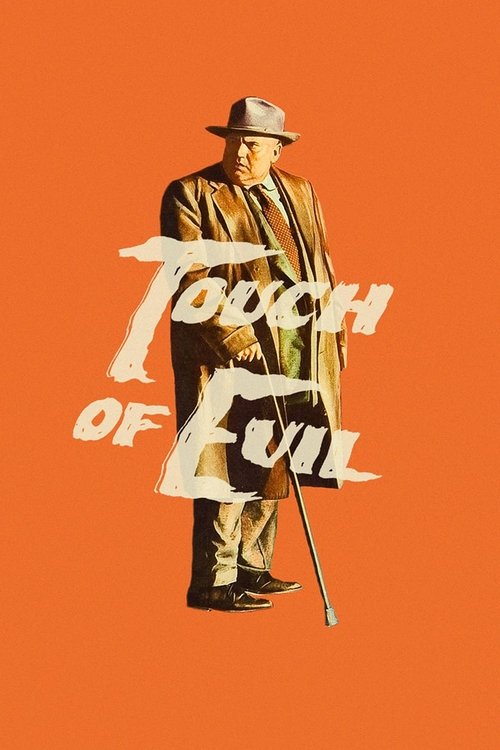
Touch of Evil
1958 · Orson Welles
For when you're in the mood for something dark and atmospheric — a late-night film that drips corruption and style in equal measure. More challenge than comfort, and better for it.
What it's about
A car bomb goes off on the US–Mexico border, and Mexican narcotics investigator Miguel Vargas — newly married, honeymoon interrupted — gets drawn into the case alongside Hank Quinlan, a hulking American police captain whose legendary record hides deep corruption. Over one long night of blackmail, intimidation, and rot on both sides of the line, the two men's collision becomes a struggle over what justice is actually worth.
The experience
Sweaty, sinister, and off-kilter — a night-world of seedy motels, looming shadows, and menace that keeps tightening around the characters. It's noir at its most baroque: grimy and grandiose at once, with a queasy tension that never lets up.
Performances
Orson Welles makes Quinlan one of cinema's great monsters — bloated, wheezing, and strangely tragic — while Marlene Dietrich steals her handful of scenes as a world-weary fortune teller who knew him when.
The craft
It opens with one of the most famous single shots ever filmed — an unbroken crane move following a ticking bomb through border-town streets — and the invention never stops: wild angles, deep shadows, restless camera work that makes the whole town feel diseased. The black-and-white photography is a masterclass worth seeing on the biggest screen you can.
Why it matters
Often called the last great film noir of the classic era, it's also a legendary studio-interference story — recut against Welles's wishes and only restored to his intentions forty years later — which has made it a touchstone for the battle between directors and studios.
Snapshot
Touch of Evil is a American crime thriller directed, written, and co-starring Orson Welles, released by Universal-International in February 1958. Set on the US–Mexico border, it follows Miguel Vargas (Charlton Heston), a Mexican narcotics investigator, who becomes entangled in a murder inquiry overseen by Hank Quinlan (Welles), a massively corrupt but legendarily effective American police captain. The collision between the two men unfolds across a single night of escalating violence, blackmail, and institutional rot. The film is most immediately famous for its unbroken opening crane shot — one of cinema's definitive demonstrations of the long take — and for the sustained controversy over Universal's re-editing of Welles's cut without his consent, a dispute that would shadow the film for forty years until Walter Murch's 1998 restoration. Widely regarded as either the last great classical film noir or the film that effectively exhausted the cycle, Touch of Evil stands as the most formally audacious work produced inside the Hollywood studio system during the 1950s.
Industry & production
The project originated as a minor Universal property: the studio held the rights to Badge of Evil (1956), a pulp novel by Whit Masterson (the pen name of the writing team of Robert Wade and H. Bill Miller). Charlton Heston was offered the lead and, learning that Welles was already attached as an actor to play Quinlan, suggested to Universal that Welles be allowed to direct as well. The studio, calculating that Welles's involvement might elevate what they envisioned as a B-picture, agreed. Welles quickly discarded the Masterson novel's plot structure and rewrote the screenplay wholesale, transforming the protagonist into a Mexican federal agent — a significant revision that injected racial and geopolitical tension the source material lacked.
Production began in early 1957, with principal photography conducted largely in Venice, California, which doubled for the fictional Mexican border town of Los Robles. The shoot lasted approximately six weeks. Welles assembled a small repertory that included Janet Leigh as Susan Vargas, Marlene Dietrich as the enigmatic madam Tanya, Akim Tamiroff as the grotesque crime boss Uncle Joe Grandi, and Joseph Calleia as Quinlan's loyal deputy Pete Menzies. Dietrich's role, largely improvised during production in close collaboration with Welles, amounts to a kind of tragic chorus.
Universal's treatment of the finished film became one of Hollywood's more notorious post-production interventions. Finding the cut Welles delivered unsatisfactory, the studio had editor Ernest Nims rework it substantially and commissioned director Harry Keller to shoot new scenes — principally sequences designed to clarify plot points Welles had left deliberately elliptical. The film was released in this altered form, often as the bottom half of a double bill. Welles responded with an extraordinary document: a detailed, approximately fifty-eight-page memorandum addressed to Universal outlining every change he objected to and explaining his intentions scene by scene. The memo went largely unheeded at the time and the theatrical cut, with its superimposed opening credits and restructured scenes, became the version seen for decades.
Technology
Russell Metty shot the film in black-and-white using anamorphic widescreen (CinemaScope ratio), pressing the format's horizontal expanse into the service of Welles's compositional obsessions rather than the epic spectacle for which it was commercially designed. Welles and Metty made extensive use of wide-angle lenses — particularly 18.5mm lenses — that exaggerate depth and spatial distortion, pushing figures in the foreground to grotesque prominence while keeping receding backgrounds in sharp focus. Low camera placements, often at floor level, combined with ceilings deliberately kept in frame, create enclosing, pressurized interiors that recall the deep-focus work Metty's predecessor Gregg Toland had achieved with Welles on Citizen Kane (1941).
The opening crane shot required a construction crane fitted with a camera mount capable of sweeping continuously from a street-level close-up of a time bomb in a car trunk up and across rooftops, descending to track alongside Vargas and Susan on foot through the crowded border crossing, and finally craning back down as the car explodes. The logistics involved coordinating camera movement with the blocking of a large number of extras, live traffic, and diegetic sound sources across a route of several hundred yards. The shot runs over three minutes without a cut. Welles had lobbied for the credits to run separately, before or after the shot, so that nothing would interrupt it; the studio overrode this and superimposed the title card and credits across the footage. The 1998 restoration honored Welles's memo by removing the credits from the image and placing them at the film's end.
Technique
Cinematography
Metty's photography is among the most kinetically aggressive in the studio era. The film rarely settles into conventional shot-reverse-shot grammar; instead, Welles and Metty construct scenes through sustained wide-angle takes that compel performers to move toward and away from the lens, controlling dramatic emphasis through proximity rather than cutting. The Grandi gang's attack on Susan Vargas in the Mirador Motel is filmed in a cramped, low-ceilinged room with a handheld-adjacent looseness, the camera pressed up against walls and against actors. Contrast is extreme throughout — deep blacks pool in doorways and under bridges, while harsh key lights bleach faces into near-abstraction. Welles frequently shoots Quinlan from below, rendering Welles's own substantial frame even more mountainous and oppressive.
Editing
Welles's intended editorial rhythm is one of the film's more contested dimensions, precisely because two significantly different versions existed for forty years. The theatrical cut moved more swiftly and conventionally; the restored version restores the ellipsis and juxtaposition Welles favored. His editing style deploys hard cuts that violate spatial continuity in favour of psychological continuity — associating images by emotional rhyme rather than geographic logic. The intercutting between Quinlan's closing confrontation with Menzies on a bridge and Vargas listening via hidden microphone, threading through sound overlap and environment contrast (darkness/noise/water), exemplifies Welles's interest in editing as a form of counterpoint rather than suture.
Mise-en-scène / staging
Welles stages scenes in depth, with characters occupying multiple planes simultaneously, forcing the viewer's eye to negotiate what the frame prioritizes. This democratic (and deliberately destabilising) use of depth-of-field is a direct inheritance from his Kane years. The Quinlan scenes accumulate a biographical weight through props and costume — the cane, the candy bars (a gestural substitute for the alcohol Quinlan has sworn off), the enormous physical bulk of the character, all staged so that Quinlan seems to press against the limits of any space he occupies. By contrast, the motel sequences surrounding Janet Leigh are staged with a horror-film economy, isolating her in frames that emphasize vulnerability and surveillance. Tanya's brothel is shot as a half-dreamlike elsewhere, its compositions more languid and symmetrical than the rest of the film, signaling a space outside time.
Sound
Henry Mancini composed the score, his first major film work, delivering a jazz-inflected suite of themes built around trumpets and mambo percussion that suit the border setting without condescending to caricature. More remarkable is Welles's conception of the opening shot's soundscape: as the car passes different establishments — a strip club, a dance hall — the source music shifts and bleeds between diegetic sources, creating a continuous sonic texture that is heard differently depending on whether one attends to the bomb's trajectory or the couple walking alongside. This layered acoustic geography was unusual for 1957–58 Hollywood sound practice. Welles's memo was particularly emphatic about the sound design for the opening shot, insisting on its logic as a counterargument to Universal's impulse to simply lay the score over the image. The 1998 restoration implemented this diegetic-source approach in place of the superimposed Mancini music that Universal had placed over the theatrical cut's opening.
Performance
Welles's own performance as Quinlan is a study in physical transformation — the padding, heavy prosthetics, and cane create a figure that is both theatrical and genuinely inhabited. Quinlan's corruption is rendered not as cartoon villainy but as a kind of institutional tragedy: a man whose methods once worked, who believes his intuition is infallible, and who has let that belief become the excuse for anything. Charlton Heston's Vargas is deliberately less charismatic, a foil of procedural rectitude against which Quinlan's baroque wrongness registers. Janet Leigh brings an intelligence to Susan Vargas that survives the film's exploitation of her as a target, and Marlene Dietrich — arguably in one of her finest late performances — uses minimal dialogue and absolute stillness to create a figure who feels she has already outlasted everyone on screen. Joseph Calleia's Menzies is the film's most emotionally exposed performance, the tragedy of a decent man who loved the wrong mentor.
Narrative & dramatic mode
The film is structured as a classical crime plot — a murder investigation, a conspiracy of evidence-planting, a final revelation — but Welles strips away the suspense that normally anchors such plots. Quinlan's guilt is apparent almost from the start; the dramatic question is not whodunit but whether institutional truth can be made to count against institutional power. The film therefore operates less as a mystery than as an inexorable moral accounting. Welles deploys time compression and ellipsis — a single night that feels both hurried and endless — to produce a sense of fate closing in. The double jeopardy structure (Vargas investigating Quinlan while Quinlan's allies threaten Susan) turns the film's geography into a trap, the border itself functioning as a symbolic threshold between jurisdictions and moral orders.
Genre & cycle
Touch of Evil arrives at the end of the classical film noir cycle (roughly 1941–1958) and is often cited as its terminal statement — the noir that exaggerates every defining element to the point of self-conscious exhaustion. The crooked cop, the femme peril, the night-world setting, the moral ambiguity of authority, the fatalistic atmosphere: all are present and all are pushed toward excess. Welles's stylization makes the genre's conventions visible as conventions, which gives the film a quality of retrospective critique unusual in genre pictures. It also inaugurates — or at minimum anticipates — what critics would later call neo-noir: the self-aware deployment of noir's grammar after the cycle's commercial and industrial conditions had dissolved.
Authorship & method
Welles operated on Touch of Evil as a total author — writer, director, and lead actor — within the constraints of a studio assignment he had not originated. His practice on set was improvisatory and intensive; many details of Quinlan's characterization were developed during shooting rather than scripted. His relationship with Metty was professionally tense by some accounts (Metty had established working methods of his own and was not always receptive to Welles's demands), but the cinematographic results transcend any friction. Welles's exclusion from post-production was not unusual for a director working without a contractual final-cut provision, but the completeness and precision of his memo to Universal stands as an unusual document in studio-era cinema: a director articulating his intentions not for a public audience but in the desperate hope of institutional redress.
Henry Mancini's contribution to the film's texture was significant despite the controversy over the opening. His score demonstrated that jazz idioms could be deployed seriously within mainstream Hollywood crime pictures, a development that influenced the sound of American crime cinema through the following decade. The restoration of Welles's intended sound design for the opening should not obscure the fact that Mancini's thematic material is genuinely integrated into the rest of the film.
Movement / national cinema
Touch of Evil is a Hollywood studio production, but its relation to that institution is antagonistic in both production history and formal orientation. Welles had spent the decade between Citizen Kane and this film working largely in Europe (in Shakespeare adaptations funded through various expedient means), and his return to a Universal contract brought European art-cinema sensibilities into collision with Poverty Row-adjacent production logistics. The film therefore occupies an unstable position: formally allied with European auteur practice (the kind of long-take, deep-focus, spatially continuous cinema championed by André Bazin), industrially located in the B-film sector of the Hollywood system. Its border setting — and the racial dynamics of the Vargas marriage, a Mexican official and his Anglo-American wife crossing into US territory — situates it at the literal and figurative margin of national cinema, a position that mirrors Welles's own institutional marginality.
Era / period
The film was produced in 1957 and released in February 1958, at a moment when classical Hollywood genre production was straining under competitive pressure from television, the collapse of the studio contract system, and the demographic diversification of the filmgoing audience. Film noir as a commercial cycle was exhausted; the Crime thriller was migrating toward the procedural formats more suited to television. Touch of Evil was received by Universal as a problem property and released without significant promotional support. Its reputation was built almost entirely through critical reappraisal rather than commercial performance.
Themes
The film's central preoccupation is the epistemological and moral problem of dirty methods in the service of true results. Quinlan has, by his own account and by institutional legend, never been wrong — every man he ever put away was guilty. But his means of achieving this record (planting evidence, coercing confessions, working outside legal procedure) make his certainty worthless as justice. Welles refuses the easy resolution of simply making Quinlan wrong about the current suspect; the film's final irony is that Quinlan was right, and it makes no difference. Justice requires procedure, not merely correct outcomes.
Racial and national identity underpin the narrative without being its explicit subject. Vargas's Mexican authority is consistently undermined or delegitimised by the American officers around him; the Grandi gang's targeting of Susan is partly an attempt to use racialised threat (the gang is coded as sexually dangerous to a white American woman) as a lever against Vargas. The border itself — a space of constant crossing, translation, and jurisdictional ambiguity — becomes the film's governing metaphor.
There is also an elegiac thread, carried primarily by Tanya. Her two scenes with Quinlan bracket the film's final movement, and her closing assessment — "He was some kind of a man" — refuses both eulogy and condemnation. The film ends in the canal's mud, with a corrupt man dying, and nobody particularly the better for it.
Reception, canon & influence
Influences on the film. The deep-focus photography and ceiling-in-frame compositions descend directly from Welles's work with Gregg Toland on Citizen Kane, transposed to anamorphic widescreen. The long-take philosophy owes a theoretical debt to André Bazin's essays on cinematic realism and spatial integrity, which Welles would have known; the practical influence of Jean Renoir's sustained tracking shots (particularly in La Règle du jeu, 1939) is plausibly in the background. The noir cycle's visual conventions — chiaroscuro lighting, urban night-worlds, morally compromised authority — arrive through the German Expressionist emigres who had shaped Hollywood cinematography since the 1930s. Welles was also processing his own theater background: the border-town milieu and the Quinlan-Menzies relationship carry something of Shakespearean tragic structure.
Critical reception. In the United States, the initial reception was modest and largely missed the film's ambition; it was reviewed as a competent studio thriller and little more. In Europe, the response was markedly different. The film was selected to represent the United States at the 1958 Brussels World's Fair, where it won the Critics' Prize. French critics associated with Cahiers du Cinéma — who had been systematically elevating Welles's reputation through the theoretical lens of auteurism — received it as confirmation of their claims. The film's American critical rehabilitation came gradually through the 1960s and 1970s, accelerating as auteur criticism became the dominant mode of serious film writing in English.
Legacy and forward influence. The opening crane shot became one of the most studied sequences in film history and one of the most directly imitated: long-take opening sequences establishing location through continuous movement — in works as various as Robert Altman's The Player (1992), Martin Scorsese's GoodFellas (1990), and Alfonso Cuarón's Children of Men (2006) — carry its DNA, whether or not their directors claim direct debt. The corrupt-cop narrative Welles articulated with such structural clarity runs forward through Chinatown (1974), L.A. Confidential (1997), and into the prestige television of The Wire and The Shield. The film's use of source sound in the opening anticipates later ambient-sound design practice. Janet Leigh's victimization in a highway motel by a predatory male gaze is an acknowledged part of the context in which Hitchcock conceived Psycho (1960) — Leigh herself has spoken to this connection, though the directness of the influence is difficult to establish precisely.
The 1998 restoration, edited by Walter Murch strictly according to Welles's own memo and overseen by producer Rick Schmidlin, constitutes a rare instance of a filmmaker's documented intentions being honored posthumously through archival and technical labor. The restored version is now generally accepted as the authoritative text. The existence of both versions — and the detailed paper trail that makes comparison possible — has made Touch of Evil an unusually well-documented case study in the studio system's relationship to authorial control, and it is taught in film schools on those grounds as much as on its formal merits.
A Deleuzian reading
A car with a bomb in its trunk pulls away from a curb, and the camera leaves the ground to go with it — up over the rooftops, down into the street, threading three unbroken minutes of traffic and neon and music that bleeds from one doorway to the next, until the dynamite finally goes off.
The full Deleuzian reading of Touch of Evil →
Reception
Universal took the film away from Welles, re-cut it, and dumped it as the bottom half of a double bill in the US — yet it won the top prize at the 1958 Brussels World's Fair and was championed by the French critics. Now it's routinely called the last great classic film noir, and the 1998 restoration built from Welles's 58-page studio memo sealed the reappraisal.
How Touch of Evil was received, from release to now →
Influences: the films it descends from and the films it influenced
- Citizen Kane (1941) — Russell Metty directly reprised Gregg Toland's 18.5mm wide-angle methodology — low-angle framings with ceilings kept in shot, foreground figures rendered grotesque while backgrounds hold sharp focus — the multi-plane deep-focus grammar both films build on the same director's staging instincts.
- The Magnificent Ambersons (1942) — Welles's technique of constructing scenes through sustained wide-angle takes in which actors move toward and away from the lens to modulate dramatic emphasis — rather than cutting to coverage — is carried wholesale from Ambersons into Touch of Evil as his core directorial grammar.
- Lady from Shanghai (1947) — Welles used wide-angle distortion expressionistically to externalize moral corruption — photographing himself from extreme low angles to render his own figure monstrous — establishing the self-directed physical-transformation approach he intensified as the bloated, low-angle-shot Quinlan.
- M (1931) — Lang's use of a diegetic sound signature (the Grieg whistle) simultaneously as character-identification marker and dramatic irony — where source sound carries more narrative weight than dialogue — is the foundational model for Mancini's strategy of routing the entire score through diegetic mambo and jazz sources within the border town.
- Double Indemnity (1944) — Wilder's inverted-mystery structure — Neff confessing guilt in the opening so tension derives from watching inevitability unfold rather than solving a crime — is the narrative schema Welles adapts for Quinlan: the audience knows he is corrupt from the first reel, transforming the film's suspense into dramatic irony.
- Out of the Past (1947) — Nicolas Musuraca's deep-shadow night-for-night exterior photography — pooling blacks, hard key lights bleaching faces near-abstract — codified the noir chiaroscuro grammar that Touch of Evil absorbs wholesale and then pushes to terminal formalization, treating the visual style itself as a moral system being exhausted.
- The Third Man (1949) — Robert Krasker's extreme-angle framings — canted compositions, dramatic low placements rendering authority figures as visual grotesques — and his transformation of a divided city into moral geography through high-contrast location chiaroscuro are the direct visual model for Welles's border-town photography.
- The Big Sleep (1946) — Russell Metty's cinematography pushes the venetian-blind shadow motif and high-contrast chiaroscuro to expressionist extremes, and Welles's staging of characters in corrupt environments — doorframes, stairwells, dilapidated interiors — extends Hawks's environmental-character-placement method into a politically explicit register.
- The Maltese Falcon (1941) — Welles extended Falcon's deep-focus, low-angle visual grammar to baroque excess, pushing Edeson's technique of using wide-angle lenses in cramped constructed interiors to spatially distort rooms and loom figures into a sustained expressionistic assault that treats the visual strategy as the film's primary expressive register.
- Rope (1948) — Welles's celebrated opening crane shot — a continuous take of over three minutes threading a car bomb through a border town — translates Rope's long-take ambition from theatrical soundstage to outdoor geography, demonstrating that the suppression of cutting could survive architectural scale rather than confinement to a room.
- Dr. Mabuse, the Gambler (1922) — Welles applies Hoffmann's expressionist lighting grammar — figures erupting from absolute black, wide-angle lens distortion coding moral corruption — and constructs Hank Quinlan as the structural inversion of Mabuse: the mastermind who has captured the law rather than evading it.
- Key Largo (1948) — Welles extends Key Largo's Expressionist chiaroscuro into baroque excess, pushing shadow and deep-focus depth as moral architecture toward the noir's extreme — where Freund used darkness to contain, Welles uses it to implicate the camera itself in Quinlan's corruption.
- Once Upon a Time in the West (1968) — Tonino Delli Colli's extreme wide-angle close-ups fill the CinemaScope frame with grotesquely distorted faces while keeping landscape in deep-focus resolution behind — directly extending the Welles/Metty foreground-distortion strategy — with Leone's corrupt officials rendered as physical presences whose moral weight is carried by lens geometry rather than dialogue.
- Chinatown (1974) — Polanski extends Touch of Evil's terminal-noir strategy — the corrupt authority figure who has institutionalized his own justice (Noah Cross/Quinlan) — as a genre framework in which institutional rot is structurally unresolvable, transforming Welles's exhaustion of noir conventions into a fully articulated neo-noir grammar.
- Raging Bull (1980) — Michael Chapman's wide-angle boxing-ring photography at floor level uses lens distortion to transform LaMotta into a physical grotesque — the same Welles/Metty technique of using extreme-angle wide lenses to exaggerate a performer's physical mass as a projection of moral condition, applied here to self-destruction rather than institutional corruption.
- Blood Simple (1984) — Barry Sonnenfeld's extreme wide-angle deep-focus compositions — low camera placements, foreground figures looming over sharp-resolution backgrounds in which other characters are visible but spatially unreachable — directly inherit the Welles/Metty multi-plane staging methodology as the Coens' foundational visual grammar for neo-noir.
- The Player (1992) — Altman opens with an unbroken crane-and-Steadicam shot in which characters within the film explicitly compare it to Touch of Evil's opening — one of cinema's rare direct in-film citations of a predecessor's specific device — extending Welles's model of the long take as moral geography by implicating the Hollywood industry itself.
- Snake Eyes (1998) — De Palma's 12-minute opening Steadicam shot explicitly inherits Touch of Evil's unbroken crane-shot as moral entrapment device, combining it with an inverted-mystery structure where the murder is witnessed before the investigation begins — a direct double inheritance of Welles's formal and narrative schemas.
- No Country for Old Men (2007) — Roger Deakins's wide-angle borderlands photography — figures in extreme foreground against sharp-resolution desert space, high-contrast chiaroscuro for night sequences — reprises the Welles/Metty spatial grammar while the Texas-Mexico border as moral threshold and the known-from-the-start killer structure directly echo Touch of Evil's formal and spatial logic.
- Apocalypse Now (1979) — Welles's staging of moral corruption through deep-shadow chiaroscuro—authority figures half-emerged from darkness, filmed in grotesque low angles—is the direct precursor to Storaro and Coppola's visual grammar for Kurtz's compound.
- The Untouchables (1987) — Welles's long takes through corrupt institutional spaces — the camera as autonomous predatory observer of moral rot — directly anticipate De Palma's Steadicam glides; the film's hard-edged chiaroscuro in crime-world architecture is an immediate precursor to Burum's period lighting grammar.
- Insomnia (2002) — Welles stages a corrupt detective investigation in a disorienting borderland environment; specifically, Quinlan's physical grotesquerie — the deteriorating body as legible sign of moral disorder, made visible through low-angle staging and shadow-expressionism — is the template for Pfister's construction of Pacino's Dormer as a body increasingly at odds with its surroundings.
- Klute (1971) — Welles and Russell Metty's overhead surveillance framings — the crane shot descending on Charlton Heston through a parking-lot grid — established the predatory bird's-eye angle that Pakula and Willis embed throughout Klute to implicate the camera itself in the stalker's gaze.
- The Manchurian Candidate (1962) — Welles's use of continuous wide-angle tracking to constitute institutional space as surveillance — the camera performing the act of watching that the plot is about — gives Frankenheimer the template for the 360-degree brainwashing pan, where the camera's rotation is itself the disorientation being depicted.
- Sweet Smell of Success (1957) — James Wong Howe pressed CinemaScope's horizontal expanse into service of nighttime urban expressionism at exactly the same moment Metty did for Touch of Evil — both films demonstrating in the same release year that anamorphic widescreen could serve intimate corruption rather than panoramic spectacle.
- Paths of Glory (1957) — Georg Krause's deep-focus wide-angle lens work in confined institutional spaces and Kubrick's use of the tracking shot as an instrument of moral indictment rather than spatial orientation — contemporaneous formal solutions running parallel to Welles's development of the same techniques for exposing institutional rot.
- The Trial (1962) — Welles's contemporaneous extreme wide-angle distortion and dense chiaroscuro — the lens warping faces and rooms into menace — is the immediate stylistic sibling of The Trial's visual attack.
- The Best Years of Our Lives (1946) — Welles pushes the Toland-derived deep-focus long take to its virtuoso extreme, descending from the same simultaneous-plane staging principle Best Years institutionalized.
- Kiss Me Deadly (1955) — The other 1950s apotheosis of noir: baroque wide-angle low-angle deep focus and a nocturnal border-town of total moral rot, extending Aldrich's ground-level expressionism to its limit.
- Deep Cover (1992) — Establishes the expressionist chiaroscuro portrait of a narcotics investigator dissolving into the corruption of the border-world he polices — the shadow-drenched moral-descent template Deep Cover inherits.
- Phantom of the Paradise (1974) — The sustained bravura tracking long-take shadowing a planted, ticking bomb, which De Palma explicitly restages in the recording-studio car-bomb sequence.
- The Misfits (1961) — Russell Metty's austere, high-contrast deep-focus black-and-white — the same cinematographer's anti-glamour visual grammar, favoring stark tonal fields over picturesque prettiness.
- The Big Combo (1955) — Welles routes his climax through a wire recorder, so the confession reaches us as degraded, echoing point-of-audition sound, while Russell Metty lights the motel and bridge from single visible practicals.
Similar films
- The Third Man (1949) — influence & lineage · same viewing thread · often watched together
- Chinatown (1974) — influence & lineage · often watched together
- M (1931) — influence & lineage · same viewing thread · often watched together
- The Magnificent Ambersons (1942) — influence & lineage
- The Testament of Dr. Mabuse (1933) — same viewing thread · often watched together
- Kiss Me Deadly (1955) — same viewing thread
- Mr. Arkadin (1955) — same viewing thread
- Where the Sidewalk Ends (1950) — same viewing thread
All the films related to Touch of Evil →
Watch it with: curated runs of related films
- The Long Shadow of M — A run from Lang's Weimar crime films through their noir and neo-noir children — killers, con men, masterminds, and manhunts — where you can watch expressionist menace mutate step by step into the modern thriller.
Film essays and courses that include it
- One Continuous Breath: Masters of the Unbroken Shot
- Guilty by Design: The Art and Architecture of Film Noir
- Blood, Myth, and Grammar: The Gangster Film's Century
- Scope and Shadow: The Anamorphic Vision
- The Grammar of Shadow: Chiaroscuro from Expressionism to Digital Noir
- Everything in Frame: Deep Focus from Renoir to Tarr
- The Long Beat: How Cinema Invented the Police Film
- The Fix Is In: Cinema's Anatomy of Corruption, 1939–2007
- Everything in Focus at Once
- The Style That Knew It Was Doomed
- The Shot That Won't Cut