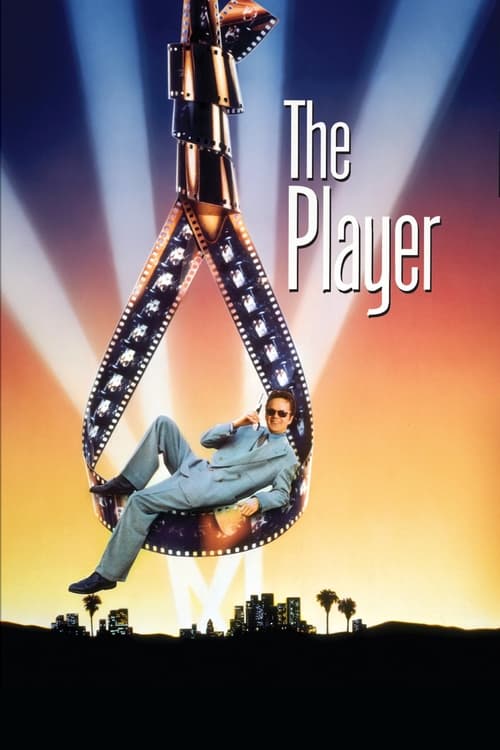
The Player
1992 · Robert Altman
For when you want something smart and wicked — a movie-industry insider's tour with a body in the trunk. Great for a night when you'd rather smirk than cry, and love watching terrible people be charming.
What it's about
A Hollywood studio executive whose job is rejecting writers starts receiving death threats from one of them — but he hears hundreds of pitches a year, so which writer is it? As he tries to unmask his stalker, one wrong move pulls him into a cover-up, and the movie business closes around him like a shark tank where everyone smiles. It's a murder story set inside the machinery that manufactures murder stories.
The experience
Cool, funny, and quietly vicious — you're always half-laughing at the pitch meetings and half-dreading what the protagonist will do next. It plays as smooth entertainment while making you complicit in rooting for a man you shouldn't.
Performances
Tim Robbins is perfect as the executive — boyishly likable and dead-eyed at once, a man whose conscience you keep waiting for. Around him, a parade of real Hollywood stars appear as themselves, blurring the line between the satire and its target.
The craft
It opens with a celebrated unbroken tracking shot that glides through a studio lot for minutes on end — while characters onscreen discuss famous long takes. Altman's roving camera and overlapping chatter make every party and pitch meeting feel eavesdropped, and the script folds the thriller and the satire into each other until the movie is commenting on itself. Sharp, layered, endlessly rewatchable.
Why it matters
The comeback that put Robert Altman back at the center of American film after a decade in the wilderness, and still the benchmark Hollywood-on-Hollywood satire — the pitch-meeting scenes get quoted whenever the industry laughs at itself.
Snapshot
The Player is Robert Altman's acid valentine to the industry that had spent the previous decade exiling him: a Hollywood satire in which a studio executive who lives by saying "no" to writers murders one of them and gets away with it, even winning the girl and the corner office. Adapted by Michael Tolkin from his own 1988 novel, the film fuses a Patricia Highsmith–style guilt thriller to a procedural anatomy of the studio pitch meeting, and wraps both inside a hall-of-mirrors structure that ends with the protagonist green-lighting the very story we have just watched. It marked the most decisive comeback of Altman's late career — a critical and (relative to its modest budget) commercial success that restored him to the center of American filmmaking and led directly to Short Cuts (1993). More than thirty years on it remains the canonical movie about movie executives, the film other Hollywood satires are measured against.
Industry & production
The Player was, by design and circumstance, a low-budget independent production rather than a studio picture — an irony the film thoroughly exploits, since its subject is the studio system that would not finance Altman through the 1980s. After the commercial failure of Popeye (1980) and a string of small, stage-derived chamber pieces (Come Back to the Five and Dime, Jimmy Dean, Jimmy Dean; Streamers; Secret Honor), Altman had been effectively shut out of mainstream feature work. The Player was produced by David Brown (a veteran producer with deep studio ties), Tolkin, and Nick Wechsler, and released through Avenue Pictures and Fine Line Features. The budget was modest — figures commonly cited are in the single-digit millions — which shaped both the casting and the style.
The film's most discussed industry feature is its cameos: a large roster of stars, directors, and personalities (Bruce Willis, Julia Roberts, Burt Reynolds, Cher, Susan Sarandon, Jack Lemmon, Anjelica Huston, and many more) appearing as themselves. Accounts of the production hold that many appeared for little or no fee, drawn by Altman's reputation and the chance to be in on the joke at Hollywood's expense — though exact arrangements varied and the full financial picture is not something I can document precisely. The cameos do double work: they lend an expensive sheen to a cheap film, and they implicate the real industry in the satire by having its members literally populate the world being mocked.
Technology
Technologically The Player is not an innovation showcase but a film deeply about the technology and craft of cinema, foregrounding the apparatus in its content. It was shot photochemically on 35mm in the conventional manner of its moment, before digital intermediate or nonlinear editing had reshaped the workflow. Its signal "technical" gesture is analog and old-fashioned: the elaborately choreographed crane-and-dolly long take, a bravura demonstration of pre-digital camera craft staged precisely as homage. The film's self-consciousness about technology lives in its dialogue and design — characters debating the merits of long takes versus cutting, the pitch culture that reduces art to high-concept loglines, the postcards and answering machines that carry the thriller plot — rather than in any new tool deployed behind the camera.
Technique
Cinematography
Shot by Jean Lépine (a frequent Altman collaborator of this period), The Player is best known for its opening: a continuous tracking shot of roughly eight minutes that prowls the studio lot, picking up and dropping conversations among executives, assistants, and pitch men. The sequence is a deliberate provocation and a thesis statement. Within it, characters discuss famous long takes in film history — invoking Orson Welles's opening to Touch of Evil, Hitchcock's Rope, and others — so that the shot comments on itself even as it unfolds, announcing the film's reflexive method before the plot proper begins. The choice rhymes with Altman's career-long preference for the roving, observational camera and the zoom, which lets the eye discover and isolate detail within a busy frame rather than having cutting dictate attention. Throughout, Lépine's camera favors mobility and a certain cool, glassy clarity appropriate to the executive milieu of glass-walled offices, restaurants, and screening rooms.
Editing
Geraldine Peroni edited the film, and her work is in productive tension with the celebrated long takes: where the camera flows unbroken, the cutting elsewhere must manage Altman's characteristically dense, overlapping ensemble texture and the film's shifts between satire and suspense. The editing also serves the meta-structure — the cuts to footage of the film-within-the-film "Habeas Corpus," the modulation between Griffin Mill's interior dread and the comic surface of studio life. Peroni's collaboration with Altman continued on later films, and her contribution here is to keep a tonally slippery picture coherent without flattening its multiplicity.
Mise-en-scène / staging
The Player is staged as a world of surfaces: studio bungalows, poolside parties, art-house screenings, and expensive restaurants where deals are made. Altman fills the frame with peripheral activity and lets significant action share space with incidental business, so the viewer is always scanning. The cameos function as mise-en-scène, real celebrities decorating the background and occasionally the foreground, collapsing the distinction between the fiction and the industry that produced it. Production and costume design code the executive class precisely — the uniform of casual money — and the recurring motif of movie posters, framed stills, and screening rooms keeps cinema-about-cinema constantly in the visual field.
Sound
Altman's signature sound practice — multi-track recording and dense overlapping dialogue, developed across MASH, McCabe & Mrs. Miller, and Nashville — is fully present. Conversations bleed into one another; the pitch meetings and party scenes are layered so that fragments of competing talk create a satirical ambient texture of an industry that never stops selling. This technique is essential to the satire: the substance of Hollywood is rendered as a continuous murmur of deal-making in which individual sentences matter less than the collective noise.
Performance
Tim Robbins anchors the film as Griffin Mill, a performance built on smooth, anxious control — a man whose professional fluency masks mounting panic and moral vacancy. Robbins keeps Griffin legible and even sympathetic without softening his emptiness, which is the film's most delicate achievement. Around him Altman assembles a deep ensemble: Greta Scacchi as June Gudmundsdottir, the dead writer's lover; Fred Ward as the studio's head of security; Whoopi Goldberg as the detective investigating the killing; Peter Gallagher as Griffin's smooth rival; Cynthia Stevenson as the girlfriend he discards; Brion James and Dean Stockwell as industry figures; and Vincent D'Onofrio as David Kahane, the writer Griffin murders. The acting register is naturalistic and overlapping rather than presentational, in keeping with Altman's ensemble method, with the celebrity cameos playing a knowing, flattened version of themselves.
Narrative & dramatic mode
The film operates in at least three modes at once, and its art lies in holding them together. It is a Hollywood satire, cataloging the venality and aesthetic cowardice of the pitch economy. It is a guilt thriller in the Highsmith vein — a man commits a murder, is suspected, and must manage his exposure — in which suspense derives less from whether he will be caught than from the queasy possibility that he won't. And it is a self-reflexive meta-film whose climax folds back on its own opening: Griffin is pitched a story that is recognizably the story of the film we are watching, and the movie ends by green-lighting itself, complete with the very happy ending (escaping punishment, getting the girl) that the satire earlier mocked Hollywood for demanding. The film-within-a-film, "Habeas Corpus," is the engine of this irony — pitched as an uncompromising, star-free tragedy and ultimately delivered with a last-minute rescue and a movie star, dramatizing the system's gravitational pull toward the reassuring lie. The narrative's deepest joke is structural: the satire is absorbed and neutralized by the thing it satirizes, and the audience is made complicit in enjoying it.
Genre & cycle
The Player belongs to the durable genre of the Hollywood-on-Hollywood film — the reflexive tradition of Sunset Boulevard (1950), The Bad and the Beautiful (1952), 8½ (1963) at a remove, and Day of the Locust (1975). It updates that tradition for the high-concept, agent-and-executive era that followed the New Hollywood's collapse, shifting the gaze from the artist (the director, the star) to the gatekeeper (the executive who decides what gets made). It also draws on the suspense-thriller cycle, specifically the literate, morally bleak strain associated with Patricia Highsmith's Ripley novels, where the audience is uneasily aligned with a killer. Within Altman's own corpus it sits with his other large-ensemble panoramas of an American institution — Nashville (country music and politics), A Wedding, later Gosford Park and Short Cuts — applying the institutional-mosaic method to the movie business itself.
Authorship & method
The Player is a signal Altman film and a signal Tolkin one, and its authorship is genuinely shared. Altman supplied the method — the roving camera and zoom, the overlapping multi-track sound, the deep ensemble, the satirical mosaic of an American institution, the preference for behavior and atmosphere over tidy plot mechanics. Tolkin supplied the spine: he wrote the 1988 source novel and the screenplay, bringing a colder, more schematic moral architecture (the guilt thriller, the self-devouring structure) than Altman's looser films usually possess, and that combination of Tolkin's tight conceptual frame with Altman's expansive texture is what gives the film its particular charge.
Among key collaborators: cinematographer Jean Lépine executed the celebrated long takes and the mobile, observational coverage; editor Geraldine Peroni shaped the tonal modulation and the meta-structure; and composer Thomas Newman provided the score. Newman, then ascending toward his signature 1990s sound, contributes music that supports both the satirical sheen and the thriller's unease. The film stands as a model of director-writer collaboration in which neither sensibility is subordinated.
Movement / national cinema
The film is a product of American cinema's independent sector of the early 1990s, made outside the major studios even as it dissects them — a position that aligns it with the indie wave then cresting around Sundance, Miramax, and Fine Line, though Altman was a New Hollywood veteran rather than a member of the younger generation. Its lineage runs through the American auteur cinema of the 1970s, of which Altman was a defining figure; The Player can be read as that movement's elder statesman returning to comment, with earned bitterness, on the industry that had supplanted the artistic freedoms of the New Hollywood with the package-and-pitch logic of the blockbuster era. It is thus both an independent film and a meditation on why independence had become necessary.
Era / period
Released in 1992, the film captures Hollywood at a specific historical hinge: the high-concept, star-and-agent-driven studio culture of the late 1980s and early 1990s, after the New Hollywood's collapse and before the digital and franchise transformations to come. Its texture — fax machines, postcards, answering machines, the CAA-era power of agents, the dominance of the pitch — is precisely of its moment, and part of the film's value now is documentary: it preserves the manners, technology, and anxieties of the early-'90s industry. For Altman personally it marks the threshold of his late-career resurgence, the pivot from a decade of marginalization to the run of work (Short Cuts, Gosford Park) that secured his final reputation.
Themes
The film's central theme is moral impunity within a system that rewards it: Griffin Mill commits the ultimate transgression and is not merely unpunished but elevated, because the institution he serves prizes results, plausibility, and the right ending over truth or justice. Adjacent to this is the corruption of art by commerce — the recurring spectacle of the pitch, in which stories are reduced to combinations of prior successes and every uncompromising vision is bent toward the reassuring resolution. The film is sustainedly self-reflexive, interrogating the act of moviemaking and the audience's appetite for the very lies it pretends to critique. It probes the gap between surface and substance — the smooth executive face over the panicking man — and the way power launders guilt. And in its closing fold, it indicts the spectator: by delivering the happy ending it mocked, it suggests we too prefer the comforting fiction, making the satire a trap that catches its audience as surely as its subject.
Reception, canon & influence
Critical reception was strongly positive and widely understood as a comeback. The film was a highlight of the 1992 Cannes Film Festival, where Altman won the prize for Best Director and Tim Robbins was named Best Actor; it went on to earn Academy Award nominations including Best Director for Altman, Best Adapted Screenplay for Tolkin, and Best Editing for Peroni, though it did not win in those categories. Reviewers praised it as Altman's sharpest, most fully realized work in years and as a definitive Hollywood satire; it restored him to critical prominence and directly enabled the ambitious Short Cuts the following year.
Influences on the film run backward to the reflexive Hollywood pictures of the classical and modern eras (Sunset Boulevard, 8½, Day of the Locust), to the Highsmith tradition of the sympathetic murderer, and to the bravura long-take tradition the opening explicitly invokes (Welles, Hitchcock) — all filtered through Altman's own 1970s ensemble innovations and Tolkin's novel.
Its legacy forward is substantial. The Player became the benchmark Hollywood-insider satire, the reference point for later industry self-portraits and a touchstone for the meta-fictional, self-aware mode in American film. Its opening long take is a standard citation in discussions of the form, frequently taught and parodied. Within Altman's career it is the keystone of his late resurgence, the film that made Short Cuts, Gosford Park, and his final works possible. It endures as both a historical document of the early-'90s industry and a still-cutting argument about how that industry absorbs and defuses criticism of itself — including, knowingly, this one.
A Deleuzian reading
A studio messenger leans into a car window and starts narrating the opening of *Touch of Evil* — Welles, the crane, the bomb in the trunk, all that unbroken motion — and behind him Altman's own camera is doing the very thing he's describing, gliding across the lot for roughly eight minutes without a cut, eavesdropping on one pitch after another.
The full Deleuzian reading of The Player →
Reception
A triumphant comeback: after a decade in the Hollywood wilderness, Altman won Best Director at Cannes in 1992 and rode the film to Oscar nominations — and it's only grown in stature since, as the definitive Hollywood-on-Hollywood satire that every subsequent industry send-up gets measured against.
How The Player was received, from release to now →
Influences: the films it descends from and the films it influenced
- Touch of Evil (1958) — Its celebrated crane-and-track opening shot is the explicit model The Player's eight-minute roving take cites and tries to one-up — Altman's characters even name-check it on screen.
- Rope (1948) — The sustained-long-take experiment of hiding cuts is invoked by name in The Player's opening conversation, the formal lineage Lépine's mobile take answers.
- Sunset Boulevard (1950) — Establishes the Hollywood-devours-itself gothic told from inside the industry with a corpse in the machinery — the template of insider self-portrait structured as a crime story.
- 8½ (1963) — The reflexive movie-within-a-movie whose self-devouring structure The Player adopts for its closing loop, where the pitched film becomes the film we just watched.
- The Day of the Locust (1975) — Its Hollywood-underbelly grotesque of strivers and façades is the world-of-surfaces staging Altman descends from in rendering the industry as glittering predation.
- Strangers on a Train (1951) — Supplies the Highsmith sympathetic-murderer architecture — Tolkin's cold guilt-thriller spine of a protagonist who kills and is psychologically stalked rather than legally caught.
- The Long Goodbye (1973) — Altman's own perpetually drifting, slowly zooming camera and genre-deconstructing cool is the literal method — the roving-zoom grammar — recycled into The Player.
- Nashville (1975) — The overlapping multi-track dialogue and deep-ensemble mosaic anatomizing an American institution is the technique Altman ports wholesale onto Hollywood here.
- The Bad and the Beautiful (1952) — The charming-monster studio producer and flashback-driven anatomy of how the industry uses people prefigures Griffin Mill's predatory executive type.
- Weekend (1967) — Its eight-minute opening tracking shot openly cites the cinephile lineage of the long take, with characters discussing famous tracking shots — Weekend's gambit turned into knowing homage.
- The Passenger (1975) — Its bravura unbroken opening tracking shot is an explicit homage tradition descending from these engineered long takes, foregrounding the take itself as a self-conscious feat of choreography.
- Sullivan's Travels (1941) — Self-reflexive Hollywood satire skewering the industry's second-guessing of its own commercial product, the perennial argument Sullivan's set the terms for.
- Short Cuts (1993) — The direct beneficiary the comeback funded — scaling The Player's overlapping-sound, interlocking-ensemble method into a full Los Angeles mosaic.
- Gosford Park (2001) — Late-Altman roving-camera ensemble whodunit, the multi-track-dialogue-over-a-guilt-plot model that The Player's resurgence made possible.
- Boogie Nights (1997) — Opens with a bravura Steadicam long take explicitly modeled on The Player's, and inherits Altman's roving-zoom ensemble grammar wholesale.
- Adaptation (2002) — Extends the self-devouring reflexive loop — the screenplay dramatizes its own writing and collapses into the film we watch, The Player's closing pitch-becomes-movie joke made structural.
- Mulholland Drive (2001) — Carries forward the insider Hollywood gothic as predatory dream-logic, the industry-eats-its-dreamers self-portrait staged as nightmare.
- Birdman (2014) — Builds an entire showbiz-reflexive satire on the apparent single continuous take — The Player's bravura opening shot stretched to feature length as method.
- State and Main (2000) — An ensemble industry-on-location satire of commerce corrupting art and moral impunity, extending The Player's argument about how production absorbs its own compromises.
- Birdman or (The Unexpected Virtue of Ignorance) (2014) — Opens with a celebrated unbroken tracking shot through a studio lot, marrying the conspicuous long take to insider show-business satire exactly as Birdman does.
- Get Shorty (1995) — Established the modern Hollywood-on-Hollywood satire where pitch meetings double as moral combat — the direct template for Get Shorty's 'pitch-as-threat' staging and its conceit that the producer is just a gangster with a parking space.
- American Fiction (2023) — Ends by manufacturing, inside itself, the crowd-pleasing ending it spent two hours mocking — the precise mechanism of American Fiction's alternate-endings sequence, where the studio version is screened as a pitch and the satire indicts the film we are watching.
- The Gentlemen (2020) — Made the studio pitch a narrative unit in itself, with characters speaking in loglines and slug lines while the film visualizes what they describe — the exact device Fletcher deploys, delivering blackmail in the register of a spec script he keeps calling 'my film'.
- Barton Fink (1991) — A near-contemporary reflexive Hollywood nightmare of a writer's creative-moral compromise, sharing the world-of-surfaces decor and dread beneath studio gloss.
- The Big Picture (1989) — An immediately prior studio-exec satire skewering pitch-meeting phoniness and the development machine — the same early-'90s pitch culture The Player canonizes.
Similar films
- The Long Goodbye (1973) — influence & lineage
- Barton Fink (1991) — influence & lineage
- Short Cuts (1993) — influence & lineage
- Crimes and Misdemeanors (1989) — shared sensibility
- Pulp Fiction (1994) — shared sensibility
- The Insider (1999) — shared sensibility
- Glengarry Glen Ross (1992) — shared sensibility
- American Psycho (2000) — shared sensibility
All the films related to The Player →