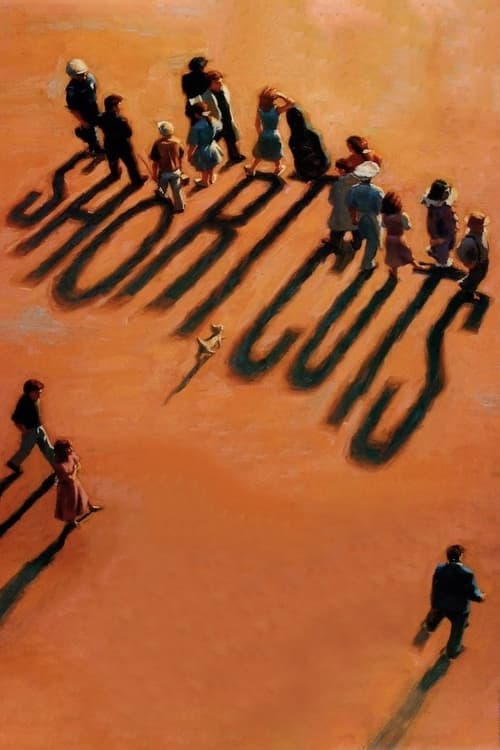
Short Cuts
1993 · Robert Altman
For when you want to sink into a big, novelistic film about ordinary lives — a long, absorbing evening that rewards patience and leaves you thinking about the strangers around you. More challenge than comfort, but generous with both.
What it's about
Twenty-two Los Angelenos — waitresses, doctors, jazz musicians, pool cleaners, cops, married couples in various states of disrepair — cross paths over one frantic week, their lives colliding through accidents, affairs, and chance. Drawn from Raymond Carver's short stories, it opens with helicopters spraying the city from above and builds toward an earthquake, with everything human and messy happening in between.
The experience
Three hours that glide by like eavesdropping — funny, sad, cruel, and tender in the same scene, often in the same line. It has a loose, wandering rhythm that keeps surprising you, and some of its threads will genuinely sting.
Performances
A staggering ensemble — Julianne Moore, Jack Lemmon, Tim Robbins, Lily Tomlin, Jennifer Jason Leigh, Tom Waits, and more — with no weak link; the cast was honored collectively, and it plays that way, everyone sharing the film rather than stealing it.
The craft
Robert Altman weaves nine storylines with overlapping dialogue, a restless roving camera, and editing that cuts between lives at exactly the moment one story comments on another. Live jazz threads through the whole thing, binding the sprawl into a single city-sized mood.
Why it matters
A landmark of the interwoven-ensemble film, it marked Altman's triumphant 90s comeback alongside The Player and set the template a generation of multi-strand Los Angeles movies would follow.
Snapshot
Robert Altman's Short Cuts is a three-hour-nine-minute mosaic portrait of twenty-two Los Angelenos whose lives collide and glance off one another across a single frantic week. Adapted from nine Raymond Carver short stories and one poem, it relocates Carver's damp Pacific Northwest working class to the flat, sun-bleached suburbs of the San Fernando Valley and South Bay, a transposition that proved both its most controversial creative choice and its sharpest interpretive argument. The film opens with a fleet of helicopters dusting the city for Medfly larvae — a bureaucratic intrusion into private life from above — and closes with a catastrophic earthquake that reshuffles the city like cards. Between those two impersonal forces, Altman maps a society held together by proximity and separated by everything else: class resentment, sexual dishonesty, emotional compartmentalization, and the random cruelty of accident. It won the Golden Lion at the 1993 Venice Film Festival, shared with Krzysztof Kieślowski's Three Colors: Blue, and stands as the fullest realization of the ensemble mode Altman had been developing since Nashville (1975).
Industry & production
Altman had spent much of the 1980s in reduced circumstances — a string of commercially marginal theatrical and television projects — before The Player (1992) restored his industry standing. Short Cuts was greenlit on that film's momentum, produced by Fine Line Features, the specialty arm of New Line Cinema that had positioned itself for prestige adult fare. The budget, while not publicly confirmed at a precise figure, was understood to be modest by major-studio standards, requiring Altman to shoot quickly across Los Angeles locations. He assembled a cast of exceptional depth — Tim Robbins, Julianne Moore, Matthew Modine, Andie MacDowell, Jack Lemmon, Fred Ward, Jennifer Jason Leigh, Chris Penn, Tom Waits, Lily Tomlin, Robert Downey Jr., Madeleine Stowe, Frances McDormand, Lili Taylor, Anne Archer, Fred Ward, and Buck Henry among them — many of whom accepted below-market rates to work with him. The screenplay was co-written with Frank Barhydt, Altman's long-standing collaborator, who had helped him adapt complex source material before. Altman condensed, fused, and in several cases grafted characters from separate Carver stories together; the resulting character web, though more intricate than any single Carver story, aimed to replicate the cumulative effect of reading the collected work. Tess Gallagher, Carver's widow, publicly expressed reservations about the Los Angeles relocation and certain narrative choices, though her position evolved somewhat after the film's reception.
Technology
Altman's technical signature was his sound system: going back to MASH (1970) and perfected on Nashville, he recorded multiple simultaneous sound channels on set, allowing different conversations and ambient layers to coexist and overlap without any single voice dominating the mix. Short Cuts inherits this infrastructure directly. The approach required actors to stay in character and in dialogue even when they were not the scene's primary focus, a discipline that produced the film's sense of a city humming at full volume under and around every nominal story. The picture was shot on 35mm by cinematographer Walt Lloyd using widescreen lenses calibrated for flat Los Angeles spaces — wide-angle framings that emphasized the horizontal sprawl of tract housing, strip malls, and swimming pools. Post-production used the Avid digital editing system, which had by 1993 become standard enough for a film of this scale; the ability to shift between ten simultaneous storylines, and to construct associative rhymes across them, was substantially aided by the flexibility of non-linear editing. The film's final earthquake sequence combined practical location shooting with controlled effects work to produce a convincing infrastructural rupture.
Technique
Cinematography
Walt Lloyd's work on Short Cuts is ostentatiously unobtrusive — precisely the register Altman required. He lights the interiors with practical and bounced naturalistic sources that read as the specific fluorescence of suburban California: the slightly too-bright kitchen, the underlit garage, the swimming pool's aqueous shimmer. The camera rarely calls attention to itself with conspicuous moves; instead it observes, sometimes from a remove that feels unsettling, as if it has no particular sympathy for what it watches. The widths of the frame keep more than one plane of action available simultaneously, enabling Altman's staging of simultaneous business. There is a consistent preference for medium and medium-long shots over close-ups, a choice that withholds the conventional emotional cue that a tight face provides, placing the burden of interpretation on the viewer.
Editing
Geraldine Peroni's editing is the film's structural intelligence. The ten storylines are not braided sequentially — Altman and Peroni intercut them associatively, juxtaposing scenes that rhyme thematically rather than following any single character's arc to a climax. The result is that no storyline feels more important than another; each exists in a field of moral equivalences. Cuts between scenes frequently refuse conventional parallel-action logic, arriving instead at an oblique angle: a scene about one couple's infidelity is followed not by its emotional consequence but by an unrelated couple's separate, parallel silence. The film's length is essential to this structure — the accumulation of incidents across the three hours produces a weight that no single story could bear alone.
Mise-en-scène / staging
Altman's staging in Short Cuts is choreographic in the manner he developed across his career: actors are placed in deep, populated frames and encouraged to carry on secondary business while the "main" action occurs. This means that in any given scene, the ostensibly peripheral characters are actually living, not waiting. The most celebrated instance of this principle is the scene in which Julianne Moore's painter, Marian Wyman, conducts an emotionally raw argument with her husband Dr. Ralph Wyman (Matthew Modine) while remaining nude from the waist down — the nakedness a deliberate choice Moore insisted upon, embodying the character's dissociation, her body withheld from emotional integration with her own voice. Altman's environments are chosen and dressed to be immediately readable as class positions: the phone-sex worker's cramped apartment (Jennifer Jason Leigh's Lois Kaiser) is cluttered with domestic necessity; the doctor's home (Modine) is spacious but not at ease.
Sound
The overlapping dialogue is not naturalistic accident but a scored effect: Altman and his sound team construct a sonic texture in which no single conversation fully owns the room. Voices arrive from outside the frame, bleed from adjacent scenes, persist as the camera moves past them. Against this continuous social murmur, Altman deploys an entirely different sonic register: the jazz vocals of Annie Ross, playing nightclub singer Tess Trainer. Her performances — torch songs and sardonic ballads, accompanied by her cellist daughter Zoe (Lori Singer) — function as a running choral commentary on the film's emotional terrain, lifting out of the social fabric to address the audience from a position of ironic omniscience. The earthquake's sound design — a low subsonic rumble that arrives before any image confirms it — is the film's most primal deployment of off-screen acoustic space.
Performance
The ensemble cast performs in a register of controlled naturalism calibrated to Altman's observational distance. What looks improvised is largely scripted but played with the latitude to breathe — actors are trusted to find the emotional truth of scenes without being pushed toward demonstrative peaks. Jack Lemmon's extended monologue as Paul Finnigan, confessing decades of infidelity to his estranged son Gene (Modine), is a set piece of a different kind: theatrical in its delivery, it stands as one of the film's few moments of sustained self-examination, and Lemmon plays it with the exhausted clarity of a man who has held a secret too long. Tim Robbins and Madeleine Stowe as the Finnegans maintain a simmering marital tension through physical proximity and avoidance. Fred Ward, Buck Henry, and Huey Lewis as the three fishermen who find and decline to report a drowned woman embody Carver's bleakest moral observation about male complicity through studied casualness — their comfort in one another's company is more damning than any explicit guilt.
Narrative & dramatic mode
Short Cuts belongs to the mode critics have variously called network narrative, hyperlink cinema, or mosaic film — a form in which causality is horizontal rather than vertical, and in which meaning accumulates through juxtaposition rather than consequence. No character learns from another's mistake; no narrative thread resolves in a way that illuminates or is illuminated by the others. Altman takes from Carver the principle that ordinary life does not offer catharsis: events end, people persist in diminished form, situations that seem to require a reckoning are absorbed back into the routine. The Los Angeles setting amplifies this structure — a city built for cars, for private compartmentalized transit between sealed domestic interiors, is formally analogous to Carver's vision of emotional isolation in adjacent lives. The earthquake ending does not resolve anything; it merely stops the film, as earthquakes stop ordinary time, and then time resumes.
Genre & cycle
The film does not sit comfortably in any single genre. It inherits the satirical ensemble comedy of Nashville, the suburban malaise of films like Ordinary People (1980) and The Ice Storm (1997), and the Los Angeles noir tradition that runs from Chinatown to Heat. Its treatment of male violence and female victimhood connects it to a strain of 1990s American film examining gender as a domain of quiet atrocity rather than spectacular event. It belongs to a 1990s cycle of literary adaptations that sought to translate the formal achievements of post-war American fiction — minimalism, indirection, ellipsis — into cinematic terms, alongside films like Household Saints (1993) and The Remains of the Day (1993), though Short Cuts is the most formally ambitious of these attempts.
Authorship & method
Altman's authorship is less the expression of a single vision than the cultivation of a system — an environment in which performances, sound, and image can interact without being overdetermined. His career practice, consistent from MASH forward, was to hire collaborators he trusted completely and then give them latitude within the constraints of the production design and screenplay. For Short Cuts, this meant Walt Lloyd had genuine freedom in how he approached light and framing within Altman's spatial preferences; Mark Isham composed the score around Annie Ross's pre-existing jazz persona rather than writing purely abstract underscoring, giving the music a diegetic anchor; and Frank Barhydt served less as traditional co-writer than as dramaturgical architect, working out how to fuse Carver's discrete story-worlds into a single plot topology. Geraldine Peroni, who had edited several Altman films, brought an understanding of his structural logic that made the parallel-editing strategy coherent. Altman's method was also characteristically social: he rehearsed the ensemble together, creating actual relationships among actors whose characters would only obliquely intersect, so that the sense of a shared world pre-existed the camera.
Movement / national cinema
Short Cuts is firmly within American cinema, but occupies an unusual position within it. It is neither the Hollywood mainstream nor the independent cinema that was achieving its highest visibility in 1993 through figures like Richard Linklater, Quentin Tarantino, and Todd Haynes. Altman is a generation older than these filmmakers and his mode — large-scale ensemble, institutional backing, literary adaptation — differs from their more self-consciously low-budget or auteurist projects. Yet Short Cuts shares with 1990s American independent cinema a refusal of narrative resolution, an interest in working- and middle-class material, and a skepticism toward Hollywood's emotional redemption machinery. Its closest spiritual kin in American cinema at the moment of its release is perhaps Jonathan Demme's ensemble work or the early films of Hal Hartley, though the scale is very different. The film is also in dialogue with the European art cinema that had influenced Altman since the 1960s — the French New Wave, Bergman, Antonioni — through its willingness to leave emotional situations unresolved and its trust in the audience's tolerance for ambiguity.
Era / period
Short Cuts was shot and released against the aftermath of the April 1992 Los Angeles uprising, the largest urban civil disturbance in twentieth-century American history. The film does not address the uprising directly, but the choice to set Carver's Pacific Northwest stories in this specific city at this specific moment is not innocent. The film's Los Angeles is white and working-to-middle class, occupying suburbs at some distance from the sites of the uprising, and the absence of that history from the film's frame has been noted by critics as itself a kind of document — a portrait of a city in willful adjacency to its own rupture. The early 1990s were also a period of post-Cold War American anxiety about economic decline, domestic dysfunction, and the inadequacy of existing social forms; Short Cuts, like the Carver stories it adapts, reads these anxieties in the grain of private life rather than through political or institutional analysis.
Themes
The organizing thematic concern of Short Cuts is the gap between what American domestic life looks like and what it contains. Nearly every marriage in the film is a site of deception: sexual infidelity, emotional withholding, unspoken violence. The film's most systematic thematic argument concerns male violence toward women — not spectacular, criminal violence, but the ambient, routine variety: the fishermen who leave a drowned woman in the river and continue their weekend; the husband whose cruelties are calibrated just below actionable; the man whose resentment finds expression in humiliation rather than assault. Alongside this runs a meditation on accident and culpability: Doreen Piggot (Lily Tomlin) hits a child with her car; the child's injury, and the waiting it imposes on his parents, triggers a cascade of revelations. The film asks whether moral responsibility can be distributed across a networked social world — whether the anonymous baker who harasses a grieving family with midnight calls is less culpable than the man who leaves a body in a stream, and whether either differs in kind from the accumulated daily failures of the marriages we watch. Water recurs throughout as an image of what is buried and will resurface: the river, the pool, the rain, the coma patient awaiting return.
Reception, canon & influence
Short Cuts received strong critical notices on its Venice premiere and wide release, with reviewers responding both to its formal ambition and to the quality of the ensemble. Roger Ebert awarded it four stars and placed it among the year's best; other major critics recognized it as a capstone achievement of Altman's late career. The film won the Venice Golden Lion alongside Three Colors: Blue, a juxtaposition that linked American formalism to the European art cinema it had long aspired to join. Altman won the Golden Globe for Best Director. Not all reception was enthusiastic: some critics found the film's tonal coldness — its refusal to permit its characters the dignity of full emotional reckoning — a form of cruelty that exceeded Carver's more compassionate minimalism. Tess Gallagher's dissatisfaction with the adaptation was documented in the press; her criticism focused particularly on the relocation and on Altman's treatment of the female characters in "So Much Water So Close to Home."
The influences feeding Short Cuts backward in time are legible: Jean Renoir's La Règle du jeu (1939) as the formal archetype for the satirical ensemble portrait of a society in moral decline; Altman's own Nashville as its direct precursor; the tradition of literary minimalism Carver represented; and the Los Angeles of Raymond Chandler and film noir, transformed here from a site of mystery into one of dispersed, unanswerable guilt.
The film's forward legacy is substantial. Paul Thomas Anderson, who has been explicit about Altman's influence on his practice, constructed Magnolia (1999) as a direct heir — a Los Angeles network narrative with an apocalyptic ending and a jazz-singer figure (Aimee Mann) serving as choral counterpoint. Gosford Park (2001), Altman's own later ensemble film, recycles the method in a period register. Steven Soderbergh's Traffic (2000) and Paul Haggis's Crash (2004) extend the multi-strand Los Angeles model, though critics have generally found both films more schematic in their use of intersection as a moral device. Alejandro González Iñárritu's Babel (2006) and his earlier Amores Perros (2000) indicate the global diffusion of network narrative as a prestige form. In television, the model influenced anthology drama and limited-series formats that would emerge in the 2000s. Short Cuts remains the form's most rigorously executed American instance — a film that, in refusing its characters and its audience the consolations of resolution, makes the strongest case that the mosaic form can do what no single story can: hold a society, intact and damning, in a single frame.
A Deleuzian reading
Begin where Altman does: a fleet of helicopters droning over Los Angeles at night, dusting the basin for Medfly larvae.
The full Deleuzian reading of Short Cuts →
Reception
It shared the Golden Lion at Venice with Three Colours: Blue and earned Altman a Best Director Oscar nod, yet divided people at the time over what it did to Raymond Carver; three decades on it's settled in as the blueprint for the sprawling ensemble mosaic — the film Magnolia was answering.
How Short Cuts was received, from release to now →
Influences: the films it descends from and the films it influenced
- Nashville (1975) — Altman's first full deployment of the 24-channel simultaneous recording system — each actor wired with an independent lapel mic so overlapping dialogue could be isolated and remixed in post — establishing the exact sound infrastructure Short Cuts inherits wholesale.
- MASH (1970) — The origin point of Altman's overlapping-dialogue method: multiple wireless mics recording simultaneously so ambient conversational density is preserved rather than sanitized, treating unintelligibility as social texture rather than technical failure.
- McCabe & Mrs. Miller (1971) — Vilmos Zsigmond's bounced-light, flashed-stock naturalism — non-directional sources reading as practical ambience, camera held at observational remove — established the visual grammar of unsympathetic witness that Walt Lloyd replicated for Short Cuts' California interiors.
- La Règle du jeu (1939) — Renoir's choreographic deep-focus staging, in which foreground drama and simultaneous background action carry equal narrative weight and neither suspends for the other, is the formal model for Altman's deep-frame ensemble blocking across Short Cuts' interiors.
- Faces (1968) — Cassavetes' telephoto observational distance on California domestic interiors — camera slow to cut away, actors overlapping in real time without theatrical resolution — established the controlled-naturalism mode Short Cuts' ensemble directly adopts.
- Husbands (1970) — Cassavetes' study of male emotional compartmentalization through overlapping improvised conversation that refuses psychological catharsis is the direct precursor for Short Cuts' male complicity storylines — Modine/Mathis, Ward/Waits/Penn — structured as recursive avoidance rather than confession.
- The Swimmer (1968) — Perry and Pollack's adaptation of John Cheever's short story transposes suburban malaise from a literary Eastern register to California geography using an episodic accumulative structure — exactly the transposition move Altman makes with Carver — letting incident pile without climax to produce weight the source's brevity never could.
- Le Plaisir (1952) — Altman transposes Le Plaisir's prestige-literary omnibus model — multiple stories structured as autonomous vignettes about desire, accident, and mortality — into American naturalism, applying the same anthology formal respect to Raymond Carver that Ophüls gave Maupassant.
- The Player (1992) — The direct beneficiary the comeback funded — scaling The Player's overlapping-sound, interlocking-ensemble method into a full Los Angeles mosaic.
- La Ronde (1950) — Network/'hyperlink' narrative whose web of brushing-past lives descends from La Ronde's closed circuit of linked encounters, trading the perfect ring for an open mesh.
- Choose Me (1984) — Returns the interlocking-strangers roundelay to Altman, retaining the device Rudolph added — a performer (Annie Ross's lounge singer) whose songs run continuously beneath and across the strands as connective scoring rather than diegetic decoration.
- Magnolia (1999) — PTA fused Altman's Los Angeles network-narrative intercutting with a diegetic choral rupture — Aimee Mann's 'Wise Up' sung simultaneously across all storylines — and a climactic weather event mirroring Short Cuts' earthquake, replacing Altman's static observational distance with Steadicam ensemble choreography.
- Happiness (1998) — Solondz built a suburban New Jersey network narrative using associative intercutting between families with no cathartic resolution, extending Short Cuts' flat observational framing and moral refusal to redeem characters into explicit satirical cruelty.
- The Ice Storm (1997) — Ang Lee adapted Rick Moody's novel using Short Cuts' literary-adaptation model — transposing written suburban malaise to screen — with associative intercutting between two Connecticut families and controlled naturalism in performance to depict sexual-emotional compartmentalization without redemptive climax.
- Gosford Park (2001) — Altman's own continuation of the multi-channel overlapping-dialogue infrastructure and deep-frame ensemble staging, applying the same simultaneous foreground/background choreography and post-mix sound architecture of Short Cuts to English country-house class anatomy.
- Code Unknown (2000) — Haneke's network of Parisians connected by a single street incident deploys long-take observational distance and deliberate withholding of cathartic resolution, extending Short Cuts' moral-equivalence network structure into an explicitly durational mode that refuses even Altman's associative intercutting.
- Traffic (2000) — Soderbergh's multi-strand network narrative uses available-light digital naturalism and non-linear intercutting across storylines with no dominant protagonist, inheriting Short Cuts' structural network model and applying it to a systemic subject — the drug trade — where diffuse causality precludes any single character's arc from bearing the film's meaning.
- Amores Perros (2000) — Altman's architecture of multiple autonomous narrative strands connected only by geographic proximity and accident, held in deliberate non-resolution, is the direct structural template Arriaga adapted — the collision in Amores Perros functions as Altman's earthquake, a hinge rather than a convergence.
- Crisis (2021) — The structural granddaddy of the mosaic — interweaving strangers' parallel lives so that ensemble breadth, not a single protagonist, carries the film.
- American Beauty (1999) — Model for the braided, converging multi-household plotlines drifting across a single suburban geography, the structural weave Alan Ball compresses into one cul-de-sac.
- Carandiru (2003) — Altman's mosaic editing of discrete character vignettes into a cumulative ensemble portrait, the portmanteau construction Mauro Alice uses to bind Carandiru's stories into one form.
- Intacto (2001) — Codifies the cross-cut convergence-plot of unrelated strangers whose fates are braided by chance, the editing structure Intacto narrows down to luck itself.
- Intermission (2003) — Model for the mosaic-of-strangers architecture — a dozen lives in one city cross-cut so that a minor character in one strand becomes the pivot of another, privileging ensemble over single protagonist.
- Slacker (1991) — Linklater independently developed no-protagonist network narrative by using a relay structure — the camera hands off to a new character at each scene's end — as an alternative formal solution to associative intercutting, arriving at the same no-catharsis, diffuse-ensemble territory contemporaneously with Altman.
- Pulp Fiction (1994) — Tarantino exploited Avid non-linear digital editing to reassemble a multi-strand narrative out of chronological sequence, using the same post-production flexibility Short Cuts employed to construct associative thematic rhymes across otherwise unconnected storylines.
- Three Colors: Red (1994) — Kieślowski's network of Geneva strangers connected by coincidence and refusal of climactic emotional resolution — culminating in a weather event that reassembles characters from across all three films — develops associative multi-strand intercutting and anti-catharsis form simultaneously and in parallel register to Short Cuts.
- 21 Grams (2003) — Established the multi-protagonist ensemble of intersecting strangers whose lives brush against each other, the dramaturgical scaffold Arriaga's script rebuilds around a single fatal accident.
- The Hours (2002) — The multi-strand ensemble architecture that distributes a single mood and existential question across separated lives intercut without their plots ever fully merging.
- H-8... (1958) — Weaves a large web of strangers whose lives brush and collide under a shared urban fate, the mature hyperlink-ensemble form H-8... prefigured.
Similar films
- Nashville (1975) — influence & lineage · same viewing thread
- Pulp Fiction (1994) — influence & lineage
- Magnolia (1999) — influence & lineage
- M*A*S*H (1970) — influence & lineage
- The Ice Storm (1997) — influence & lineage
- Faces (1968) — influence & lineage · same viewing thread
- Husbands (1970) — influence & lineage · same viewing thread
- Alice Doesn't Live Here Anymore (1974) — same viewing thread
All the films related to Short Cuts →
Watch it with: curated runs of related films
- New Hollywood Unravelings — Watch these together for the rawest strain of New Hollywood — loose, lived-in character studies of Americans who can't hold the shape their lives demand.