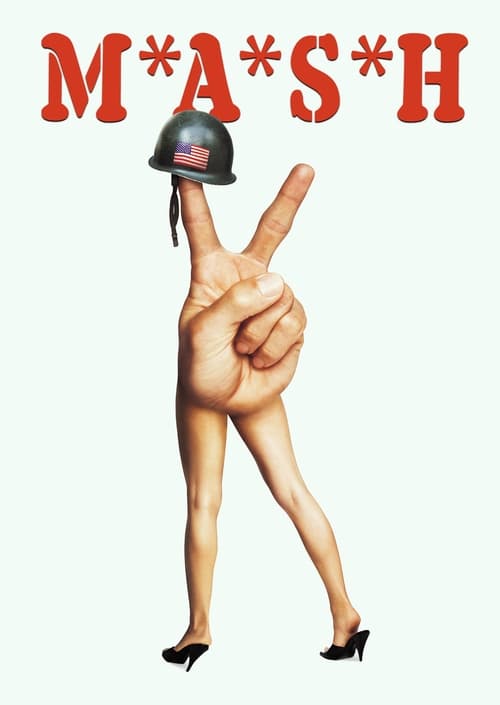
M*A*S*H
1970 · Robert Altman
For when you're in an irreverent mood and want comedy with teeth — something to laugh at authority with, not a cozy hangout watch. Fair warning: it's a product of 1970 and plays rough by design.
What it's about
At a mobile army surgical hospital just behind the front lines of the Korean War, a rotating crew of drafted surgeons — brilliant in the operating tent, insubordinate everywhere else — wage a running campaign of pranks, gambling, and open contempt against military authority. There's no real plot, just life at the 4077th: bloody surgery shifts, absurd schemes, and a climactic football game, with the chaos itself as the point.
The experience
Loose, rowdy, and mean in a way that still startles — the comedy is anarchic and the laughs sit right next to open wounds. It feels overheard rather than staged: conversations overlap, jokes happen at the edge of frame, and you're dropped into the noise and left to swim.
Performances
Donald Sutherland and Elliott Gould are effortlessly cool as Hawkeye and Trapper John, tossing off deadpan mutiny like they invented it, with Tom Skerritt and a young Robert Duvall in sharp support.
The craft
Robert Altman's method is the revelation: overlapping dialogue, a roving zoom lens, and a documentary clutter of background noise and behavior that makes the war's absurdity feel like weather rather than plot. Ring Lardner Jr.'s script won an Oscar, but half the film feels gloriously improvised around it.
Why it matters
The film that made Altman an American auteur and caught the anti-establishment mood of the Vietnam era dead center — and it spawned one of the most beloved TV series ever made. Its loose, ensemble style rewired what an American comedy could sound like.
Snapshot
M\A\S\H* is the film that made Robert Altman, at age forty-five, an American auteur after two decades of television and industrial work. Adapted from Richard Hooker's novel by screenwriter Ring Lardner Jr., it follows a rotating cast of drafted surgeons at the 4077th Mobile Army Surgical Hospital during the Korean War, though no viewer in 1970 mistook its subject for Korea. Released at the height of American involvement in Vietnam, the film weaponized irreverence: its heroes are insubordinate, lecherous, brilliant under the knife, and contemptuous of every institution above them. Altman's innovation was less in story than in texture — overlapping dialogue, a roving zoom lens, a documentary density of incidental noise and behavior that made the war's absurdity feel ambient rather than plotted. It became a major commercial success, won the Palme d'Or at Cannes, earned an Academy Award for Lardner's screenplay, and spawned one of the most successful television series in American history. More durably, it announced a new American cinema in which tone, ensemble, and ironic detachment could displace conventional narrative architecture.
Industry & production
The project arrived at Twentieth Century-Fox at a moment of institutional crisis. The studio was reeling from the financial damage of overscaled roadshow musicals, and M\A\S\H* was, by design, a comparatively modest production — one of three war films Fox had in development. By the well-documented account that Altman himself repeated for years, more than a dozen directors turned the material down before it reached him, in part because the studio regarded it as a minor picture; that very neglect gave Altman unusual freedom on a project no one was watching closely. He shot largely on the Fox Malibu Creek ranch, the same backlot terrain that would later serve the television series.
Altman's methods generated immediate friction with his credited screenwriter. Lardner Jr. — a member of the Hollywood Ten whose blacklisting gave the film an additional layer of political resonance — wrote a tighter, more conventional script than what reached the screen. Altman encouraged improvisation, overlapping rewrites, and ensemble invention, and the finished film departs substantially from the page. The well-known irony is that Lardner won the Academy Award for Best Adapted Screenplay for a film whose director claimed comparatively little of the dialogue survived as written; the dispute between Altman's improvisational ethos and Lardner's authorship is part of the historical record rather than studio legend. The leads, too, were uneasy: Donald Sutherland and Elliott Gould reportedly attempted to have Altman removed during production, alarmed by his unorthodox, seemingly chaotic shooting style — a fact both later acknowledged with regret once they understood what he had built.
The film's commercial performance was substantial and helped stabilize Fox, and its critical reception and Cannes triumph repositioned Altman from journeyman to author. It is the rare case where a studio's indifference, a contentious set, and an embattled director combined to produce both a hit and a stylistic watershed.
Technology
M\A\S\H is technically conservative in apparatus but radical in how it deploys familiar tools. It was shot on 35mm color stock; the era's faster films and zoom lenses are the enabling technologies here, and Altman exploited the zoom not as an occasional emphasis but as a continuous searching instrument. The defining technical experiment, however, was in sound. Altman pursued a multi-track recording approach that captured overlapping dialogue from a populated frame, allowing competing conversations to coexist rather than being cleanly isolated and prioritized in the mix. The film predates the elaborate multi-channel radio-mic systems Altman would refine on later pictures such as California Split and Nashville, so the specific technical means on M\A\S\H should be described cautiously — the achievement is partly in recording and substantially in editorial layering — but the aesthetic intention is unmistakable and was, for mainstream American cinema, genuinely novel. The result is a soundtrack that demands the viewer's active listening, scanning the audio field the way the zoom scans the visual one.
Technique
Cinematography
Harold E. Stine shot the film, and the look is deliberately anti-glamorous: muddy, olive-and-khaki, often flat in light, with the camp's tents and surgical theaters rendered as a continuous unkempt environment. Altman's signature is the long zoom — the camera frequently hangs back and pushes in optically rather than physically, isolating a face or a gesture within a crowded, busy frame and giving the image a quality of eavesdropping. This produces a documentary detachment: the camera seems to discover action already in progress rather than to stage it. Compositions are crowded and lateral; foreground and background activity compete for attention, rewarding repeat viewing. The operating-room scenes are shot with a clinical bluntness — visible blood, exposed viscera, the labor of surgery — that was startling for a comedy and that anchors the film's gallows humor in physical reality.
Editing
Edited by Danford B. Greene, the film is structured as a loose accretion of episodes rather than a goal-driven plot — a sequence of arrivals, pranks, surgeries, and set pieces (the football game, the "Last Supper" suicide gag, the shower humiliation of Major Houlihan) strung along the duration of the characters' tours. The cutting must serve the dense soundtrack, often holding wider shots longer to let overlapping speech breathe, then cutting sharply for comic punctuation. The episodic rhythm — closer to anecdote than to three-act causality — is itself a formal argument: war as an open-ended condition rather than a story with a resolution. The recurring camp loudspeaker announcements function as editorial connective tissue, ironic chapter breaks that comment on, deflate, or simply interrupt the action.
Mise-en-scène / staging
Altman stages in depth and in breadth, filling the frame with simultaneous business so that the principal action is one event among many. Performers were encouraged to inhabit the camp continuously, and minor characters carry on their own lives at the edges of shots. This populated naturalism — the sense of a functioning, lived-in world indifferent to whoever the camera happens to be following — became Altman's defining method and is already fully formed here. The 4077th feels improvised into existence: tents, gurneys, a perpetually muddy compound, bodies in constant motion.
Sound
Sound is the film's most influential element. Overlapping dialogue dissolves the conventional hierarchy in which one speaker is foregrounded and others fall silent; here, conversations collide, trail off, and bury their own punchlines, forcing the audience to do the work of attention. The omnipresent public-address system — announcing film screenings, surgical schedules, and bureaucratic trivia in an incongruously chipper register — is a structural and satirical device, the voice of the institution rendered absurd. The musical motif "Suicide Is Painless," with music by Altman's then-teenaged son Michael Altman and Johnny Mandel, is sung diegetically during the mock-suicide set piece and threads through the score; its blandly melodic nihilism crystallizes the film's tone.
Performance
The ensemble performs in a loose, overlapping, semi-improvised register that subordinates star turns to collective texture. Donald Sutherland's Hawkeye Pierce and Elliott Gould's Trapper John are insolent and cool, their competence the only thing they take seriously; Tom Skerritt's Duke rounds out the surgical trio. Robert Duvall plays Major Frank Burns as a sanctimonious hypocrite and Sally Kellerman plays Major "Hot Lips" Houlihan as his foil and victim — both targets of the film's cruelty, which the picture frames as comedy and which later criticism has reassessed (the shower scene, in particular, is now widely read as misogynist humiliation rather than mere prankishness). Gary Burghoff's Radar O'Reilly — the one actor to carry his role directly into the television series — supplies the film's note of uncanny, anticipatory innocence. The performances feel overheard rather than delivered, which is precisely the point.
Narrative & dramatic mode
M\A\S\H* operates in a picaresque, episodic mode with no protagonist arc in the classical sense and no climactic resolution of stakes. Its dramatic engine is situational and tonal: the friction between brilliant, anarchic individualists and the bureaucratic machinery of the Army. The film withholds the usual war-movie pieties — no speeches about sacrifice, no redemptive deaths given weight — and instead lets comedy and carnage occupy the same frame, so that surgery and gags share a continuous emotional surface. The structure is cumulative rather than causal; the football game that climaxes the film is a set piece, not a culmination, and the characters simply rotate home. This refusal of conventional shape is the dramatic statement: institutions grind on, the war has no third act, and survival is a matter of irony rather than triumph.
Genre & cycle
The film is a war comedy that systematically dismantles the war film. It belongs to a late-1960s and early-1970s cycle of anti-authoritarian, anti-war American pictures — released the same year as Mike Nichols's Catch-22, with which it is inevitably paired, and adjacent to the revisionist energies of Little Big Man and the broader New Hollywood turn against genre orthodoxy. Where Catch-22 dramatized absurdity through Heller's surreal architecture, M\A\S\H achieved it through tonal and behavioral realism, and it was the more commercially and culturally successful of the two. As black comedy it sits in a lineage running back through Dr. Strangelove*; as ensemble service-comedy it inverts the morale-boosting military pictures of earlier decades. It also helped inaugurate a cycle of irreverent, R-rated studio comedies aimed at a younger, draft-age audience.
Authorship & method
M\A\S\H is the foundational text of Altman's authorship, the film in which his method announces itself complete: overlapping dialogue, ensemble staging, the roving zoom, tonal irony, and a structural preference for atmosphere over plot. His collaborators were essential to its realization. Lardner Jr.'s screenplay supplied the architecture and characters even as Altman dispersed its dialogue into improvisation — a genuine and unresolved authorship tension that the Oscar only sharpened. Cinematographer Harold E. Stine executed the searching, documentary look. Editor Danford B. Greene shaped the episodic flow and managed the dense audio layering. Johnny Mandel scored the film and arranged "Suicide Is Painless," whose lyric was written by Michael Altman. The casting of an ensemble of relative unknowns and character actors over established stars was itself a methodological choice, enabling the collective, anti-hierarchical performance style. Crucially, Altman established here a working ethos — set as laboratory, actor as collaborator, the frame as a populated world — that he would carry through McCabe & Mrs. Miller, The Long Goodbye, California Split, and Nashville*.
Movement / national cinema
The film is a central document of the New Hollywood (or "Hollywood Renaissance"), the late-1960s-to-1970s period in which a generation of directors gained authorial control as the old studio system collapsed. It shares that movement's debts to European art cinema — the loosened narrative, the ironic distance, the ambient realism recall the French New Wave and the modernist drift away from classical causality — while remaining a thoroughly American product of a major studio in financial retreat. Within that movement M\A\S\H is distinctive for routing its radicalism through comedy and through sound rather than through the violent lyricism of Bonnie and Clyde or the road-movie melancholy of Easy Rider*.
Era / period
Made in 1969 and released in 1970, the film is inseparable from the politics of the Vietnam era and the draft. Its Korean setting was a transparent displacement; contemporary audiences read the 4077th as a stand-in for the contradictions of the present war. The casting of Ring Lardner Jr., a blacklist survivor, gave the production a direct line to an earlier era of American political repression, and the film's contempt for military authority resonated with a counterculture audience and an exhausted national mood. It belongs to the brief window when a studio would finance, and a mass audience embrace, open derision of the armed forces.
Themes
The film's governing theme is survival through irreverence: humor, sex, and professional excellence as the only sane responses to institutional madness. It sets individual competence against bureaucratic authority, repeatedly siding with the talented insubordinate over the pious functionary. Hypocrisy — especially the religious and sexual sanctimony embodied by Burns and Houlihan — is its preferred target, though the film's treatment of women, and of Houlihan in particular, has been justly criticized as cruel and misogynist, and that tension is part of any honest reading of it. Beneath the comedy runs an insistence on the body's vulnerability: the operating room never lets the audience forget the carnage that the jokes hold at bay. The result is a sustained argument that in an absurd war, sanity looks like anarchy and decency looks like contempt for the rules.
Reception, canon & influence
M\A\S\H* was a critical and commercial success on release, won the Palme d'Or (then the Grand Prix) at the 1970 Cannes Film Festival, and received several Academy Award nominations including Best Picture and Best Director, with Lardner winning for Adapted Screenplay. It has since entered the canon: it was selected for preservation in the United States National Film Registry by the Library of Congress as a culturally significant work, and it is routinely cited in surveys of the great American comedies.
Its influences run backward to the black comedy of Dr. Strangelove, to the absurdist anti-war tradition, and to the loosened narrative grammar of European modernism. Its forward legacy is twofold and immense. Stylistically, it established the Altman idiom — overlapping sound, ensemble realism, the zoom-driven roving eye — that shaped not only his own subsequent masterworks but a wide swath of later naturalistic American filmmaking; the dense, overheard soundscape is a direct ancestor of approaches later associated with Paul Thomas Anderson and others working in the ensemble mode. Industrially, it helped legitimate the irreverent, R-rated studio comedy and reinforced the New Hollywood thesis that a director's vision could be a commercial asset. Its most visible offspring is the long-running CBS television series (1972–1983), developed by Larry Gelbart, which grew into one of the most-watched programs in American history and whose finale set audience records — a cultural afterlife so large that it has, for many, overshadowed the film that began it. The film and the series together made "M\A\S\*H" a permanent fixture of American popular memory, even as the movie itself remains the sharper, harsher, and more formally adventurous of the two.
A Deleuzian reading
Start with the loudspeaker.
The full Deleuzian reading of M*A*S*H →
Reception
A genuine sensation in 1970 — it won the Palme d'Or at Cannes and was a huge box-office hit that helped kick off the New Hollywood — but it's since been overshadowed by the TV series it spawned, and modern rewatches have complicated its reputation.
How M*A*S*H was received, from release to now →
Influences: the films it descends from and the films it influenced
- The Rules of the Game (1939) — Pioneered the populated frame and deep-focus ensemble staging where overlapping action and chatter spill across the composition, the model for Altman treating the frame as a crowded, democratic world rather than a vehicle for the principal.
- His Girl Friday (1940) — Established machine-gun overlapping dialogue with characters stepping on each other's lines, the direct precursor to Altman's overheard, half-audible soundscape.
- Breathless (1960) — Loosened narrative grammar toward improvisation, casual realism, and the privileging of behavior over plot — the French New Wave license Altman cites for dispersing Lardner's script into actor invention.
- 8½ (1963) — Modeled an episodic, atmosphere-over-plot architecture in which a teeming gallery of characters drifts through loosely linked set pieces rather than a causal throughline.
- Dr. Strangelove (1964) — Codified the black-comic anti-war register — military authority rendered absurd through deadpan institutional satire — that M*A*S*H transplants from the war room to the operating tent.
- Dr. Strangelove or: How I Learned to Stop Worrying and Love the Bomb (1964) — Altman adopted Kubrick's model of improvised ensemble performance within military institutional farce and extended it into multi-channel overlapping dialogue; his ironic deployment of 'Suicide Is Painless' as a recurring source-music motif directly extends Kubrick's use of 'We'll Meet Again' as tonal counterpoint to institutional catastrophe.
- From Here to Eternity (1953) — Altman's PA-loudspeaker announcements function exactly as Taps functions in Eternity — a recurring diegetic institutional sound used as ironic structural counterpoint that interrupts personal scenes to reassert the military machine's indifference to individual experience — while the war-without-combat premise is a direct generic inheritance from Eternity's barracks-centered model.
- Viridiana (1962) — Directly cites Viridiana's most famous shot, staging an ironic Last Supper tableau of the surgeons that mimics da Vinci's composition for satirical blasphemy.
- King of Hearts (1966) — Carries forward the pacifist service-comedy in which clowning irreverence is the only sane response to institutional slaughter.
- McCabe & Mrs. Miller (1971) — Carries the M*A*S*H idiom forward — the roving zoom, the anti-glamorous documentary look, and overlapping mumbled dialogue — into genre revisionism, the next application of the method announced here.
- The Long Goodbye (1973) — Extends the searching zoom and ironic tonal drift to deconstruct genre, with the camera constantly reframing in slow zooms to find behavior within a populated space.
- California Split (1974) — First full deployment of Altman's Lion's Gate multitrack recording, pushing the overlapping-dialogue technique pioneered in M*A*S*H into a fully layered, separable eight-track soundfield.
- Nashville (1975) — Scales the ensemble-realism and multitrack overlapping sound to two dozen interwoven characters, the culmination of the picaresque, atmosphere-driven mosaic structure prototyped in M*A*S*H.
- Slap Shot (1977) — Inherits the irreverent, profane, R-rated studio-comedy ensemble — vulgar male institutional camaraderie played for anti-authoritarian laughs — that M*A*S*H legitimated commercially.
- Boogie Nights (1997) — Adopts the Altman package wholesale: roving long-take camera moving through a large ensemble, overlapping overheard dialogue, and episodic time-jumps that favor a populated milieu over linear plot.
- Magnolia (1999) — Builds the Nashville-style hyperlink ensemble of interlocking lives with dense layered sound, the most explicit continuation of Altman's mosaic-of-overheard-voices architecture.
- Three Kings (1999) — Revives the M*A*S*H mode of irreverent, tonally unstable war satire — black comedy braided with sudden graphic surgery and anti-authoritarian wisecracking soldiers undercutting the mission.
- The Larry Sanders Show (1992) — Translates the overlapping-dialogue ensemble naturalism and verité roving look into television, descending from the same loosened-grammar realism (and the M*A*S*H franchise's own TV afterlife).
- Atropia (2025) — Establishes the war-as-absurdity register through overlapping naturalistic dialogue and a diegetic PA-loudspeaker soundscape that frames the camp itself as a performed stage.
- Full Metal Jacket (1987) — Johnny Mandel's 'Suicide is Painless' — written for Altman and deployed over opening helicopter credits as sardonic commentary on military carnage — established the pop/military irony grammar that FMJ inherits directly; Kubrick's 'These Boots Are Made for Walkin'' over the first scene is the structural descendant of Altman's alienation device.
- Short Cuts (1993) — The origin point of Altman's overlapping-dialogue method: multiple wireless mics recording simultaneously so ambient conversational density is preserved rather than sanitized, treating unintelligibility as social texture rather than technical failure.
- Catch-22 (1970) — Released the same year and adapting the same absurdist anti-war tradition, it pursues the institutional-insanity satire of military bureaucracy through a fractured, episodic war narrative.
- The Great War (1959) — Independently extends the same proof — that a war film can run as sustained ensemble comedy shot through with sudden death — trading Monicelli's tonal reversal for an anarchic overlapping texture but the identical anti-war wager.
- Kelly's Heroes (1970) — The same-year anti-war satire that treats war as an absurd day-job, holding broad comedy and sudden gore in one frame exactly as Kelly's oscillates between caper romp and carnage.
Similar films
- Catch-22 (1970) — influence & lineage
- Nashville (1975) — influence & lineage
- The Long Goodbye (1973) — influence & lineage
- Network (1976) — shared sensibility
- The Dirty Dozen (1967) — shared sensibility
- Charlie Wilson's War (2007) — shared sensibility
- Kelly's Heroes (1970) — shared sensibility
- Dr. Strangelove or: How I Learned to Stop Worrying and Love the Bomb (1964) — shared sensibility
All the films related to M*A*S*H →