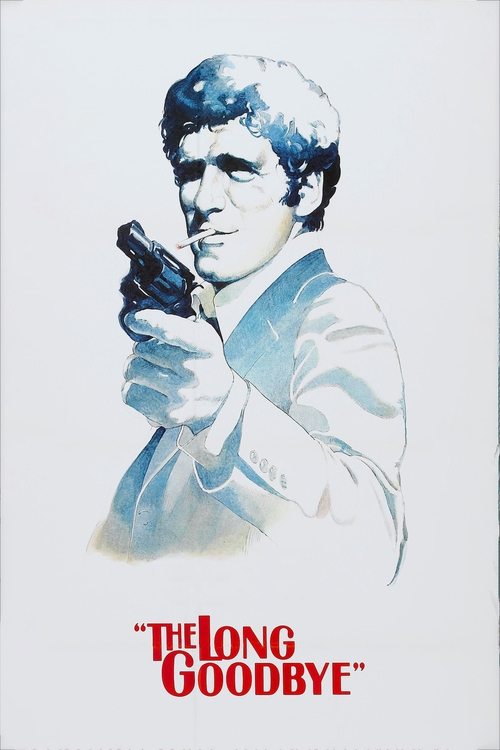
The Long Goodbye
1973 · Robert Altman
For a late night when you want to drift through a mystery rather than race one — laid-back, hazy, and sardonic, with a sting waiting at the end. Best when you're in the mood for atmosphere over adrenaline.
What it's about
Private detective Philip Marlowe — chain-smoking, wisecracking, hopelessly old-fashioned — does a small favour for a friend: a late-night drive to the Mexican border. Then the friend is accused of murdering his wife, and Marlowe, the last man in 1970s Los Angeles who still believes in loyalty, starts pulling at threads. What he finds runs through Malibu beach houses, a drunken novelist's crumbling marriage, and a gangster who wants his money back.
The experience
Loose, funny, and quietly melancholy — it ambles like a shaggy-dog joke, then tightens without warning into moments of genuine menace. You come out feeling wry and a little heartbroken about a world where decency looks like naivety.
Performances
Elliott Gould's mumbling, rumpled Marlowe is one of the great against-type performances — a detective played as a sleepwalking wiseacre whose 'it's okay with me' shrug hides a moral core. Sterling Hayden is a force of nature as the ruined writer.
The craft
Robert Altman keeps the camera perpetually drifting and zooming, so you feel like an eavesdropper in sun-bleached, smog-soft Los Angeles. John Williams's title theme sneaks into the film in a dozen disguises — supermarket muzak, doorbell chime, mariachi band — a running joke that doubles as the movie's sad soul. It rewards patient viewing and a good pair of speakers.
Why it matters
A commercial flop that became one of the defining American films of the 1970s, its irreverent take on the private eye reshaped how later filmmakers approached noir — and its slacker-detective DNA runs through decades of LA crime stories since.
Snapshot
Robert Altman's adaptation of Raymond Chandler's 1953 novel is one of the most audaciously revisionist genre films in American cinema. It takes the most iconic figure of hard-boiled fiction — Philip Marlowe — strips him of his romantic authority, and drops him into a 1970s Los Angeles that has forgotten what he stands for. Elliott Gould's Marlowe is a mumbling anachronism, a man of private code adrift in a world where loyalty is a sucker's game. The film is simultaneously an elegy for the classical detective picture, a scorched-earth critique of the California dream, and a formal experiment in cinematographic observation. It failed commercially on first release, earned a cult following on re-release, and is now regarded as one of the defining American films of its decade.
Industry & production
The project originated with producer Elliott Kastner, who acquired the rights to Chandler's novel and hired Leigh Brackett to write the adaptation. Brackett's involvement was a deliberate act of continuity: she had co-written the screenplay for Howard Hawks' The Big Sleep (1946) alongside William Faulkner, making her one of the few writers with deep, practitioner-level knowledge of the Marlowe universe. Her script for Altman retained the novel's Los Angeles setting but pushed the action decisively into the early 1970s, transplanting Chandler's postwar anxieties into the era of Watergate and the counterculture's collapse. Altman was brought on as director after the script was in place, and he immediately understood the film as an opportunity to interrogate the genre rather than honor it. United Artists distributed the picture. Its initial commercial release in 1973 performed poorly, and UA reissued it with a different campaign — leaning into the film's satirical, irreverent tone — with only modest improvement. The production was a relatively contained operation by Altman's standards, shot largely on location in Los Angeles: Malibu beach houses, a private clinic in the hills, and the unremarkable apartment complex where Marlowe lives, surrounded by yoga-practicing neighbors who barely register his existence.
Technology
Vilmos Zsigmond, who had collaborated with Altman on McCabe & Mrs. Miller (1971) and Images (1972), employed a set of photographic techniques that gave The Long Goodbye its distinctive visual texture. The film was shot in anamorphic widescreen, exploiting the wide frame's capacity to hold multiple planes of action — characters at the edges of the image, conversations half-glimpsed through glass. Zsigmond used a process of pre-exposing, or "flashing," the film stock, which bleached the color palette toward a hot, washed-out California warmth; shadows desaturate rather than deepen, giving the image a quality closer to overexposed memory than hard-edged noir. The technique had been central to McCabe & Mrs. Miller as well, but here it suits a different end: rather than the frozen romanticism of a dying frontier, it evokes the bleached moral vacancy of Malibu affluence. The camera work itself — a perpetual, nearly imperceptible zooming and slow lateral drift — required careful calibration of the zoom lens to operate almost subliminally, creating restlessness without obvious mechanical intrusion.
Technique
Cinematography
The film's cinematographic signature is its ceaselessly mobile, observational camera. Zsigmond and Altman agreed that the lens should behave like an alert but passive witness — always slightly repositioning, zooming in or pulling back, panning across a room without tracking the eye of a conventional editor. The effect is that of a camera with its own curiosity, catching the margins of scenes: a character walking away from the frame, the periphery of a party, a conversation glimpsed through a window. This technique refuses the classical grammar of shot/reverse-shot authority; instead, the image suggests a world indifferent to the detective at its center. Marlowe is frequently framed against reflective surfaces — glass doors, mirrors, car windows — which doubles and fragments him, as though he already belongs to another image. The anamorphic frame is used not for grandeur but for dispersal; the wide space often accommodates competing centers of attention, none of them definitively "the scene."
Editing
Lou Lombardo edited the film, and the cutting sustains Altman's commitment to a loose, anti-emphatic rhythm. There are few hard punctuation moments; scenes drift toward their endings rather than snapping closed. The editing does not prioritize revelation — it accumulates texture. Sequences of apparent inconsequence, like Marlowe's extended, futile attempts to purchase a specific brand of cat food in the opening minutes, are allowed full duration, establishing a pace that refuses genre urgency. The film trusts its audience to wait, and rewards that patience with cumulative unease rather than episodic tension.
Mise-en-scène / staging
Altman's staging throughout is deliberately anti-theatrical. Characters are frequently not positioned for optimal viewing; they talk with their backs to the camera, move through cluttered spaces, or deliver significant dialogue half-offscreen. The Malibu beach house belonging to Roger and Eileen Wade becomes a key staging environment: its glass walls and open decks blur interior and exterior, private and surveilled. The Malibu colony's architecture — designed for visibility as much as habitation — becomes a spatial metaphor for the world's performative transparency that conceals nothing and reveals nothing useful. Marlowe's apartment building, by contrast, is a warren of domestic noise and cheerful indifference; his neighbors' communal life proceeds entirely without reference to him.
Sound
The film's most celebrated formal achievement is its treatment of music. John Williams composed the title song, with lyrics by Johnny Mercer; the melody — melancholic, modal, slightly out of time — recurs throughout the entire film in an extraordinary series of variations. It appears as a Mexican border crossing band's slow rhumba, as a supermarket's piped Muzak, as a doorbell chime, as a funereal dirge, as lounge jazz. The song is everywhere and nowhere; it follows Marlowe without explaining him. This saturation of a single theme across radically different orchestrations and contexts is one of cinema's more inventive deployments of the leitmotif, and it turns the film's emotional grammar inside out: instead of musical variations tracking the protagonist's interiority, the music becomes a running joke about the world's capacity to recycle sentiment without meaning. Altman's characteristic multi-track sound design — overlapping dialogue, ambient noise weighted against speech — is present but subordinated here to Williams's structural conceit.
Performance
Elliott Gould's Marlowe is the film's fulcrum and its most radical gesture. Where Humphrey Bogart's Marlowe in Hawks's The Big Sleep radiates laconic command, Gould's is a muttering, chain-smoking, distracted figure who apologizes as he enters rooms. He is not stupid, and he is not without dignity, but he lacks the charismatic authority the genre assumes its detective possesses. Gould plays Marlowe as a man who still believes in a code that the world has quietly discarded. The performance is naturalistic to the point of anti-performance — he seems barely to register moments that would be emphatic beats in a conventional noir. Against him, Sterling Hayden as the dissolute writer Roger Wade gives a performance of grand, self-consuming energy: alcoholic, grandiloquent, Hemingwayesque in its theatrical self-destruction. Nina van Pallandt, cast as Eileen Wade, was a Danish singer with limited film experience; Altman selected her partly for that quality of unfamiliarity, and she delivers a performance of quiet opacity that the film finally reveals as strategic concealment. Mark Rydell — director of The Rose and On Golden Pond — plays gangster Marty Augustine with operatic volatility; his scene involving a Coca-Cola bottle is one of the film's most casually brutal moments.
Narrative & dramatic mode
The film is structured around the systematic betrayal of genre expectation. Its plotting follows the form of a mystery — a missing friend, a suspicious death, a tangled web of Malibu money — but withholds the satisfactions the form promises. Clues do not cohere into revelation; the detective's efforts feel less like investigation than like restless, loyal motion. Altman and Brackett relocate the climactic recognition scene to an ending that departs sharply from Chandler's novel: Marlowe, having discovered that his friend Terry Lennox has used him as a cover for a murder and faked his own death, shoots Lennox on a Mexican road and walks away dancing. The ending is both parodic — Marlowe finally does something decisive — and genuinely devastating: the one act of genre resolution in the film is an act of personal betrayal of the genre's own ethos. The detective's code, in this film, ends in murder.
Genre & cycle
The Long Goodbye belongs to and helps constitute the neo-noir cycle of the early 1970s, alongside Chinatown (1974), Night Moves (1975), and Farewell, My Lovely (1975). These films revisit the hard-boiled and film noir traditions through a post-1960s, post-Vietnam lens that refuses the genre's consolations: order is not restored, the detective does not triumph, the mystery resolves into something worse than the initial crime. Altman's contribution to this cycle is the most formally experimental and the most explicitly revisionist in its treatment of its source material. Where Chinatown uses the noir form with tragic grandeur, The Long Goodbye uses it with mordant, deflating irony. The film is also in dialogue with the tradition of literary adaptation of Chandler in Hollywood: Brackett's own The Big Sleep, Edward Dmytryk's Murder, My Sweet (1944), and the various Marlowe films of the 1940s. It treats that tradition as a cultural residue — something that once made meaning and now only circulates.
Authorship & method
Altman was at the height of his powers and his idiosyncratic method when he made The Long Goodbye. Fresh from McCabe & Mrs. Miller (1971) and Nashville would follow in 1975; the early-to-mid seventies represent his most sustained period of formal innovation. His method on set was famously collaborative and improvisational — he encouraged actors to develop their own dialogue rhythms, worked with overlapping sound to capture naturalistic simultaneity, and resisted the classical Hollywood tendency toward scenes built for clean decipherability. Leigh Brackett's script provided the structural skeleton, but Altman's directorial sensibility transformed its genre architecture into something more ambient and corrosive. Vilmos Zsigmond's cinematographic partnership was essential; Zsigmond had the technical precision to execute Altman's conceptually loose, drift-based visual style with rigor. Lou Lombardo's editing collaborated with Zsigmond's approach rather than correcting for it. John Williams, then not yet the composer of blockbuster scores for which he is now universally known, delivered what is arguably the most formally inventive music of his career in the title song's proliferating variations.
Movement / national cinema
The film is squarely a product of the New Hollywood — that period from roughly 1967 to 1977 when American studios, facing financial crisis and the collapse of the classical system, extended unusual creative latitude to a generation of directors influenced by European art cinema, the French New Wave, and Italian neorealism. Altman is the most consistently anti-classical figure of the movement, the director least interested in genre satisfaction and most committed to using genre form as a container for something genre does not normally permit. The Long Goodbye is also a specifically Californian film: its critique of Malibu wealth and Los Angeles moral vacancy is precise, located, and registered through the visual grammar of its production design and locations. The film belongs to a current of 1970s American cinema suspicious of California as ideology — suspicious of the sun, the openness, the therapeutic culture, and the money that moves beneath it.
Era / period
The film is historically situated in the early 1970s with unusual self-consciousness: Altman does not merely set the film in his present, he thematizes it. Marlowe explicitly does not belong to his moment. His clothes are slightly wrong, his values are conspicuously unfashionable, and his neighbors' frictionless counterculture is as alien to him as anything from another century. The film registers the early 1970s as a period of exhaustion — the idealism of the previous decade having curdled, the Nixon era making visible the corruption that had always underlain American institutional life — and figures Marlowe's out-of-time loyalty as both admirable and futile. He is the last honest man in a world that has stopped valuing honesty.
Themes
Loyalty and its betrayal are the film's organizing preoccupations, and Altman works the theme through every register: personal, generic, and cultural. Marlowe's code — do right by your friend, see the job through, don't be bought — is presented with genuine sympathy even as the film demonstrates its complete inefficacy. Alongside this, the film concerns itself with the decay of masculine idealism, specifically the Chandlerian fantasy of the knight-detective who moves through corruption without being corrupted. In the 1970s, Altman argues, this figure can only survive as anachronism; the world has moved on. California as a site of moral dissolution is a consistent visual and narrative motif — the beach house, the private clinic, the money that flows without traceable origin. The film also, obliquely, concerns performance: almost every significant character is performing something for Marlowe, and the detection plot is partly a story about the failure of reading, of the gap between surface and depth in a culture organized around image.
Reception, canon & influence
The Long Goodbye was not well received on its initial release in 1973. Audiences expecting a conventional Marlowe picture were disoriented by Gould's performance and Altman's anti-genre method. Some critics were similarly unpersuaded. Roger Ebert wrote a negative notice on first release; he subsequently revisited the film, reversed his judgment entirely, and included it in his "Great Movies" series — an index of how substantially critical consensus around the film shifted over time. United Artists reissued the film with revised marketing that emphasized its comic and satirical dimensions, a campaign that performed only marginally better.
Looking backward, The Long Goodbye is in dialogue with: Chandler's novel and its period; the entire cycle of 1940s Marlowe pictures, particularly Hawks's The Big Sleep; the French New Wave's appropriation and dismantling of American genre forms; and Altman's own McCabe & Mrs. Miller in its use of a genre hero displaced from his own myth.
Looking forward, the film's influence operates across multiple vectors. Its neo-noir revisionism is part of the generic substrate on which Chinatown and Night Moves would build, and its deconstruction of the detective as authoritative reader anticipates later films from Body Heat (1981) to Paul Thomas Anderson's Inherent Vice (2014) — itself a conscious reworking of the Chandler California-noir tradition. Altman's camera methodology — observational, drift-based, refusing the classical grammar of emphasis — influenced the look of subsequent American independent cinema. The film's use of the title-song leitmotif across wildly different contexts has been widely studied as a model for ironic musical counterpoint. Among directors, the film is frequently cited as an influence; its willingness to make genre failure expressive rather than merely critical remains an achievement that later filmmakers have aspired to and rarely equaled.
A Deleuzian reading
Start with the cat food.
The full Deleuzian reading of The Long Goodbye →
Reception
It bombed on first release in 1973 — Chandler purists were furious and United Artists yanked it, re-marketing it with a jokey Mad-magazine-style poster before trying again. Half a century later it's canonized as one of the great 70s LA films and peak Altman.
How The Long Goodbye was received, from release to now →
Influences: the films it descends from and the films it influenced
- The Big Sleep (1946) — Leigh Brackett co-wrote both screenplays; Altman constructs The Long Goodbye as a systematic inversion of every authority guarantee Hawks's Marlowe delivers — where Hawks resolves and restores moral order, Altman refuses and deflates it at every generic promise point.
- Kiss Me Deadly (1955) — The first Hollywood hard-boiled adaptation to use the genre's investigative structure to arrive at a nihilistic, genre-destroying ending; Aldrich's Hammer, like Gould's Marlowe, is a detective whose pursuit triggers catastrophe rather than restoration, voiding the genre's moral contract.
- Blow-Up (1966) — The drift-and-observe camera that accumulates visual detail without delivering interpretive authority; Antonioni places an investigator at the center of evidence he cannot finally decode, building epistemological failure into camera movement — the direct formal model for Altman and Zsigmond's observational-drift approach.
- Point Blank (1967) — Lee Marvin's Walker is the formal ancestor of Gould's Marlowe — an anachronistic code-bearer in modernist Los Angeles whose loyalty and sense of justice the corporate world no longer recognizes; Boorman also uses LA architecture (concrete towers, parking structures) to express moral vacancy.
- MASH (1970) — Altman's first systematic deployment of multi-track overlapping dialogue, where characters speak simultaneously without dramatic hierarchy; the acoustic architecture of dense, unglamourized conversation that The Long Goodbye inherits and deepens as its central sound design principle.
- McCabe & Mrs. Miller (1971) — Vilmos Zsigmond first deployed systematic film-flashing pre-exposure here; the washed-out color palette that drains shadow of hard-edged darkness was developed with Altman in this film and directly transposed to The Long Goodbye's bleached California moral vacancy.
- Images (1972) — Altman and Zsigmond's intermediate collaboration between McCabe and The Long Goodbye, where they continued refining the film-flashing technique and drift-camera observational grammar that would define The Long Goodbye's photographic signature the following year.
- Shoot the Piano Player (1960) — Altman applies Piano Player's tonal-instability method to Hollywood noir — Marlowe as passive, anachronistic figure who cannot impose his will on events — while John Williams's recycled theme (one song in endless ironic variations) functions in the same counterpointing mode as Delerue's score, denying the narrative the musical resolution it keeps seeming to promise.
- The Lady from Shanghai (1947) — Altman uses a diegetic theme song reprised in continuous variations to undercut genre romance exactly as Welles deploys 'Please Don't Kiss Me,' and systematically dismantles the Chandler detective figure by inhabiting noir conventions only to expose their internal incoherence.
- To Have and Have Not (1945) — Altman's actors-on-open-mics overlapping-dialogue technique is a direct extension of Hawks's approach, and Elliott Gould's Marlowe — the competent professional whose studied informality reads simultaneously as cool and as catastrophically out of step — extends To Have and Have Not's relaxed-persona tradition into 1970s disillusionment while making the gap between self-presentation and outcome fatal rather than endearing.
- Petulia (1968) — Vilmos Zsigmond's persistent slow-zoom lens movement — the camera constantly adjusting focus and framing within shots, refusing to fix the spectator's attention — translates Petulia's telephoto estrangement into kinetic form; sun-bleached Los Angeles consumer spectacle deployed as the same kind of disorienting environmental backdrop Roeg built in San Francisco, making a genre film's setting produce social critique through visual excess rather than plot commentary.
- Murder, My Sweet (1944) — Revisionist deconstruction of the screen Marlowe codified here — Altman keeps the private-eye-adrift-in-a-corrupt-milieu and Chandler source but drains the heroic voice-over and chiaroscuro certainty.
- California Split (1974) — Altman immediately extends The Long Goodbye's anti-dramatic overlapping dialogue rhythm into the gambling genre, using the same acoustic democracy — characters talking across each other without hierarchy — to strip another genre of its excitement and urgency.
- Night Moves (1975) — Gene Hackman's Harry Moseby directly inherits Gould's Marlowe as the defeated detective whose investigation yields no prevention; Penn extends Altman's genre betrayal by making the investigator's failure not comic but openly tragic, the epistemological despair fully realized.
- Nashville (1975) — The multi-track overlapping dialogue and anti-dramatic texture accumulation that The Long Goodbye uses within a genre frame become Nashville's total formal structure — twenty-four characters talking across each other without hierarchy, the same acoustic democracy scaled from a genre picture to a portrait of an entire culture.
- Taxi Driver (1976) — Bernard Herrmann's jazz-inflected score — his last — operates like John Williams's Long Goodbye theme: a single melodic cell that returns across the city in variations, functioning as a haunted memory of moral order that no longer applies; both films use a repeating musical phrase to measure the gap between the protagonist's code and the world he inhabits.
- Inherent Vice (2014) — PTA's observational drift camera in the same Southern California geography, Doc Sportello as Marlowe reincarnated in stoned anachronism, Jonny Greenwood's leitmotif variations returning across the landscape, and systematic genre betrayal of the detective's epistemological authority — the most direct formal heir of Altman's revisionist method.
- The Mastermind (2025) — Genre revisionism over desaturated, flashed Zsigmond imagery and an anti-heroic deglamorized lead — the desaturated-palette-plus-genre-skepticism approach Blauvelt and Reichardt extend.
- The Big Lebowski (1998) — Altman's Marlowe — passive, mumbling, an anachronism in 1973 Malibu — is the direct prototype for the Dude: the hard-boiled detective stripped of agency, using overlapping naturalistic ensemble dialogue and a needle-drop score (John Williams playing the title song in every conceivable style) as connective tissue for a neo-noir that defeats detection.
- Jackie Brown (1997) — Demonstrated that a genre picture could adopt observational patience and behavioral naturalism — handheld camera, long takes, ambient sound as texture — to demythologize a genre hero, a methodology Tarantino applies to revise the blaxploitation template from reverence toward portraiture.
- L.A. Confidential (1997) — Altman's deployment of extended scene length and performance naturalism to sustain moral ambiguity — trusting behavior over expository dialogue to register complex ethics — is the staging patience Hanson inherits for his elongated confrontation scenes between Exley, White, and their institutional superiors.
- The Nice Guys (2016) — Vilmos Zsigmond's restless zoom-lens photography and Altman's systematic undercutting of hardboiled convention — Marlowe as bewildered anachronism, Los Angeles as morally indifferent sprawl — established the formal template of the deflated detective-in-LA that The Nice Guys inherits as its foundational genre argument.
- Once Upon a Time... in Hollywood (2019) — Altman's peripatetic, observational camera following Marlowe through early-1970s LA without conventional dramatic urgency is the direct formal precedent for Cliff Booth's unhurried, purposeless wandering through 1969 Hollywood.
- One Battle After Another (2025) — Vilmos Zsigmond's telephoto compression of 1970s Los Angeles — tracking Marlowe through plate-glass and car windows, the city flattened into surveillance footage of itself — is the direct visual template Anderson inherits: a neo-noir protagonist photographed as if already under observation by a city that has no use for him.
- The Friends of Eddie Coyle (1973) — Robert Mitchum's worn, naturalistic anti-heroic performance strips the crime genre of masculine glamour through exactly the device Altman uses with Gould: a lead performance that refuses conventional authority, surrounded by Yates's unglamourized observational camera work.
- Chinatown (1974) — The neo-noir companion piece that arrives at the same genre-destroying pessimism through opposite visual means — where Zsigmond bleaches and drifts, John Alonzo shoots classically — but Gittes, like Marlowe, is a detective whose investigation guarantees the worst possible outcome, the genre's promise of competence systematically refused.
- The Conversation (1974) — Multi-track sound design as both formal technique and narrative theme; the investigator who cannot finally hear what he has captured mirrors Altman's detective who cannot finally know what he has witnessed, and Coppola uses architectural space (warehouse, hotel room) as moral environment in the same way Altman uses the Malibu beach house.
- 3 Women (1977) — Vilmos Zsigmond's continuously restless zoom lens and surveillance-style camera movement — the eye perpetually reframing without the characters' awareness, holding them at an ironic observational distance — is the cinematographic technique Chuck Rosher Jr. extends and applies to 3 Women's pool and desert spaces, producing the same sense of watched-but-unknowable femininity.
- El Dorado (1966) — Written by Leigh Brackett, who applies the same loose, digressive, character-first adaptation approach she used for Hawks, dissolving Chandler's plot into behavioral drift just as she loosened Harry Brown's novel.
Similar films
- Chinatown (1974) — influence & lineage · same viewing thread
- The Big Sleep (1946) — influence & lineage
- McCabe & Mrs. Miller (1971) — influence & lineage
- Kiss Me Deadly (1955) — influence & lineage
- Night Moves (1975) — influence & lineage
- The Conversation (1974) — influence & lineage
- L.A. Confidential (1997) — same viewing thread
- Once Upon a Time in America (1984) — same viewing thread
All the films related to The Long Goodbye →
Watch it with: curated runs of related films
- American Crime, Long Memory — A run of mob epics, noir, and neighborhood tragedies that all circle the same wound — loyalty, masculine violence, and the past that never lets go — so watch them close together and let the decades and cities blur into one long American story.