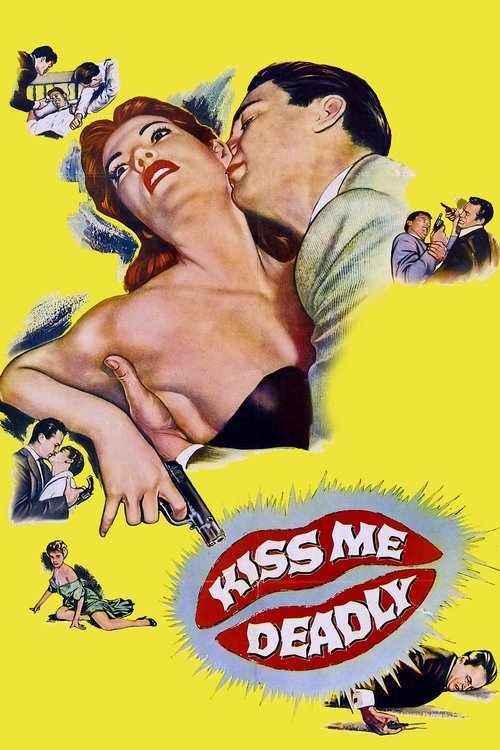
Kiss Me Deadly
1955 · Robert Aldrich
When you want hard-boiled with real teeth: a late-night black-and-white fever dream, not a cozy mystery. Reach for it when you're up for a classic that still feels dangerous.
What it's about
Late one night, private eye Mike Hammer picks up a barefoot, terrified hitchhiker on a lonely road — and within hours she's dead and he's nearly killed. Sensing 'something big' behind it, he bullies his way through a nocturnal Los Angeles of thugs, dames, and frightened scientists toward a mysterious prize everyone will kill for.
The experience
Fast, brutal, and strange — a pulp detective story that keeps curdling into something closer to nightmare, with an atomic-age dread humming under every scene. It's nasty fun that leaves a genuine chill.
Performances
Ralph Meeker plays Hammer as a sneering, venal bully — a private eye stripped of every romantic trait — and the film's whole unsettling charge runs through his grin.
The craft
Robert Aldrich shoots with jagged low angles, inky shadows, and violence that still startles, starting with an opening credit sequence that famously scrolls the wrong way. A.I. Bezzerides' script turns pulp into poison-pen satire, and the sound design saves its most unearthly effect for the object everyone is chasing. Gorgeous, aggressive black-and-white that rewards the biggest screen you can find.
Why it matters
The film that pushed noir to its breaking point — championed by the young French critics who would launch the New Wave, and the source of the glowing 'whatsit' box echoed by cult and crime films for decades after.
The film noir that ends the cycle by detonating it. Robert Aldrich took Mickey Spillane's thuggish private eye Mike Hammer and, with screenwriter A.I. Bezzerides, turned the character inside out: Ralph Meeker plays him as a sneering, venal bully blundering through a nocturnal Los Angeles toward something far bigger than a divorce case — the glowing 'great whatsit' that swallows the genre's every convention into Cold War dread. From the opening — a barefoot woman panting on a highway under credits that scroll the wrong way — Aldrich films with a jagged, low-angle violence that made the Cahiers du cinéma critics swoon; Truffaut and company claimed it as proof that American genre pictures could be modernist art. Its radioactive box echoes through Repo Man, Pulp Fiction and beyond, and its true ending, long circulated in a truncated version, was only restored in 1997. Few films are so cynical about their own hero, or so alive to the apocalypse humming under the streetlights.
A Deleuzian reading
A woman runs down the middle of a night highway with no shoes on, wearing a trench coat and nothing else, and the only thing on the soundtrack is her breathing.
The full Deleuzian reading of Kiss Me Deadly →
Reception
Trashed in the US on release — the Kefauver Commission flagged it as a menace to American youth — while the young critics at Cahiers du cinéma hailed it as a revelation; it's since climbed to apex-noir status, routinely cited among the greatest films noir ever made.
How Kiss Me Deadly was received, from release to now →
Influences: the films it descends from and the films it influenced
- The Maltese Falcon (1941) — Establishes the coveted object that every character kills for and that finally proves worthless ('the stuff dreams are made of'), the MacGuffin template Aldrich weaponizes into the radioactive 'great whatsit.'
- Murder, My Sweet (1944) — Pioneers the brutalized first-person PI subjected to drugging and beating (the swirling 'black pool' subjectivity), the abused-detective template Aldrich escalates into Mike Hammer's sadism.
- Double Indemnity (1944) — Codifies adapting disreputable pulp fiction into fatalistic noir with venetian-blind chiaroscuro low-key lighting, the visual and adaptive grammar Kiss Me Deadly inherits and corrodes.
- Out of the Past (1947) — Nicholas Musuraca's nocturnal chiaroscuro and the doomed detective lured to destruction by a femme fatale supply the doom-laden nightscape Aldrich stages across Los Angeles.
- He Walked by Night (1948) — John Alton's extreme low-angle, single-source expressionist noir lighting models the ground-level upward compositions Ernest Laszlo deploys throughout Kiss Me Deadly.
- Thieves' Highway (1949) — A.I. Bezzerides adapting his own working-class novel establishes the sweat-and-labor blue-collar naturalism the same screenwriter carries into Hammer's grubby LA milieu.
- White Heat (1949) — Ends a crime picture in a literal apocalyptic fireball ('Top of the world, Ma!'), the explosive-annihilation climax that anticipates the beach-house nuclear blast.
- The Testament of Dr. Mabuse (1933) — Builds its dread around an unseen criminal authority known mainly by a disembodied voice on the phone, carrying Lang's curtain-and-loudspeaker mastermind into American noir.
- Criss Cross (1949) — Continues the Bunker Hill location practice as moral topography, shooting the same funicular, retaining walls and rooming houses in high-contrast night exteriors, and inherits the tilted, obstructed framing of figures pressed against real stairwells.
- Breathless (1960) — Built from the American B-noir gestures the Cahiers critics revered in Aldrich, its jump-cut energy channels the same disreputable pulp material into self-aware modernism.
- Alphaville (1965) — Casts a trench-coated detective (Lemmy Caution) into a nuclear-dread dystopia, transposing noir's nocturnal grammar onto science fiction exactly as Aldrich fused the PI film with atomic apocalypse.
- Point Blank (1967) — The affectless, near-mechanical brutal anti-hero on a revenge march, rendered in fractured modernist editing, extends Hammer's amoral single-mindedness into the New Hollywood.
- The Long Goodbye (1973) — Strands an anachronistic private eye in a drifting, zoom-happy nocturnal Los Angeles, deconstructing the hard-boiled detective Aldrich had already begun to indict.
- Chinatown (1974) — A Los Angeles neo-noir in which the detective's investigation uncovers a corruption vastly larger than he can grasp, mirroring Hammer's blundering pursuit of a catastrophe beyond his comprehension.
- Repo Man (1984) — The glowing car trunk that vaporizes onlookers is a direct homage to the radioactive Pandora's-box 'great whatsit,' Cox being an avowed Aldrich devotee.
- Blade Runner (1982) — Fuses noir's low-angle, rain-slick nocturnal detective grammar with apocalyptic technological dread in a future Los Angeles, the same genre-splice Aldrich performed with the atomic bomb.
- Pulp Fiction (1994) — The glowing briefcase whose contents are never revealed lifts Aldrich's unopenable radioactive box directly, preserving the MacGuffin as pure luminous object of lethal desire.
- Mulholland Drive (2001) — Organizes a dread-soaked nocturnal Los Angeles around an unopenable blue mystery-box as an object of annihilating desire, echoing the fatal allure of the whatsit.
- Sin City (2005) — Translated Mickey Spillane's brutal pulp protagonist into noir cinema, the slab-fisted Mike-Hammer archetype that Frank Miller's Marv (and Rourke's performance) directly descends from.
- What Ever Happened to Baby Jane? (1962) — Aldrich's own brutal, unsentimental noir method — pushing genre material toward the grotesque and cruel — is the directorial muscle he channels into the confined two-hander.
- The Dirty Dozen (1967) — Established Aldrich's method of institutions rotting from within alongside editor Michael Luciano's aggressive, rhythm-driven cutting, both carried directly into the later film's crescendo assembly.
- Touch of Evil (1958) — The other 1950s apotheosis of noir: baroque wide-angle low-angle deep focus and a nocturnal border-town of total moral rot, extending Aldrich's ground-level expressionism to its limit.
- The Big Sleep (1946) — Aldrich extends The Big Sleep's intentional-opacity logic to its formal extreme: Hammer's bewilderment at what he is chasing is not a plot failure but the film's argument that the detective's comprehension is structurally capped by design — a position The Big Sleep licenses but stops short of making explicit.
- Bring Me the Head of Alfredo Garcia (1974) — Its nihilistic MacGuffin — the 'great whatsit' everyone kills for — is the direct ancestor of the head-in-the-burlap-sack as an obsessively pursued object emptied of real value.
- The Big Combo (1955) — Same terminal, mannerist phase of the cycle: wide-angle canted chamber compositions and sadism carried by offscreen sound — screams and pliers heard, not seen — so the soundtrack does the censored work.
Similar films
- Touch of Evil (1958) — influence & lineage · same viewing thread
- Murder, My Sweet (1944) — influence & lineage
- Double Indemnity (1944) — influence & lineage
- The Long Goodbye (1973) — influence & lineage
- Mulholland Drive (2001) — influence & lineage
- Point Blank (1967) — influence & lineage
- In a Lonely Place (1950) — same viewing thread
- Pickup on South Street (1953) — same viewing thread
All the films related to Kiss Me Deadly →
Watch it with: curated runs of related films
- The Long Shadow of M — A run from Lang's Weimar crime films through their noir and neo-noir children — killers, con men, masterminds, and manhunts — where you can watch expressionist menace mutate step by step into the modern thriller.