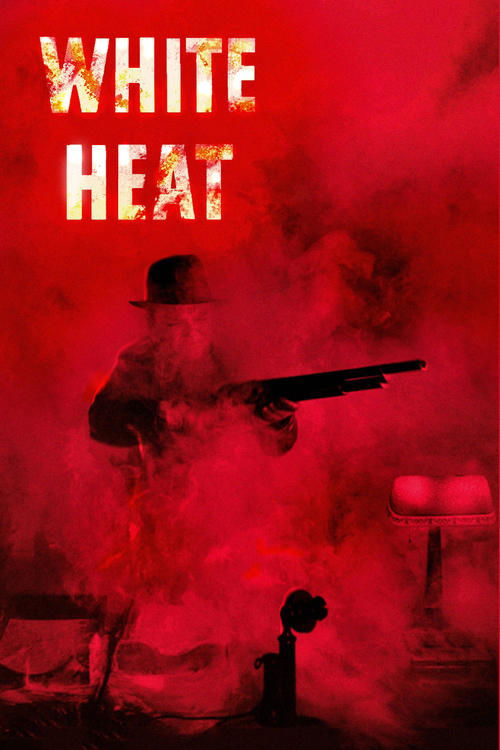
White Heat
1949 · Raoul Walsh
For when you want a crime picture with real teeth — a fast, ferocious classic that proves old Hollywood could be as savage as anything made since. A thrill, not a comfort.
What it's about
Cody Jarrett is a gang leader with blinding headaches, a hair-trigger for murder, and a devotion to his mother that runs deeper than anything else in his life. After a train robbery, he engineers a stay in prison as cover — where the authorities plant an undercover agent in the next bunk to win his trust. What follows is a jailbreak, a chemical-plant payroll heist, and a man coming apart at speed.
The experience
It runs at a hard gallop — ruthless, propulsive, and shockingly violent for its era, with an undertow of genuine psychological unease. You spend the film uncomfortably close to a psychopath who is also magnetic company, and the finish hits with a force that hasn't dimmed since 1949.
Performances
James Cagney, returning to the gangster archetype he helped invent, gives one of the great performances in American crime film: Cody Jarrett is feral, funny, pathetic, and terrifying by turns, his seizures of pain and bursts of grinning violence played with total abandon. Margaret Wycherly is quietly chilling as the mother who is the one steady point in his chaos.
The craft
Raoul Walsh fuses three currents — the Depression-era gangster melodrama, the semi-documentary police procedural, and film noir's shadow-world — into a hybrid that shouldn't cohere and instead becomes one of Hollywood's most ferocious crime films. The set pieces, from the prison mess hall to the final refinery shootout, are staged with brutal clarity.
Why it matters
It detonated the classical gangster film and reset what the genre could be — swapping the rising hood with a code for the criminal as damaged psyche — and its climax is one of the most quoted endings in American movies.
Snapshot
White Heat is the picture that detonated the classical gangster film and salted the crater. Released by Warner Bros. in 1949, it returned James Cagney to the criminal archetype he had helped invent in The Public Enemy (1931) — but the eighteen intervening years had darkened the form past recognition. Cody Jarrett is not a rising hood with a code; he is a migraine-wracked psychopath bonded to his mother, prone to seizures of pain that drop him to the floor, and capable of casual, grinning murder. Raoul Walsh directs the material at a hard gallop, fusing the Depression-era gangster melodrama with two newer currents: the semi-documentary police-procedural cycle then in vogue, and the encroaching shadow-world of film noir. The result is a hybrid that should not cohere and instead becomes one of the most ferocious crime films Hollywood produced in the studio era, culminating in an image — Cagney atop an exploding gas tank, screaming "Made it, Ma! Top of the world!" — that has outlived nearly everything around it.
Industry & production
White Heat was a Warner Bros. production, and its making is inseparable from Cagney's fraught relationship with that studio. Through the 1930s Cagney had been Warners' combustible house tough, repeatedly in contractual revolt over money and roles. In the mid-1940s he broke away to run Cagney Productions, an independent venture with his brother William, but its slate (including Johnny Come Lately and the ambitious The Time of Your Life) underperformed. White Heat marks Cagney's return to the Warner lot and to the genre that had made him — a commercially pragmatic reunion that both sides understood.
The screenplay is credited to Ivan Goff and Ben Roberts, working from a story by Virginia Kellogg, a writer who specialized in researched, social-problem crime material (she would soon co-write the women's-prison drama Caged). Kellogg's story contribution drew on the period's interest in modern law-enforcement methods, and it earned her an Academy Award nomination for Best Motion Picture Story. The producer was Louis F. Edelman. The film was shot on Warners' soundstages and Los Angeles–area locations, with the climactic finale staged at a chemical/gas plant whose spherical storage tanks supply the film's apocalyptic final image. Beyond these established credits the granular production record — shooting schedule, budget, exact location particulars — is not something I can document precisely here, and I won't invent figures.
Technology
White Heat is unusually preoccupied, for a gangster picture, with the apparatus of policing — and that preoccupation is itself a technological signature of its moment. The late-1940s crime film had absorbed a fascination with scientific law enforcement from the semi-documentary cycle (The House on 92nd Street, T-Men, He Walked by Night). Here the Treasury agents track Cody's gang using a radio direction-finder: a transmitter is planted, and pursuers triangulate the signal on an oscilloscope-style display, the camera lingering on dials and rotating antennae. Spectrographic and forensic methods are name-checked as the manhunt tightens. This procedural hardware is presented with documentary gravity — explanatory, almost instructional — and it functions structurally as the rational, collective counterweight to Cody's irrational individual violence. The technology is the film's argument that the lone criminal cannot outrun an organized modern state.
Technique
Cinematography
Sidney Hickox photographed the film, and his work bridges two visual idioms. The procedural and daylight exterior material is shot with documentary clarity, but the prison interiors, the night work, and the gang's hideouts lean hard into the noir vocabulary Hickox knew well (he had shot The Big Sleep and Dark Passage): low-key lighting, deep pools of shadow, faces half-swallowed by darkness. The camera is mobile and aggressive in Walsh's manner — tracking with the action rather than observing it — and reserves its most expressive compositions for Cody's breakdowns, where framing tightens claustrophobically around Cagney. The final sequence at the gas plant exploits scale and silhouette, the small figure of Cody dwarfed by industrial spheres before the conflagration whites out the frame.
Editing
Owen Marks cut the film, and the editing is calibrated to Walsh's velocity. The picture moves: the early train robbery is dispatched with brutal economy, and the cross-cutting between the gang's movements and the agents' tracking apparatus builds the procedural tension that drives the second half. The editing's most celebrated moment, however, is one of restraint within chaos — the prison mess-hall scene, where the cutting holds on Cagney long enough to let the seizure of grief play out and then relays its shock outward to the surrounding inmates and guards, the camera and cuts following the disturbance as it ripples down the long tables.
Mise-en-scène / staging
Walsh's staging is built around contained spaces that Cody violates with violence: the cramped mountain hideout, the prison, the back of a car. The single most quoted staging gag — Cody, irritated by a whining captive locked in a car trunk who complains it's "stuffy," firing his pistol into the trunk to provide "air" — compresses his entire character into one offhand gesture of lethal whimsy. Domestic space is weaponized too: the recurring image of the grown, murderous Cody seated on his mother's lap, or being soothed by her during a migraine, makes the Jarrett kitchen as disturbing as any crime scene. The gas-plant climax stages industry itself as a deathtrap, the geometry of catwalks and tanks turning the set into the arena for Cody's self-immolating apotheosis.
Sound
Sound is dramatically functional throughout — the procedural sequences depend on the audible whine and pulse of tracking equipment, gunfire punctuates the action with documentary flatness — but the film's sonic signature is the human voice. Cagney's vocal performance ranges from clipped command to the animal howling of his pain attacks and the final, cracked exultation atop the tank. The detailed technical record of the sound department's work is thin in the standard literature, but the design's priorities are unmistakable on screen.
Performance
The film is a performance event organized around James Cagney, who plays Cody Jarrett as a man whose violence is continuous with his vulnerability. The mother-fixation, the headaches that fold him double, the sudden tonal swerves from cooing affection to homicide — Cagney makes the pathology legible without softening it. The mess-hall sequence, in which Cody receives word of his mother's death and collapses into an inhuman keening that has to be wrestled out of the room by guards, is one of the most extreme acting passages in studio-era Hollywood; the long-circulated account that the surrounding extras' alarmed reactions were partly genuine, because Cagney's choices weren't fully telegraphed in advance, is plausible and oft-repeated, though it should be treated as production lore rather than documented fact.
Around him, Margaret Wycherly's Ma Jarrett is a chilling matriarch — the source and mirror of Cody's derangement, hard and devoted in equal measure. Virginia Mayo plays Verna, Cody's faithless, status-hungry wife, with a brassy opportunism. Edmond O'Brien carries the moral and procedural weight as Hank Fallon, the undercover agent who insinuates himself into Cody's confidence under the alias "Vic Pardo," and O'Brien's quiet duplicity — the betrayal of a friendship Cody genuinely feels — supplies the film's tragic undertow. Steve Cochran is effective as the treacherous lieutenant Big Ed.
Narrative & dramatic mode
The screenplay braids two modes that the period usually kept separate. One strand is the criminal psychodrama: Cody's relationship with Ma, his disintegration after her death, his displaced attachment to the undercover "Vic." The other is the police procedural: the patient, technological, institutional pursuit of the gang. The film's structural ingenuity is to run these on a collision course, with the undercover-informant device (Fallon befriending Cody inside prison) as the hinge that joins them. Dramatic irony saturates the back half — we know Vic is Fallon, and Cody's trust becomes unbearable to watch. The mode is ultimately tragic in shape if not in sympathy: Cody is doomed from the first reel, and the narrative is the mechanism of his destruction, engineered partly by the state and partly by his own unraveling mind.
Genre & cycle
White Heat sits at a genre fault line. It is a late, self-aware entry in the Warner Bros. gangster tradition the studio had defined in the early 1930s, and it consciously summons that lineage by recasting Cagney as a criminal. But it is also a noir-inflected crime film and a participant in the late-1940s semi-documentary policier cycle. It does not belong cleanly to any one of these; it is the film in which the optimistic, sociological gangster figure of the Depression curdles into the postwar psychopath, and in which the genre's energy migrates from the criminal's rise to his pathology and his hunting-down. In that sense it is both a culmination and a terminus of the classical gangster cycle.
Authorship & method
Raoul Walsh was among the most reliable action stylists of the studio system, a director of kinetic, unfussy momentum whose filmography includes The Roaring Twenties (1939, also with Cagney), They Drive by Night, High Sierra (which had already pointed the gangster toward fatalism), and Objective, Burma!. Walsh's authorial method was not the imposition of overt visual signature but the propulsive, economical staging of physical action and the willingness to let strong performers go to extremes — exactly what White Heat requires. His direction frames Cagney's pyrotechnics without taming them and keeps the procedural machinery moving with documentary briskness.
His key collaborators here form a recognizable Warners craft team. Writers Ivan Goff and Ben Roberts (a long-running screenwriting partnership) built the dual-mode structure from Virginia Kellogg's researched story. Cinematographer Sidney Hickox supplied the noir-procedural visual blend. Editor Owen Marks shaped the tempo. The score is by Max Steiner, Warners' preeminent house composer, whose music underlines both the action and Cody's psychological storms with the full-orchestral late-Romantic idiom Steiner had brought to dozens of the studio's pictures. The dominant authorial presence over all of them, however, remains Cagney, whose star persona and performance choices effectively co-author the film.
Movement / national cinema
This is classical Hollywood studio filmmaking at high efficiency — a Warner Bros. genre picture made within the vertically integrated American system shortly before that system began to fracture under the Paramount antitrust decree and television's rise. It is not a movement film in the European sense, but it participates in the broader postwar American crime-cinema current that later critics would gather under the term film noir, and in the specifically American semi-documentary mode that grew out of wartime newsreel and information filmmaking. Its national character is emphatic: institutional faith in scientific law enforcement set against a homegrown, almost mythic figure of violent individualism.
Era / period
White Heat is a deeply postwar artifact. Released in 1949, it registers a darker, more clinical national mood than the gangster films of the 1930s: an interest in psychopathology and in the disturbed individual, a fascination with technocratic state power, and an undercurrent of anxiety that pairs naturally with the era's atomic and Cold War tensions — the final mushrooming explosion has invited (retrospective) atomic readings, though the film itself makes no such explicit claim. It belongs to the brief, rich window of late-1940s American crime filmmaking before the genre dispersed into 1950s syndicate dramas and television.
Themes
The governing theme is pathology — criminality reconceived not as social product but as mental illness, rooted in a grotesque Oedipal attachment. Cody's bond with Ma is the film's psychological engine, and her death is the catastrophe from which he cannot recover; the displacement of that need onto the false friend "Vic" turns the betrayal-of-trust theme into something almost unbearably intimate. Against the individual's derangement stands the institution: the film repeatedly contrasts Cody's chaotic, mother-dependent isolation with the patient, collective, technologized machinery of the Treasury agents. There is a sustained meditation on betrayal — within the gang, within the marriage, and at the film's moral center, where the law's victory is achieved through the systematic abuse of a damaged man's affection. And there is the theme of self-destruction, literalized in the suicidal triumph of the ending, where annihilation and ecstasy become the same gesture.
Reception, canon & influence
White Heat was well received on release and restored Cagney's standing as a screen force, with his performance singled out as a tour de force; Virginia Kellogg's Oscar nomination for the story confirmed the industry's regard. Over the following decades the film's reputation only grew, and it is now routinely ranked among the greatest gangster films and a landmark of late classical Hollywood; the U.S. Library of Congress's National Film Registry has recognized it for preservation.
Looking backward, the film draws on the Warner Bros. gangster tradition Cagney himself had founded, on the fatalism Walsh had already explored in High Sierra, and on the semi-documentary procedural cycle that taught late-1940s crime films to revere forensic technique. The Freudian framing of criminality reflects the period's broader popular psychologizing.
Looking forward, its influence is large and durable. Cody Jarrett became a template for the screen psychopath — the criminal defined by mental disturbance rather than social grievance — and the mother-fixated killer echoes through later crime cinema. The undercover-informant structure, with its agonizing dramatic irony, has been reworked countless times. Above all, the final image and its line — "Made it, Ma! Top of the world!" — became one of the most quoted and parodied endings in American film, an instantly legible shorthand for doomed, self-immolating ambition. Cagney's performance, and the film's fusion of psychodrama with procedural, remained a reference point for the gangster and crime filmmakers who followed, securing White Heat's place as both an end and a hinge in the history of the form.
A Deleuzian reading
The news comes down the long prison table the way a current moves through water — a whisper passed mouth to mouth until it reaches Cody Jarrett, hunched over his tray.
The full Deleuzian reading of White Heat →
Reception
A hit on release in 1949 — though some critics were rattled by just how feral Cagney was allowed to be — it's since been canonized as the ferocious grand finale of the Warner Bros gangster cycle, and joined the National Film Registry in 2003.
How White Heat was received, from release to now →
Influences: the films it descends from and the films it influenced
- The Public Enemy (1931) — Established the Cagney gangster persona — the small, coiled, eruptively violent figure whose physical unpredictability (the grapefruit, the sudden brutality) Cody Jarrett inherits and pathologizes.
- The Roaring Twenties (1939) — Walsh's earlier Cagney vehicle that paired his propulsive, economical staging of rise-and-fall criminal action with Cagney's star physicality — the same director-star working method White Heat refines.
- High Sierra (1941) — Walsh's own template for the doomed criminal driven to a fatal mountain-top last stand, supplying the fatalism and the elevated-terrain immolation finale White Heat restages atop the gas tank.
- Angels with Dirty Faces (1938) — Built the Cagney death-set-piece as moral spectacle (the feigned-cowardice electric-chair walk), establishing the convention of the Cagney criminal exiting in a charged, performed finale that 'Top of the world!' fulfills.
- Scarface (1932) — Pioneered the gangster defined by sexual-familial fixation (Tony's possessive obsession with his sister), the Freudian psychopathology White Heat transfers to the mother-bond.
- T-Men (1947) — Codified the undercover-agent-embedded-in-the-gang plot with semi-documentary narration and John Alton's low-key photography, the forensic-procedural craft White Heat fuses to its psychodrama.
- The House on 92nd Street (1945) — Originated the semi-documentary policier's reverence for surveillance technology and bureaucratic technique narrated with newsreel authority — the procedural register of White Heat's tailing and radio direction-finding.
- He Walked by Night (1948) — Advanced the scientific-police-method procedural (composite sketches, forensic labs, manhunt-by-technology), the documentary briskness White Heat's investigative track borrows.
- Key Largo (1948) — Cagney's Cody Jarrett is the terminal convulsive figure of the classic gangster cycle that Key Largo's Rocco anticipates closing; Walsh pushes the archetype into explicit psychopathology as the genre exhausts the criminal-strongman model Key Largo had already marked as historically obsolescent.
- Pursued (1947) — Walsh extends Pursued's Freudian architecture into noir crime with the overtly Oedipal, mother-fixated Cody Jarrett, again making psychological pathology the engine of action.
- Psycho (1960) — Inherits and literalizes White Heat's mother-fixated killer, making the smothering maternal bond the engine of psychopathology — Cody's 'Ma' obsession taken to its Freudian extreme.
- Bonnie and Clyde (1967) — Carries forward the self-immolating-ambition arc and the criminal's spectacular, doom-laden death as climax, modernizing the 'top of the world' blaze-of-glory exit.
- Donnie Brasco (1997) — Reworks White Heat's undercover-informant structure and its agonizing dramatic irony — the planted agent earning the trust of the criminal he must betray.
- Heat (1995) — Mann descends directly from the T-Men/White Heat procedural line, splitting the film between meticulous cop technique and criminal psychology in the dual-mode structure White Heat balanced.
- The Departed (2006) — Extends the undercover-mole architecture and its sustained dramatic irony, building suspense from the audience's knowledge of the informant's true identity exactly as White Heat does with Fallon/Pardo.
- GoodFellas (1990) — Walsh's refusal to frame Cody Jarrett's psychotic violence within a redemptive moral arc — presenting gangster charisma as seductive spectacle while withholding corrective judgment — established the demythologizing register GoodFellas inherits, where the criminal world is glamorized and indicted simultaneously without resolving the tension.
- Carlito's Way (1993) — Proves that Greek tragedy mechanics work inside the American gangster genre: the protagonist's single inalienable loyalty becomes the exact mechanism of self-destruction, converting genre film into classical tragedy — the structural template that Carlito's Way's Kleinfeld plot inherits directly.
- Mesrine: Public Enemy #1 (2008) — Walsh's anti-redemptive gangster arc — refusing to morally contain the protagonist's violence, transforming his destruction into perverse apotheosis — establishes the structural template for Mesrine's final ambush as fulfillment rather than punishment, the outlaw immolated by the legend he constructed.
- Bugsy (1991) — Cagney's charismatic-narcissist gangster — psychological volatility carried entirely by star magnetism — is the performance template Beatty channels for Siegel's seductive instability.
- Scarface (1983) — Cagney's psychotic, mother-fixated gangster and his 'Top of the world!' immolation are the operatic-megalomania template behind Tony's coked-out 'world is yours' final apotheosis.
- Kiss Me Deadly (1955) — Ends a crime picture in a literal apocalyptic fireball ('Top of the world, Ma!'), the explosive-annihilation climax that anticipates the beach-house nuclear blast.
- Kiss of Death (1947) — Richard Widmark's giggling Tommy Udo launched the postwar screen psychopath defined by mental disturbance rather than social grievance — the same template Cody Jarrett's migraines and laughter perfect contemporaneously.
- The Asphalt Jungle (1950) — Extends the doomed-criminal fatalism and contained-space caper craft into a cool procedural register, the heist-as-clockwork sibling to White Heat's planning-and-pursuit machinery.
- Gun Crazy (1950) — Pairs psychosexually compulsive criminality with mobile-camera kinetics (the in-car robbery long take), the same marriage of pathology and propulsive staging White Heat practices.
- White Heat (1949) — Seed.
- The Funeral (1996) — Pathological family-bond gangster psychology where grief and loyalty curdle into self-destruction — the affective engine behind Walken's and Penn's fraternal mourning and rage.
- Caged (1950) — Contemporaneous Warner noir routed through the same craft departments — including Max Steiner's disciplined, punctuating score — applying expressionist penal imagery to the institution.
Similar films
- The Roaring Twenties (1939) — influence & lineage
- Heat (1995) — influence & lineage
- Scarface (1932) — influence & lineage
- High Sierra (1941) — influence & lineage
- Stalag 17 (1953) — shared sensibility
- The Big Heat (1953) — shared sensibility
- Dirty Harry (1971) — shared sensibility
- I Am a Fugitive from a Chain Gang (1932) — shared sensibility
All the films related to White Heat →