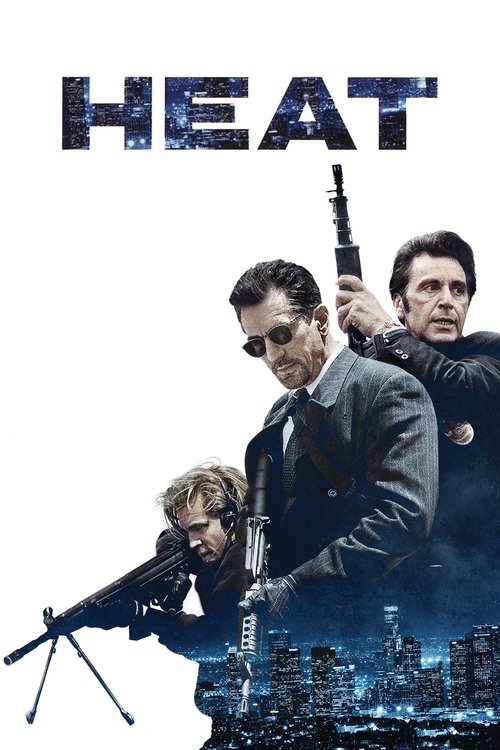
Heat
1995 · Michael Mann
For when you want a serious, immersive crime saga to give a whole evening to — tense and adult rather than escapist, and worth the commitment. Reach for it when you're in the mood for craft and consequence, not popcorn.
What it's about
In Los Angeles, a master thief runs a disciplined crew through a series of high-stakes heists while a relentless detective works to bring him down. The two men are mirror images — equally obsessive, equally alone, each aware the other is the best he's ever faced — and the film gives as much weight to their fraying marriages and private codes as to the scores themselves. It's a cops-and-robbers story scaled up to a full portrait of a city.
The experience
Nearly three hours that never feel long: patient, brooding stretches punctuated by action of overwhelming force and precision. It's cool-blooded and melancholy at once — a thriller that keeps making you feel the loneliness underneath the professionalism.
Performances
Al Pacino and Robert De Niro, sharing the screen in their prime, play the pursuit as a duet — De Niro coiled and controlled, Pacino live-wire volatile — and their one face-to-face conversation is among the most celebrated two-hander scenes in American movies. The deep supporting cast, Val Kilmer especially, matches them.
The craft
Michael Mann shoots Los Angeles at night like no one else — glass towers, freeways and empty spaces rendered vast and cold — and stages a downtown street shootout whose deafening, precise sound design remains a benchmark. This is a film built for the biggest screen and the best speakers you can find.
Why it matters
It became the canonical modern heist film, studied and imitated by crime filmmakers and game designers for thirty years, and cemented Mann's reputation as the poet of the American professional. Its influence on how movies stage gunfights alone is immeasurable.
Snapshot
Heat is a 170-minute crime epic in which Los Angeles detective Vincent Hanna (Al Pacino) and professional thief Neil McCauley (Robert De Niro) pursue each other across the geography of a city that neither man truly inhabits. Its central gambit — presenting antagonist and protagonist as mirror images who recognize each other across an unbridgeable divide — had been circling Michael Mann's imagination for more than a decade before the film reached Warner Bros. screens in December 1995. The result is one of the most formally ambitious American studio crime films of the decade: simultaneously a rigorous heist picture, a neo-noir meditation on masculine alienation, and a widescreen study of Los Angeles as a city whose vastness enforces solitude. It has aged into a canonical text, cited as a primary influence on a generation of crime filmmakers and on the action aesthetics of contemporary Hollywood at large.
Industry & production
The script's genealogy runs to Mann's research in the mid-1980s, when former Chicago detective and consultant Chuck Adamson told him about tracking a real career criminal named Neil McCauley, who was killed in 1964 after Adamson's unit closed in. Mann absorbed the story into his television series Crime Story (1986–88) and then channeled the Hanna/McCauley dynamic — including an account of the two men sharing coffee and acknowledging each other's professionalism — into L.A. Takedown, a 1989 NBC television movie that served as an explicit dry run for Heat. Dissatisfied with the constraints of the TV format, Mann spent the following years expanding the screenplay and reconceiving the project for the theatrical scale he felt the material demanded.
The studio packaging of Pacino and De Niro, who had shared the frame in The Godfather Part II (1974) but never appeared in a scene together, gave Warner Bros. a promotional event of rare magnitude: two titans of the post-Method generation in their first genuine on-screen confrontation. The film was produced by Mann's own Forward Pass Productions in association with Art Linson Productions. Mann maintained extensive creative control, shooting on location throughout Los Angeles with a large ensemble — Val Kilmer, Jon Voight, Tom Sizemore, Diane Venora, Amy Brenneman, Ashley Judd, Natalie Portman, Wes Studi, Ted Levine, Dennis Haysbert, and William Fichtner among them — and bringing to the production the meticulous research culture he had developed in television. The budget ran to approximately sixty million dollars. The film performed solidly at the domestic box office, though commercial tracking at the time underestimated the degree to which it would become, over subsequent years, a touchstone of the form.
Technology
Heat was shot on 35mm film using Panavision anamorphic lenses at a 2.39:1 aspect ratio — a choice that aligned the visual grammar of the wide Western landscape with the horizontal sprawl of the Los Angeles basin. Location shooting was unusually extensive even by the standards of LA-set productions: the downtown streets, freeways, warehouses, and beachfront homes that constitute the film's geography were all practical locations, photographed with available and augmented practical light rather than the hermetically controlled studio environment that dominated major studio productions of the period.
The film's most celebrated technological decision concerns sound. For the downtown Los Angeles bank robbery and its prolonged running firefight, the production recorded live gunfire using blanks on the actual streets of downtown LA, capturing the specific acoustic signatures of those concrete canyons — the crack, report, and echo of automatic weapons in an urban grid. Sound designer and supervising sound editor Bob Beemer and the sound team preserved this environmental reverb in the final mix rather than substituting library sounds processed in post, and the result — an overwhelming, almost industrial assault of overlapping ricochets and echoes — was unlike anything contemporary action cinema had produced. Mann was operating entirely within photochemical and analog production technologies; he would not begin experimenting with digital video acquisition until Ali (2001), a formal shift that would define the second half of his career.
Technique
Cinematography
Dante Spinotti, the Italian-born director of photography who had already collaborated with Mann on Manhunter (1986), brings a precision to Heat's widescreen compositions that is inseparable from its thematic architecture. Los Angeles at night is rendered in deep blues and gray-greens — the palette of surveillance and alienation — while warm domestic interiors register as fragile intrusions of color against the city's cold metallic dominance. Spinotti and Mann favour long focal lengths that flatten depth and compress the city into layered surfaces: glass towers, freeway interchanges, and the dark Pacific are recurring visual environments rather than mere backdrops. Overhead shots — including a famous bird's-eye view of the freeway system that opens McCauley's pursuit of the armored truck — establish surveillance as a structural metaphor, the city itself appearing to monitor its inhabitants from above. Interior framings, especially in the diner scene between Hanna and McCauley, make careful use of two-shot compositions that place the men in shared space before isolating them in close-up: the camera's grammar enacts the film's argument about doubling and unbridgeable separation.
Editing
Heat employed four editors — Dov Hoenig, Pasquale Buba, William Goldenberg, and Tom Rolf — an unusually large editorial team whose division of labor across the film's sequences reflected the scale and tonal range of the material. The film's rhythm is its most demanding formal achievement: extended passages of procedural preparation and domestic life are interrupted by sudden, concentrated violence, and the editing must calibrate the audience's readiness for each register. The downtown shootout is cut with almost musical precision, the cross-cutting between McCauley's crew, Hanna's units, and civilian bystanders organized around the acoustic rhythm of the gunfire rather than conventional action-continuity principles. Elsewhere, and especially in the film's final movement, Mann uses extended takes and restrained cutting to let performances breathe — a patience unusual in studio crime cinema of the period.
Mise-en-scène / staging
Mann's staging consistently expresses his thematic preoccupations through physical environment. The homes of McCauley and Hanna are telling: McCauley occupies a minimalist beachfront house in which every surface is bare, nothing personal visible, the dwelling configured for rapid evacuation — a space that instantiates his own rule about never being attached to anything he cannot walk away from in thirty seconds. Hanna's domestic space is perpetually disrupted, his third marriage dissolving around him, the household disorder the physical correlate of his professional absorption. The film's setpieces — the armored truck heist, the bank robbery, the airport confrontation — are staged with logistical clarity that Mann had developed partly through his television training and partly through direct research with law enforcement and former criminal consultants. The bank robbery sequence in particular is choreographed with the spatial specificity of documentary reconstruction: the positions of crew members, responding units, and civilians are tracked with a precision that gives the sequence the quality of a terrible rehearsal finally going live.
Sound
Beyond the landmark gunfire design, the film's sonic architecture reflects Mann's understanding of ambient urban texture as a dramatic resource. Elliot Goldenthal's orchestral score occupies portions of the film with a cold, angular grandeur that keeps sentiment at a formal distance, while Mann supplements it with electronic and ambient pieces — most notably Moby's "God Moving Over the Face of the Waters," which accompanies the film's final sequence, and pieces by Brian Eno that drift through transitional passages — creating a layered soundscape that blurs the boundary between score and environmental sound. The film's use of silence is equally deliberate: the diner scene between Pacino and De Niro is almost entirely devoid of underscore, the ambient noise of the restaurant pushed low, so that the scene exists in a kind of acoustic isolation that marks it as categorically distinct from the surrounding film.
Performance
The Pacino/De Niro pairing is constructed around deliberate tonal contrast. Pacino's Hanna is excessive, hyperarticulate, his famous tendency toward declamatory enlargement here presented as the behavior of a man who cannot modulate his professional intensity into ordinary life. De Niro's McCauley is its inverse: contained, economical, a man whose emotional life has been systematically reduced to professional competence. The contrast was a conscious directorial choice, not an accidental divergence of acting styles, and Mann has spoken of orchestrating it to make the men's fundamental kinship — their shared single-mindedness — all the more visible beneath the surface difference. Val Kilmer, in what many observers consider the performance of his career, brings a physical menace to Chris Shiherlis that operates almost entirely through the body rather than speech. The ensemble work — particularly Diane Venora as Hanna's disintegrating wife and Natalie Portman in an early role as Hanna's suicidal stepdaughter — sustains the film's argument that the cost of extreme professional commitment is specifically the destruction of the domestic.
Narrative & dramatic mode
Heat operates structurally as a dual-protagonist crime picture in which the conventional moral polarity of detective and criminal is suspended rather than inverted. Both men are coded as exceptional practitioners; both are shown destroying their intimate relationships through professional absorption; both are, in the film's ethical accounting, casualties of their own excellence. The film's dramatic mode is fundamentally elegiac: the action sequences are presented not as spectacle to be celebrated but as the material consequence of choices that have already foreclosed other lives. The diner scene — in which Hanna and McCauley share coffee and explicitly acknowledge each other's situation — is the film's dramatic center of gravity precisely because it stages the conversation the film has been building toward: two men who have organized their entire existences around an adversarial structure that is also, the scene suggests, the only genuine understanding either has known. The narrative's tragic logic is that this mutual recognition cannot alter the structural outcome; neither man can deviate from the course his choices have determined.
Genre & cycle
Heat works simultaneously within and against several genre traditions. It belongs to the heist film lineage that runs through Rififi (Jules Dassin, 1955), The Killers (Don Siegel, 1964), and above all the films of Jean-Pierre Melville — particularly Le Samouraï (1967) and Le Cercle Rouge (1970) — in its investment in the professional criminal as a figure of existential discipline, stripped of sentiment, operating by a private code whose rigor is inseparable from its tragedy. From the American police procedural tradition it borrows the institutional texture of law enforcement and the structural cross-cutting between investigator and investigated. The film participates in the mid-1990s American crime renaissance — alongside Pulp Fiction (Tarantino, 1994), The Usual Suspects (Singer, 1995), and Seven (Fincher, 1995) — but distinguishes itself by its scale and by its refusal of irony: where Tarantino foregrounds genre self-consciousness, Mann treats the crime film with an earnestness that is closer to Melville or Siegel than to the postmodern meta-cinema surrounding it.
Authorship & method
Mann had been developing a consistent authorial signature since Thief (1981), his theatrical debut, which introduced many of the preoccupations Heat would elaborate: the professional criminal who cannot abandon his craft even when survival demands it, the cold beauty of American urban space at night, and the formal use of widescreen to articulate solitude within density. His television production — Miami Vice (1984–89), Crime Story — expanded his facility with serialized procedural structure and with location-based, available-light aesthetics that could read as simultaneously glamorous and clinical.
Dante Spinotti's contribution to Heat's visual identity is substantial enough to warrant recognition as collaborative rather than merely executive. The blue-tinted nocturnal palette that has become the film's visual signature was developed in close collaboration between Mann and Spinotti, as was the specific use of telephoto compression to collapse LA's distances into a claustrophobic geometry. Elliot Goldenthal, who had composed scores for Interview with the Vampire (1994) and would go on to Titus (1999) and Final Fantasy: The Spirits Within (2001), brings to Heat a compositional approach that holds emotion at arm's length through modernist angularity, complementing rather than underlining the film's refusal of conventional sentiment. The film's editing team — working under Mann's detailed oversight — developed the tonal alternation between procedural patience and explosive violence that became a template for subsequent crime filmmaking.
Movement / national cinema
Heat is an American studio film of the 1990s and participates in the specifically Californian tradition of using Los Angeles as a site of existential inquiry rather than mere setting. The city in Heat is not the mythologized Los Angeles of noir — not the corrupt paradise of Chinatown or The Long Goodbye — but a post-mythological space of pure function: freeways, glass towers, container terminals, and bleached suburban sprawl from which all romantic residue has been stripped. This is Los Angeles as infrastructure, as a city that enables and accelerates movement without providing anywhere to stop. Mann's treatment of the city aligns him loosely with other 1990s Los Angeles filmmakers — most notably Michael Connelly's novelistic vision of the city, or the spatial anxiety of Strange Days (Bigelow, 1995) and Falling Down (Schumacher, 1993) — but Heat's LA is finally more indebted to Melville's Paris than to the Los Angeles of classical Hollywood: a city as stage for private codes enacted between men who have reduced their lives to professional geometry.
Era / period
The mid-1990s were the final extended period in which major American studios regularly financed prestige adult crime films at the scale Heat required. The superhero era and the franchise consolidation that would define post-2000 Hollywood had not yet foreclosed the space for such work, and the decade produced an unusual concentration of formally ambitious crime pictures for adult audiences. Heat was among the last of these made at full studio scale with no concessions to franchise logic or demographic hedging. Its 170-minute running time, its moral complexity, its refusal of simple catharsis, and its investment in the texture of professional life over action spectacle mark it as a product of a specific industrial window that closed relatively quickly after its release.
Themes
The film's dominant preoccupation is the cost of single-minded excellence: both Hanna and McCauley have achieved mastery in their respective fields at the expense of everything else a life might contain. McCauley articulates his philosophy explicitly — never let yourself become attached to anything you cannot walk away from in thirty seconds if you feel the heat around the corner — and the film tracks the consequences of that philosophy with rigorous consistency. Hanna's counterpart absorption in detection has produced three failed marriages and a domestic life that is effectively fictional, a series of relationships he inhabits only between cases. Both men are, in the film's language, professionals who have mistaken their vocation for their identity, and the film presents this as a specifically masculine pathology rooted in a version of American individualism that valorizes self-sufficiency until it becomes self-erasure.
Related to this is the film's interest in the double: Hanna and McCauley are mirror images not in a superficial genre sense but in a structural one, and the film consistently stages their relationship as a form of unacknowledged intimacy. The diner scene makes this explicit; the final airport confrontation, in which Hanna holds McCauley's hand as he dies, makes it overwhelming. Mann is not interested in the homosocial undercurrent as subtext to be decoded; it is the text, the film's argument about what masculine codes of professionalism both enable and foreclose.
Reception, canon & influence
Heat was received respectfully but not rapturously on initial release. Critics acknowledged its ambition and the landmark quality of the Pacino/De Niro pairing, though some found its length excessive and its emotional register too austere for popular enthusiasm. The film's reputation grew steadily over the following decade as it circulated on home video and cable, and by the 2000s it had achieved something close to consensus canonical status within the crime genre.
Influences on the film (backward): The clearest antecedent is Jean-Pierre Melville, whose professional-criminal films — Le Samouraï, Le Cercle Rouge, Un flic — provided the tonal and ethical template for McCauley's character and for the film's treatment of criminality as vocation. Don Siegel's tight, efficient crime films, particularly The Killers (1964), are a more proximate American influence. Mann's own Thief (1981) is essentially the same argument in an earlier, more compressed form. The research foundation provided by Chuck Adamson's account of tracking the real Neil McCauley gave the film its factual armature and the coffee-shop meeting that became the diner scene.
Legacy / what it shaped (forward): Heat's influence on subsequent crime cinema and action filmmaking is pervasive and largely uncontested. Christopher Nolan has cited it directly and demonstrably in The Dark Knight (2008), whose opening bank robbery sequence, cat-and-mouse structure between detective and criminal, and thematic architecture of mirrored identities owe clear debts to Mann. The downtown LA firefight's acoustic design — its insistence on realistic rather than stylized gunfire — influenced a generation of action films and entered video game design through productions that explicitly studied the sequence. Nicolas Winding Refn's Drive (2011) operates within a Melville-Mann lineage that Heat made legible to a new generation of filmmakers. Mann's own subsequent work — Collateral (2004), Miami Vice (2006), Public Enemies (2009) — extends, varies, and sometimes deconstructs the formal and thematic concerns Heat consolidated. The film's central conceit of the professional criminal and the professional detective as tragic doubles has become sufficiently familiar to read, in retrospect, as genre convention; Heat is largely responsible for making it one.
A Deleuzian reading
Two men sit across a table in a Los Angeles coffee shop.
The full Deleuzian reading of Heat →
Reception
Well-reviewed in 1995 but famously shut out of the Oscars and treated as just a classy crime thriller; in the decades since it's been elevated to masterpiece status — routinely called the greatest heist film ever made, with a 4K restoration, endless retrospectives, and even a Mann-penned sequel novel (Heat 2) confirming its canonization.
How Heat was received, from release to now →
Influences: the films it descends from and the films it influenced
- Le Samouraï (1967) — McCauley's 'thirty seconds flat' rule of non-attachment directly inherits Melville's professional-as-ascetic archetype: the criminal defined entirely by operational code rather than psychology, rendered through spare behavioral observation instead of interior monologue.
- Le Cercle Rouge (1970) — Provides Heat's structural template for the ensemble heist film: strangers converging into a professional unit, observed with detached procedural precision, within an elegiac frame that positions skilled men as already-doomed before the finale begins.
- Rififi (1955) — The 28-minute silent heist sequence — executed in real time without music, using only ambient sound — established the procedural-realism standard for depicting thieves at work that Heat's vault-preparation and execution sequences inherit: camera as neutral professional observer rather than dramatic amplifier.
- Point Blank (1967) — Boorman's telephoto compression of LA's mid-century modernist architecture — parking garages, industrial waterfronts, concrete interchanges — into geometrical traps for a professional protagonist who cannot stop anticipates Mann's use of the same city as an alienating surveillance system.
- The Friends of Eddie Coyle (1973) — Victor Kemper's location-realist available-light photography of Boston's industrial districts strips crime of glamour and presents cops and criminals as working professionals in a shared ecosystem — a direct precedent for Heat's unglamorous proceduralism and its treatment of urban industrial geography as operational terrain rather than noir backdrop.
- Thief (1981) — Mann's own prototype: Tangerine Dream's electronic score established the ambient-layered-score template Heat would evolve through Moby and Brian Eno; Dean Tandy's neon-nocturnal Chicago palette prefigures Spinotti's nocturnal-blue LA; and Caan's explicit professional-code monologue is the direct verbal precursor to McCauley's 'thirty seconds' speech.
- Manhunter (1986) — The first Mann-Spinotti collaboration established every cinematographic parameter Heat would refine: telephoto compression flattening urban space into surveillance geometry, blue-green nocturnal palette of alienated masculinity, and the dual-protagonist mirror structure in Will Graham/Hannibal Lecktor anticipating Hanna/McCauley through compositions that physically rhyme the pursuer with the pursued.
- The French Connection (1971) — Mann and DP Dante Spinotti extended French Connection's professional-competence procedural into scope-ratio location filmmaking, with the downtown Los Angeles bank robbery sequence shot on actual streets without road closure — the same commitment to live urban space and genuine crowd displacement that Friedkin used in the Brooklyn elevated-railway chase.
- Carlito's Way (1993) — Extends De Palma's technique of extended scene duration into a full formal strategy of atmospheric patience — holding the diner confrontation and tactical sequences past the point conventional crime editing would cut — while inheriting the exit-narrative structural logic of men who know they cannot leave and choose loyalty over survival.
- The Big Heat (1953) — Mann's threshold geometry — Hanna and McCauley meeting across a diner table, two institutional worlds briefly occupying the same space — is the formal descendant of Lang's liminal staging, and the downtown shootout's auditory shock (the first realistic gunfire in open urban space) directly descends from Lang's use of sound to encode moral stakes rather than genre convention.
- Army of Shadows (1969) — Mann extends the professional-code thesis to its full formal scale — both sides of the law operating by identical ethics, anamorphic widescreen framing as moral geometry, underplayed ensemble performance where emotional life is visible only in restraint, the elegiac doom structure in which the code is simultaneously the professional's identity and his death sentence.
- The Asphalt Jungle (1950) — Mann's procedural attention to the actual mechanics of professional criminal work—armored-car choreography, counter-surveillance routines, the division of specialist labor—descends directly from Asphalt Jungle's insistence that how the job is done is the site of moral and cinematic meaning, not merely its premise.
- Collateral (2004) — Mann's direct revision of Heat's visual project: the same telephoto-compressed LA nocturnal geography, now shot in HD digital on a Sony F900, exploiting the available-light city as an aliasing surface; Max and Vincent locked into the same Hanna/McCauley double-bind of forced proximity and professional recognition between antagonists.
- The Dark Knight (2008) — Nolan has cited Heat explicitly: the Batman/Joker mirror as necessary complements echoes Hanna/McCauley; the interrogation scene reprises the diner confrontation's two-shot grammar; and Hans Zimmer and James Newton Howard's ambient score architecture directly inherits Mann's Moby/Brian Eno method of using sustained electronic textures as emotional environment rather than theme.
- The Town (2010) — Affleck has named Heat as the template: the Charlestown crew mirrors McCauley's team in professional discipline and emotional unavailability, the FBI-agent/thief parallel explicitly echoes Hanna/McCauley, and the Fenway Park ambush stages acoustic-realist gunfire by recording live blanks in an actual arena, inheriting the downtown LA firefight's method.
- Drive (2011) — Newton Thomas Sigel transposes Heat's nocturnal-blue LA palette to a neon-pink register while maintaining telephoto compression; Cliff Martinez's electronic ambient score descends directly from the Tangerine Dream lineage Mann established in Thief and Heat; and the film's silence-then-sudden-violence rhythm structurally mirrors Mann's tonal alternation between procedural preparation and concentrated action.
- Sicario (2015) — Roger Deakins inherits Heat's overhead surveillance grammar in the infrared-aerial night-crossing sequence, using telephoto compression to flatten the Nogales border zone into an operational map; Villeneuve's procedure-then-violence tonal alternation — long stretches of convoy preparation interrupted by sudden lethal action — directly descends from Heat's editing rhythm.
- Insomnia (2002) — Pacino's Vincent Hanna — a law enforcement figure whose psychological intensity mirrors his quarry's in a mirror structure that collapses moral distance between cop and criminal — is the direct performance lineage Nolan conscripts for Dormer; Spinotti's overlit, geometrically cold anamorphic Los Angeles is the visual idiom Pfister's Arctic overexposure inherits.
- Inside Man (2006) — Mann establishes the procedural chess-match between morally equivalent cop and criminal in anamorphic widescreen as the prestige crime-genre register; Washington's Frazier and Owen's Russell are structurally Mann's Pacino and De Niro, and Inside Man's formal decision to hold both figures at the same moral altitude — neither hero nor villain — directly inherits Mann's refusal to differentiate.
- The Departed (2006) — Mann structures his entire film around parallel-timeline cutting between a detective and a thief as professional mirrors — two men in equivalent institutional roles on opposite sides of the law, each aware the other is their quarry — the most direct formal template for The Departed's double-infiltration structural irony.
- L.A. Confidential (1997) — Dante Spinotti, who shot both films, developed with Mann the specific cinematographic toolkit Hanson hired him to deploy — the warm amber Los Angeles palette, anamorphic depth-plane compositions, and parallel procedural crosscutting between multiple male protagonists pursuing each other across a shared institutional terrain.
- American Gangster (2007) — Mann's diptych parallel-cutting architecture bifurcates detective and criminal into symmetrical narrative strands — equal screen time, matching procedural logic on each side — converging asymptotically until a single confrontation; this is the structural template Scalia and Scott directly inherit, their parallel cutting calibrated against Mann's precedent.
- Shooter (2007) — Established the benchmark for stoic-craftsman performance and procedural weapons authenticity: the protagonist whose identity is expressed entirely through professional competence, with a character-actor supporting ensemble providing layered antagonist menace — a direct formal antecedent to Shooter's Glover/Beatty/Koteas configuration.
- Mesrine: Killer Instinct (2008) — Mann's downtown LA shootout set the standard for acoustically precise, unglamourized firearms reproduction — the dry percussive crack of real gunfire over Hollywood's romanticized ballistics — against which Richet calibrates Mesrine's gunfight sound design.
- Miami Vice (2006) — Scales Heat's dual-protagonist professional mirror to an international arena, shot entirely in HD digital with handheld telephoto lenses; the score/ambient architecture deepens through Mogwai and John Murphy, advancing Heat's method of using music as an immersive environmental layer rather than dramatic punctuation.
- Public Enemies (2009) — Mann and Spinotti's third major collaboration applies the live-location acoustic gunfire recording principle to period environments — blank fire in Chicago's real streets and rural Wisconsin locations — while placing the same elegiac professional-outlaw structure on Dillinger, whose pursuit by Purvis replicates the Hanna/McCauley dynamic in a Depression-era key.
- Ronin (1998) — The ensemble of career operatives performing tradecraft through constant surveillance and counter-surveillance — checking sight lines, establishing exits, verifying bona fides — directly extends Heat's procedural grammar of professional competence as the primary register of characterization, with location-realist photography of Paris and Nice that inherits Mann's unglamorous urban operational aesthetic.
- No Country for Old Men (2007) — Places Chigurh and Moss in a professional hunter/hunted mirror that never resolves in shared-frame confrontation, executing Heat's elegiac mode through Roger Deakins' West Texas landscapes — professionals defined entirely by operational code moving through space as a series of solvable problems, with Bell as the elegiac witness parallel to Heat's law-enforcement perspective.
- True Romance (1993) — Mann and Scott were parallel architects of the amber-toned photochemical neo-noir ensemble crime film; the Pacino/De Niro diner confrontation — two equally weighted performers held in sustained close-up with listening faces — deploys the same extended-take restraint Scott used for Hopper/Walken, confirming it as the decade's prestige set-piece form.
- Casino (1995) — Mann's anamorphic crime epic with De Niro's controlled interiority and precisely calibrated diegetic ambient sound design — the heist's acoustic specificity, the diner's deliberate silence — makes it Casino's closest formal sibling in the same release year.
- The Usual Suspects (1995) — Mann deploys a desaturated blue-gray LA industrial palette and procedural ensemble staging simultaneously with Singer, sharing the same mid-1990s crime-renaissance commitment to treating criminal organization with the visual authority of the police procedural.
- Donnie Brasco (1997) — Behavioral bifurcation as structural principle — De Niro's McCauley compartmentalizing professional and domestic identity mirrors Pistone's directly — paired with desaturated urban palette, diegetic ambience, and a score used as punctuation rather than underlining.
- The Insider (1999) — Shares the long-lens handheld intimacy and the two-hander architecture — two committed professionals on opposite sides of an institution circling each other — plus the cool-surface/romantic-interior tonal signature.
- In the Line of Fire (1993) — Stages the pursuer and pursued as mirror images who meet face-to-face in mutual respect, the cat-and-mouse duel elevated to existential equivalence.
- King of New York (1990) — Shares the neon-and-sodium night palette and the cult of the cool, understated professional criminal, building crime as glossy nocturnal city-symphony in the same neo-noir lineage.
- Ambulance (2022) — Direct LA-crime-cinema ancestor: the downtown heist-gone-wrong staged across real city geography, with cops-and-thieves blocked as opposing forces moving through an expansive urban grid.
Similar films
- Collateral (2004) — influence & lineage · often watched together
- Thief (1981) — influence & lineage · often watched together
- Casino (1995) — same viewing thread · often watched together
- Ronin (1998) — influence & lineage
- L.A. Confidential (1997) — same viewing thread · often watched together
- Raging Bull (1980) — same viewing thread · often watched together
- Carlito's Way (1993) — same viewing thread
- GoodFellas (1990) — often watched together
All the films related to Heat →
Watch it with: curated runs of related films
- American Crime, Long Memory — A run of mob epics, noir, and neighborhood tragedies that all circle the same wound — loyalty, masculine violence, and the past that never lets go — so watch them close together and let the decades and cities blur into one long American story.
Film essays and courses that include it
- The Job: How the Heist Film Invented Itself
- The Art of the Steal: A Century of Criminal Craft
- The Long Beat: How Cinema Invented the Police Film
- The Family Business: Ten Films That Built the Mob Movie
- The Speck That Moves the World: Action Cinema's Grandest Form
- The Plan and the Flaw
- The Loneliness of the Professional