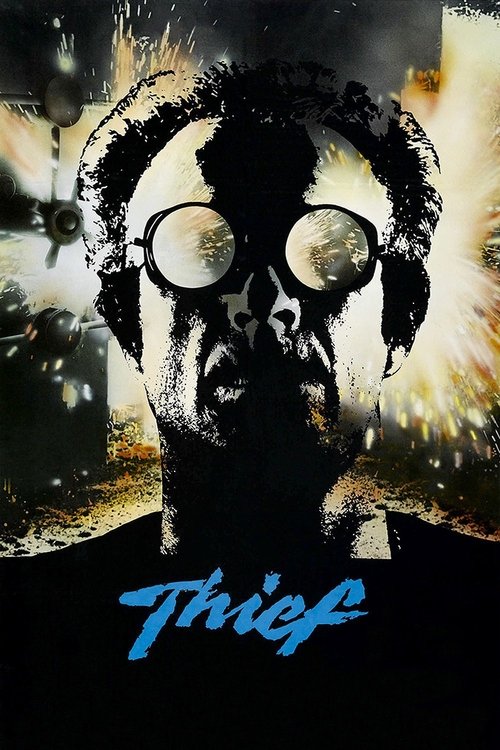
Thief
1981 · Michael Mann
For a late night when you want something cool, stylish, and adult — a crime movie that takes its time and takes its people seriously. More brooding than fun, but the kind of brooding you sink into.
What it's about
Frank is the best safecracker in Chicago — a professional who drills into high-security vaults for diamonds and treats the work like a trade, not a thrill. Years in prison taught him to want an ordinary life on a compressed schedule: a house, a wife, kids, all of it now. To get there fast he takes one big score for a syndicate boss, trading his fierce independence for a shortcut that comes with strings he can already feel tightening.
The experience
Cool, precise, and quietly seething — long stretches of hushed nighttime work punctuated by bursts of feeling, all of it gliding on rain-slicked streets and an electronic score. It's tense in the way watching a surgeon is tense, and underneath the procedure there's real ache: a man narrating the life he wants and running out of time to have it.
Performances
James Caan gives one of his best performances as Frank — coiled, proud, and wounded, especially in a long diner conversation where he lays his whole philosophy of life on the table. It's tough-guy acting with the soul showing through.
The craft
Michael Mann's first theatrical feature already looks and sounds like nobody else: Chicago at night rendered in wet asphalt, glass, and electric color, heists shot with documentary attention to real tools and technique, and a pulsing synthesizer score that turns burglary into something hypnotic. It rewards a dark room and good speakers — the sparks, the rain, and the music are half the movie.
Why it matters
This is the origin point of Mann's whole career — the lone professional, the neon-soaked city, the code — and its night-time electronic-scored style echoes through decades of crime cinema that came after.
Snapshot
Thief is Michael Mann's first theatrical feature, a Chicago crime film that already contains, in fully formed shape, almost every preoccupation that would define his career: the dignity and danger of expert work, the lone professional who lives by a private code, the city rendered as a field of rain, glass, and electric color, and the impossibility of buying one's way out of a chosen life. James Caan plays Frank, a master safecracker who has built a controlled existence — a bar, a car dealership, a meticulous plan — and who tries to compress the family and future he was denied by prison into an accelerated timeline by taking one large score for a syndicate boss. The film is at once a hard procedural about cracking diamonds and a near-existentialist parable about a man who would rather burn everything he owns than be owned. Scored by Tangerine Dream and shot in luminous nocturnal blacks and neons, it is the template from which much of Mann's later cinema — and a wide swath of subsequent crime filmmaking — was drawn.
Industry & production
Mann arrived at Thief from television, where he had written for series work and directed the acclaimed prison telefilm The Jericho Mile (1979). Thief was his entry into theatrical features, released through United Artists. It was an early producing credit for Jerry Bruckheimer, working here in a register far removed from the high-gloss blockbusters he would later be associated with; Ronnie Caan, the star's brother, also produced.
The screenplay was Mann's own, adapted from the novel The Home Invaders by "Frank Hohimer," the pen name of a real Chicago jewel thief. From the outset Mann pursued an unusually documentary approach to authenticity, surrounding the production with people who had lived the world being depicted. Real former criminals and real Chicago police served as technical advisors and, in several cases, appeared on camera. John Santucci, an actual jewel thief, both advised on safecracking and played a crooked cop; Dennis Farina, then a working Chicago police officer, appears in a small role and would become a recurring Mann collaborator. Robert Prosky, a veteran stage actor, made his film debut as the boss Leo. Willie Nelson plays Frank's imprisoned mentor Okla, and a young James Belushi appears as Frank's partner Barry. This blend of trained actors, stage performers, and genuine insiders is central to the film's texture.
The production embedded itself in Chicago, and the city's wet streets, diners, and industrial edges became a co-author of the film's mood. (The film was released in some territories under the title Violent Streets.)
Technology
The film's most striking technological dimension is its commitment to depicting the craft of safecracking with real tools rather than movie shorthand. The heist set-pieces show the use of high-temperature cutting equipment — burning bars and thermal-lance techniques that throw extraordinary showers of sparks — to breach hardened safes and vaults. Mann's insistence on procedural accuracy, informed by his advisors, gives these sequences a near-instructional precision: the audience watches a job get done the way a practitioner would do it, with the attendant heat, noise, and time pressure.
Equally important to the film's identity is its musical technology. The score by Tangerine Dream is built from synthesizers and sequencers, part of the German group's run of film work in this period. The electronic score is not incidental color; it is structural, lending the procedural sequences a pulsing, hypnotic momentum and binding the film's images of neon and machinery to a correspondingly synthetic, modern sound.
Technique
Cinematography
Shot by Donald Thorin, Thief establishes a nocturnal visual grammar that Mann would refine for decades. The film lives at night and in the rain. Streets are wet so that they return light; neon signage, traffic signals, and streetlamps smear and reflect across asphalt, car hoods, and windows. The palette favors deep blacks against saturated reds, blues, and greens, with the city's artificial light sources doing much of the work of illumination. Reflective surfaces — glass storefronts, windshields, the polished metal of cars and tools — recur as a motif, fracturing and doubling the figures within them. The result is a crime film that looks less like classical noir's chiaroscuro than like a new, electrified urban romanticism: hard surfaces made beautiful by light.
Editing
Dov Hoenig's cutting gives the film its characteristic rhythm: long, patient passages of dialogue and observation punctuated by tightly constructed work sequences. The heist scenes are built to honor process — the steps of the job laid out clearly enough that suspense arises from competence and time rather than from confusion. Against these procedural blocks, the film sets extended conversational scenes that are allowed to breathe, so that the editing alternates between contemplation and concentrated action.
Mise-en-scène / staging
Mann stages Thief around environments of labor and transaction: the car lot, the bar, the diner, the workshop, the vault. Frank is repeatedly framed at work or in the spaces he has built as instruments of control. The film's most celebrated staged scene is a long exchange in a diner between Frank and Jessie (Tuesday Weld), in which Frank lays out the entirety of his inner life — including the collage of the life he wants, assembled in prison as a survival tool. The scene is staged with relative stillness, trusting the actors and the dialogue, and it functions as the film's emotional and thematic keystone. Throughout, Mann composes the city as a lived-in industrial place rather than a postcard, anchoring his stylization in concrete and steel.
Sound
Beyond the Tangerine Dream score, the film's sound design foregrounds the textures of the work itself — the roar and crackle of cutting equipment, the ambient hum of the nighttime city. The electronic music and the mechanical noise of the heists are closely allied, both synthetic, both rhythmic, so that score and effect bleed into a single propulsive sonic field during the set-pieces.
Performance
James Caan's Frank is the film's center of gravity and is frequently cited as among his finest performances. He plays Frank as a man of coiled control and sudden, frightening force — tender in his pursuit of an ordinary life, but capable of cold violence the moment that life is threatened. The diner monologue gives Caan room to expose Frank's vulnerability without sentimentality. Tuesday Weld brings a wary, bruised quality to Jessie. Robert Prosky, in his screen debut, makes Leo genuinely chilling precisely because he is avuncular and reasonable before he is monstrous, embodying the seduction of the paternal organization that Frank ultimately rejects. Willie Nelson's brief turn as Okla carries real pathos, and the supporting cast of advisors-turned-actors lends the criminal milieu its unforced credibility.
Narrative & dramatic mode
The film operates as a character-driven crime drama wrapped around a heist structure. Its dramatic engine is not the question of whether the score will succeed but whether Frank can convert criminal proficiency into a legitimate, attached life — and the film's tragic logic is that he cannot do both. The narrative gives Frank everything he says he wants (the woman, the adopted child, the house) only to reveal those things as new leverage in the hands of the boss who controls him. The dramatic mode is ultimately one of subtraction: the climax is an act of radical renunciation in which Frank destroys his own holdings and severs every tie so that he can no longer be coerced. The story thus reads as a parable about autonomy as much as a thriller about a robbery.
Genre & cycle
Thief sits at the intersection of the heist film and the urban crime drama, but it modernizes both. It belongs recognizably to the lineage of the professional-criminal picture — the lone expert, the meticulously depicted job, the betrayal by the larger organization — while reorienting that tradition away from the shadowy black-and-white of classic noir and toward a glossy, neon-lit, electronically scored sensibility. In this respect it stands near the front of a new cycle of stylized crime cinema in the early 1980s, one that married procedural realism to a heightened, almost music-video pictorial surface — a sensibility Mann himself would carry into television with Miami Vice and back into features for the rest of his career.
Authorship & method
Thief is the foundational statement of Mann's authorship, and its method is as significant as its style. As writer-director, Mann fused two impulses that would remain in tension and balance across his filmography: rigorous research-based realism and a romantic, expressionist visual style. His insistence on real tools, real practitioners, and authentic procedure is of a piece with his later productions; the casting of genuine criminals and police, and the reliance on technical advisors, is the Thief-era origin of a working method that prizes lived authenticity.
The key collaborators each contribute defining elements. Cinematographer Donald Thorin establishes the wet-neon nocturne. Editor Dov Hoenig shapes the alternation of contemplation and process. Tangerine Dream supplies the synthesizer idiom that becomes inseparable from the film's modernity. And in his actors — Caan above all — Mann finds the embodiment of his recurring archetype: the disciplined male professional whose competence is also a kind of loneliness. The collaboration is notable for how completely Mann's sensibility is already present; Thief is not an apprentice work groping toward a style but a debut that arrives with its vocabulary intact.
Movement / national cinema
The film is firmly within American commercial cinema of the early 1980s, but it is inflected by influences from outside the Hollywood mainstream. The Tangerine Dream score connects it to a European, specifically German, electronic-music current then crossing into film scoring. Stylistically, Mann's romantic treatment of the modern city and his fascination with surfaces and light place him among a generation of American directors absorbing European art-cinema mood into genre frameworks. Thief is thus a hybrid: an American crime picture with a continental sonic and atmospheric sensibility.
Era / period
Thief is a thoroughly contemporary film for its moment, set and shot in the early-1980s Chicago of car lots, diners, and rain-slicked downtowns. It captures a transitional period in American crime cinema — after the gritty realism of the 1970s and at the dawn of the more stylized, synthesizer-driven aesthetic that would dominate the decade. Its imagery of neon and night, its electronic score, and its sleek surfaces feel like an early articulation of the 1980s look, even as its hard, downbeat ending retains the moral seriousness of the prior decade.
Themes
The film's governing theme is autonomy — the desperate insistence on being, in Frank's words, the master of one's own body and time. Closely bound to this is the theme of time itself: Frank has lost years to prison and tries to make up the deficit by purchasing a ready-made life, only to learn that compressed, transactional living cannot substitute for the real thing. Professionalism is presented as both a virtue and a trap: Frank's expertise is his pride and his identity, yet it is precisely his usefulness that delivers him into bondage to the syndicate. The film interrogates the American dream of the self-made man, exposing the house, the family, and the business as commodities that can be granted and revoked by those with power. And it dramatizes a stark vision of freedom as renunciation — the idea that the only way to be truly unownable is to have nothing left to lose. Underlying all of it is a meditation on authenticity: the difference between a life one builds and a life one is allowed to keep.
Reception, canon & influence
Thief was met with respect on release, with particular praise for Caan's performance and for the film's atmosphere, and its critical standing has risen considerably over the decades; it is now widely regarded as one of the strongest directorial debuts in the American crime genre and as the essential prologue to Mann's body of work. (Specific contemporaneous box-office figures and the full detail of its initial commercial performance are not something I can reliably quantify here, and I will not invent numbers.)
Looking backward, the film draws on the classical heist and professional-criminal tradition and on a hard-boiled urban realism, while transmuting noir's shadow-language into something brighter and more electric. Its source in a real thief's account, and its use of genuine practitioners, root it in the documentary-realist impulse of 1970s American cinema.
Looking forward, Thief is foundational. Within Mann's own filmography it is the direct ancestor of Heat, Collateral, and the procedural-romantic crime cinema he would spend his career developing, as well as of the neon style he brought to television. Beyond Mann, its marriage of synthesizer score, neon-noir imagery, and the silent professional protagonist became a touchstone for a later generation of filmmakers working in stylized crime and "synthwave"-adjacent registers; its DNA is widely felt in subsequent night-city crime pictures built around a laconic expert and an electronic pulse. As both an authorial origin point and a stylistic seedbed, Thief exerts an influence out of proportion to its modest debut-feature status.
A Deleuzian reading
Start with the sparks.
The full Deleuzian reading of Thief →
Reception
Respectable but modest in 1981 — praised for its style, with some critics sniffing at the synth score — Thief has since been fully canonized: a Criterion release, a fixture on 'greatest directorial debuts' lists, and now routinely called the blueprint for everything Mann did after.
How Thief was received, from release to now →
Influences: the films it descends from and the films it influenced
- Rififi (1955) — The film's near-wordless, half-hour safecracking centerpiece — procedure rendered in real time and near-silence — is the template for Mann staging the thermal-lance crack as patient, audible skilled labor rather than montage.
- The Killing (1956) — Establishes the heist as a precisely diagrammed professional process executed by a crew of narrow specialists, the structural backbone Mann inherits for his process-driven score.
- Bob le Flambeur (1956) — Roots the milieu of the aging professional criminal moving through a nocturnal, lamplit city as a figure of code and ritual rather than action spectacle.
- Le Samouraï (1967) — The silent, ritualized professional whose flawless competence is itself a form of solitude is the direct archetype for Caan's Frank — economy of speech, fetishized tools, emotional containment.
- Point Blank (1967) — Modernist crime told through cold reflective glass-and-chrome surfaces, with a laconic criminal who wants only what is owed him — both the reflective compositions and the renunciation-of-everything-but-the-debt logic.
- Le Cercle Rouge (1970) — The extended, near-silent heist procedural built around a single virtuoso technical feat, prizing the texture of expertise over dialogue.
- The Friends of Eddie Coyle (1973) — Documentary-realist criminal milieu of non-glamorous working professionals talking shop, the hard-boiled urban realism behind Mann's casting of real thieves and authentic procedure.
- Sorcerer (1977) — The immediate sonic precedent: a Tangerine Dream synthesizer score laid over men performing dangerous, sweat-soaked skilled labor — exactly the synth-over-process marriage Mann adopts.
- The Driver (1978) — The nameless minimalist getaway expert defined purely by craft and silence, an existential American professional stripped of backstory — a model for Frank's tool-defined identity.
- Army of Shadows (1969) — Mann translates Melville's procedural-ritual grammar into a Chicago nocturne: Frank's criminal-specialty sequences as near-meditative preparation, Tangerine Dream's sparse synthesizer performing the same marking-extremity-without-amplifying function as Army of Shadows's score, the professional's code occupying the ethical center where psychological exposition would conventionally sit.
- The Getaway (1972) — Distills the lone professional's meticulous craft-code and existential ethic into a loner protagonist whose identity is his competence — the professionalism theme pushed to its purest expression.
- Manhunter (1986) — Mann reapplies his own reflective-surface compositions and synth-driven nocturne to the procedural, advancing the wet-neon visual grammar Thief established.
- Heat (1995) — The direct expansion of Thief's DNA: a professional crew, the diner détente between cop and thief lifted from the diner-monologue staging, and competence-as-loneliness driving a renunciation climax.
- Collateral (2004) — Carries the laconic night-city professional into the digital era, with HD-captured neon nocturne over Los Angeles replacing celluloid but preserving the contemplation/action alternation.
- The American (2010) — The silent craftsman-assassin defined by ritual gun-assembly procedure and a renunciation arc — Melville-via-Thief minimalism applied to a single expert's tools.
- Drive (2011) — The most explicit heir: a near-silent expert driver, a pulsing synthwave score, and wet-neon city imagery that consciously reconstruct Thief's marriage of electronic pulse and laconic professional.
- Good Time (2017) — Neon-soaked nocturnal crime propelled by a relentless analog-synth pulse (Oneohtrix Point Never), extending Thief's synth-and-neon nocturne into frantic real-time desperation.
- Reservoir Dogs (1992) — Mann's industrial available-light cinematography — steel, concrete, hard shadows on working surfaces — establishes the visual grammar Reservoir Dogs inherits for the warehouse sequences; both films treat the stripped industrial workspace as the natural habitat of men who define themselves entirely by their professional trade.
- The Town (2010) — Mann's diner scene—the professional criminal explaining his aspirational worldview across a table to a woman—is the structural template for The Town's ice cream parlor scene; Affleck lifts the device of intimate confession as character exposition and the existential 'wants out' arc intact.
- Baby Driver (2017) — Tangerine Dream's synthesizer score pulses continuously beneath action and dialogue alike, refusing classical silence-as-neutral-ground — the score as environmental texture rather than punctuation, a mode Baby Driver's subjective soundscape develops.
- Emily the Criminal (2022) — Mann's decision to film James Caan's safecracking with procedural precision — lingering on the tactile details of criminal craft as a form of professional expertise — provides the template for Ford's fraud-training sequences, where Emily's growing technical skill is treated with the same seriousness Mann extended to career criminals.
- The Order (2024) — Establishes the patient, process-fixated rendering of criminal labor — the mechanics of the score shown as skilled work under nocturnal low-key light — that The Order borrows for its heist and counterfeiting procedural texture.
- The Last of the Mohicans (1992) — Mann's own origin point for the lone man defined by a professional code and for the orchestral-electronic score (Tangerine Dream) that prefigures the Jones/Edelman synth-and-strings soundscape.
- Blade Runner (1982) — The same-era elaboration of the wet-neon nocturne — rain-slick reflective surfaces and a synth score (Vangelis) — extending Thorin and Tangerine Dream's visual-sonic register into SF.
- To Live and Die in L.A. (1985) — Neon crime with a synth-pop score (Wang Chung) and a process-driven counterfeiting sequence shown start-to-finish — the same fusion of electronic pulse, night city, and fetishized procedure.
- Scarface (1983) — Contemporary crime film that, like Scarface, fuses neon-lit widescreen surfaces with a propulsive synthesizer score (Tangerine Dream) to render the criminal's world as cold electronic spectacle.
- American Gigolo (1980) — Pairs a Tangerine Dream synth pulse with rain-slicked reflective night surfaces and a taciturn professional loner — the Moroder-score/Bailey-light template running in parallel.
- Le Trou (1960) — Mann's documentary-grade depiction of real safecracking with actual tools and expert consultants, treating criminal work as skilled physical craft, extends Le Trou's fidelity to the texture of manual labor.
- Choose Me (1984) — Donald Thorin's rain-slicked pavement bouncing colored signage back into frame, scored to Tangerine Dream's unbroken synth bed rather than cue-by-cue underscoring, defines the same neon-noir surface Kiesser arrives at independently three years later.
- Risky Business (1983) — Shares the Tangerine Dream commission and the same nocturnal Chicago grammar — wet asphalt returning sodium amber against tungsten blue, professional competence filmed as ritual procedure — and both use the score's arpeggio to make a transaction feel like a heist.
Similar films
- Rififi (1955) — influence & lineage · same viewing thread
- Le Cercle Rouge (1970) — influence & lineage · same viewing thread
- Heat (1995) — influence & lineage · often watched together
- Manhunter (1986) — influence & lineage · often watched together
- Collateral (2004) — influence & lineage · often watched together
- The Driver (1978) — influence & lineage
- Drive (2011) — influence & lineage
- The Killing (1956) — influence & lineage
All the films related to Thief →
Watch it with: curated runs of related films
- Cells, Vaults, and Codes of Honor — A run of methodical men — safecrackers, escapees, informers, resistants — filmed as pure process, where the suspense is less whether the job or the escape works than who honors the code and who breaks it first.