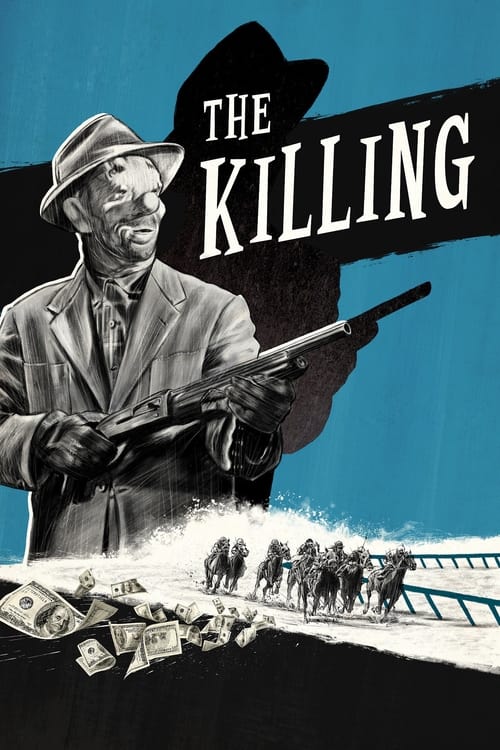
The Killing
1956 · Stanley Kubrick
For when you want a tight, no-fat crime picture you can finish in under 90 minutes and think about all night — the pleasure of watching a perfect plan meet imperfect people.
What it's about
Johnny Clay, fresh out of prison, has one last job planned before he marries and goes straight: rob two million dollars from a racetrack's daily take, timed to the second around a big race. He recruits a crew of ordinary, compromised men — a crooked cop, a bartender, a nervous betting-window teller named George — each with his own reason to need the money. The plan is airtight. Then George tells his restless wife about it, and she starts making plans of her own.
The experience
Lean, fast, and fatalistic — the film keeps rewinding the clock to show the same stretch of time from a different man's angle, so you're always a step ahead of somebody and a step behind somebody else. It plays like a stopwatch ticking toward something you can feel coming but can't name.
Performances
Sterling Hayden anchors it as Johnny Clay, all gravel and weary competence, and Marie Windsor is deliciously venomous as the wife whose greed sets everything wobbling.
The craft
This is young Stanley Kubrick announcing himself: the time-shuffled structure — replaying the heist day from each conspirator's point of view — was radical for a 1950s crime movie and still feels sharp. The black-and-white photography is hard and unglamorous, the deadpan narration ticks off times like a police report, and the racetrack sequence is a small masterclass in cutting for tension.
Why it matters
The film that turned Kubrick from a scrappy self-financed unknown into a director Hollywood had to take seriously, and its jigsaw-timeline heist became a template that crime films have been borrowing ever since.
Snapshot
The Killing is the film on which Stanley Kubrick stopped being a promising amateur and became a director the industry had to reckon with. His third feature — after the self-financed Fear and Desire (1953) and the scrappy Killer's Kiss (1955) — it is a lean, ruthless racetrack-heist noir built around a fractured, time-shuffling structure that was unusually bold for a mid-1950s American crime picture. Sterling Hayden plays Johnny Clay, an ex-con assembling a crew of compromised ordinary men for a single $2 million robbery of a California track's daily take, timed to the running of a feature race. The plan is meticulous; human weakness is not part of the plan. The picture's lasting reputation rests less on its plot than on its architecture — the way Kubrick rewinds the clock to follow each conspirator through the same window of time — and on a closing image of cash scattering across an airport tarmac that has become one of noir's definitive emblems of fate mocking control.
Industry & production
The film was the first product of Harris-Kubrick Pictures, the partnership between Kubrick and producer James B. Harris, who had bought the rights to Lionel White's novel Clean Break. It was released through United Artists, the distributor most hospitable in this period to independent production financed and packaged outside the studio system. The casting of Sterling Hayden — a recognizable, if not top-tier, star with noir credentials from The Asphalt Jungle (1950) — was central to making the project bankable. Production was modest and tightly budgeted; figures in the low six figures are commonly cited in the literature, and the picture was shot quickly on Los Angeles locations and economical sets. The financial particulars beyond this are not something I can state with precision, and accounts of its commercial performance generally agree it was a modest earner rather than a hit. Its real return was reputational: it drew strong notices and the attention of Kirk Douglas, leading directly to Paths of Glory (1957) and Kubrick's move into larger productions.
Technology
The Killing is a black-and-white film made with the standard professional 35mm tools of mid-1950s Hollywood, presented in the Academy ratio rather than the widescreen formats then sweeping the industry. There is no technological novelty in the equipment itself; what matters technically is how conventional resources were pushed. The most-discussed instance is the deep-focus interior camerawork: long lateral tracking shots that glide through cramped apartments as if the dividing walls had been removed, holding foreground and background in sharp focus simultaneously. Achieving this required wide-angle lenses and careful lighting to keep depth of field large in confined, low-budget interiors — a technical solution dictated by a directorial idea rather than by available gadgetry.
Technique
Cinematography
The cinematographer was Lucien Ballard, a seasoned Hollywood professional. The film's most enduring technical anecdote concerns a clash between the two men over precisely the tracking shots described above: the widely repeated account is that Kubrick insisted on a particular wide-angle lens to execute the dollying moves through the apartments as he envisioned them, overruling Ballard's more conventional alternative. Whatever the exact details — and these production stories should be treated as the lore they are — the visible result is a hard, deep, frontal style. Ballard's images are crisp and high-contrast, the framing geometric, the camera frequently tracking parallel to walls so that figures slide across the frame. The look is colder and more controlled than the shadow-drenched expressionism of classic 1940s noir, anticipating the rigorous, architectural compositions of Kubrick's mature work.
Editing
Editing, credited to Betty Steinberg, is the film's defining formal achievement, though the structural conception belongs to Kubrick and is rooted in White's source novel. Rather than tell the heist in linear sequence, the film repeatedly doubles back: it follows one conspirator up to a moment, then resets the clock to trace another man's movements across the same interval, the strands converging on the robbery itself. A documentary-style omniscient narration anchors this scheme with stated times of day, lending the shuffling a spurious newsreel objectivity. The narration is not without friction — commentators have long noted apparent inconsistencies in its timekeeping, which readers may take as error or as design. The cutting between parallel timelines, and the discipline of withholding the heist's mechanics until each piece has been laid in, is what gives the film its clockwork tension.
Mise-en-scène / staging
The staging is built on confinement and exposure. Conspirators are repeatedly arranged in tight, deep-focus interiors — the apartment, the bar, the betting windows — where the camera's lateral glide turns domestic and workplace spaces into corridors of entrapment. Against these cramped rooms Kubrick sets the wide, flat openness of the racetrack and, finally, the airport, where the plan dissolves in the air. The chess motif is staged literally in the figure of Maurice, the wrestler-philosopher recruited to start a brawl, and underwrites the whole design: men moved like pieces, a player who has calculated every move except the random one.
Sound
The sound design is functional in service of the structure, with the authoritative male narrator (the voice belongs to a professional radio/announcer-style narration) imposing a calendar-and-clock order over the images. Gerald Fried's score — see Authorship below — drives the procedural sequences. The film's sonic register is brisk and unsentimental, matching its hard visual surfaces.
Performance
Hayden anchors the film with a granite, fatalistic weariness; Johnny Clay is competent and doomed, and Hayden plays him without self-pity. The supporting ensemble carries much of the picture's noir texture. Elisha Cook Jr., the great hangdog character actor, is George Peatty, the meek betting-window teller, paired with Marie Windsor as his contemptuous, scheming wife Sherry — one of noir's most acidic marital portraits, and the human flaw through which the plan leaks. Timothy Carey gives an indelibly strange turn as Nikki, the racist marksman hired to shoot the horse; Jay C. Flippen, Ted de Corsia, Joe Sawyer, Vince Edwards, and the wrestler Kola Kwariani round out a gallery of vivid, compromised men.
Narrative & dramatic mode
The film operates in a procedural-fatalist mode: it presents itself as the cool reconstruction of a crime, narrated with the detachment of a case file, while the drama lies in watching an over-engineered scheme meet the parts of life that cannot be engineered. The nonlinear telling is not a gimmick but the meaning — by repeatedly returning us to the same moment from new angles, the film makes the audience experience the heist as a system of interlocking dependencies, any one of which can fail. The dramatic irony is total: the narrator's clockwork certainty is continually undercut by what we sense is coming. The ending — money lost to a small dog and an open suitcase on the tarmac, and Johnny's flat, resigned "what's the difference?" — completes the design by replacing the master plan with sheer chance.
Genre & cycle
The Killing belongs squarely to film noir and, more specifically, to the heist or caper cycle that flourished in the early-to-mid 1950s. Its most obvious American antecedent is John Huston's The Asphalt Jungle (1950), which established the template of a doomed multi-man robbery undone by the participants' weaknesses — and which also starred Hayden. On the European side, Jules Dassin's Rififi (1955) had just demonstrated the appetite for procedural heist cinema. Kubrick's contribution to the cycle was formal: he took the caper's inherently mechanical, multi-part plot and matched it with a multi-part, time-fractured narration, fusing the heist film's clockwork ethos to a modernist structure.
Authorship & method
The screenplay is credited to Kubrick, with additional dialogue credited to the pulp and noir novelist Jim Thompson — a division of credit that, by widely circulated accounts, left Thompson aggrieved, feeling his contribution warranted more than a secondary line. Thompson's hand is generally felt in the hard-bitten texture of the talk, especially the Peatty marriage. The source was Lionel White's novel Clean Break. James B. Harris produced, beginning a partnership that would run through Lolita (1962). Cinematographer Lucien Ballard supplied the deep-focus surfaces (under Kubrick's exacting direction). Composer Gerald Fried — Kubrick's boyhood friend and the musical collaborator on his first features — wrote the score, one of the last of their collaborations before Kubrick moved toward established film composers. Editing was credited to Betty Steinberg, executing the parallel-timeline scheme. The method on display is already recognizably Kubrickian: obsessive control of the image, a fascination with systems and procedure (the chess player's logic), and a cold-eyed view of human plans defeated by contingency.
Movement / national cinema
This is American studio-adjacent independent cinema — a Hollywood genre picture made just outside the majors and released through United Artists. It sits at the late edge of the classical film-noir movement, the dark crime cycle that ran roughly from the early 1940s into the late 1950s. Stylistically it shows Kubrick's absorption of noir's iconography while pointing past it: the expressionist shadow has begun to give way to a harder, more geometric, almost clinical clarity that is closer to the European-influenced modernism Kubrick would pursue.
Era / period
The Killing is a thoroughly mid-1950s artifact: a contemporary-set crime film made as the studio system was loosening and independent production gaining ground, and as television and widescreen were reshaping the industry. Its world of racetracks, betting windows, cheap apartments, and men chasing one last score is the disenchanted underside of the Eisenhower-era prosperity. The film's fatalism — the sense that diligence and intelligence guarantee nothing — reads as a quiet rebuke to the period's official optimism.
Themes
The governing theme is the collision between control and chance. Johnny Clay's plan is a model of rational design, and the film's own clockwork structure mirrors his ambition to master time and contingency; both the plan and, arguably, the narrator's tidy chronology are defeated by what cannot be foreseen — a marriage's resentments, a stranger's prejudice, a dog on a runway. Surrounding this are noir's recurrent concerns: greed and the corrupting fantasy of escape; the femme fatale and the weak man (the Peattys); masculine competence as a doomed value; and fate as an indifferent force. The chess metaphor binds these together — life as a game of moves in which the decisive factor is the one the player did not calculate.
Reception, canon & influence
Critically, The Killing was well received on release and quickly came to be regarded as the film that announced Kubrick as a major talent, paving the way to Paths of Glory. Over the following decades its standing only rose; it is now firmly canonical, routinely cited as one of the finest 1950s noirs and as a key early statement of Kubrick's themes and methods.
Looking backward, its influences are clear: The Asphalt Jungle for the doomed-heist template (and for Hayden), the broader noir tradition for its iconography and fatalism, Lionel White's novel for the plot and much of the fractured chronology, and Jim Thompson's pulp sensibility for the dialogue's hard edge. Kubrick's own chess-player's temperament shaped the structural conceit.
Looking forward, the film's nonlinear, multiple-perspective storytelling has had an outsized legacy. It is the most frequently named structural ancestor of Quentin Tarantino's Reservoir Dogs (1992) — itself a heist-gone-wrong told out of sequence — and of the time-scrambling crime cinema that followed in the 1990s; Tarantino has spoken admiringly of Kubrick's film. More broadly, The Killing helped legitimize the fractured timeline as a tool for genre storytelling rather than arthouse experiment, and its racetrack robbery and downbeat, fate-driven ending have become reference points for the heist film as a form. Within Kubrick's career it is the hinge: the last of his apprentice works and the first that fully looks like the work of the director he became.
A Deleuzian reading
The wind, first.
The full Deleuzian reading of The Killing →
Reception
Released as the bottom half of a double bill and a box-office non-event, it still earned reviews sharp enough to get Hollywood watching Kubrick — Time compared the 27-year-old to Orson Welles. Now it's routinely called one of the great heist films, the moment Kubrick became Kubrick.
How The Killing was received, from release to now →
Influences: the films it descends from and the films it influenced
- The Asphalt Jungle (1950) — Supplied the doomed-heist blueprint Kubrick inherited wholesale — the job as a precision operation undone by the participants' private weaknesses — and literally handed him Sterling Hayden as the strong-armed planner fated to fail.
- The Killers (1946) — Reconstructs a payroll robbery through non-chronological, multiple-witness flashbacks stitched by an investigator, the fractured-perspective scaffolding that Kubrick formalizes into a clockwork timeline.
- Citizen Kane (1941) — Gregg Toland's deep-focus, wide-angle interior compositions and the time-rearranging, multiple-account narration are the formal parents of Kubrick's deep-focus rooms and omniscient voiceover that resets the clock.
- Criss Cross (1949) — Frames an armored-car heist inside fatalist flashback, fixing the noir convention that the robbery is recounted from a vantage already doomed before it begins.
- Rififi (1955) — Its near-wordless, real-time central robbery treated as procedural choreography established the heist set-piece as an exercise in clockwork process that Kubrick's racetrack job extends.
- Killer's Kiss (1955) — Kubrick's own prior noir — location-shot lateral tracking, wide-angle deep-focus, and a fatalist boxing-and-crime milieu — the apprentice run-up whose technique The Killing consolidates.
- Le Jour Se Lève (1939) — Built an entire noir from a doomed man's flashbacks, the poetic-realist fatalism-via-fractured-chronology that Kubrick secularizes into a heist procedural.
- Night and the City (1950) — Inherits the doomed-noir-striver template — a meticulous schemer whose grand plan collapses through his own limits — capped by the same ironic, fatalistic last-reel reversal.
- Paths of Glory (1957) — Carries forward the authorial signature The Killing crystallized — the chess-player's logic of systems and procedure, exacting deep-focus staging, and a cold view of human plans crushed by contingency.
- The Grifters (1990) — Descends directly from Jim Thompson's hard-bitten pulp idiom — the same writer credited with The Killing's dialogue — extending that mistrustful, double-crossing con-artist talk to feature length.
- Reservoir Dogs (1992) — A heist-gone-wrong told out of sequence with the robbery itself elided, the single most frequently named structural heir, with Tarantino openly citing Kubrick's fractured chronology.
- Pulp Fiction (1994) — Extends the scrambled-timeline crime film into interlocking chapters that loop and re-cross, turning Kubrick's parallel-timeline convergence into a whole architecture.
- The Usual Suspects (1995) — Reconstructs a heist crew's job through unreliable, non-chronological fragments narrated under interrogation, weaponizing the multiple-perspective reconstruction The Killing pioneered for genre.
- Jackie Brown (1997) — Replays the mall money-handoff three times from different characters' vantage points — a near-direct elaboration of Kubrick's racetrack robbery shown from converging angles.
- Go (1999) — Threads a single botched drug scheme through overlapping, character-by-character timelines that converge, the parallel-perspective heist structure transposed to comedy.
- Memento (2000) — Completes the legitimization The Killing began — the deliberately scrambled timeline as a genre-storytelling engine rather than arthouse experiment, with structure carrying the fatalism.
- Fargo (1996) — Kubrick's fractured-heist film models the cross-cutting that withholds and then accelerates catastrophe, the everyman desperation Macy reprises as flop-sweat panic.
- Thief (1981) — Establishes the heist as a precisely diagrammed professional process executed by a crew of narrow specialists, the structural backbone Mann inherits for his process-driven score.
- The Friends of Eddie Coyle (1973) — Builds its heist from small-time specialists negotiating their cuts and roles, modeling crime as a fragile transactional arrangement rather than a glamorous caper.
- Ronin (1998) — The specialist-crew caper undone from within, where each professional is defined by function and the operation collapses through treachery — the assembled-mercenaries-betrayed shape Ronin reproduces.
- Bob le Flambeur (1956) — A contemporaneous casino-robbery caper sharing the cool, diagrammatic planning and ironic fate-undoes-the-plan ending, arrived at independently the same year.
- The Killers (1964) — Sibling in fractured crime chronology and the heist-as-professional-operation, dissecting a robbery through non-linear, multi-perspective time the way Siegel dissects the contract.
- Le Deuxième Souffle (1966) — A parallel offshoot of the same Asphalt Jungle procedural lineage, treating the heist as a coldly diagrammed clockwork that betrayal unwinds — the shared 'process film' grammar.
Similar films
- The Asphalt Jungle (1950) — influence & lineage
- Rififi (1955) — influence & lineage
- Reservoir Dogs (1992) — influence & lineage
- Paths of Glory (1957) — influence & lineage
- Strangers on a Train (1951) — same viewing thread
- Rear Window (1954) — same viewing thread
- Elevator to the Gallows (1958) — same viewing thread
- The Big Sleep (1946) — same viewing thread
All the films related to The Killing →
Watch it with: curated runs of related films
- The Golden Age of Suspense — A run of immaculate mid-century crime pictures — Hitchcock plus his sharpest rivals — where guilt, obsession, and dangerous romance are staged in gorgeous black-and-white; watch them close together and the shared DNA of the perfect-murder plot lights up.