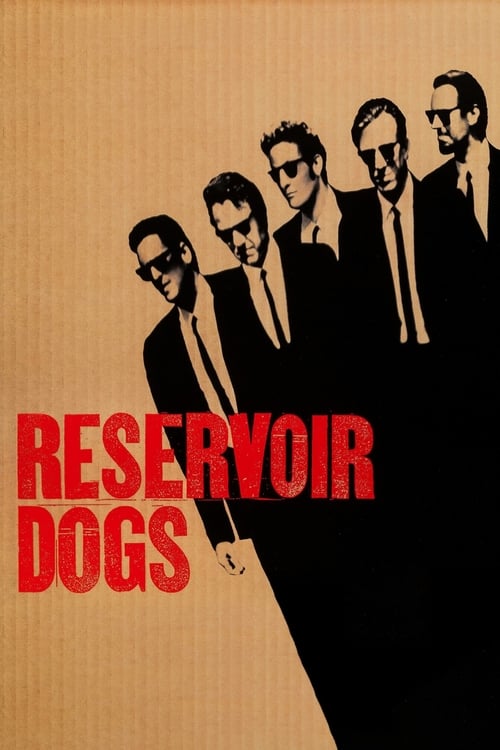
Reservoir Dogs
1992 · Quentin Tarantino
Generates discourse without releasing anything: the abandoned Movie Critic "final film," podcast hot takes (dunking on Marvel actors as "not movie stars," snubbing Toy Story 3), and the eternal "what will the tenth film be" watch. The industry's loudest opinion-haver.
For when you want sharp dialogue, dark laughs, and a thriller that plays like a locked-room chess game — gripping company for a night in, if you have the stomach for its nastier moments.
What it's about
Six strangers with color-coded aliases are hired to pull a diamond heist. The job goes catastrophically wrong, and the survivors regroup at an empty warehouse with one certainty: someone in the room tipped off the police. The film skips the robbery entirely and lives in the aftermath — accusations, alliances, and the slow squeeze of paranoia among men who don't know each other's names.
The experience
Tense, talky, and viciously funny — long stretches of profane banter that snap without warning into brutal violence. The pressure keeps ratcheting because you're doing the same math the characters are: who's the rat?
Performances
Harvey Keitel anchors the film with weary professional decency, Steve Buscemi's motormouthed Mr. Pink is a comic-nervy marvel, Tim Roth does agonizing physical work for most of the runtime, and Michael Madsen's soft-spoken menace produced one of crime cinema's most infamous scenes.
The craft
Tarantino's debut announces everything at once: a fractured timeline that withholds the heist itself, dialogue that turns small talk into music, and a jukebox soundtrack that scores violence with sunny 70s pop. Made for about $1.2 million, mostly in one warehouse, it proves how much tension you can generate from talk, geography, and what you refuse to show.
Why it matters
The Sundance premiere that launched Tarantino and reshaped 90s American crime cinema — its structure, its banter, and its needle-drop irony spawned a decade of imitators. It remains the model for the micro-budget debut that changes the industry's vocabulary.
Snapshot
A crew of color-coded strangers hired for a diamond heist reassembles at a warehouse after the job goes catastrophically wrong. Someone tipped off the police. The film never shows the robbery itself. Instead, Reservoir Dogs works through aftermath, confession, and slow-burn confrontation, trusting that what is withheld generates more pressure than anything it could depict directly. Made for approximately $1.2 million, it premiered at the 1992 Sundance Film Festival and effectively announced a new vernacular for American crime cinema: profane, allusive, structurally fractured, and in love with the sound of men talking before they kill each other.
Industry & production
The screenplay circulated in Hollywood as a writing sample before it became a production. Tarantino had co-written True Romance (sold to producer Don Murphy and eventually directed by Tony Scott) and Natural Born Killers (sold and later substantially reworked by Oliver Stone), but Reservoir Dogs was the script he intended to direct himself — originally envisioned as a $30,000 no-budget effort shot on 16mm with friends. The project's scale changed when Harvey Keitel read the script, committed to playing Mr. White, and became an active producer, helping to attract financing and additional cast. Lawrence Bender produced; Monte Hellman, the cult director of Two-Lane Blacktop, served as executive producer. Miramax acquired North American distribution rights following the Sundance premiere, positioning the film as the centerpiece of the company's emerging identity as an importer and champion of transgressive indie and foreign-language cinema. The domestic theatrical run was modest, but home-video and international revenue made the film profitable and, more importantly, made Tarantino the most discussed new filmmaker in American cinema within eighteen months of its release.
The casting assembled a deliberately uneven mixture of generations and registers: Keitel and Lawrence Tierney (as the crime boss Joe Cabot) brought an old-Hollywood roughness; Tim Roth and Steve Buscemi arrived from the independent-film margins; Michael Madsen had worked steadily in genre pictures without quite breaking through; Chris Penn added comedic-menacing unpredictability. Eddie Bunker, the ex-convict turned crime novelist whose books had already been adapted as Straight Time and Runaway Train, appears as Mr. Blue, lending the ensemble an authenticity-by-association that Tarantino clearly relished. Tarantino cast himself as Mr. Brown.
Technology
Shot on 35mm by cinematographer Andrzej Sekula, Reservoir Dogs makes relatively conventional use of period technology — the low budget precluded elaborate technical ambition and the script's warehouse-bound chamber-drama structure did not demand it. The practical constraints reinforced the film's aesthetic: interiors lit with hard available-style light, a limited number of camera setups per scene, and a minimal crew that kept shooting efficient. The film does not announce its technological hand; what is distinctive is achieved through planning and staging rather than equipment. Sekula and Tarantino would work together again on Pulp Fiction, and the relationship between the two films' visual approaches — one austere and cornered, one more freewheeling and location-rich — suggests that Reservoir Dogs used its restrictions productively rather than despite them.
Technique
Cinematography
Sekula's framing favors medium shots and two-shots that keep bodies in legible spatial relation, important in a film where physical proximity encodes threat. The warehouse is photographed without glamour: concrete floors, corrugated walls, industrial light. The camera stays close enough to read faces but rarely intrudes into the space between characters with the discomfort it will later exert in the torture sequence, where the slow circling of Michael Madsen's Mr. Blonde is captured from a position that makes the viewer feel trapped alongside the bound officer. The film's most famous formal gesture is arguably the opening credits — a slow-motion walk by the assembled crew over George Baker Selection's "Little Green Bag," a device borrowed from the European crime tradition that simultaneously introduces character and announces the film's pleasure in cool posture. Against the claustrophobia of the warehouse, this opening operates as the film's only moment of expansive movement.
Editing
Sally Menke, who would edit every subsequent Tarantino film until her death in 2010, cuts Reservoir Dogs with a rigor that its non-linear time scheme demands but does not oversell. The film's chronological fragmentation — we arrive in medias res, then move into discrete character chapters before converging on a simultaneous climax — requires editing that can change register abruptly without disorientating the viewer about cause and effect. Menke achieves this primarily through tonal control: the shifts between the diner prologue, the warehouse present-tense, and the extended backstory sequences feel motivated rather than arbitrary. The Kubrickian confidence of the structure is in the writing, but Menke's editing makes the unconventional chronology feel like dramatic revelation rather than structural showing-off.
Mise-en-scène / staging
The warehouse is Reservoir Dogs' sustained staging challenge, and Tarantino solves it by treating the space as a theater in the round — actors move through it, around the central injured body of Mr. Orange, with blocking that maps power and allegiance geometrically. When Mr. White cradles Mr. Orange against the wall, we read it as a pietà, a pose of loyalty that the film will retroactively make tragic. The final Mexican standoff concentrates all the film's spatial energies into a single static geometry of mutual destruction. Tarantino had absorbed the grammar of Italian genre filmmaking — the standoff as formal endpoint, the bodies arrayed to express irresolvable opposition — and transplanted it into an American warehouse with deadpan literalism.
Sound
The sound design of Reservoir Dogs is inseparable from its use of licensed popular music, which Tarantino treats as diegetic narrative counterpoint rather than non-diegetic scoring. The radio in the warehouse plays K-Billy's Super Sounds of the Seventies, a fiction that allows 1970s rock to drift through the film's 1992 present tense as both period atmosphere and ironic commentary. The ear-cutting sequence — in which Mr. Blonde dances to Stealers Wheel's "Stuck in the Middle with You" while mutilating a captive policeman — became one of the most discussed scenes in American cinema not because the violence is explicit (Tarantino cuts away at the act itself) but because the cheerful disconnect between song and action generates a specific kind of horror: pleasure in form, disgust at implication. The scene crystallized what would become a signature Tarantino tactic — the deployment of pop music to estrange violence, making the viewer aware of their own aesthetic engagement with something morally troubling.
Performance
Keitel grounds the film in an older tradition of American screen naturalism — his Mr. White is physically still, emotionally armored, a man whose sentimentality about loyalty becomes the film's central dramatic irony. Roth, playing Mr. Orange, works in the British tradition of physical and psychological preparation; his long embedded-informant backstory sequence is essentially a bravura acting showcase that Tarantino stages as a kind of story-within-story meditation on performance itself. Buscemi's Mr. Pink is the film's comic engine: fast-talking, self-interested, capable of making a cogent argument about tipping wages in one breath and abandoning his colleagues in the next. Madsen plays Mr. Blonde's sociopathy as aesthetic detachment — he seems genuinely not to understand why his colleagues are upset — and the performance's flat affect makes him more frightening than any amount of actorly signaling of menace would.
Narrative & dramatic mode
Reservoir Dogs is structured as a procedural from which the procedure has been removed. The heist, the conventional center of a crime film, is absent; what remains is the social contract of professional criminality under maximum stress. The film's non-linear time scheme is not a puzzle but a dramatic trap: we know that Orange is the informant before the backstory section confirms it, which means we watch the earlier scenes — particularly White's tenderness toward Orange — with a knowledge the characters do not share. This gap between audience knowledge and character knowledge, a form of tragic irony, is the film's core dramatic engine. The warehouse becomes a pressure cooker in which every exchange of information, every declaration of loyalty, is already compromised. The ending, in which almost everyone dies, feels less like a twist than a logical completion of a system designed to self-destruct.
Genre & cycle
Reservoir Dogs belongs to the early-1990s American independent crime revival that also includes The Usual Suspects (1995) and Pulp Fiction (1994), but its immediate generic ancestors are as much European as American. The film sits at the intersection of the American heist film (a lineage running from The Killing through The Anderson Tapes and Kansas City Confidential) and the French polar tradition, particularly the work of Jean-Pierre Melville — whose cool, code-bound criminals, stripped of psychology and placed in formal compositions, clearly inform Tarantino's conception. The influence of Hong Kong crime cinema, specifically Ringo Lam's City on Fire (1987), was noted immediately upon Reservoir Dogs' release and has been extensively documented; the structural and plot similarities between the two films remain the most discussed instance of appropriation in Tarantino's filmography, though the question of the precise relationship is better described as one of intense creative absorption than simple copying.
Authorship & method
Tarantino is the film's dominant creative intelligence, functioning as writer-director and working through a method that is explicitly citational — the script's texture is built from absorbed genre materials, television crime drama, exploitation film, and decades of movie-watching. He has been consistently open about this process, describing himself as a filmmaker who thinks through other films rather than through lived experience in the conventional auteur sense. The screenplay's dialogue — its overlapping registers of professionalism and vulgarity, its detours into pop-culture exegesis — is the most immediately distinctive element of his style, and it is already fully formed in Reservoir Dogs.
Andrzej Sekula's cinematography translates the script's spatial intelligence into practical decisions about framing and light without imposing an independent visual personality on the material. Sally Menke's editorial sensibility is harder to isolate in a first feature but becomes evident in retrospect: she understood how to handle the cuts between time schemes and the pacing of dialogue-heavy sequences in a way that would become essential to the Tarantino project. Lawrence Bender's producing relationship with Tarantino — extending through most of his filmography — established a continuity of production infrastructure that enabled the idiosyncratic methods the later films required.
Movement / national cinema
Reservoir Dogs is a founding document of the American independent cinema surge of the early 1990s, the Sundance-to-Miramax pipeline that made films by Steven Soderbergh, Richard Linklater, Kevin Smith, and others into a coherent cultural movement. It also absorbed and refracted influences from outside American cinema — the French polar, the Hong Kong Category III crime film, Italian genre cinema — in a way that represented a new mode of American cinephilia: film-school-generation enthusiasm for world cinema processed into something recognizably Californian. The film's emergence from the video-store culture of Los Angeles (Tarantino had worked at Video Archives in Manhattan Beach) is not merely biographical; it shaped the film's aesthetic DNA, its sense that all cinemas and all periods were equally available as raw material.
Era / period
The film belongs to the post-New Hollywood moment when the major studios had largely consolidated around franchise filmmaking, and independent distributors like Miramax, Fine Line, and October Films occupied a niche for adult-oriented, formally unconventional work. The early 1990s also saw the American absorption of Hong Kong action cinema — John Woo was about to move to Hollywood — and a renewed interest in crime fiction, partly catalyzed by the success of neo-noir in the late 1980s. Reservoir Dogs arrived at the moment when these currents converged and helped define the dominant aesthetic of the decade's independent cinema: post-genre self-awareness, structural ambition, verbal dexterity, and a violence that was simultaneously visceral and aestheticized.
Themes
The film's central theme is the failure of professional codes under pressure. Joe Cabot's precaution of using color-coded pseudonyms is presented as a rational security measure, but it ultimately cannot prevent exposure because the informant was embedded before the code was in place. The color names also function as a dehumanizing abstraction — these men do not know each other, cannot trust each other, and are held together only by the mercenary logic of the job. Against this, Mr. White's personal loyalty to Mr. Orange — his willingness to kill for and die beside a man he barely knows — reads as either admirable or catastrophically naive, and the film refuses to adjudicate. Masculinity is examined through the register of professional performance: what it means to be a "professional," how competence and cruelty relate, whether there is honor available in criminal work. The absent heist also functions thematically: we are asked to reconstruct an event from its consequences, to understand an act through its wound — a structure that rhymes with Tarantino's broader argument that cinema is made of consequences and responses, not of actions themselves.
Reception, canon & influence
The Sundance premiere generated substantial critical attention and positioned Tarantino as the most exciting new American filmmaker of his generation. The film's violence — particularly the ear scene — was genuinely divisive; several critics found the aestheticization of torture morally indefensible, a charge that has followed Tarantino's career. Others, including many who became the film's critical champions, argued that the precisely calibrated discomfort was the point: Reservoir Dogs implicates the viewer in its pleasures in ways that more straightforwardly brutal films do not. The film was not a major domestic theatrical success on original release, but home video extended its reach enormously through the mid-1990s and it became, for a generation of filmmakers and cinephiles, a foundational text.
The influences the film absorbed — Melville, Kubrick's The Killing, the Hong Kong crime film, the American heist tradition, Godard's use of pop music as alienation device — are well-documented in Tarantino's own interviews and in the critical literature. The City on Fire parallel was raised immediately and has been analyzed at length by scholars including David Desser in his work on Hong Kong cinema's global circulation; it stands as the most instructive case study in the film's complex relationship to its sources.
The film's forward influence on crime cinema was rapid and broad. Guy Ritchie's Lock, Stock and Two Smoking Barrels (1998) and Snatch (2000) carried the non-linear criminal ensemble format into British cinema. Bryan Singer's The Usual Suspects (1995) refined the unreliable narrator concealed within a genre structure. The general permission Reservoir Dogs granted — to treat crime film materials with structural ambition, verbal intelligence, and sincere investment in cinephile reference — became the template for an entire decade of independent crime filmmaking. Its most immediate consequence was Tarantino's own Pulp Fiction (1994), which extended and complicated every method Reservoir Dogs established, but the first film remains the founding statement: the moment when a new cinematic voice arrived fully formed and immediately changed what American genre filmmaking thought it was allowed to do.
A Deleuzian reading
A man lies on a concrete floor in a spreading lake of his own blood, and he stays there for most of the movie.
The full Deleuzian reading of Reservoir Dogs →
Reception
It premiered at Sundance in 1992 to walkouts over the violence and left without a prize, then did modest US box office — but a rabid UK run and the VHS era turned it into the defining indie calling-card, and it's now shorthand for the great debut feature.
How Reservoir Dogs was received, from release to now →
Influences: the films it descends from and the films it influenced
- City on Fire (1987) — Tarantino transplants Lam's scenario almost wholesale: undercover cop who bonds with the crew he's infiltrating, post-heist warehouse standoff, and a three-way Mexican standoff finale in which the embedded loyalty is revealed through simultaneous gunfire — the source blueprint Reservoir Dogs remakes in an American register.
- Le Doulos (1962) — Melville's polar supplies Reservoir Dogs' central dramatic engine: the informant-hunting question deferred until late revelation, professionals who identify each other by conduct and code rather than name, and a narrative structured entirely around the gap between what men profess and what they have done.
- Bob le Flambeur (1956) — The heist that falls apart before the audience sees it — Melville's absent-heist structure, where meticulous planning dissolves into aftermath, anticipates Reservoir Dogs' most radical formal decision: to place the robbery entirely off-screen and build the film from its wreckage.
- The Killing (1956) — Kubrick's splintered chronology — the same heist timeline revisited through discrete character chapters, each adding a new temporal angle — is the direct formal template for Reservoir Dogs' non-linear structure, in which Mr. Blonde's, Mr. Orange's, and Mr. White's separate backstory sequences converge on a single catastrophic present.
- Mean Streets (1973) — Scorsese's jump-cut drop of 'Be My Baby' over Harvey Keitel's first appearance establishes the technique Tarantino inherits: diegetic licensed pop placed at scene-openings to function as ironic emotional counterpoint, the specific device Reservoir Dogs deploys in the credits walk and the torture sequence.
- Le Cercle Rouge (1970) — Melville's near-silent professionals — defined entirely by behavioral precision and mutual trust under duress — supply the code that Reservoir Dogs' color-named crew aspires to and fails: the fatalist circle in which professional men are destroyed not by incompetence but by the impossibility of perfect loyalty.
- The Wild Bunch (1969) — Peckinpah's slow-motion ballet of men in collective motion is the direct ancestor of the Reservoir Dogs opening credits walk: Tarantino borrows the device to confer operatic grandeur on the crew before the story begins, repurposing Peckinpah's death-walk grammar as a birth-of-cool introduction.
- Thief (1981) — Mann's industrial available-light cinematography — steel, concrete, hard shadows on working surfaces — establishes the visual grammar Reservoir Dogs inherits for the warehouse sequences; both films treat the stripped industrial workspace as the natural habitat of men who define themselves entirely by their professional trade.
- A Clockwork Orange (1971) — The 'Stuck in the Middle with You' ear-cutting sequence is a direct structural appropriation of ACO's central technique: a cheerful, recognizable pop song played diegetically while violence is committed, so that the viewer's pleasure in the music and the pleasure of the spectacle fuse into a single uncomfortable experience that refuses moral comfort.
- Blood Simple (1985) — Tarantino has cited Blood Simple as a direct influence; the staging of confrontation in confined theatrical spaces with characters as precise blocking units, the structural withholding of a central event (what happened inside the vault), and the systematic alignment of audience knowledge against character knowledge all rehearse the Coens' narrative grammar in a different genre register.
- A Better Tomorrow (1986) — Tarantino extracts the men-in-matching-costumes archetype and the Mexican standoff geometry from the heroic bloodshed cycle ABT launched, reframing the honor-code-under-betrayal narrative within American crime genre conventions.
- The Asphalt Jungle (1950) — Tarantino inverts the Asphalt Jungle structure by showing only the aftermath of a heist destroyed by contingency, stripping out the robbery itself to concentrate on the ensemble's mutual recrimination, while retaining the specialist-character gallery and the elegiac regard for professional competence under terminal pressure.
- Pulp Fiction (1994) — Tarantino and Sally Menke extend Reservoir Dogs' non-linear chapter chronology into a three-strand structure where temporal fragmentation creates thematic rhyme across independent storylines; the diegetic pop soundtrack strategy scales from a formal gesture into a full compositional system governing mood and irony across the entire film.
- The Usual Suspects (1995) — Singer lifts Reservoir Dogs' structural architecture wholesale — the absent crime reconstructed through fragmented retrospective testimony, a hidden informant within an ensemble of named criminals — and extends the 'who is the traitor?' engine into an unreliable narrator framework that makes the narrative's own reconstruction its subject.
- Lock, Stock and Two Smoking Barrels (1998) — Ritchie absorbs the Reservoir Dogs ensemble-criminal toolkit — color-coded crew, non-linear bravado editing with titled chapter inserts, diegetic pop juxtaposed against violence — and franchises it to working-class London, producing the film's most direct international descendant in both formal method and tonal register.
- Snatch (2000) — The ensemble of named criminals introduced through rapid graphic title cards and the licensed pop soundtrack used as ironic counterpoint to violence (K-Billy's Super Sounds) are formal devices Ritchie inherits wholesale, recalibrating them from American noir cool to British working-class comedy.
- The Hateful Eight (2015) — Tarantino's debut establishes his own chamber thriller grammar — criminals in a confined interior, extended monologue as narrative engine, chapter-based temporal scrambling with retrospective revelation — and The Hateful Eight is a deliberate return to and formal expansion of that template at roadshow scale.
- Baby Driver (2017) — K-Billy's radio broadcast simultaneously constitutes diegetic source music and ironic score during the ear-cutting sequence, collapsing the diegetic/non-diegetic distinction in a way Baby Driver systematizes across an entire feature.
- Strange Darling (2024) — Pioneers color-coded character identity and a withhold-then-reveal architecture, the costume-coding and information-rationing grammar Strange Darling uses to disguise predator and prey.
- Go (1999) — Establishes the talky, color-coded ensemble crime model — extended scenes of low-life banter punctuated by sudden violence — and the trick of withholding the central botched job and reconstructing it obliquely through fragments.
- Guardians of the Galaxy (2014) — Ironic counterpoint of an upbeat oldies track against onscreen menace, the tonal-clash needle-drop that Gunn echoes in 'Hooked on a Feeling' over Quill's arrest montage.
- Pusher 3 (2005) — Early-90s independent crime's confrontational, contained aftermath-not-heist staging — bloody problem-solving in mundane rooms — anticipating Pusher 3's kitchen dismemberment set-piece.
- The Craft (1996) — The slow-motion line-abreast walk cut to a needle-drop, a device for converting a group into an icon of itself, is what The Craft repurposes for the corridor walk that became stock teen-film grammar.
- Bottle Rocket (1996) — Fixes the matching-uniform crew advancing in slow motion to a period rock cue as a genre signature, which Bottle Rocket deflates by swapping black suits for yellow jumpsuits worn by men whose competence does not survive the shot.
- Miller's Crossing (1990) — Working from the same Melville-and-Hammett source material two years before Reservoir Dogs, the Coens build their film around the same dramatic question — which man in the crew is the informant — using stylized gang-world codes and the gap between professional loyalty and private betrayal as their central formal and moral engine.
- Hard Boiled (1992) — Woo develops the Mexican standoff as a sustained formal choreographic language — long-duration, geometrically precise, bodies locked in simultaneous aim — through the Hong Kong action tradition, arriving at the same standoff grammar as Reservoir Dogs' warehouse finale from a parallel national cinema working the same professional-codes-as-tragedy argument.
- True Romance (1993) — Tarantino's own screenplay, written in the same period as Reservoir Dogs, deploys the identical diegetic pop counterpoint strategy and Mexican standoff geometry — the hotel-room multi-party simultaneous-aim finale is the sibling of the warehouse endgame, written by the same hand and governed by the same formal rules.
- Killing Zoe (1993) — Avary, who co-developed early narrative concepts with Tarantino and received a story credit on Pulp Fiction, applies the warehouse heist-gone-wrong structure, French polar professional codes, and ensemble-criminal-aftermath staging to a Paris bank robbery — the closest sibling text to Reservoir Dogs by both personnel and formal approach.
- Bound (1996) — Sibling in mid-90s indie crime staging: a nearly single-location standoff, mob-money paranoia, and stylized off-screen/threatened violence played for suspense (Pantoliano's Caesar is cut from the same jittery-heist cloth).
- Brute Force (1947) — Extends the same craft of scoring sadism to incongruously pleasant music — the ear-severing set to 'Stuck in the Middle with You' descends from Munsey's phonograph-accompanied torture.
Similar films
- Thief (1981) — influence & lineage · same viewing thread · often watched together
- Le Doulos (1962) — influence & lineage · same viewing thread
- Le Cercle Rouge (1970) — influence & lineage · same viewing thread
- Pulp Fiction (1994) — influence & lineage
- The Killing (1956) — influence & lineage
- Bob le Flambeur (1956) — influence & lineage · same viewing thread
- The Asphalt Jungle (1950) — same viewing thread
- Rififi (1955) — same viewing thread
All the films related to Reservoir Dogs →
Watch it with: curated runs of related films
- Cells, Vaults, and Codes of Honor — A run of methodical men — safecrackers, escapees, informers, resistants — filmed as pure process, where the suspense is less whether the job or the escape works than who honors the code and who breaks it first.