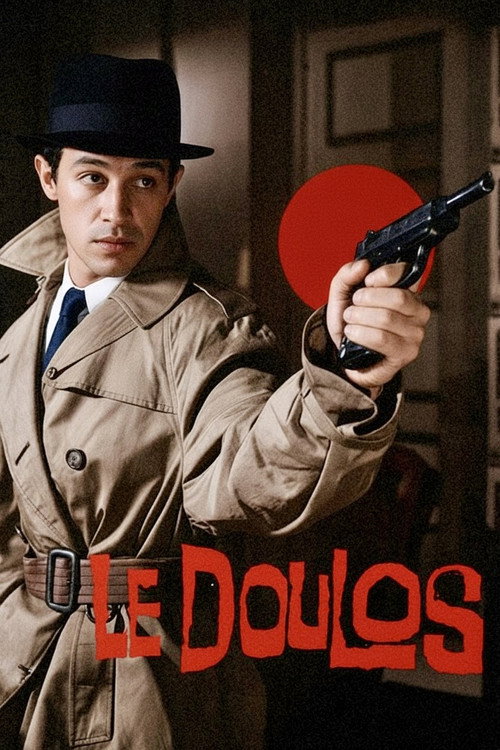
Le Doulos
1962 · Jean-Pierre Melville
For when you want a puzzle with style — a film to lean into, argue about after, and probably rewatch. Choose it when you're sharp, not when you want to switch your brain off.
What it's about
Maurice Faugel walks out of prison and straight back into the trade — a simple burglary to get on his feet. Shadowing him is Silien, a sharp-dressed friend with police connections whom everyone in the underworld suspects of being an informer, the 'doulos' of the title. When the job goes wrong, the question of who talked poisons every friendship in the film.
The experience
Cool, coiled, and deliberately disorienting — it plays fair but withholds, so you spend the film reassessing everyone, then reassessing yourself. The trench-coats-and-shadows atmosphere is thick enough to drink.
Performances
Jean-Paul Belmondo, fresh off his new-wave stardom, plays Silien with an unreadable cool that keeps the whole film's central question alive — you can never quite decide whether to trust that face.
The craft
Jean-Pierre Melville distills the gangster picture to hats, guns, silences, and geometry — long unbroken interrogation scenes, immaculate black-and-white shadows, and a plot built as a deliberate puzzle that saves its explanation for the end. It's minimalism with a knife in it.
Why it matters
A key film in Melville's run of underworld classics, it fixed his signature style — French fatalism wearing American noir's wardrobe — and became a lodestar for crime filmmakers on both sides of the Atlantic.
Snapshot
Le Doulos is Jean-Pierre Melville's seventh feature and the film that crystallized his mature underworld manner: an austere, morally vertiginous policier in which loyalty, betrayal, and information itself become the true commodities of the criminal economy. Adapted from a 1957 novel by Pierre Lesou, the film follows Maurice Faugel, newly released from prison, whose attempt to resume his trade is shadowed by Silien (Jean-Paul Belmondo), a man who may or may not be a police informer — a doulos in argot, slang for both "hat" and, by extension, the stool pigeon who wears one. Built as a deliberate puzzle that withholds its own solution until a late, dialogue-heavy reversal, the film is less a whodunit than a meditation on the impossibility of knowing another person's allegiances. It arrived as Melville was consolidating the genre identity that would culminate in Le Samouraï (1967) and Le Cercle rouge (1970), and it stands as one of his most influential early statements — a key text for understanding the lineage that runs from American crime film through Melville to the post-Tarantino crime cinema of the 1990s.
Industry & production
Le Doulos was produced within the modestly budgeted, artisanal framework that defined Melville's career. Melville was famously an independent operator who had built his own studio facilities on the rue Jenner in Paris in the 1950s, giving him a degree of control unusual among French directors of the period. The film was a French-Italian co-production, a common financing arrangement for French genre films of the era that broadened distribution and spread risk. It was produced through arrangements involving Rome-Paris Films, the company associated with Georges de Beauregard and Carlo Ponti that backed a number of significant French films of the early 1960s. Precise budget figures are not well documented in the accessible record, and I will not invent them.
The casting of Jean-Paul Belmondo was central to the film's commercial logic. Belmondo had become a star with Godard's À bout de souffle (1960) and was, by 1962, one of the most bankable young actors in French cinema; his presence connected Melville's relatively austere project to the broader cultural moment of the Nouvelle Vague while also drawing a popular audience to a genre picture. Melville and Belmondo had a productive working relationship — Belmondo had appeared in Melville's Léon Morin, prêtre (1961) immediately prior — and would reunite again. The film performed respectably and helped secure Melville's standing as a commercially viable auteur of the crime film, a reputation that underwrote his subsequent, more ambitious productions.
Technology
Le Doulos was shot on 35mm black-and-white film, the standard professional format of the period, and Melville's choice of monochrome was by 1962 an aesthetic decision as much as an economic one — color was increasingly available, but black-and-white remained essential to the noir tonality Melville cultivated. The film employs the largely conventional sound-on-film and studio-and-location production technology of early-1960s French filmmaking. Melville's ownership of his own studio allowed him to construct and light interiors to his exact specifications, and the film mixes these controlled studio sets with location shooting in and around Paris. There is no notable technological novelty to claim here; Melville's distinction lay not in equipment but in the rigor with which he deployed standard tools. The record does not support specific claims about particular camera or lens models, and I will not fabricate them.
Technique
Cinematography
The cinematography, by Nicolas Hayer, is fundamental to the film's identity. Hayer — a veteran whose credits included Cocteau's Orphée (1950) — renders Melville's world in a cold, silvery, high-contrast monochrome dominated by rain-slicked streets, smoke-filled rooms, and the gray light of dawn. The visual scheme is deliberately desaturated of warmth: trench coats, fedoras, and shadow combine into an iconography that is at once an homage to American film noir and a stylization beyond it. Melville and Hayer favor a controlled, classical camera that observes rather than editorializes, with deep, deliberate compositions and a restrained palette of camera movements. The film's most celebrated set piece — Silien's lengthy interrogation/conversation sequence, often discussed as an extended take or near-continuous staging — demonstrates the cinematography's confidence in duration and spatial clarity, letting the camera glide and reframe rather than cut. The overall effect is of a world drained of color and sentiment, observed with forensic detachment.
Editing
The editing serves Melville's commitment to ambiguity and deferral. Cutting is generally measured and unhurried, allowing scenes to play out at length and trusting the spectator to read behavior without underlining. The structural editing logic is the film's signal achievement: information is deliberately withheld, rearranged, and recontextualized so that the viewer's understanding of who has betrayed whom shifts late and decisively. The famous extended interrogation sequence is built to showcase staging over montage, while the film's revelations arrive through a verbal reconstruction — a flashback-inflected accounting — that retroactively reorganizes everything the audience believed it had seen. This is editing as epistemology: the cut, or its withholding, becomes the instrument of the film's central deception.
Mise-en-scène / staging
Mise-en-scène is arguably Melville's supreme strength, and Le Doulos is a textbook of his method. He constructs a hermetic, ritualized underworld of bars, apartments, and police offices, dressed with a fetishistic attention to objects — guns, telephones, hats, cigarettes — that function as the props of a private mythology. Bodies are arranged with sculptural precision; gestures are pared to essentials. The studio interiors, built and controlled by Melville himself, achieve an abstracted, almost theatrical purity, while the staging of violence and confrontation is choreographed with a cool formality that drains spectacle of melodrama. The overall design subordinates realism to a stylized code of masculine conduct, in which how a man wears his coat or holds his silence carries the dramatic weight that dialogue elsewhere would bear.
Sound
The sound design is characteristically spare. Melville uses silence and ambient texture — footsteps, rain, the click of a lighter — as expressive elements, reserving emphasis for moments of decision and violence. The score, by Paul Misraki, is used selectively rather than continuously, punctuating the action without flooding it; Melville's general preference was for restraint, allowing quiet to build tension. Dialogue is delivered in clipped, laconic registers consistent with the film's ethos of withholding, and the argot of the milieu gives the speech a coded, insider quality that reinforces the theme of partial knowledge.
Performance
The performances are governed by Melville's demand for understatement. Belmondo, against the volatile charisma he displayed for Godard, here delivers a controlled, opaque Silien whose surface gives away nothing — a performance built on calculated impassivity that keeps the audience guessing about his true loyalties to the end. Serge Reggiani, as Faugel, brings a worn gravity to the released convict caught in the machinery of suspicion. The supporting players inhabit the milieu with a lived-in authenticity. Across the ensemble, the acting style suppresses overt emotion in favor of micro-expression and behavior, in keeping with Melville's conviction that character in the criminal world is a matter of conduct under pressure rather than confession.
Narrative & dramatic mode
Le Doulos operates in a mode of sustained epistemological suspense. Its dramatic engine is not the heist (which is dispatched relatively early and goes wrong) but the unresolved question of Silien's allegiance — whether he is the informer who betrayed Faugel. Melville structures the film so that the audience shares the characters' uncertainty, presenting events that admit multiple interpretations and only late supplying a reframing that reorganizes the apparent facts. This withholding is the film's defining formal gesture, and it produces a peculiarly modern viewing experience in which the spectator must continually revise judgments. The narrative is fatalistic in the noir tradition — culminating in deaths that feel less like dramatic punishment than the mechanical outcome of a world where trust is structurally impossible. The mode is ultimately tragic and ironic: the truth, once revealed, comes too late to save anyone, and the film closes on a note of bleak, almost absurd futility.
Genre & cycle
The film belongs to the French policier, the indigenous crime-film tradition that absorbed and transformed American gangster and noir cinema. It sits within the cycle of Melville's own crime films — following Bob le flambeur (1956) and Deux hommes dans Manhattan (1959) and preceding Le Deuxième Souffle (1966), Le Samouraï, Le Cercle rouge, and Un flic (1972) — that collectively define a distinctly Melvillian subgenre: the existential gangster film, in which professional criminals operate by a private code of honor within an indifferent and treacherous world. Le Doulos is a pivotal entry in this cycle because it foregrounds the figure of the informer and the theme of betrayal that would recur throughout Melville's work, and because it refines the cold, ritualized style that became his signature.
Authorship & method
Le Doulos is unmistakably an auteur work, but it is also the product of a stable team of collaborators Melville trusted. Melville himself wrote the screenplay, adapting Pierre Lesou's novel, and his authorship extends beyond writing and directing to a near-total control of the production environment through his rue Jenner studio. His method combined obsessive preparation with a deep cinephile's dialogue with American cinema — Melville had adopted his very surname in homage to Herman Melville and was steeped in Hollywood crime film, which he reimagined through a French sensibility.
His key collaborators on this film were essential. Cinematographer Nicolas Hayer translated Melville's visual conception into its precise monochrome textures. Composer Paul Misraki supplied a score deployed with Melvillian economy. The cast — anchored by Belmondo and Reggiani — embodied the director's demand for restraint. The editing realized the film's structural withholding. Across these collaborations, Melville's authorial method is visible in the subordination of every department to a unified vision of cool, fatalistic stylization. He worked as a meticulous controller of detail who nonetheless drew committed performances and craft from a recurring circle of collaborators.
Movement / national cinema
Melville occupies a singular position in French cinema. He was neither fully of the classical "tradition of quality" that the Nouvelle Vague attacked nor a member of the Cahiers du cinéma generation, yet he was claimed by the New Wave as a crucial precursor and fellow traveler — his independent production model, location shooting, and personal authorship anticipated their practices, and he famously appears as the novelist Parvulesco in Godard's À bout de souffle. Le Doulos, made at the height of the Nouvelle Vague and starring its emblematic actor, sits at the intersection of Melville's independent classicism and the new French cinema's energies. It belongs to French national cinema as a sophisticated reworking of an American genre into something culturally specific — a Parisian underworld governed by codes of honor and a melancholy fatalism that is distinctly French in its philosophical inflection.
Era / period
The film is a product of the early 1960s, a moment of transformation in French cinema as the Nouvelle Vague reshaped the industry's aesthetics and economics. Le Doulos both benefits from and stands somewhat apart from that ferment: it employs a major New Wave star and the independent-production ethos the movement championed, yet its classical rigor and genre commitment mark it as the work of an older, more controlled sensibility. The period's growing acceptance of moral ambiguity and stylistic self-consciousness in French film created a receptive context for Melville's deliberately puzzling, unsentimental crime drama. Set in a contemporary Paris of bars, apartments, and police precincts, the film also reflects the postwar urban milieu that Melville mythologized throughout his career.
Themes
The film's central theme is betrayal and the unknowability of loyalty — the informer as the figure who corrodes the criminal code from within. Around this cluster the recurring Melvillian preoccupations: the code of honor among criminals and the tragic consequences of its violation; male friendship and its fragility under suspicion; fatalism and the inexorability of death; and the performance of identity, where every character may be wearing a mask. Le Doulos is profoundly concerned with appearance versus reality — with how impossible it is to read another person's true allegiance — and it extends this to implicate the viewer, who is made to misjudge along with the characters. Trust emerges as the film's true subject: its scarcity, its necessity, and the lethal cost of its misplacement. There is also a persistent melancholy about loyalty arriving too late, about gestures of friendship undone by the structural treachery of the milieu.
Reception, canon & influence
Critical reception. Le Doulos was received as a significant work by a major French director and has grown steadily in critical estimation. It is now regarded as one of Melville's essential films and a high point of the French policier. Its restoration and re-release in the 2000s, including through prestige home-video editions, brought renewed critical attention and consolidated its canonical standing among cinephiles and scholars, who praise its formal control, its narrative ingenuity, and Belmondo's against-type performance. (Specific contemporary review citations and box-office figures are not reliably available to me, and I will not invent them.)
Influences on the film (backward). Le Doulos draws deeply on American film noir and the Hollywood gangster film of the 1930s–50s — the trench coats, fedoras, and chiaroscuro are conscious homage — filtered through Melville's literary cinephilia. The hardboiled tradition of crime fiction, both American and the French Série noire (Lesou's source novel belongs to this milieu), shapes its laconic ethos and its preoccupation with informers and double-crosses. Melville's own earlier crime films, especially Bob le flambeur, establish the immediate stylistic lineage.
Legacy (forward). The film's influence has been substantial and lasting. Within Melville's career it is a crucial step toward the perfected minimalism of Le Samouraï. More broadly, Melville's cool, ritualized crime style — of which Le Doulos is a foundational example — became a touchstone for later filmmakers. It is frequently cited as an influence on the crime cinema of the 1980s and 1990s, including directors such as John Woo and Quentin Tarantino, whose work on loyalty, betrayal, and stylized male codes among criminals descends in part from Melville. Tarantino has publicly admired Melville, and Le Doulos in particular is often noted for its dialogue-driven reversals and its puzzle-box treatment of betrayal — qualities that resonate strongly with the post-Tarantino crime film. As both a refined genre object and an enduring influence on filmmakers who treat the gangster film as a vehicle for existential and formal seriousness, Le Doulos holds a secure place in the canon of crime cinema.
A Deleuzian reading
Start with a hat.
The full Deleuzian reading of Le Doulos →
Reception
Received as a solid but knotty policier in 1963 France, it spent decades in the shadow of Le Samouraï — then the 2000s restorations and a Rialto/Criterion revival recast it as one of Melville's essential noirs.
How Le Doulos was received, from release to now →
Influences: the films it descends from and the films it influenced
- Bob le flambeur (1956) — Melville's own prototype for the ritualized French underworld — the gambler-criminal's code, location shooting in a nocturnal Montmartre, and laconic milieu-as-character that Le Doulos refines into a tighter puzzle.
- The Maltese Falcon (1941) — Establishes the informer/double-cross plot driven by who-is-lying-to-whom and the fetishized object whose pursuit organizes every betrayal — the epistemological suspense Melville rebuilds around Silien's true loyalties.
- This Gun for Hire (1942) — Codifies the trench-coated, impassive lone gunman whose professional ethic outweighs sentiment — the wardrobe and calculated blankness Melville treats as iconography and Belmondo wears as homage.
- Out of the Past (1947) — Models noir fatalism delivered through flashback architecture and a doomed protagonist narrating his way to a death already decided — the structural fatalism Le Doulos inherits.
- The Asphalt Jungle (1950) — The heist-procedural treatment of criminals as working professionals undone by a single weak link, lending the policier its sober, sympathetic-to-the-crook gravity that Melville adopts wholesale.
- The Killing (1956) — Pioneers the deliberately withheld and re-sequenced presentation of plot information so the audience reconstructs events after the fact — the editing strategy of withheld information Le Doulos turns into a moral trap.
- Quai des Orfèvres (1947) — The French policier template of the patient interrogation scene and the cop-criminal pas de deux conducted in dialogue rather than action, which Melville stylizes into Silien's verbal reversals.
- Scarface (1932) — Supplies the 1930s Hollywood gangster iconography — the fedora-and-overcoat silhouette and clipped milieu of honor among killers — that Melville consciously quotes and abstracts.
- Le Samouraï (1967) — The perfected endpoint of the same method — spare sound design, object ritual, and performance reduced to calculated impassivity — that Le Doulos advances within Melville's own filmography.
- The Friends of Eddie Coyle (1973) — Carries forward the informer-as-tragic-figure at the center of a milieu defined by who is wearing a wire, treating the snitch's doomed calculus with the same deglamorized fatalism.
- The Killer (1989) — Directly descends from Melville's stylized male code — the honorable hitman, the cop who mirrors him, loyalty and betrayal staged as ritual — Woo's acknowledged debt to the Melvillian gangster.
- Reservoir Dogs (1992) — Builds its entire engine from the dialogue-driven betrayal reversal and the puzzle of the hidden informer among thieves — the post-Tarantino crime film's debt to Le Doulos's withheld-loyalty structure.
- Ghost Dog: The Way of the Samurai (1999) — Transposes the Melvillian impassive killer governed by a written code into a new register, inheriting the spare staging, object fetishism, and performance of calculated blankness.
- Drive (2011) — Revives the near-silent professional criminal defined by restraint, fetishized tools and wardrobe, and a fatalist code — a self-conscious late heir to Melville's impassive antihero.
- Army of Shadows (1969) — Melville refined here the anamorphic negative-space compositional system and the informer-within-the-code plot architecture that Army of Shadows inherits, establishing the moral framework — betrayal as systemic rather than personal failure — that the Resistance subject then loads with autobiographical weight.
- Pale Flower (1964) — Melville's elliptical editing strategy that withholds the scene most necessary to narrative orientation — cutting around rather than through the film's hinge — is the closest model for Shinoda's elliptical cut technique, which refuses to stabilize the viewer's temporal position within Muraki's story.
- Le Deuxième Souffle (1966) — Directly rehearses the informer/betrayal mechanics and the code of silence — the film where Melville makes ambiguous loyalty the engine of plot, which Le Deuxième Souffle systematizes.
- The Beat That My Heart Skipped (2005) — Supplies the polar's information discipline: allegiances and obligations stated only through transaction, backstory withheld from the audience as a matter of professional decorum, and criminal work shown as unglamorous procedure conducted in cars, stairwells and rented rooms.
- Breathless (1960) — Shares Belmondo channeling American crime-cinema cool through a French nouvelle-vague filter, the contemporary companion to Melville's own cinephile dialogue with Hollywood noir.
- Shoot the Piano Player (1960) — A parallel New Wave appropriation of Série noire pulp, mixing hardboiled fatalism with tonal play — same source milieu (French noir crime fiction) Le Doulos draws on.
- Le Cercle Rouge (1970) — Extends the ritualized code-of-honor crime film with the same fatalistic geometry of trust and betrayal among professionals rendered in cool monochrome-derived palette and long-take restraint.
Similar films
- Le Samouraï (1967) — influence & lineage · same viewing thread
- Bob le Flambeur (1956) — influence & lineage · same viewing thread
- Le Cercle Rouge (1970) — influence & lineage · same viewing thread
- Reservoir Dogs (1992) — influence & lineage · same viewing thread
- Shoot the Piano Player (1960) — influence & lineage
- Breathless (1960) — influence & lineage
- The Maltese Falcon (1941) — influence & lineage
- The Asphalt Jungle (1950) — influence & lineage · same viewing thread
All the films related to Le Doulos →
Watch it with: curated runs of related films
- Cells, Vaults, and Codes of Honor — A run of methodical men — safecrackers, escapees, informers, resistants — filmed as pure process, where the suspense is less whether the job or the escape works than who honors the code and who breaks it first.