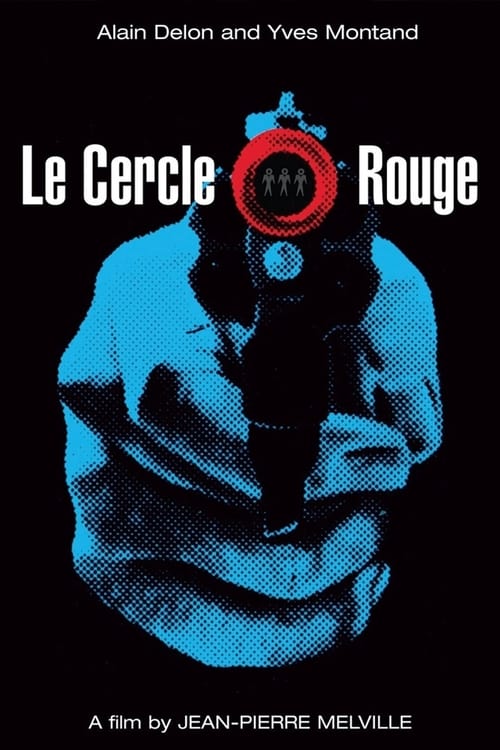
Le Cercle Rouge
1970 · Jean-Pierre Melville
For a late-night, no-distractions mood when you want crime cinema at its most elegant and patient — style, procedure, and fatalism instead of car chases. If you like watching professionals work in silence, this is the peak of that pleasure.
What it's about
A convict fresh out of prison, an escaped murderer on the run, and a disgraced ex-police marksman drowning in drink converge — seemingly by chance — around one job: robbing a jewelry house on the Place Vendôme in Paris. As they plan the heist with wordless professionalism, a patient, methodical police commissioner closes in, and an opening epigraph about a red circle suggests all of them were always destined to meet.
The experience
Cool, unhurried, and quietly gripping — a slow-burn thriller where silence does the work dialogue usually does, building to a heist sequence of almost unbearable concentration. It's tension by ritual: every gesture deliberate, every pause loaded.
Performances
Alain Delon anchors the film with glacial stillness, and Yves Montand brings real pathos to the ruined ex-cop marksman — a man rebuilding his dignity one steady hand at a time.
The craft
Melville directs with ceremonial precision: muted blue-gray color, exact compositions, and a centerpiece robbery played out at length in near-total silence — a masterclass in how long a film can hold its breath. The craft is the suspense; watch it somewhere quiet enough to hear the room tone.
Why it matters
A cornerstone of French crime cinema whose fatalistic cool and wordless set-pieces echo through decades of heist films and stylish thrillers that followed.
Snapshot
Jean-Pierre Melville's penultimate feature is the fullest expression of his singular vision: a jewel-heist film stripped to its existential skeleton, where fate operates with the inevitability of a mathematical proof and silence is the primary dramatic medium. Three men — a freshly released convict, an escaped murderer, and a ruined ex-police marksman turned alcoholic — converge by apparent chance to rob a Place Vendôme jewelry house, while a police commissioner pursues them with the methodical patience of a chess player. The film opens with an invented Buddhist epigraph about a red circle in which all men destined to meet will inevitably find themselves; that circular logic of predestination governs every frame. At roughly 140 minutes, Le Cercle Rouge is Melville's most spacious work: unhurried, ceremonial, and strangely mournful, with a heist sequence of nearly half an hour conducted in near-total silence. It is among the most rigorously realized crime films in the history of the medium.
Industry & Production
Melville produced the film through his own Melville Productions, in co-production with the Italian firm Selenia Cinematografica — an arrangement that facilitated the casting of Gian Maria Volonté as Vogel. The executive producer was Robert Dorfmann, who had also backed several prestige French productions of the period. Melville had suffered a severe setback when his private studio on the rue Jenner burned in January 1967, destroying sets, equipment, and irreplaceable prints; by 1970 he was working out of other Paris facilities. That disaster did not slow his output — L'Armée des ombres had appeared the previous year — but it removed the hermetic self-sufficiency that had defined his earlier filmmaking life. The cast was a calculated assembly of heavyweight names: Alain Delon, fresh from Le Samouraï and now one of the biggest stars in France; Yves Montand, whose film career had dipped and who needed a strong role; and André Bourvil, cast entirely against type. Bourvil was the most beloved comic actor in France, famous for broad rural farce, and Melville's decision to cast him as the quietly menacing Commissioner Mattei was a deliberate inversion that Bourvil reportedly embraced with seriousness. He completed the film while suffering from bone cancer and died on September 23, 1970, shortly before the film's French release, making Le Cercle Rouge his final screen appearance and investing Mattei's weary persistence with an unintended elegy.
Technology
Henri Decaë, Melville's longest-standing cinematographic collaborator, shot the film in anamorphic widescreen — a 2.35:1 aspect ratio — on Eastmancolor negative stock. Decaë used the wide frame to enforce spatial isolation: characters occupy opposite ends of the image, separated by empty corridors, café tables, the open countryside of southern France in the early reels. The color palette gravitates toward draining blues, leached grays, and the ochre tones of artificial lamplight — a temperature range that makes the film feel perpetually nocturnal even in its daytime sequences. For the climactic heist, Decaë lit the Vendor jewelry set largely from below, with the cool gleam of display cases providing most of the available light, creating a near-abstract environment of reflective surfaces and shadow that strips the sequence of any thriller warmth. No unusual or experimental camera apparatus is documented for the production, but Decaë's handling of the telephoto lens — used frequently in surveillance-style shots of Mattei's informants — subtly flattens depth while emphasizing the impersonal geometry of the police state.
Technique
Cinematography
Decaë's work here is the apotheosis of a style he and Melville had developed since Bob le Flambeur (1956): classical in its compositions, deeply anti-expressionist, refusing the subjective camera tricks that flourished in the contemporaneous New Wave. Shots are held long past the point where another director might cut. The camera observes rather than participates. A repeated strategy is the slow forward push into a face or a space — Mattei's apartment, the interior of a prison, the heist set — that generates dread not through distortion but through accumulation of duration. The opening sequences in the Marseille train station and the countryside use vast, uncrowded widescreen framings that prefigure the existential loneliness Corey will carry throughout. The celebrated sequence in Jansen's apartment — where the alcoholic, in the grip of delirium tremens, sees scorpions and snakes emerging from the walls — provides the film's sole eruption of visual subjectivity, and Decaë shoots it in jagged, tight close-up at odds with everything surrounding it, making the break from the film's dominant register feel genuinely alarming.
Editing
Marie-Sophie Dubus, Melville's editor across his final period, cut the film in a rhythm that respects the director's commitment to duration. There are almost no cuts for mere emphasis. Transitions between scenes are often abrupt and functional — a hard cut from one location to another without establishing buffer — which paradoxically reinforces the sense of a world already known to the viewer, of actions picked up in medias res. Within the heist itself, Dubus's editing becomes almost percussive: the tiny, precise movements of safecracking tools are intercut not for excitement but for exact calibration, matching the patience of the men on screen. The editing does not accelerate as the heist approaches its climax; if anything, it slows, trusting the audience to inhabit the operation at the same tempo as the characters.
Mise-en-scène / Staging
Melville's staging is ritualistic. Characters move through space with deliberate economy; unnecessary gesture is abolished. The famous scene in which Corey is released from prison, walks to his car, and discovers that another inmate has concealed stolen jewels in the trunk is choreographed with a near-balletic precision that requires no exposition — we understand what has happened, and what it means for Corey's resolve, purely through spatial arrangement and timing. Similarly, the three protagonists' first assembly in Jansen's apartment is staged as a ceremony of mutual appraisal; they circle, sit, pour drinks, communicate in the grammar of professional recognition rather than verbal negotiation. Melville's staging consistently treats interiors as arenas governed by unspoken codes, and the decor — trench coats, wide-brimmed hats, the geometric severity of modern Paris apartments — is not costume but uniform, marking membership in a caste.
Sound
The film's most radical formal decision is its use of silence. The heist sequence, lasting approximately twenty-five to twenty-eight minutes of screen time, proceeds in near-complete acoustic emptiness: there is no dialogue, the score is absent, and only the subdued ambient noise of the jewelry store — the creak of metal, the controlled breathing of the men, the faint sound of tools — accompanies the action. This approach extends the precedent set by Jules Dassin's Rififi (1955), whose famous heist was also conducted in silence, but Melville's version is colder and more abstract. Éric de Marsan's sparse score — which marks boundaries between sequences and provides a kind of tonal punctuation — is notable for what it withholds; it refuses to editorialize and makes no emotional appeals. The score sounds at key transition points like a signature rather than a commentary.
Performance
Delon gives perhaps his most interior performance. As Corey, he communicates almost entirely through stillness: the suppression of expression becomes expression, and his occasional moments of warmth — a conversation about horses, the faintest smile — register as revelations. Volonté, a committed political actor whose training was Brechtian in its insistence on social type, brings a contrasting physical urgency to Vogel; he is rangy, watchful, more obviously animal in his survival instincts. Yves Montand's Jansen is the film's emotional center by default — the only character who displays visible vulnerability (the delirium tremens sequence) — and Montand plays the dissolution without sentimentality, keeping Jansen's pride fully intact even in degradation. Bourvil's Mattei is the performance that has most surprised subsequent viewers: he is quiet, precise, and oddly gentle, with a domestic life (his cats) that humanizes without softening him. Bourvil's natural warmth is present but carefully redirected toward melancholy rather than comedy.
Narrative & Dramatic Mode
Le Cercle Rouge operates in what might be called the mode of inevitability. Its narrative is not concerned with suspense in the conventional sense — whether the heist will be pulled off — but with demonstrating, methodically, how the Buddhist epigraph's logic will be fulfilled. The film advances in long, self-contained sequences that function less like scenes than like movements in a suite: arrival, assembly, preparation, execution, dissolution. There is almost no backstory offered and very little interiority made explicit; motivation is inferred from action. Dialogue serves primarily logistical functions. The parallel structure — cutting between the criminals' preparations and Mattei's investigation — creates irony rather than tension, since the viewer understands before any character does that the net is tightening. The ending refuses catharsis: it simply closes the circle, fulfilling the epigraph's promise with cold fidelity.
Genre & Cycle
The film belongs to the French polar — the crime genre as developed in postwar France, shaped by translations of American hardboiled fiction (particularly the Série Noire imprint at Gallimard, which published Hammett, Chandler, and Horace McCoy in French) and by the influence of American studio noir. Melville had been the foremost architect of the polar's cinematic identity since the 1950s, and by 1970 Le Cercle Rouge represents the genre's late, self-conscious phase: it knows its own conventions well enough to hollow them out, turning the heist film into a meditation on professional ritual and fated failure rather than a thriller. The film contributes to a strain of European crime cinema — also visible in contemporaneous Italian giallo and later in the British films of Mike Hodges — that treats the genre as a vehicle for existentialist inquiry. Within the heist subgenre specifically, it sits alongside Rififi, Topkapi, and The Killing (Kubrick, 1956) as a model of procedural rigor elevated to thematic seriousness.
Authorship & Method
Jean-Pierre Melville (born Jean-Pierre Grumbach, 1917–1973) wrote as well as directed Le Cercle Rouge, as he did all his mature films. His authorial signature is immediately legible: the trench-coat iconography, the homosocial world evacuated of significant female presence, the equation of professional competence with moral worth, the fatalistic worldview expressed through deadpan narrative logic. Melville was openly and passionately in love with American cinema — with Humphrey Bogart, with the visual grammar of Warner Bros. crime films, with the compositional habits of John Huston and Howard Hawks — while simultaneously producing work rooted in a French intellectual tradition that filtered Americanism through existentialism. He described his own practice in terms of a "mythology" of the American gangster film reconstituted from memory and desire rather than social realism.
Henri Decaë's collaboration with Melville spanned decades, from Les Enfants terribles (1950) through this film, and their visual partnership is among the most consistent and consequential in postwar European cinema. Decaë independently shot important films for Claude Chabrol, Louis Malle, and others associated with the New Wave, which means his work carries the traces of multiple stylistic contexts; with Melville, he adopted a discipline and austerity that differentiates their shared films from his work elsewhere. Éric de Marsan's score maintained the economy that Melville demanded of all collaborators. Marie-Sophie Dubus's editing was trusted to preserve tempo without intervention.
Movement / National Cinema
Melville occupied an eccentric position within French cinema. He predated the New Wave and was in some respects its secret godfather — Jean-Luc Godard cast him in À bout de souffle (1960) as an act of homage, and the Cahiers du Cinéma critics recognized his auteurist integrity before they themselves began directing. Yet he was not a New Wave director: he had no theoretical program, no interest in Brechtian distanciation, and his visual approach was antipodal to the handheld immediacy that characterized Godard or Cassavetes-influenced work. By 1970, with the New Wave fragmenting into political militancy (Godard's Dziga Vertov Group) and various other directions, Melville's polar filmmaking constituted a kind of parallel national cinema — popular, formally rigorous, politically quietist, deeply engaged with questions of masculine identity and the codes that govern it. His films sold consistently; they did not require the art-cinema circuits that sustained more experimental work.
Era / Period
The film arrived in the specific context of post-May '68 France, a moment of political and cultural turbulence in which the institutions of the state were objects of intense suspicion. Melville's work does not engage this context polemically — he had little interest in the left politics that energized his contemporaries — but the film's portrait of the police, with its informers, its bureaucratic patience, and its casual ruthlessness, participates in a broader cultural skepticism about institutional authority without endorsing any particular counter-ideology. The criminals of Le Cercle Rouge are not romanticized as rebels; they are simply the more human face of a world organized entirely around predation. In this sense the film belongs to the early 1970s European cinema of disillusionment, alongside Bertolucci's The Conformist, Elio Petri's Investigation of a Citizen Above Suspicion (both 1970), and other works that treat the state as an apparatus of cold violence.
Themes
Fatalism is the film's organizing principle and its announced subject, delivered via the invented epigraph before a single image appears. Everything that follows is demonstration rather than drama: the red circle is already drawn, and the film merely watches the men walk into it. Within that framework, Melville develops several interlocking themes.
Professional code and masculine ritual: The three protagonists define themselves entirely through competence — the precision with which they execute their roles is their only legible inner life. Melville treats craft as a form of dignity and its loss (Jansen's alcoholism, which has cost him a police career) as tragedy. The code is tacit; it requires no articulation. Corey and Vogel recognize each other as belonging to the same guild without exchanging résumés.
The mirror of cop and criminal: Mattei and Corey are structurally doubled — patient, intelligent, operating by codes their institutions barely contain, equally isolated in their professional personas. Mattei's relationship with his informers involves the same corruption of loyalty that defines the criminal world; his domestic tenderness toward his cats is a counterpart to the camaraderie among the three thieves. Neither side is cleanly distinguished from the other by moral category.
Betrayal and the informer: The film's denouement turns on police use of an informer, and the informer represents a kind of existential pollution in Melville's moral universe — the figure who violates the only code that gives the world structure. The mouton (informant) is a recurring figure in Melville's cinema, always treated as the most fundamental betrayal.
Silence and the limits of speech: Language in the film is largely instrumental; emotional states are not discussed, motivation is not explained, and the decision to commit the heist is communicated through spatial proximity and shared attention rather than verbal agreement. Silence is not absence but a more honest register — the characters exist fully only in their actions.
Reception, Canon & Influence
Influences on the film: Dassin's Rififi (1955) is the most immediate generic ancestor, establishing the model of the long silent heist sequence as a centerpiece and the procedural ethos of professional criminality. John Huston's The Asphalt Jungle (1950) provided a template for the heist film as ensemble tragedy with fatalistic resolution. Melville's own prior work — particularly Le Deuxième Souffle (1966) and Le Samouraï (1967) — had already developed the dominant thematic and stylistic vocabulary he deploys here at full confidence. The American hardboiled tradition, mediated through the Série Noire, supplied the mythological substrate: the professional criminal as tragic figure navigating a world without moral architecture.
Critical reception: The film was a substantial commercial success in France upon its October 1970 release, confirming Melville's standing as one of the country's most bankable serious filmmakers. Contemporary French criticism recognized its accomplishment, though the major theoretical journals were at this moment more absorbed by politically committed cinema and by the theoretical elaborations of semiotics and psychoanalysis. International critical reception was slower and more complicated by the truncation of the film for some foreign markets — versions significantly shorter than Melville's cut circulated in several countries for years, distorting the experience of its pacing.
Legacy and forward influence: The film's rehabilitation and international canonization accelerated significantly after Criterion Collection's restoration and release, which brought Melville's full cut to wide attention and provided the critical apparatus (essays, interviews) that established the scholarly terms for discussing his work. Michael Mann has cited Melville's polar films — Le Cercle Rouge in particular — as a fundamental influence on Heat (1995), and the structural parallel between detective and criminal, the professional code as governing ethos, and the near-silent procedural sequences in Mann's film show direct debts. John Woo's Hong Kong crime films, especially the heroic bloodshed cycle of the late 1980s, absorbed Melville's homosocial world and his equation of violence with ritual. Wong Kar-wai's formal melancholy and his interest in men defined by what they cannot express owe something to Melville's emotional register, even if the stylistic vocabularies diverge. Quentin Tarantino, Jean-Jacques Beineix, and the cinéma du look directors of the 1980s French crime revival all acknowledged the gravitational pull of Melville's late work. Le Cercle Rouge now sits in the canonical company it always deserved: recognized as one of the dozen or so films that define what the crime genre can accomplish when a filmmaker of sufficient seriousness chooses to work within it without condescension.
A Deleuzian reading
A man walks out of prison, gets into a car that is only provisionally his, and discovers that someone has already hidden stolen jewels in the trunk.
The full Deleuzian reading of Le Cercle Rouge →
Reception
A big commercial hit in France in 1970, it reached America only in a badly cut dub and stayed semi-invisible there for decades — until the 2003 restored re-release (championed by John Woo) and a Criterion edition turned it into a canonical art-house event.
How Le Cercle Rouge was received, from release to now →
Influences: the films it descends from and the films it influenced
- Rififi (1955) — Dassin's 28-minute silent heist — no score, only ambient diegetic sound — is the direct formal template for Le Cercle Rouge's jewelry robbery; Melville adopted and extended the technique of building suspense through duration and ambient silence rather than editing tempo or underscore.
- The Asphalt Jungle (1950) — Huston's procedural pre-heist planning sequences — shot with documentary patience as professionals rehearse a job — and the fatalistic structure in which craft competence cannot outpace structural doom provided Melville's template for the heist film as ensemble tragedy.
- Touchez Pas au Grisbi (1954) — Becker established the French polar grammar of depicting criminal milieu through ritual and quotidian routine rather than action — men eating, dressing, moving through their world with procedural deliberateness — a grammar Melville absorbed wholesale for his depiction of underworld codes.
- Pickpocket (1959) — Bresson's close-focus observation of skilled hands executing craft in near-real-time, with duration as the primary formal device and a protagonist whose inner life is accessible only through physical behavior, is a direct formal precedent for Melville's treatment of the heist as aesthetic subject in itself.
- Le Deuxième Souffle (1966) — Melville perfected here the structural counterpoint of police investigation and criminal planning as parallel procedurals with equivalent internal logic; Le Cercle Rouge inherits and tightens this formal architecture, mapping the two worlds' mirror-logic onto a predestination structure rather than a collision narrative.
- Le Samouraï (1967) — Melville developed the complete Delon performance grammar here — interior stillness expressed through physical economy, emotion accessible only through posture and gaze — and the existential-professional protagonist whose code is his only interiority; Le Cercle Rouge extends this vocabulary to a multiple-protagonist structure.
- Bob le Flambeur (1956) — Returns Bob's heist architecture and honor-among-criminals fatalism to a near-wordless, choreographed caper governed by Melville's deterministic codes of luck and fate.
- The Driver (1978) — Hill stripped both protagonist and antagonist of backstory, motivation, and psychology, leaving only professional competence as characterization — a direct application of Melville's minimalist performance grammar — and structured the film as a parallel procedural in which detective and criminal are defined by their craft relationship rather than moral contrast.
- Thief (1981) — Mann's safecracker executes near-silent procedural sequences attended by Tangerine Dream's sparse synthesizer score functioning as emotional architecture in place of dramatic underscore — a direct inheritance of Melville's equation of professional excellence with moral worth, with the synthesizer score as the American analog of Melville's sparse jazz.
- A Better Tomorrow (1986) — Woo transplanted Melville's trench-coat iconography and the equation of violence with ritual masculine loyalty — honor among criminals as the only surviving moral framework, homosocial bonds substituting for conventional ethics — into Hong Kong cinema, establishing heroic bloodshed as a direct extension of the French polar's existential grammar.
- The Killer (1989) — Woo here explicitly reprises Melville's structural device of the detective and criminal as mirror figures bound by a shared professional code, extending it into choreographed violence as ritual; the cop's growing respect for the hitman's honor code is a direct reworking of Bouvier's relationship to the men he pursues.
- Heat (1995) — Mann explicitly cited Le Cercle Rouge as a governing model; the structural mirroring of detective and criminal as parallel professionals, the anamorphic telephoto surveillance of urban space reducing figures to observed objects, and the near-silent procedural crime sequences are direct formal derivations of Melville's late system.
- Ghost Dog: The Way of the Samurai (1999) — Jarmusch re-stages Le Samouraï's structural premise through RZA's sparse hip-hop score functioning as Melvillian minimalist emotional architecture; the lone professional assassin defined by code rather than psychology, accepting fatalistic doom with equanimity, is a direct citation of the Delon-Melville existential-professional model.
- Drive (2011) — Gosling's performance of interior stillness — near-monosyllabic, expression accessible only through physical economy and gaze — directly channels Delon's Melvillian mode; the sparse synthesizer score as emotional architecture and the fatalistic narrative structure in which professional excellence cannot forestall doom are identifiable Melville inheritances.
- Reservoir Dogs (1992) — Melville's near-silent professionals — defined entirely by behavioral precision and mutual trust under duress — supply the code that Reservoir Dogs' color-named crew aspires to and fails: the fatalist circle in which professional men are destroyed not by incompetence but by the impossibility of perfect loyalty.
- Hard Boiled (1992) — Melville's long silent heist sequence—group action choreographed without dialogue, rendered abstract by spatial precision—provided the formal model for staging multi-body violence as something closer to dance than conventional screen action.
- The Town (2010) — Melville's extended silent heist sequence established the grammar of robbery as pure craft demonstration—spatial choreography replacing dialogue, editing as functional rather than expressive—which filtered through Mann's Heat into The Town's vault execution.
- A Bittersweet Life (2005) — Cold-blue-gray palette, hushed procedural restraint, and the doomed-fatalism architecture of the crime film that Kim transposes into his cold-luxury interiors.
- Night in Paradise (2020) — Extends Melville's deterministic structure in which the criminal's defeat is foreordained from the first frame, modeling the anti-cathartic crime tragedy whose ending is mourning rather than payoff.
- Get Carter (1971) — Hodges deployed in parallel with Melville the lone professional defined entirely by personal honor in a world without moral architecture, using telephoto lenses to observe criminal milieu with emotional detachment, and constructing a fatalistic revenge procedural that ends in the professional's destruction by forces indifferent to his competence.
- The Friends of Eddie Coyle (1973) — Yates applies the same procedural-fatalist grammar as Melville — professional criminal depicted with ethnographic patience, doom accumulating through information asymmetry revealed to audience before character, the betrayal structure operating as genre inevitability — while working entirely within an American realist register.
- Army of Shadows (1969) — Made immediately after, Le Cercle Rouge extends the same formal grammar — anamorphic compositions emptying space around figures, silence as the operational climax's primary texture, episodic structure of preparations and executions — applying Army of Shadows's procedural vocabulary to a pure heist vehicle.
- Le Doulos (1962) — Extends the ritualized code-of-honor crime film with the same fatalistic geometry of trust and betrayal among professionals rendered in cool monochrome-derived palette and long-take restraint.
- Le Trou (1960) — The prolonged, dialogue-free heist executed in real time with only diegetic sound directly inherits the Rififi/Le Trou lineage of suspense built from meticulous manual process.
- Jin-Roh: The Wolf Brigade (1999) — Its ritualized, elegiac cool and the sense of characters moving inexorably toward a preordained end share Melville's fatalist grammar of doomed loners that Jin-Roh transposes into animation.
Similar films
- Rififi (1955) — influence & lineage · same viewing thread
- Le Samouraï (1967) — influence & lineage · same viewing thread
- Le Deuxième Souffle (1966) — influence & lineage · same viewing thread
- Pickpocket (1959) — influence & lineage · same viewing thread
- The Asphalt Jungle (1950) — influence & lineage · same viewing thread
- Thief (1981) — influence & lineage · same viewing thread
- Heat (1995) — influence & lineage
- Bob le Flambeur (1956) — same viewing thread
All the films related to Le Cercle Rouge →
Watch it with: curated runs of related films
- Cells, Vaults, and Codes of Honor — A run of methodical men — safecrackers, escapees, informers, resistants — filmed as pure process, where the suspense is less whether the job or the escape works than who honors the code and who breaks it first.