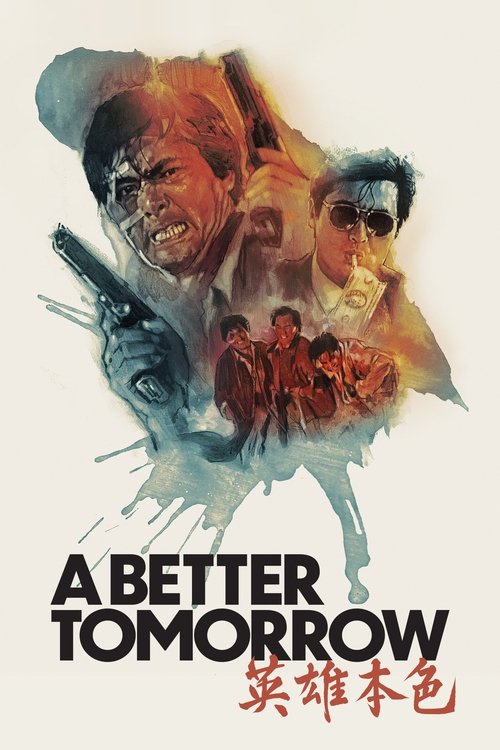
A Better Tomorrow
1986 · John Woo
For when you want to feel something big — male friendship, honor, tears and gunfire all in one sitting. A cornerstone watch for anyone who loves action movies and wants to see where so much of the genre's swagger was born.
What it's about
A high-level counterfeiter in Hong Kong tries to go straight after prison, hoping to win back his younger brother — a rising police cadet who can't forgive what the family name now costs him. But his old partner, a swaggering gangster fallen on hard times, and the triad world they built together won't let go so easily. It's a crime story where the real stakes are loyalty, face, and whether a man is allowed to change.
The experience
Full-blooded and unashamedly emotional — brotherhood, betrayal, and redemption played at operatic pitch, punctuated by gunfights staged like musical numbers. It's melodrama in the best sense: you feel everything, loudly.
Performances
Chow Yun-fat, in the role that made him a superstar, is pure charisma as Mark — trench coat, sunglasses, matchstick in his teeth, wounded pride under all the cool. Ti Lung brings genuine gravitas to the elder brother, and Leslie Cheung gives the young cop a raw, boyish anger.
The craft
John Woo turns gunplay into choreography — two-fisted shootouts, slow motion, doves' worth of style — while shooting in Hong Kong's real streets and back alleys, so the myth-making stays grounded in a living city. The action grammar invented here has been borrowed ever since.
Why it matters
It shattered Hong Kong box-office records, resurrected the careers of everyone involved, and launched the 'heroic bloodshed' genre whose fingerprints are on decades of action cinema worldwide, from Hollywood to Korea.
Snapshot
A reformed counterfeiter attempts to reconcile with his estranged younger brother, a police cadet, while his former partner in crime — the most mythologized figure in the film — spirals toward a sacrificial end. Shot in and around Hong Kong's actual streets, back alleys, and waterfront restaurants, A Better Tomorrow (英雄本色, Yingxiong Bense, literally "True Colours of a Hero") transformed what had been a routine crime narrative into a genre-defining statement about masculine loyalty, honor, and the cost of redemption. It broke box-office records in Hong Kong upon release, revived the careers of its principal actors, and established the template for what critics would come to call "heroic bloodshed" cinema. Its influence radiates outward through two decades of global action filmmaking.
Industry & production
By 1986 John Woo had spent several years in creative and commercial drift, producing a string of comedies and martial-arts pictures that failed to find his voice. It was producer Tsui Hark, operating through his Film Workshop company, who brought Woo the project — loosely revisiting a 1967 Shaw Brothers melodrama — and backed him with the resources and creative latitude to reinvent it. The collaboration was famously fractious. Tsui's instincts ran toward kinetic genre mechanics; Woo's toward operatic male sentiment. The tension between them shaped the film and, eventually, fractured the partnership: Tsui directed A Better Tomorrow III (1989) himself after asserting control over the sequel series.
The budget was modest by international standards but substantial for Film Workshop at the time. Shooting took place on genuine Hong Kong locations — Tsim Sha Tsui side streets, harbor-front restaurants, Statue Square — lending the film a gritty, documentary-adjacent texture that contrasts sharply with its stylized action set-pieces. The production moved quickly, as was common in Hong Kong commercial cinema, with a compressed shoot that nonetheless yielded images of unusual visual authority.
The casting decisions proved consequential beyond the film itself. Ti Lung, a Shaw Brothers martial-arts veteran whose career had stalled, was cast as Ho, the older brother seeking redemption. Leslie Cheung, already a Cantopop star, played Kit, the younger brother-as-cop. Chow Yun-fat, then known primarily for television work and light comedies, took the role of Mark — and the part remade him entirely. Mark's combination of menace, tenderness, and doomed elegance became the template for Chow's screen persona and one of the most imitated images in Asian popular culture.
Technology
The film was shot on 35mm with anamorphic lenses, giving the widescreen compositions their characteristic width and slight optical flare. Woo exploited the format to arrange figures across horizontal space — two men facing the same direction, a silhouette bisecting the frame — in ways that emphasized geometric relationship over conventional eyeline editing. Much of the practical location photography was supplemented by artificial lighting rigs that sculpted the faces of protagonists against dark, rain-slicked backgrounds, a technique borrowed partly from film noir and partly from the visual grammar of Hong Kong television drama.
The optical effects work — slow-motion achieved in-camera by overcranking — was relatively straightforward by the standards of the day, yet Woo's deployment of it felt unusually purposeful: deceleration was reserved for peaks of violence and sacrifice, creating a rhythm in which the slowing of the image signaled that something irreversible was occurring. This was not new in 1986, but the emotional weight Woo attached to the device was.
Technique
Cinematography
The cinematography, credited to Wong Wing-hang, operates across two visual registers that rarely coexist so successfully: a near-naturalistic handheld mode for interiors and street scenes, and a formally composed, near-painterly mode for the major action sequences. The lighting in the restaurant scenes has a warm amber quality — candles, practical sources, the suggestion of heat and comfort before violence shatters it. The action sequences shift to cooler, harder light: fluorescent spill, muzzle flash, the gray-blue of Hong Kong after dark.
Woo frequently positions characters against mirrors, reflective windows, and doorways, creating visual rhymes between what is real and what is merely its image. The famous Statue Square shootout is staged with an almost diagrammatic spatial clarity, each gun position mapped before chaos erupts, so that the audience never loses their bearings even as the editing accelerates.
Editing
The editing strategy is essentially musical. Extended passages of near-wordless preparation — Mark toothpicking a matchstick, the arrangement of a coat, the loading of weapons — build a slow pressure that the action sequences release. Woo cuts between slow-motion and normal speed within single action beats, a technique that mimics the physiological experience of perceived time distortion during moments of extreme stress. The juxtaposition of stillness and sudden violence owes a debt to Sam Peckinpah, but the operatic duration of individual shots — the camera holding on a dying man's face far longer than genre convention requires — is distinctly Woo's own.
Mise-en-scène / staging
The single most consequential staging decision in the film is the introduction of Mark at the restaurant: trench coat, sunglasses, matchstick, dual pistols. This is not characterization through psychology but through costume, posture, and prop — an image constructed as an archetype. The borrowed grammar of Jean-Pierre Melville's solitary gunman (particularly Alain Delon in Le Samouraï, 1967) is fully legible here, but Woo domesticates it: Mark is not cold, he is wounded. His flamboyance is grief in disguise.
The shootouts are staged as choreography, with bodies moving in arcs and trajectories that have the internal logic of a dance piece. Weapons are doubled — two pistols rather than one — not for practical reasons but for symmetry, for visual balance, for the suggestion that the gunman exists in a different moral and aesthetic register than ordinary violence. Blood is abundant but stylized; the deaths are prolonged, almost ceremonial.
Sound
The sound design mixes the hard, percussive impact of gunfire with a swelling orchestral score that signals to the audience when to feel rather than simply observe. The theme composed for the film — associated with Mark's character and reprised at key emotional turns — functions less as underscore than as a second narrative voice, editorializing on the action's moral weight. The choice to overlay lyrical music over scenes of destruction was radical in Hong Kong action cinema at the time and has since become so normalized that its original provocation is difficult to recover. The use of Cantonese dialogue is worth noting: at a moment when Mandarin-language martial-arts pictures still dominated prestige action filmmaking, A Better Tomorrow's vernacular naturalism helped anchor it as specifically, emphatically Hong Kong.
Performance
Ti Lung's performance grounds the film's sentiment in something the more theatrical elements might otherwise unravel. His Ho is weary, ashamed, and genuinely uncertain about his own capacity for change — a character whose redemption arc is at every moment in doubt. Leslie Cheung, playing a simpler role, brings a raw emotional volatility to Kit's scenes; his refusal to forgive his brother is petty and human and entirely believable.
But it is Chow Yun-fat who defines the film. Mark is, on paper, a supporting character. Chow makes him the film's center of gravity through a quality of radical physical relaxation — a loose-limbed ease that makes the violence, when it comes, shocking rather than expected. His performance gave the film its iconic still image: the trench coat, the raised pistols, the unhurried face.
Narrative & dramatic mode
The film operates as melodrama in the classical sense — a mode organized around moral legibility and emotional extremity — set inside a crime genre framework. Its structural engine is not the thriller's forward momentum but the melodrama's tragic irony: we know the path Ho is trying to walk is likely impassable, and the film's suspense derives from watching the attempt anyway.
The narrative triangle — reformed criminal, loyal friend, policeman brother — maps a set of competing claims on loyalty that the film refuses to resolve sentimentally. Institutional justice (represented by Kit and the police) is not simply wrong, and the criminal code of honor represented by Mark is not simply right. The film is honest about the costs of both.
Genre & cycle
A Better Tomorrow is the founding text of the heroic bloodshed cycle — a body of Hong Kong genre cinema from roughly 1986 to 1992 organized around triad gunmen, codes of brotherhood, spectacular violence, and operatic sacrifice. The cycle includes Woo's own The Killer (1989) and Hard Boiled (1992), Ringo Lam's City on Fire (1987), and dozens of lesser works that borrowed the visual grammar without the emotional architecture.
The genre draws on several antecedents: the brotherhood codes of classical wuxia fiction, transposed from sword to gun; the American film noir gangster-who-wants-out; the lone-gunman tradition of Italian westerns and Melville's crime films. What distinguishes the cycle from its sources is its sentimentality — its willingness to stage weeping men in tuxedos with the same formal gravity it affords to shootouts — and its Hong Kong specificity: the cramped urban geography, the Cantonese-language realism, the colonial city's particular anxiety about belonging and identity.
Authorship & method
John Woo had served his apprenticeship under Chang Cheh at Shaw Brothers, absorbing that director's preoccupation with male sacrifice and screen violence before finding a more personal visual language. His method is operatic in the precise sense: sequences are organized as arias, with visual rhythm, musical counterpoint, and emotional climax as explicit structural goals. He has cited John Ford (for compositional classicism), Sam Peckinpah (for the aestheticization of violence), and Melville (for the existential loner) as formative influences, and all three are visibly present in A Better Tomorrow.
The collaboration with cinematographer Wong Wing-hang gave Woo the visual grammar he needed; the compositional precision of the film's key images reflects a working relationship that understood what Woo was reaching for. The score — credited to composer Violet Lam and including a theme vocal associated with the film's release — operates as an explicit emotional instruction to the audience, and its integration into the editing rhythm was evidently central to Woo's conception rather than an afterthought.
The screenplay, developed by Woo with writers including Chan Hing-kai, foregrounds the fraternal melodrama over the crime plot. Tsui Hark's producing influence leaned in the direction of tighter genre mechanics, and the film that emerged is in some sense a negotiated object between Woo's lyrical sentimentality and Hark's appetite for forward momentum.
Movement / national cinema
A Better Tomorrow is a landmark of Hong Kong cinema's commercial and artistic peak — the decade roughly spanning the mid-1980s to the mid-1990s — when the territory produced action cinema of extraordinary formal invention under conditions of high commercial pressure and collective anxiety about the 1997 handover to mainland China. The films of this period are saturated with themes of loyalty under pressure, the impossibility of trust in institutions, and sacrifice as the only available form of integrity. Whether this thematic content maps directly to political allegory is debated, but the films' emotional register is unmistakably shaped by their historical moment.
Era / period
The film belongs to the second half of the 1980s, when Hong Kong's New Wave directors (Tsui Hark, Ann Hui, Allen Fong, Patrick Tam) had established a new cinematic ambition for the territory's industry, and a second generation was absorbing those lessons and recombining them with genre energy. A Better Tomorrow sits at the intersection of commercial genre cinema and auteurist aspiration — it is simultaneously a crowd-pleasing action picture and a work with a distinct moral and aesthetic intelligence. It appeared at a moment when Hong Kong action cinema was exported widely across Asia and beginning to attract serious critical attention in Europe.
Themes
The film's central theme is brotherhood (兄弟情, xiongdi qing) — not as sentiment but as ethical commitment. The question it poses is whether loyalty to a person can survive the dissolution of the context in which that loyalty formed. Ho and Mark's bond was forged in crime; when Ho attempts to leave that world, he cannot take Mark with him, and Mark's devotion becomes a liability.
Adjacent to this is the question of redemption: whether a person who has done serious harm can earn their way back into legitimate relationship. The film is skeptical. Ho serves his prison term, renounces his past, and offers his brother reconciliation — and is refused. The institution (the police, represented by Kit) does not forgive; the world does not reset. This is not pessimism but moral realism, and it gives the film's eventual sacrifices their weight.
Masculinity as performance and burden is a third sustained concern. The film's men perform toughness as a survival strategy, but their interior lives — grief, love, shame — leak constantly through the armor. Mark's dandyism reads as both ultra-masculine styling and as barely coded emotional exposure.
Reception, canon & influence
A Better Tomorrow was the highest-grossing Hong Kong film of 1986, reportedly earning in the range of HK$34–35 million — figures widely cited in the literature, though precise verified documentation of Hong Kong box-office records from this period varies by source. Its commercial success was accompanied by critical recognition within Hong Kong, including multiple Hong Kong Film Awards, with Ti Lung and Chow Yun-fat both cited for their performances.
Influences on the film: The film draws most visibly on Jean-Pierre Melville's cinema of the solitary gunman, particularly Le Samouraï (1967) and Le Cercle Rouge (1970) — the visual iconography of the trench coat, the code of honor among men outside society's sanction, and the contemplative pace amid violence are all Melvillian inheritances. Sam Peckinpah's The Wild Bunch (1969) is the primary template for the slow-motion violence aesthetic. American film noir provided the city-as-moral-landscape grammar. The classical wuxia tradition — especially the brotherhood ethics of Chang Cheh's Shaw Brothers pictures, under whom Woo trained — supplied the sacrificial male sentiment and the notion that the bond between men constitutes its own law.
The film's legacy: The influence of A Better Tomorrow is both specific and diffuse. Within Hong Kong cinema it launched the heroic bloodshed cycle and redefined the commercial possibilities of local action filmmaking. Woo's subsequent films — The Killer, Bullet in the Head (1990), Hard Boiled — developed the grammar he established here, and collectively they constituted the stylistic vocabulary that exported Hong Kong action cinema globally.
Woo's subsequent Hollywood career (beginning with Hard Target in 1993) carried the style into American studio filmmaking, where it influenced the visual language of late-1990s and 2000s action cinema. The Wachowskis' The Matrix (1999) is visibly indebted to the balletic gun choreography, slow-motion punctuation, and black-coat iconography that A Better Tomorrow codified. Quentin Tarantino and Robert Rodriguez have acknowledged Woo's influence extensively. In East Asian cinema, the film's templates shaped Korean crime cinema into the 2000s — the works of Park Chan-wook and others bear its imprint — and spawned a Korean-language remake in 2010.
The film also launched Chow Yun-fat as an international icon. Mark Gor became one of the most imitated images in Asian popular culture: the combination of trench coat, sunglasses, matchstick, and dual pistols entered the visual vocabulary of action cinema worldwide and remains there.
Critical rehabilitation of the film in Western contexts was slower, associated with the rise of dedicated Hong Kong cinema scholarship in the 1990s and the work of critics including David Bordwell, whose writing on Hong Kong action cinema gave the heroic bloodshed cycle its analytical framework. The film now occupies a secure position in any serious account of world cinema's action genres, recognized not merely as a stylistic influence but as a work with genuine emotional intelligence and formal ambition that the decades since release have not diminished.
A Deleuzian reading
Watch the matchstick.
The full Deleuzian reading of A Better Tomorrow →
Reception
No reappraisal needed at home — it smashed Hong Kong box-office records in 1986 and won Best Film at the Hong Kong Film Awards. The arc is geographic: in the West it spread slowly through bootlegs and cult video circles before being canonized as the film that launched 'heroic bloodshed' and rewired action cinema.
How A Better Tomorrow was received, from release to now →
Influences: the films it descends from and the films it influenced
- Le Samouraï (1967) — Woo directly lifts the costumed lone-gunman archetype — trench coat, hat, pistol as identity rather than tool — transplanting Melville's cold existentialism onto Mark's restaurant entrance and domesticating it into wounded sentiment.
- Once Upon a Time in the West (1968) — The architecture of extended near-wordless preparatory sequences building pressure before explosive release, and the Morricone model of orchestral score functioning as emotional counterpoint against — not accompaniment to — on-screen death.
- The Wild Bunch (1969) — Woo inherits the technique of cutting between real-time and in-camera overcranked slow-motion within single action beats, using temporal dilation as an editorial signal that something irreversible is occurring.
- Le Cercle Rouge (1970) — The geometric spatial logic of multi-man shootouts — positions established and sight-lines mapped in advance of chaos — and the ensemble male honor code as the film's primary moral architecture rather than psychology.
- The Godfather (1972) — The Baptism sequence establishes the template of editing violence to ceremonial musical rhythm rather than conventional narrative continuity — a structural model for Woo's strategy of building action sequences around editorial music rather than plot logic.
- Blood Brothers (1973) — Chang Cheh's Shaw Brothers template of sworn fraternal loyalty, male sacrifice, and honor-unto-death gives Woo his direct generic precursor in Hong Kong melodrama, transposing wuxia masculine codes into the contemporary triad crime milieu.
- The Killer (1989) — Woo's direct refinement of ABT's heroic bloodshed grammar: the church-as-arena set-piece, Chow Yun-fat's two-gun performance vocabulary taken to its fullest extension, and the killer-cop fraternal bond as moral mirror of ABT's Ho-Kit sibling structure.
- Bullet in the Head (1990) — Woo applies ABT's fraternal-melodrama structure and slow-motion elegy to a Vietnam-era political canvas, extending the same craft logic — male friendship tested by institutional betrayal and moral compromise — into explicit historical allegory.
- Hard Boiled (1992) — The apotheosis of Woo's in-camera action choreography: the hospital corridor sequence extends ABT's dual-pistol symmetry staging to its physical limit, testing how far continuous choreographed space can replace editorial assembly.
- Reservoir Dogs (1992) — Tarantino extracts the men-in-matching-costumes archetype and the Mexican standoff geometry from the heroic bloodshed cycle ABT launched, reframing the honor-code-under-betrayal narrative within American crime genre conventions.
- Face/Off (1997) — Woo transposes ABT's mirror-composition device to a literal thematic conceit — two men who become each other's reflection — while carrying the dual-pistol symmetry and orchestral-violence counterpoint into Hollywood's industrial apparatus.
- The Matrix (1999) — The dual-pistol firing stance, trench coat as costume-archetype, and real-time/slow-motion intercutting within action sequences are direct visual quotations of ABT and The Killer, transmitted through Woo's influence on the global diffusion of Hong Kong action choreography.
- Infernal Affairs (2002) — Lau and Mak inherit ABT's fraternal-loyalty-under-institutional-pressure narrative and its operatic sacrifice ending, transposing Woo's slow-motion choreographic elegy into procedural psychological tension without discarding the genre's emotional grammar.
- Election (2005) — To builds on ABT's codification of ceremonial triad masculine violence and the honor-code-as-genre-engine, replacing Woo's operatic sentiment with cold bureaucratic ritual while retaining the geometric staging of bodies making irreversible decisions.
- Mission: Impossible II (2000) — Originated the heroic bloodshed visual grammar MI:II directly inherits: dual-pistol symmetrical gunplay staged as ballet, white doves released as spiritual counterpoint to killing, and the action-melodrama fusion where romantic sacrifice and gun violence carry equal emotional freight.
- Fallen Angels (1995) — Codified the hitman-as-romantic-outcast in Hong Kong cinema and established slow-motion ballistic choreography as the genre's rhetorical register — the heroic-bloodshed conventions Fallen Angels directly inherits before dissolving them into neon-lit alienation rather than operatic catharsis.
- Infernal Affairs II (2003) — Woo's origination of heroic bloodshed's ceremony-as-opera — Triad oath rituals staged with candlelit chiaroscuro, hierarchically arranged bodies, and slow-motion consecration — gives IA2 its blocking grammar for Ngai Wing-Hau's ritual authority over the Sam organization.
- The Man from Nowhere (2010) — The heroic-bloodshed grammar of male withdrawal and reentry — the damaged man estranged from violence whose emotional obligation to another forces his return, providing the tonal and moral architecture the Korean paternal action cycle later secularizes.
- City on Fire (1987) — Ringo Lam deploys Chow Yun-fat in the same fraternal-loyalty-over-institution register, using the standoff geometry and sacrifice-ending heroic bloodshed grammar that ABT codified, within a production cycle running directly parallel to Woo's.
- Once Upon a Time in China (1991) — Tsui-produced New Wave landmark whose crescendo-built set-piece architecture and elegiac heroic register parallel OUATIC's construction and tone.
Similar films
- Hard Boiled (1992) — influence & lineage · same viewing thread
- The Killer (1989) — influence & lineage · same viewing thread
- Bullet in the Head (1990) — influence & lineage
- Infernal Affairs (2002) — influence & lineage
- City on Fire (1987) — influence & lineage
- Face/Off (1997) — influence & lineage
- The Mission (1999) — same viewing thread
- The Pig, the Snake and the Pigeon (2023) — same viewing thread
All the films related to A Better Tomorrow →
Watch it with: curated runs of related films
- Elegant Savagery — A run of sleek, merciless thrillers where vengeance arrives in tailored suits and is paid in broken bone — watch these when you want beauty and brutality in the same frame.