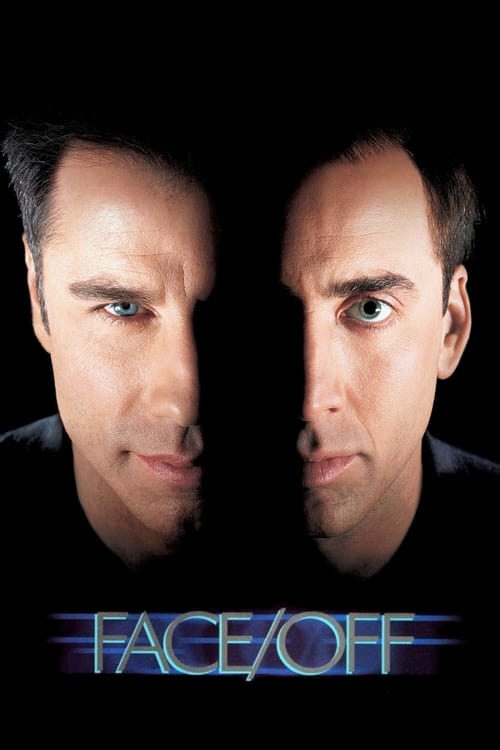
Face/Off
1997 · John Woo
For a big loud crowd-pleasing night when you want maximum action with a wicked streak of camp — the ideal watch-with-friends movie. Pure entertainment, zero homework.
What it's about
To stop a terrorist's bomb plot, an FBI agent undergoes experimental surgery to wear the face of the criminal mastermind he's hunted for years — and infiltrate his world as him. Then the terrorist wakes up early, takes the agent's face, and walks off with his life, his job, and his family. Two mortal enemies, each trapped inside the other's identity, hunt each other down.
The experience
Gloriously over-the-top — a two-hour adrenaline rush of doves, standoffs, and slow-motion mayhem that's also, sneakily, an operatic melodrama about grief and identity. It's funny, it's absurd, and it commits so totally that the absurdity becomes the point.
Performances
John Travolta and Nicolas Cage each play both men, swapping roles mid-film — Cage doing Travolta's decency, Travolta gleefully devouring Cage's mania — and their mutual impersonation is one of the great high-wire acting stunts of the 1990s.
The craft
John Woo brought his full Hong Kong action grammar to Hollywood intact: balletic gunfights, churches full of doves, Mexican standoffs staged like arias, action sequences cut with genuine emotional stakes underneath. It's a maximalist feast that rewards a big screen and a sound system with some kick.
Why it matters
The film where Woo's Hong Kong style finally conquered Hollywood on its own terms — a summer blockbuster critics embraced, and a benchmark for stylized American action ever since.
Snapshot
Face/Off is John Woo's third and most fully realized American production, the film in which the Hong Kong master's operatic action grammar finally fused with a Hollywood star vehicle without being diluted by it. From a long-gestating science-fiction premise — an FBI agent and the terrorist he has hunted for years literally exchange faces, and therefore identities — Woo built a delirious melodrama of doubling, grief, and moral contagion. John Travolta and Nicolas Cage each play both men, trading roles at the midpoint, and the conceit licenses two of the most extravagant performances of the decade. Released by Paramount in the summer of 1997, the picture was both a substantial commercial hit and the rare action blockbuster embraced by serious critics, who recognized in it a coherence of theme and style that Woo's earlier American work (Hard Target, Broken Arrow) had only gestured toward. It remains the standard reference point for what the Hong Kong-to-Hollywood migration of the 1990s could achieve at its best.
Industry & production
The screenplay by Mike Werb and Michael Colleary had circulated in Hollywood since the early 1990s, originally conceived in a more overtly futuristic, dystopian register before being revised toward a contemporary setting. Across its long development the project attracted interest from major action stars of the era — Arnold Schwarzenegger and Sylvester Stallone were associated with it at various points — and the high-concept "swap" hook made it a recognizable property well before cameras rolled. When John Woo came aboard, the futuristic trappings were further pared back so that the face-transplant device functioned as a single fantastical premise inside an otherwise grounded crime thriller.
The film was produced for Paramount Pictures by a team including David Permut, Barrie M. Osborne, and Woo's long-standing producing partner Terence Chang, with Christopher Godsick also producing; Michael Douglas's company was among the entities attached during development. Woo, Chang, and their collaborators had been building an American base since Woo's arrival in the wake of the 1997 Hong Kong handover anxieties that pushed many of the territory's leading filmmakers westward. Face/Off arrived after two American films on which Woo felt his control was compromised, and the production is generally understood to have granted him meaningfully greater authority over staging and tone. The casting of Travolta — then enjoying a career resurgence following Pulp Fiction — opposite Cage, a recent Best Actor Oscar winner for Leaving Las Vegas, gave the picture two performers willing to push into operatic excess, which was precisely the register Woo needed.
Technology
Face/Off sits at an interesting technological hinge. Its premise depends on a science-fiction conceit — a covert surgical procedure that transplants one man's face onto another and alters voice and physiognomy — but the film deliberately keeps the operation's mechanics vague and clinical rather than dwelling on digital spectacle. The "morphological" surgery is conveyed through medical staging, prosthetic detail, and a recurring image of the two removed faces, rather than through showcase visual-effects sequences. This is largely a practical-effects picture: the action is built from stunt performers, squib-loaded squibs and blood charges, full-scale pyrotechnics, vehicle work, and elaborate live gun choreography, in keeping with Woo's method and with the pre-digital action idiom of the mid-1990s. Computer-generated imagery is used sparingly and in support rather than as the main attraction, which is part of why the film's set pieces retain a tactile weight that has aged well.
Technique
Cinematography
Oliver Wood photographed the film in widescreen, favoring a glossy, high-contrast surface punctuated by Woo's characteristic theatrical lighting — shafts of light through windows, backlit smoke, and the white interiors and fluttering doves of the climactic church-adjacent and chapel imagery. The camera is mobile and assertive: sweeping dolly and crane moves, whip pans that track ricocheting action, and the operatic use of slow motion to dilate moments of violence and recognition. Wood's frame consistently organizes the two leads in mirrored compositions, reinforcing the doubling motif at the level of staging.
Editing
Cut by Christian Wagner and Steven Kemper, the film exemplifies Woo's rhythmic approach to action — long, legible builds that explode into rapid, percussive bursts, with slow motion used not as decoration but as punctuation, holding a beat so the audience registers the emotional stakes beneath the gunfire. The editing also manages the film's central trick of identity: it must keep the audience oriented as to which soul inhabits which body, and it does so through performance cues and reaction shots as much as through plot mechanics. The famous standoff staged on either side of a two-way mirror, the antagonists' guns trained on their own reflected faces, is a set piece of editorial and conceptual ingenuity.
Mise-en-scène / staging
This is the film's richest dimension. Woo's signatures are present in concentrated form: the Mexican standoff, the dual-wielded pistols, the slow-motion dove taking flight at a moment of moral reckoning, the church-like spaces and Catholic iconography. He stages action as melodrama — bodies arranged in tableaux, violence choreographed to feel like dance or opera. A celebrated sequence sets a brutal shootout against the incongruous sweetness of a child wearing headphones playing "Over the Rainbow," the music insulating the girl from the carnage around her. Throughout, Woo uses mirrors, reflections, and symmetrical blocking to literalize the theme of men who become each other.
Sound
John Powell composed the score — a notable feature debut for the British composer, who emerged from the Hans Zimmer–led Media Ventures stable. The music blends propulsive electronic and orchestral action writing with a darker, more lyrical undercurrent for the film's themes of loss and identity, and Powell's work here launched a major Hollywood scoring career. The sound design leans into Woo's operatic mode: gunfire is weighted and theatrical, and music is used emotionally, sometimes ironically (as in the "Over the Rainbow" juxtaposition), to elevate violence into something closer to tragedy.
Performance
The film's engine is its central acting conceit. Cage first plays the flamboyant terrorist Castor Troy, then plays the straitlaced agent Sean Archer trapped inside Troy's body; Travolta first plays the grim, grieving Archer, then plays Troy luxuriating in Archer's stolen face and life. Each actor therefore had to construct a baseline character and then impersonate the other's calibrated tics — Cage's lascivious swagger, Travolta's clenched rectitude — so that the audience reads the swapped soul through borrowed mannerisms. The result is a controlled excess that the film's melodramatic frame not only tolerates but requires. Joan Allen grounds the picture as Archer's wife Eve, Gina Gershon plays Troy's former lover Sasha, Dominique Swain plays the imperiled daughter Jamie, and a deep supporting bench (Nick Cassavetes, CCH Pounder, Colm Feore, Harve Presnell, Margaret Cho) fills out the world.
Narrative & dramatic mode
Beneath its action-thriller plumbing, Face/Off is structured as melodrama — a mode organized around family, fate, and overwhelming emotion rather than around realism. Its inciting wound is domestic: Archer's young son was killed years earlier by a bullet Troy intended for the father, and the entire revenge plot is a displaced act of mourning. The face swap externalizes a melodramatic fantasy, forcing each man to inhabit the other's life — Archer must live inside his enemy's body alongside that enemy's brother and child; Troy moves into Archer's home, bed, and family. The drama turns on recognition, mistaken identity, and the question of whether the self resides in the face one wears or in something deeper, and it resolves, characteristically for Woo, through sacrifice and the restoration of family.
Genre & cycle
Face/Off belongs to the mid-to-late 1990s Hollywood action blockbuster cycle, the high-concept, star-driven mode then at its commercial peak. More specifically it is the signal achievement of the Hong Kong-to-Hollywood action wave, in which Woo, Tsui Hark, Ringo Lam, and stars such as Jackie Chan, Jet Li, and eventually Chow Yun-fat brought the kinetic, emotionally heightened style of Hong Kong cinema into the American studio system. The science-fiction premise nests inside the crime-thriller and undercover-cop traditions, but the film's true generic lineage is the "heroic bloodshed" action melodrama Woo had perfected in Hong Kong.
Authorship & method
Face/Off is the clearest American expression of John Woo's authorship. The doves, the dual pistols, the standoffs, the slow-motion grace notes, the male doubles bound in mutual obsession, and the Catholic-inflected imagery of guilt and redemption all recur from his Hong Kong masterworks A Better Tomorrow, The Killer, and Hard Boiled. Central to the method is Woo's conviction that action is an expression of character and emotion, not a break from them — violence as a vehicle for melodrama. The realization of that vision here was a collaborative achievement: cinematographer Oliver Wood, editors Christian Wagner and Steven Kemper, production designer Neil Spisak, composer John Powell, and writers Mike Werb and Michael Colleary, whose script supplied the doubling structure that let Woo's recurring theme of mirrored antagonists become the literal mechanism of the plot. Producer Terence Chang's long partnership with Woo was instrumental in securing the conditions under which that style could survive the studio process intact.
Movement / national cinema
The film is a hybrid artifact of two national cinemas. Its body is a Hollywood studio production, but its sensibility — the operatic violence, the moral seriousness about loyalty and brotherhood, the fusion of sentiment and spectacle — derives from the Hong Kong action cinema of the 1980s and early 1990s. Face/Off is thus best understood within the diaspora of Hong Kong filmmaking talent that relocated westward around the 1997 handover, and it stands as the most successful translation of that tradition into American commercial cinema, the point at which Woo's idiom was absorbed rather than flattened.
Era / period
Arriving in the summer of 1997, Face/Off is a document of the late-1990s blockbuster moment — the era of the movie star as the central engine of the studio tentpole, of practical action craft on the cusp of the digital turn, and of Hollywood's active appetite for imported Hong Kong style. Travolta's post-Pulp Fiction stardom and Cage's post-Oscar ascendancy place it precisely in a window when both actors commanded marquee status while remaining willing to take genuine performative risks. It predates the full CGI saturation of the action genre, which is part of its enduring tactility.
Themes
Identity is the film's governing obsession: the question of whether the self is located in the face, the body, or some less tangible essence, and what happens to a man forced to perform his enemy from the inside. Around this sit Woo's perennial themes — the mirrored bond between hero and villain, who come to understand and even resemble each other; family as both the source of grief and the site of redemption; faith, guilt, and sacrifice, rendered through churches, doves, and quasi-religious gestures of absolution. The film also probes the contagion of violence — how vengeance deforms the avenger — and the porousness of the line between cop and criminal, a line the plot dissolves entirely by housing each man in the other's skin.
Reception, canon & influence
Face/Off was a commercial success — a major summer hit that grossed well over $200 million worldwide — and, unusually for a film of its kind, a critical one. Reviewers who had been cool to Woo's earlier American efforts singled it out as the picture in which his style and a Hollywood project finally cohered, praising the audacity of the central performances and the clarity and emotion of the action. It has since been widely regarded as the best of Woo's American films and as one of the strongest action pictures of the 1990s, frequently cited in retrospectives of the heroic-bloodshed tradition's crossover.
Its influences run backward to Woo's own Hong Kong canon — The Killer and Hard Boiled above all — and, through them, to the gun-ballet aesthetic Woo synthesized from sources including Jean-Pierre Melville's cool fatalism and the Hollywood musical's choreographic logic; the body-swap and double-identity premise also draws on a long literary and cinematic lineage of doppelgängers and mistaken identity. Forward, the film helped normalize Hong Kong-style action choreography within American studio filmmaking and stands as a touchstone for later directors working in heightened, balletic violence. Its central performances became a benchmark for the "two actors playing each other" device, and its imagery — the mirror standoff, the slow-motion dove, the dual pistols — entered the common vocabulary of action cinema, endlessly referenced and parodied. Within Woo's career it marks the high-water mark of his Hollywood period, the achievement against which his subsequent American films were measured and, by general consensus, the one in which his sensibility arrived fully intact.
A Deleuzian reading
Keep the two-way mirror.
The full Deleuzian reading of Face/Off →
Reception
A critical and commercial hit in summer 1997 — rare for an action film, it drew serious critical praise on release — and it's since only climbed, now widely held up as John Woo's Hollywood peak and a high-water mark of '90s studio action maximalism.
How Face/Off was received, from release to now →
Influences: the films it descends from and the films it influenced
- A Better Tomorrow (1986) — Codified Woo's dual-wielded-pistols, slow-motion gun ballet and the male-brotherhood melodrama that Face/Off reprises as its emotional engine.
- The Killer (1989) — Source of the literal craft signatures Face/Off reuses — the slow-motion dove, the church-and-candle Catholic iconography, and the cop-and-killer pair who mirror each other across a Mexican standoff.
- Hard Boiled (1992) — Perfected the sustained long-take balletic gunfight staged as an escalating emotional crescendo rather than a break from character, the method Face/Off inherits wholesale.
- Le Samouraï (1967) — Woo's acknowledged template for the cool, ritualized, fatalist professional — the minimalist gangster grace that underlies Castor Troy/Sean Archer's coded antagonism.
- The Wild Bunch (1969) — Invented the multi-camera slow-motion montage of gunfire as operatic balletic spectacle, the editing grammar Woo extends in Face/Off's set-pieces.
- West Side Story (1961) — Models the Hollywood-musical choreographic logic — violence blocked as dance — that Woo explicitly transposes onto gun choreography.
- Vertigo (1958) — Template for obsessive identity-substitution and mirrored compositions, the doppelgänger visual grammar Face/Off literalizes through the face transplant.
- Persona (1966) — Pioneered rendering two merging identities through superimposed, mirror-symmetric faces — the formal device behind Face/Off's swapped-protagonist staging.
- Bullet in the Head (1990) — Exports Bullet's gun-fu grammar to Hollywood — the dual-wield standoffs, freeze-frame slow motion, and released doves crossing the frame during gunfire.
- The Rock (1996) — Directly enabled by The Rock's proof that Cage's mannerist, neurotic-comic register could headline an action film — Woo then makes that performance style the movie's formal subject by having two actors trade it.
- The Replacement Killers (1998) — Woo-produced, Chow Yun-fat-led import of the heroic-bloodshed church/standoff iconography directly into American studio action.
- The Matrix (1999) — Its lobby shootout fuses bullet-time slow-motion with Hong Kong wire-fight choreography, normalizing the Woo-style balletic gunfight Face/Off had just legitimized.
- Mission: Impossible 2 (2000) — Woo re-literalizes Face/Off's mask/face-swap deception alongside the doves and slow-motion grace notes within a Hollywood franchise.
- Equilibrium (2002) — Formalizes Woo's dual-pistol gun ballet into 'gun kata,' codifying the balletic-shooter choreography as an explicit martial system.
- Kill Bill: Vol. 1 (2003) — Extends the operatic, stylized, music-scored choreography of violence and revenge-melodrama tone that Woo's crossover made bankable in Hollywood.
- John Wick (2014) — Builds sustained 'gun-fu' set-pieces — close-quarters pistol choreography shot for legibility and rhythm — directly extending Woo's balletic-shooter grammar.
- Mission: Impossible II (2000) — Immediate technical precursor in every dimension: Jeffrey L. Kimball's anamorphic slow-motion cinematography, the identity-swap narrative engine, dove staging as authorial signature, and the physical-melodrama emotional register are all rehearsed here and carried forward unchanged into MI:II.
- Hard Target (1993) — Woo's first American transplant of the slow-motion dove and dual-pistol aesthetic, the rougher draft of the studio integration Face/Off completes.
- Desperado (1995) — Stages dual-pistol gun-ballet set-pieces as overt homage to the heroic-bloodshed slow-motion shooter tradition Woo founded.
Similar films
- Hard Boiled (1992) — influence & lineage
- The Killer (1989) — influence & lineage
- A Better Tomorrow (1986) — influence & lineage
- The Matrix (1999) — influence & lineage
- Mission: Impossible II (2000) — shared sensibility
- Die Hard (1988) — shared sensibility
- The Rock (1996) — shared sensibility
- Tenet (2020) — shared sensibility