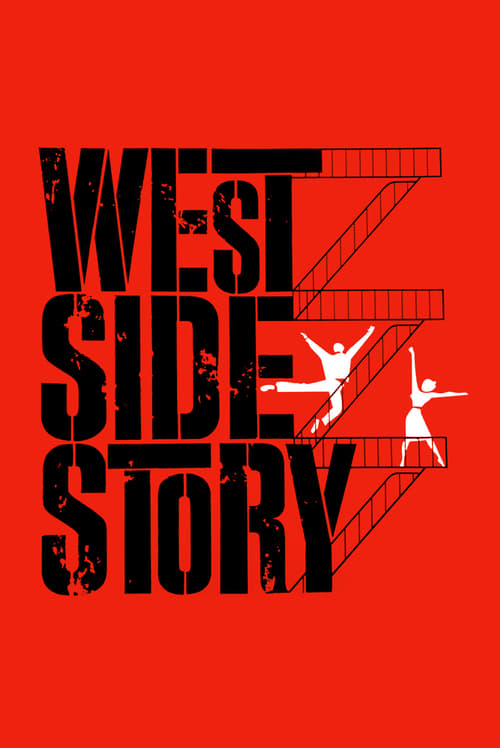
West Side Story
1961 · Robert Wise
For when you want to be swept up — big emotions, big music, dancing in the streets — and you're willing to have your heart broken at the end of it. A grand, romantic evening rather than a light one.
What it's about
On Manhattan's Upper West Side, two street gangs — the white ethnic Jets and the Puerto Rican Sharks — fight for a few blocks of turf, and the tension is building toward a showdown. Into that feud fall Tony and María, one from each side, who meet at a dance and fall instantly, dangerously in love. It's Romeo and Juliet moved to the tenements, told through Leonard Bernstein's music and Jerome Robbins's choreography.
The experience
Exhilarating and heartbreaking in turns — the dance numbers crackle with athletic aggression, the love songs soar, and underneath it all runs a dread you can feel tightening. Few musicals swing this hard between joy and tragedy.
Performances
Rita Moreno and George Chakiris both won Oscars as Anita and Bernardo, and Moreno especially burns through the screen — funny, fierce, and devastating. Natalie Wood gives María a luminous openness that makes the romance land.
The craft
Jerome Robbins's choreography turns gang warfare into ballet without softening it, and the opening — shot on real New York streets — fuses location grit with pure stylization in a way movie musicals hadn't dared. Bernstein's score and Sondheim's lyrics are among the best ever written for the form; the widescreen color and that music demand the biggest screen and best sound you have.
Why it matters
It swept the Academy Awards with ten Oscars — still the most ever for a musical — and set the standard for how a stage musical could be reimagined as cinema rather than merely filmed.
Snapshot
West Side Story is the film adaptation of the 1957 Broadway musical conceived by Jerome Robbins, with music by Leonard Bernstein, lyrics by Stephen Sondheim, and book by Arthur Laurents — a modern-dress transplant of Romeo and Juliet to the tenement blocks of Manhattan's Upper West Side, where the white ethnic Jets and the Puerto Rican Sharks feud over turf while Tony and María fall in love across the divide. The 1961 film, produced by the Mirisch Corporation and released through United Artists, was co-directed by Robert Wise, a seasoned Hollywood craftsman, and Robbins, the stage production's originating choreographer and director. It became one of the most acclaimed and awarded musicals in Hollywood history, sweeping the Academy Awards with ten Oscars, the most ever won by a musical. Its fusion of location shooting, symphonic scoring, and modernist dance made it a landmark in how the film musical could carry weight — social, tragic, kinetic — beyond escapism.
Industry & production
The film emerged at a transitional moment for the studio system. The Mirisch Company, an independent production outfit run by the brothers Harold, Marvin, and Walter Mirisch, financed the picture and released it through United Artists, the distributor that had built its postwar identity around backing independent producers. The property was a proven stage success, and its screen rights represented a substantial gamble on a musical whose subject matter — juvenile gang violence, ethnic hostility, death — ran against the genre's reputation for uplift.
The production's most-discussed feature was its divided direction. Jerome Robbins, who had conceived and staged the original and was indispensable to its choreography, was paired with Robert Wise, a director and former editor with a reputation for efficiency and range. Robbins's perfectionism and slow, expensive shooting pace on the dance sequences led to his removal partway through production; Wise carried the remainder to completion, though Robbins's choreography and its staging remained central to the finished film, and both men shared the directing Oscar. This arrangement — a screen-craft director managing the mechanics of filmmaking, a theater-and-dance auteur shaping the numbers — is essential to understanding the film's texture.
Casting reflected period-standard practices that later drew sustained criticism. Natalie Wood, a white star, played the Puerto Rican María; Richard Beymer played Tony. The film relied heavily on dubbed singing voices: Marni Nixon sang for Wood, and Jimmy Bryant for Beymer, a common studio practice of the era. Rita Moreno, who is of Puerto Rican descent, played Anita, and George Chakiris played Bernardo — both won supporting Oscars. Moreno has spoken publicly in later decades about the film's use of dark makeup on non-Puerto Rican and lighter-skinned performers to homogenize the Sharks, a practice now widely regarded as one of the film's ethical failures.
Technology
West Side Story was shot in Super Panavision 70, a large-format process using 65mm camera negative to produce a 70mm release print with a wide aspect ratio and exceptional clarity and color depth. The choice aligned the film with the roadshow presentation model then favored for prestige releases — reserved-seat engagements, overtures, intermissions — that Hollywood used to differentiate the theatrical event from television. The film was presented in Technicolor and, in its premier engagements, with six-track magnetic stereophonic sound, then the highest-fidelity exhibition format available, which suited a picture built around a full symphonic-jazz score. The large negative and stereo scoring together gave the musical numbers an immersive scale that smaller formats could not match.
Technique
Cinematography
Daniel L. Fapp, the director of photography, won the Academy Award for his color cinematography. The film opens with one of its most celebrated technical gestures: a prolonged overhead aerial view of Manhattan that descends slowly across the grid of the city before settling into the specific blocks where the story unfolds — a movement from abstraction to street level that establishes the film's documentary claim on real space. Much of the early material was shot on location in New York, in a district then slated for demolition to make way for the Lincoln Center redevelopment, lending the tenements and playgrounds an authenticity of decayed brick and cyclone fencing. Fapp's compositions in the widescreen 70mm frame accommodate Robbins's group choreography, keeping ensembles legible in depth, and the film's color design is expressive rather than naturalistic — saturated reds and oranges, gel-lit fantasy passages, the bleaching of the world to isolate the lovers.
Editing
Thomas Stanford won the Academy Award for editing. The film's cutting is inseparable from its choreography: dance is edited to preserve the reading of the body's line while sustaining rhythmic momentum, a balance between the theatrical impulse to hold a full figure and the cinematic impulse to fragment and accent. Wise's own background as an editor — he had cut at RKO earlier in his career — informs the film's tight coordination of image and Bernstein's score, particularly in the tense build of the rumble and the percussive snapping and cross-cutting of the opening confrontation.
Mise-en-scène / staging
The film's defining formal achievement is its staging of dance in real and semi-real space. Robbins's choreography translates gang antagonism into a stylized physical vocabulary — finger-snaps, leaps, prowling group formations — that hovers between naturalism and abstraction. The famous opening, in which the Jets move through the streets in escalating stylization from walk to full dance, dramatizes exactly this negotiation between the actual city and the artifice of the musical. Boris Leven's production design and the film's art direction won an Oscar; the sets and locations render the neighborhood as a contested territory, its chain-link, brick, and painted backdrops organizing the drama spatially around turf.
Sound
The score is among the most celebrated in American film. Leonard Bernstein's music fuses symphonic writing with jazz idioms and Latin rhythms, and Stephen Sondheim's lyrics — his first major produced work — sharpen the characterization. The film's musical direction, credited to Saul Chaplin, Johnny Green, Sid Ramin, and Irwin Kostal, won the Oscar for scoring. Sound in the film also serves the drama structurally: numbers such as the contrapuntal "Tonight" quintet layer multiple characters' desires simultaneously, and the film reorders and re-places some of the stage songs. The reliance on dubbed vocals means that the singing voices heard are frequently not those of the on-screen actors, a fact central to any account of the film's performances.
Performance
Performance in West Side Story is stratified between dance, song, and dramatic acting, and the film's reputation on these axes is uneven. The dancing — carried by trained performers, many from the stage production — is universally admired. The romantic leads, Wood and Beymer, have long been the target of critical reservation, their earnestness sometimes read as bland against the vitality around them. The supporting performances are the film's acting glory: Rita Moreno's Anita and George Chakiris's Bernardo animate the Sharks with force and grief, and both were honored with Academy Awards. Moreno's Anita, in particular — her fury in "A Boy Like That," her ordeal in the drugstore — carries much of the film's tragic and moral weight.
Narrative & dramatic mode
The film is a tragic musical, adapting the deep structure of Romeo and Juliet: warring factions, lovers from opposite camps, a fatal chain of misunderstanding and violence, and a closing death that indicts the survivors. Laurents's book streamlines Shakespeare into a two-gang symmetry, and the film preserves the tragic architecture rather than softening it — Tony dies, and there is no reconciliatory resurrection. What distinguishes the work as drama is its integration of the musical number into the tragic action. Songs are not interludes but the primary vehicle of feeling and event: aggression, longing, mockery, and grief are all sung and danced. The mode is thus expressionist as much as realist — the film asks the audience to accept stylized dance in documentary streets as the true register of the story's emotion.
Genre & cycle
West Side Story belongs to the integrated book musical, the dominant Broadway form of the mid-century in which song and dance advance plot and character rather than merely decorating them — a lineage running through Rodgers and Hammerstein. On screen it sits within the late-golden-age Hollywood musical, at the point where the genre was straining toward greater seriousness and social relevance even as its theatrical audience was eroding. It also participates in the era's cycle of juvenile-delinquency pictures, which had made troubled urban youth a marketable subject in the 1950s. The film's innovation was to marry that gritty social-problem material to the lavish roadshow musical, producing a hybrid that felt at once prestigious and topical.
Authorship & method
Authorship here is genuinely collective, and the film resists reduction to a single vision. Robert Wise, credited director and producer, brought the discipline of a studio craftsman — an editor's sense of rhythm, an ability to marshal a large production — and completed the film after Robbins's departure; his later The Sound of Music (1965) confirmed his command of the large-scale musical. Jerome Robbins, the originating stage director-choreographer, is the source of the film's distinctive movement language and its most audacious sequences; his contribution is so foundational that the shared directing credit is fully earned even though he did not finish the shoot. Leonard Bernstein's score is arguably the film's true author, the element that gives the drama its scale and its enduring life. Stephen Sondheim's lyrics mark the arrival of a major theatrical voice. Daniel L. Fapp (cinematography), Thomas Stanford (editing), and Boris Leven (production design) each shaped the film's look decisively, all recognized by the Academy. Arthur Laurents wrote the original stage book; the screenplay adaptation is credited to Ernest Lehman, a leading screenwriter of the period. The method — a theater-born property realized by film specialists — is the film's signature and its productive tension.
Movement / national cinema
This is a work of mainstream American commercial cinema, not of any avant-garde or national art-cinema movement, but it reflects a specifically American mid-century synthesis: the Broadway musical theater of the Rodgers-and-Hammerstein era translated to Hollywood at the height of its resources. Its aesthetic ambition — location realism fused with symphonic-jazz scoring and modern concert-dance — draws on distinctly American vernacular forms, jazz and musical theater above all. The film's engagement with immigration and ethnic conflict, however awkwardly executed by later standards, ties it to a national self-image in flux at the start of the 1960s, as questions of race, assimilation, and belonging were moving toward the center of American public life.
Era / period
West Side Story arrived in 1961, near the end of the classical Hollywood studio era and at the beginning of the decade that would dismantle it. The roadshow prestige format it exemplifies was a studio strategy for surviving television, and the film's enormous success helped sustain the big-budget musical as a viable form for several more years — a cycle that would culminate and then collapse by the late 1960s. Its subject matter registers period anxieties about urban decay, youth violence, and postwar Puerto Rican migration to New York. The Lincoln Center redevelopment that cleared the film's shooting locations is itself an emblem of the era's urban-renewal politics, so that the film literally documents a neighborhood in the act of disappearing.
Themes
The film's governing theme is the tragedy of tribal hatred — the way inherited group loyalty and turf-defense destroy the young who are bound by them. Ethnic prejudice and the immigrant experience run throughout, most explicitly in "America," which stages an argument about the promise and the cruelty of the United States for Puerto Rican newcomers. Love as a fragile, doomed force against social structure drives the central plot, in the Shakespearean key. The film also examines masculinity and belonging through the Jets, whose identity is inseparable from the gang, satirized and diagnosed in "Gee, Officer Krupke." Underlying all of this is the question of place and displacement — who owns the neighborhood, who is native and who is foreign — rendered materially in a story shot on ground about to be demolished.
Reception, canon & influence
On release, West Side Story was a major critical and commercial success and became one of the most honored films in Academy history, winning ten Oscars including Best Picture, both supporting acting awards, direction, cinematography, editing, art direction, costume design, scoring, and sound. It entered the canon quickly and has remained there; the U.S. Library of Congress selected it for preservation in the National Film Registry as a culturally significant work, and it is routinely cited among the great American musicals.
Looking backward, the film's influences are unusually legible: Romeo and Juliet as narrative armature; the integrated book-musical tradition of Broadway; the 1950s juvenile-delinquency film cycle for its social subject; and the concert-dance and jazz idioms that Robbins and Bernstein brought from the theatrical and musical worlds. The stage production itself is the immediate source, and the film is best understood as its transposition rather than a free invention.
Looking forward, its legacy is broad. It demonstrated that the film musical could sustain tragedy and social argument, expanding the genre's expressive range and influencing later serious-minded musicals. Its integration of choreography with cinematic location shooting shaped subsequent approaches to dance on film. Bernstein's score and Sondheim's lyrics became a permanent part of the repertoire, endlessly performed and revived. The film also became a durable object of critical re-examination, particularly regarding its casting of white performers as Puerto Ricans and its use of darkened makeup — critiques voiced pointedly by Rita Moreno and others, and central to the motivations behind Steven Spielberg's 2021 re-adaptation, which sought to address the original's representational failures. That a film should generate both an enduring canonical status and a sustained ethical reckoning is itself a measure of its cultural weight.
A Deleuzian reading
The Jets are just walking.
The full Deleuzian reading of West Side Story →
Reception
A colossal hit in 1961 — ten Oscars including Best Picture, the most ever for a musical — and instantly canonized. Today it's admired and argued over in equal measure, its brownface casting and dubbed voices making it a classic people love with an asterisk.
How West Side Story was received, from release to now →
How to watch West Side Story: what to notice on a first viewing
- Watch the camera come down from above Manhattan. The film opens on a long overhead view drifting across the city grid, then descends until it lands in the particular blocks where the story happens. You see the whole island before you see the turf. From that height the disputed ground is a few indistinguishable blocks. The film shows you that first and never mentions it again.
- Watch for the frame where walking becomes dancing. The Jets are just moving down a sidewalk. Somebody snaps, the walk picks up a beat, the beat picks up the block. Nobody decides to start. Robbins builds it out of snaps, prowling formations, and leaps. The initiative leaves the boys and passes into everything around them, so the dance looks like it is moving them.
- Look at the color when the lovers first see each other. Daniel Fapp's palette is expressive rather than naturalistic. Saturated reds and oranges take over whole scenes, gels light the fantasy passages, and the world bleaches away to leave two people in it. Color here does not describe the room. It absorbs the scene and its feeling, which is why the shifts land as events.
- Listen to how many people sing Tonight at once. Five parties sing the same word simultaneously: the lovers, Anita, and both gangs. To one it means a wedding, to another a good time, to two more a killing. Bernstein stacks them instead of cutting between them. Five versions of the same night arrive in one instant, all true, none able to reach the others. That is the tragedy stated as music.
- Look at the brick and chain-link in the street scenes. Much of the early material was shot in a real New York district already scheduled for demolition to make way for Lincoln Center. The decayed brick, the playgrounds, and the cyclone fencing were all there. The ground these boys are dying over was condemned while the camera was running, which the film never says out loud.
The whole guide to watching West Side Story, with the keys for a rewatch →
Influences: the films it descends from and the films it influenced
- On the Town (1949) — The direct Bernstein–Robbins template: the first musical to take its dancers out of the soundstage and choreograph numbers against real New York City locations, the location-dance method West Side Story pushes into the streets and playgrounds of the Upper West Side.
- The Red Shoes (1948) — Established the extended dance sequence as a self-contained cinematic world built from saturated Technicolor and editing rather than a filmed stage number, the 'expressive-color + dance-cutting' fusion Wise and Fapp adopt for the fantasy 'Somewhere' and rumble staging.
- Oklahoma! (1955) — Agnes de Mille's dream-ballet made narrative-advancing choreography central to the integrated book musical, and its Todd-AO 70mm roadshow release set the large-format, reserved-seat presentation model West Side Story inherits in Super Panavision 70.
- Carousel (1956) — Proved a Rodgers-and-Hammerstein book musical could place death and grief at its structural center, the tragic-musical armature that lets West Side Story kill its leads and still resolve through song.
- Seven Brides for Seven Brothers (1954) — Michael Kidd's athletic, near-acrobatic male-ensemble choreography—dance as muscular physical competition in widescreen—is the direct precedent for the Jets-and-Sharks gang movement vocabulary Robbins builds.
- An American in Paris (1951) — Its climactic 17-minute narrative ballet legitimized surrendering the plot entirely to sustained danced storytelling, the license behind West Side Story's wordless prologue and dream sequences.
- Rebel Without a Cause (1955) — Anchored the 1950s juvenile-delinquency cycle West Side Story draws its social subject from, and modeled the use of color-coded expressive CinemaScope to charge teenage gang conflict with operatic scale.
- The King and I (1956) — Preserves Jerome Robbins's own choreography in the 'Small House of Uncle Thomas' ballet-within-the-film, direct screen evidence of the Robbins movement language that authors West Side Story.
- The Sound of Music (1965) — Wise reprised his own signature here: the helicopter-borne aerial opening that descends from abstract landscape into human drama—the exact establishing gambit of West Side Story's Manhattan overture—again in 70mm roadshow presentation.
- Fiddler on the Roof (1971) — Another Jerome Robbins stage property transposed to film, carrying his choreographic 'community-in-motion' staging and the model of a serious, death-shadowed integrated musical realized by film specialists after the theater director.
- Cabaret (1972) — Extends West Side Story's proof that the musical could carry adult social argument and tragedy, advancing the form through razor-cut rhythmic editing between number and dramatic scene.
- Moulin Rouge! (2001) — Inherits the tragic-musical structure and radicalizes West Side Story's dance-cutting into hyper-kinetic montage, where choreography lives as much in the edit as in the bodies.
- Chicago (2002) — Revived the serious book musical on film by staging numbers as editing-driven fantasy, extending the West Side Story lineage of using cutting rhythm—not just camera—to render dance cinematically.
- La La Land (2016) — Opens with an aerial-into-the-crowd freeway production number that consciously echoes West Side Story's overture, and revives its CinemaScope expressive-color palette and bittersweet tragic-romance resolution for a modern integrated musical.
- West Side Story (2021) — A direct re-adaptation that reconstructs Robbins's location-dance and Bernstein's score while explicitly correcting the original's casting of white performers in brownface—the representational reckoning built into the lineage itself.
- In the Heights (2021) — Carries forward the location-shot New York Latino musical, staging integrated numbers against real Washington Heights streets in the direct On the Town–West Side Story tradition of choreography rooted in the actual city.
- Oliver! (1968) — Robbins formalized the principle of designing choreography around specific architectural features as movement infrastructure—fire escapes, gymnasium floors, fences that dictate spatial patterns—a method John Box absorbed when designing Oliver!'s sets as functional choreographic machines rather than period decoration.
- Face/Off (1997) — Models the Hollywood-musical choreographic logic — violence blocked as dance — that Woo explicitly transposes onto gun choreography.
- The Young Girls of Rochefort (1967) — Demonstrates ensemble dance choreographed across actual streets in anamorphic widescreen, snapping between everyday movement and full number that Rochefort adopts.
- 10 Things I Hate About You (1999) — Precedent for relocating Shakespeare into contemporary American youth idiom and staging its emotional beats through musical performance rather than verse.
- The Umbrellas of Cherbourg (1964) — A parallel European experiment in the tragic through-composed musical, using ravishing expressive color and fully dubbed 'ghost-singer' vocals to sustain a doomed working-class romance, the same dubbed-vocal and saturated-palette strategies West Side Story ran three years earlier.
- The Outsiders (1983) — Establishes the operatic, balletic staging of warring street gangs as romantic tragedy — the choreographed rumble and stylized tableau Coppola echoes in his Greasers-vs-Socs set pieces.
Similar films
- Cabaret (1972) — influence & lineage
- La La Land (2016) — influence & lineage
- Chicago (2002) — influence & lineage
- The Sound of Music (1965) — influence & lineage
- Funny Girl (1968) — often watched together
- Romeo and Juliet (1968) — shared sensibility
- Swing Time (1936) — shared sensibility
- Raging Bull (1980) — shared sensibility