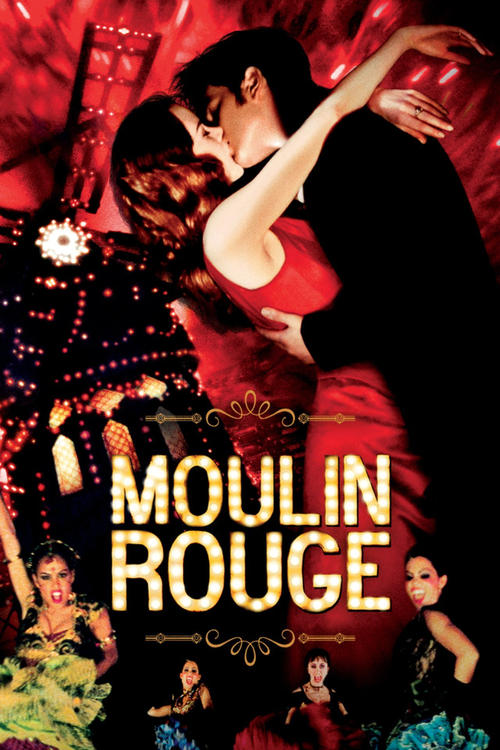
Moulin Rouge!
2001 · Baz Luhrmann
Elvis revived maximalism discourse and gave the culture Austin Butler's voice; his re-edited EPiC Elvis project keeps the "director's cut as living text" conversation going.
For when you want to fall in love and have a good cry in the same evening — spectacle, songs, and grand doomed romance. Pure maximalist comfort for anyone who doesn't mind their emotions turned up to eleven.
What it's about
Paris, 1899. Christian, a penniless young writer, falls into the glittering demimonde of the Moulin Rouge nightclub and into a secret affair with Satine, its most celebrated courtesan — while a wealthy Duke who's bankrolling the club wants her for himself. It's a backstage love story told at full volume, with the whole cast singing 20th-century pop songs decades before they were written.
The experience
Delirious, dizzying, and unashamedly romantic — the first half moves at a sugar-rush sprint, then it slows down and aims straight for your heart. It's a film that asks you to surrender to excess, and if you do, it will wreck you.
Performances
Nicole Kidman and Ewan McGregor do their own singing and throw themselves into the melodrama without a shred of irony — Kidman glitters and breaks your heart, McGregor's open-faced sincerity holds the whole fantasy together.
The craft
Baz Luhrmann's signature move is anachronism as method: Elton John, Madonna, Nirvana, and The Police stitched into 1899 Montmartre, cut at whip-crack speed with sets and costumes of insane density. It's one of the great big-screen, loud-speakers films — every frame is stuffed.
Why it matters
It's widely credited with reviving the Hollywood musical for the 21st century and it made the jukebox musical a mainstream form, capping Luhrmann's Red Curtain Trilogy.
Snapshot
Moulin Rouge! is Baz Luhrmann's maximalist jukebox musical, the third and culminating entry in what he and his collaborators termed the "Red Curtain Trilogy" (following Strictly Ballroom, 1992, and William Shakespeare's Romeo + Juliet, 1996). Set in the bohemian Montmartre of 1899–1900, it stages a doomed love affair between Christian (Ewan McGregor), an idealistic young writer, and Satine (Nicole Kidman), the star courtesan of the Moulin Rouge cabaret, against the machinations of the club's impresario Harold Zidler (Jim Broadbent) and a jealous, financing Duke (Richard Roxburgh). Its defining gambit is anachronism as method: characters express themselves through recognizable twentieth- and late-twentieth-century pop songs — Elton John, Madonna, Nirvana, The Police, Whitney Houston, and others — knitted into a through-composed pastiche. The film became a critical flashpoint and a commercial success, won two Academy Awards for its design, earned a Best Picture nomination, and is widely credited alongside Chicago (2002) with reviving the mainstream Hollywood musical. It remains the most fully realized statement of Luhrmann's "cinema of excess."
Industry & production
The film was produced by Luhrmann's Bazmark company in partnership with 20th Century Fox, and shot primarily at Fox Studios Australia in Sydney — a choice that let Luhrmann build the entire fin-de-siècle Paris of Montmartre, including the Moulin Rouge interior and a stylized elephant lodging, on soundstages rather than on location. This studio-bound artificiality was a deliberate aesthetic decision, not merely a budgetary one: the Paris of the film is frankly a set, a painted and constructed dreamworld.
Production was famously arduous. The shoot ran long and overlapped with real-world disruption, and Kidman sustained injuries during filming that affected the schedule — details widely reported at the time, though I would treat the precise timeline as the kind of production lore best cited cautiously. The music clearances alone represented an unusual industrial undertaking: because the film's dramaturgy depends on the audience recognizing existing songs, Bazmark had to secure rights to a large catalog of commercial pop, and in some cases the willingness of rights-holders (reportedly including personal approvals from artists) shaped what could be used. This rights-dependency is itself a notable production fact — the film could only exist in a music-licensing environment willing to sanction wholesale recontextualization.
The film premiered as the opening selection of the Cannes Film Festival in 2001, an unusual berth for a Hollywood musical and a signal of its art-cinema ambitions. It went on to strong box-office performance and a long awards campaign; I won't cite specific grosses, but its commercial success was sufficient to make its influence on studio appetite for the musical genre credible rather than merely critical.
Technology
Moulin Rouge! sits at a hinge moment in digital production. It combines practical sets, matte-augmented cityscapes, and computer-generated establishing imagery — the swooping, impossible camera moves over a toylike, storybook Paris that plunge from a heavenward vantage down into the cabaret are the film's most conspicuous use of digital compositing and CGI. These shots announce the film's operating principle: the camera is unbound by physics, and the world is explicitly a fabrication.
Equally important, though less discussed as "technology," is the film's music production. The songs were re-recorded, re-orchestrated, mashed together, and often performed by the cast (McGregor and Kidman sing), which required an extensive studio apparatus of arrangement and post-production layering. The seamless fusion of disparate pop sources into medleys — most elaborately the "Elephant Love Medley" — is a technological-artisanal achievement of music editing as much as a compositional one.
Technique
Cinematography
Donald McAlpine's cinematography embraces saturated, high-key color, theatrical spotlighting, and a jewel-toned palette dominated by reds, golds, and deep blues. The look descends consciously from the Technicolor tradition of the classic Hollywood and British musical, but pushed toward hyper-saturation. The camera is restless and frequently untethered — crash zooms, whip pans, and vertiginous crane and (digital) aerial moves — treating space as elastic. Lighting is frankly artificial: the film never pretends to naturalism, favoring the footlight logic of the stage.
Editing
Jill Bilcock's editing is the film's most divisive and influential technical element. The cutting is hyperkinetic, at times reducing action to a strobe of fragments — the opening cabaret numbers ("Zidler's Rap" / "Lady Marmalade," "The Can-Can") are montage assaults of very short shots. Bilcock, a longtime Luhrmann collaborator, builds rhythm musically, cutting on beat and accent, borrowing the grammar of the music video and advertising while pushing it to an operatic scale. The technique enforces the film's subjectivity: we experience Montmartre as sensory overload, as Christian's intoxication rendered as tempo.
Mise-en-scène / staging
The mise-en-scène is the province of Catherine Martin, Luhrmann's principal creative partner, who oversaw production and (with Angus Strathie) costume design. The world is dense, ornamental, and stagey — a "cinema of attractions" crowded with dancers, streamers, mirrors, and gilt. Staging is choreographic even when no one is dancing; the frame is composed as a proscenium. The recurring motifs — the windmill, the elephant, the illuminated sign, the play-within-a-play "Spectacular Spectacular" — organize the space as a series of tableaux. The Academy Awards for Art Direction and Costume Design (both credited to Martin, with Ian Gracie and Strathie respectively) recognize this achievement as the film's most consensually admired dimension.
Sound
Sound is the film's spine. Craig Armstrong provided orchestral score, with Marius De Vries and Armstrong among the key figures shaping the film's musical architecture; the soundtrack fuses original scoring with re-arranged pop. The one original song written expressly for the story's emotional climax, "Come What May," carries the lovers' theme — notably, it had been composed earlier for Romeo + Juliet and was therefore ineligible in the Best Original Song category, a well-documented eligibility quirk. The sound design blends song, dialogue, and effect into continuous heightened texture, so that speech itself often slides toward the sung.
Performance
Performance is pitched to melodrama and operetta rather than psychological realism. Broadbent's Zidler is a barker-showman of vaudevillian broadness; Roxburgh's Duke is a hissable near-pantomime villain; Leguizamo's Toulouse-Lautrec is grotesque-comic. Against this, Kidman and McGregor are asked to be sincere at the center of a knowingly artificial frame — the "Red Curtain" demand that the audience believe in the emotion precisely because everything around it declares itself as theater. That both performers sing their own roles is central to the film's intimacy amid spectacle; Kidman's Satine, in particular, must carry the courtesan-tragedy weight while sustaining the film's camp surface.
Narrative & dramatic mode
The dramatic mode is melodrama in its fullest, oldest sense — heightened emotion, moral legibility, music as the carrier of feeling. The narrative is openly archetypal: a poor artist and a "fallen woman" love across the barrier of a wealthy patron, and consumption (tuberculosis) claims the heroine. This is the template of La Traviata and La Bohème, and the film invokes the Orphean structure of an artist who descends into an underworld of pleasure and cannot bring his beloved back out. Luhrmann frames the story as memory and confession — Christian narrates in retrospect, typing his grief — so the whole film is a lament composed after the fact. The "Spectacular Spectacular" play-within-the-play mirrors the outer plot, a self-conscious doubling that lets the film comment on its own artifice while still asking to be wept over.
Genre & cycle
Moulin Rouge! is a musical, but more precisely a jukebox musical and a postmodern pastiche — it belongs to a lineage of self-aware, anthological song-films while pushing the recycling of pre-existing pop to an unprecedented density. Within Luhrmann's own output it completes the Red Curtain cycle, whose shared principle is a "theatrical cinema": the audience knows it is watching a constructed spectacle, is cued by a familiar formal device (ballroom dance, Shakespeare's verse, pop songs), and is drawn into heightened emotion through, not despite, that awareness. Industrially, the film sits at the front of an early-2000s revival cycle of the screen musical that Chicago would extend the following year.
Authorship & method
The film is the product of a tight, recurring creative unit rather than a lone auteur. Baz Luhrmann directed, produced, and co-wrote (with Craig Pearce, his writing partner across the trilogy); Luhrmann's method is collaborative and workshop-driven, developing productions over long gestation with his ensemble. Catherine Martin — production and costume designer, and Luhrmann's spouse and career-long collaborator — is arguably co-author of the films' visual identity; her design work is the most decorated aspect of Moulin Rouge! Donald McAlpine shot it; Jill Bilcock edited it; Craig Armstrong scored it, with Marius De Vries central to the musical direction. The authorial signature is thus best understood as "Bazmark," a company aesthetic of curated excess, anachronistic collage, and sincerity-through-artifice.
Movement / national cinema
As an Australian production by Australian filmmakers working for a Hollywood studio and shooting in Sydney, Moulin Rouge! is a hybrid — a piece of the internationalized, studio-financed cinema of the 1990s–2000s that also carries the imprint of a distinctively Australian theatrical-cinematic sensibility (Luhrmann's roots in opera and stage). It does not belong to a "movement" in the avant-garde sense; rather it synthesizes traditions — the Hollywood and British musical, continental opera and operetta, and, importantly, the emotional maximalism and song-and-spectacle structure of popular Indian (Bollywood) cinema, an influence Luhrmann has openly cited as shaping the film's mode of unembarrassed feeling and its integration of song, dance, comedy, and tragedy in a single register.
Era / period
The film is a product of the turn-of-the-millennium moment: MTV-era visual literacy, the maturation of digital compositing, and a media culture fluent in remix and sampling. Its whole method — quoting a shared jukebox of pop that a mass audience already carries in memory — presumes an era of saturated musical archive and postmodern quotation. It is set at the 1899–1900 fin de siècle, the historical dawn of cinema and of modern mass entertainment, and it self-consciously rhymes that threshold with its own; the real Moulin Rouge cabaret (opened 1889) and figures like Toulouse-Lautrec are invoked as loose, mythologized emblems of la vie bohème rather than as documentary subjects.
Themes
The film's explicit creed is the Bohemian mantra "Truth, Beauty, Freedom, and Love," with love placed above all. Its governing tensions are love versus commerce (Satine is a woman who is bought and sold; her heart cannot be), and authenticity versus artifice — the film insists on the reality of feeling while flaunting that everything on screen is fake. Art as both salvation and commodity runs throughout: Christian's writing, Zidler's showmanship, and the "Spectacular Spectacular" all stage the question of whether creative expression can survive its own monetization. Above these sits the ancient theme of love bound to death — the courtesan-consumptive who must die so that the love may become eternal, art, and memory. The film is finally about the making of the film we are watching: grief transmuted into performance.
Reception, canon & influence
Critical reception was sharply split. Admirers hailed it as an intoxicating, formally daring revival of a moribund genre and a triumph of design and audacity; detractors found the frenetic cutting and sensory overload exhausting and emotionally distancing. This polarization is itself part of the film's canonical identity — it is a touchstone in debates about maximalism, camp, and the music-video aesthetic in cinema. Institutionally, it was validated: two Academy Awards (Art Direction and Costume Design), a Best Picture nomination and a Best Actress nomination for Kidman, and a broad awards presence — a level of establishment recognition unusual for a work so stylistically extreme.
Influences on the film (backward): the classic Hollywood musical (the MGM tradition, the "let's-put-on-a-show" backstage musical, An American in Paris's painterly Paris); the lush, theatrical Technicolor cinema of Powell and Pressburger (The Red Shoes, The Tales of Hoffmann); the cabaret-decadence lineage that runs through Bob Fosse's Cabaret; nineteenth-century opera and operetta (La Bohème, La Traviata) and the Orpheus myth; and popular Indian cinema's spectacle and emotional heightening. To these it grafts the grammar of MTV, advertising, and remix culture.
Legacy (forward): Moulin Rouge! is credited with catalyzing the early-2000s screen-musical revival that Chicago consolidated, and with legitimizing the jukebox-musical template that later fed films like Mamma Mia! and Rock of Ages and television's Glee. Its editing and color aesthetics became a widely imitated (and parodied) house style for maximalist romance and for a generation of music videos and advertisements. Within Luhrmann's own career it set the template extended in The Great Gatsby (2013) and Elvis (2022). Finally, it completed a full circuit back to the stage: Moulin Rouge! The Musical opened on Broadway in 2018 and became a major, Tony-winning theatrical property — a film built from borrowed songs returning, decades later, as live spectacle, exactly the loop of art-into-performance the film itself is about.
A Deleuzian reading
The camera falls out of the sky.
The full Deleuzian reading of Moulin Rouge! →
Reception
It opened Cannes 2001 to genuinely split reviews — the hyper-caffeinated editing was called everything from exhilarating to unwatchable — yet it landed eight Oscar nominations including Best Picture. Now it's credited with single-handedly reviving the movie musical, clearing the runway for Chicago and two decades of jukebox shows.
How Moulin Rouge! was received, from release to now →
How to watch Moulin Rouge!: what to notice on a first viewing
- Watch the camera fall out of the sky into Paris. It comes down over a toy-sized Montmartre, goes through the windmill sails, and lands inside the room. No lens could make that move. Luhrmann opens by announcing that physics does not apply here. The world picks you up and carries you in, which is how the film intends to move you all night.
- Watch for red and gold soaking every surface in frame. Donald McAlpine lights to footlight logic, hyper-saturated, never once pretending to daylight. Red is not the color of a curtain here. It is a condition the entire scene sits inside. Color carries the temperature of each scene, so you feel the film turn before the plot tells you.
- Count the shots in the opening cabaret number. Jill Bilcock cuts the early numbers into a strobe of very short shots landing on beat and accent. Orientation goes out the window. Rhythm rather than space is what the cut serves. Tempo is doing the storytelling, which is why the first twenty minutes split audiences so sharply.
- Listen for songs written a century after the setting. A man in 1899 opens his mouth and Elton John comes out. Then Nirvana, Madonna, The Police. The cast sing their own vocals in re-orchestrated medleys stitched from other people's hits. Two eras run at once and neither is demoted to a joke, because the film needs both of them true.
- Watch how often the frame is arranged like a stage. Catherine Martin composes each shot as a proscenium crowded with dancers, mirrors, streamers, and gilt. The windmill, the elephant, and the illuminated sign organize the space into tableaux. Every act here is also a performance for somebody watching, which is what the whole place was built to do.
The whole guide to watching Moulin Rouge!, with the keys for a rewatch →
Influences: the films it descends from and the films it influenced
- The Red Shoes (1948) — Its saturated three-strip Technicolor and the plunge into a stylized, non-realist ballet sequence — theater bleeding into pure cinematic fantasy — is the Powell-Pressburger 'composed film' template Luhrmann rebuilds for the Elephant Love Medley and Spectacular Spectacular.
- The Tales of Hoffmann (1951) — Shot to pre-recorded operatic playback so image could be cut and staged entirely to music, it models the 'total artifice' method — sets, camera and performance choreographed to a soundtrack rather than location realism — that governs Moulin Rouge!'s numbers.
- An American in Paris (1951) — Its painterly, frankly artificial soundstage Paris and the extended fantasy-ballet climax establish the backlot-Paris-as-emotional-canvas approach Catherine Martin's design and the film's fantastical Montmartre directly extend.
- Singin' in the Rain (1952) — The self-reflexive backstage musical about the machinery of show-business illusion supplies both the 'authenticity-versus-artifice' engine and the meta 'the show is being made before our eyes' structure of Spectacular Spectacular.
- 42nd Street (1933) — The archetypal 'let's-put-on-a-show' backstage musical — an unknown ingénue thrust into a troubled production whose survival depends on the number — is the plot skeleton Moulin Rouge! inherits wholesale.
- The Umbrellas of Cherbourg (1964) — Its wall-to-wall through-sung pop melodrama drenched in candy-saturated color proves emotional sincerity can be carried entirely by recitative and hyper-designed hue — the emotional grammar behind 'Come What May' and the film's color-as-feeling palette.
- Cabaret (1972) — Fosse's decadent turn-of-century cabaret milieu and his cross-cutting between stage number and offstage story — the club as commentary on the world outside it — is the direct model for the Moulin Rouge as both venue and moral arena.
- All That Jazz (1979) — Its rapid-fire, fragmentary montage cutting of performance and its mortality-haunted, retrospective-confessional framing of a showman's life prefigure Jill Bilcock's kinetic editing and the dying-narrator confession structure.
- Mughal-e-Azam (1960) — Its opulent song-and-dance spectacle and full-throated emotional heightening — grand set-piece numbers as peaks of feeling — is the Hindi-cinema debt Luhrmann names, surfacing literally in the Bollywood-styled 'Hindi Sad Diamonds' finale.
- Strictly Ballroom (1992) — The first Red Curtain film, it establishes Bazmark's core method — heightened theatrical artifice, a knowing 'cinema of attractions' address, and sincerity delivered through overt stylization — that Moulin Rouge! amplifies.
- William Shakespeare's Romeo + Juliet (1996) — It fuses MTV/music-video cutting, anachronistic pop scoring and a restless untethered camera onto a classical text — the exact remix grammar Moulin Rouge! turns onto the pop songbook.
- Lola Montès (1955) — The swirling theatrical spectacle, the courtesan sold as public attraction, and the explicit show-within-the-film revive Lola's gaze-as-transaction in maximalist form.
- Chicago (2002) — It consolidated the screen-musical revival Moulin Rouge! catalyzed by borrowing its fragmented, music-video editing of numbers — cutting numbers as interior fantasy spliced against reality rather than filming them as continuous stage performance.
- Across the Universe (2007) — It extends the re-orchestrated-pop-catalog musical — building narrative from reinterpreted existing songs (the Beatles) staged as heightened theatrical set-pieces — the jukebox template Moulin Rouge! legitimized.
- Mamma Mia! (2008) — A pure jukebox musical built entirely from a pre-existing pop catalog (ABBA), it commercializes the borrowed-songs-as-book-musical model Moulin Rouge! proved viable on screen.
- The Great Gatsby (2013) — Luhrmann re-runs the exact Moulin Rouge! recipe — anachronistic contemporary pop over a period setting, CGI-built maximalist environments, and a retrospective-confessional narrator — on Fitzgerald.
- La La Land (2016) — It revives the original (non-jukebox) Hollywood musical Moulin Rouge! reopened the door for, reprising the saturated primary-color palette, soundstage-artificial city, and love-versus-ambition melodrama in a self-consciously classical register.
- Elvis (2022) — The fullest late extension of the Bazmark aesthetic — remixed/anachronistic sound, whip-pan untethered camera, montage overload and a manipulator-narrator confessional frame — applied to the biopic.
- Rocketman (2019) — Luhrmann's technique of stripping songs from their original recordings and reassigning them to new emotional contexts — anachronistic jukebox sequencing — is the direct formal model for Rocketman's treatment of the Elton John catalog as emotional raw material rather than chronological record.
- Pitch Perfect (2012) — Pioneers the pop-mashup medley — stitching recognizable hits into a single arrangement — and the rapid on-beat musical match-cut editing that governs the riff-off and finale.
- Me Before You (2016) — Established Craig Armstrong's signature method of scoring doomed romance by fusing lush strings with recognizable pop, the exact collaborator technique MBY hires him to reproduce.
- The Greatest Showman (2017) — The direct template: anachronistic pop scoring and maximalist reflexive montage, where period spectacle is cut to contemporary chart music and numbers erupt as delirious editing set-pieces rather than staged theater.
- Beauty and the Beast (2017) — Model for the craning, circling camera and high-key saturated palette deployed for maximalist, kinetic musical set-pieces.
- Cruella (2021) — Precedent for jukebox pop-anachronism maximalism staged as fashion-happening spectacle, cut fast against saturated, high-contrast production design.
- Speed Racer (2008) — It pushes hyper-saturated candy-color compositing and a 'cinema of attractions' assault of CGI spectacle to the same maximalist extreme — image as pure sensory overload built in the compositing suite rather than the lens.
- Velvet Goldmine (1998) — Shares the pastiche-cover strategy of reworking anachronistic pop songs into diegetic numbers amid maximalist, saturated-color spectacle.
- Memories of Matsuko (2006) — Hyperkinetic montage married to karaoke-style pop scoring — recycling familiar hit songs as emotional shorthand — inside a maximalist doomed-love tragedy that never lets its cutting rest.
- Sweeney Todd: The Demon Barber of Fleet Street (2007) — Fellow flagship of the mid-2000s musical revival built on music-bound cutting, where the edit is cut to the score's rhythm and song drives narrative continuity rather than pausing it.
Similar films
- Elvis (2022) — influence & lineage
- Chicago (2002) — influence & lineage
- La La Land (2016) — influence & lineage
- Cabaret (1972) — influence & lineage
- Singin' in the Rain (1952) — influence & lineage
- The Umbrellas of Cherbourg (1964) — influence & lineage
- Moulin Rouge (1952) — same viewing thread
- Birdman or (The Unexpected Virtue of Ignorance) (2014) — often watched together
All the films related to Moulin Rouge! →
Watch it with: curated runs of related films
- Love as a Wrecking Ball — Watch these when you want desire pushed all the way to self-destruction — affairs and infatuations that leave nothing standing.