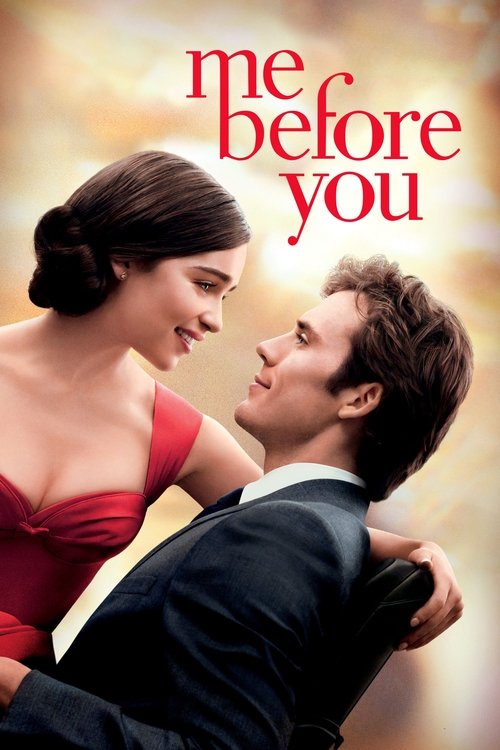
Me Before You
2016 · Thea Sharrock
When you want a proper cry — the kind of romance you put on with tissues already in reach. Comfort viewing in style, though its central question about dignity and choice may leave you arguing afterward.
What it's about
Lou Clark is a chatty, aimless 26-year-old from a small English town who takes the only job going: caregiver and companion to Will Traynor, a wealthy young banker left quadriplegic by an accident and living in bitter withdrawal at his family's castle. She decides to prove to him that life can still be worth living; he starts cracking her small world open in return. It's a romance built on a collision of class, temperament, and two very different ideas about what a good life looks like.
The experience
A glossy, warm, openly sentimental tearjerker — charming and light on its feet for long stretches, then quietly devastating. It courts your affection shamelessly and, for most viewers, gets it before it wrings you out.
Performances
Emilia Clarke is all eyebrows and radiant awkwardness as Lou, a performance of pure charm offensive, while Sam Claflin does subtle work conveying Will's wit and grief almost entirely from the neck up.
The craft
Thea Sharrock shoots the English countryside and castle setting like a storybook, and the film's costume design — Lou's riotous, bumblebee-tights wardrobe — does real character work. It's polished studio romance craftsmanship: bright, handsome, and engineered to make the final act land hard.
Why it matters
A major commercial hit from a bestselling novel, it also became a genuine cultural flashpoint, drawing protests and debate from disability-rights advocates over how it frames disability and autonomy — a controversy that now travels with the film.
Snapshot
Me Before You is a studio romantic melodrama adapted from Jojo Moyes' 2012 international bestseller, built as a modern "weepie" in the lineage of the terminal-love tragedy. It pairs a working-class English caregiver, Lou Clark, with Will Traynor, a formerly athletic young financier left quadriplegic by a road accident, and tracks their courtship toward an ending that refuses the genre's usual redemptive rescue: Will, having decided his life is no longer worth living, proceeds with an assisted death. The film functions on two registers at once — as a glossy, star-driven English romance and as a cultural flashpoint over disability, autonomy, and the "right to die." Released amid a wave of bestseller-to-screen "sick-lit" adaptations, it became a substantial commercial success while drawing sustained protest from disability-rights advocates. It also served as a career pivot for Emilia Clarke, then defined by Game of Thrones, into mainstream romantic leading roles.
Industry & production
The picture was produced by New Line Cinema and Metro-Goldwyn-Mayer and distributed by Warner Bros., a conventional mid-budget studio configuration for adult-skewing romance in the mid-2010s. Its central industrial fact is the source: Moyes' novel was a word-of-mouth publishing phenomenon that sold in the millions across many territories, giving the film a pre-sold audience and a built-in emotional contract with readers. Crucially, Moyes adapted her own novel for the screen — an unusual degree of authorial continuity that shaped the film's fidelity to the book's beats and, by extension, its commitment to the controversial ending rather than a softened studio alternative.
The film marked the feature directing debut of Thea Sharrock, an accomplished British theater director (associated with the Olivier and West End stages) with prior television work. Hiring a stage director for an intimate, performance-forward two-hander is a familiar studio strategy, and it aligns with the film's chamber-drama emphasis on actors in rooms. Production was UK-based, using English and Welsh locations; the "castle" of Will's family estate was realized through British heritage locations, with Pembroke Castle in Wales widely reported among them, and a tropical holiday sequence shot on location abroad. The exact roster of locations is only loosely documented in the scholarly record, so specifics beyond the broad UK/heritage-property strategy should be treated cautiously. The marketing campaign leaned on the tagline "Live Boldly," a phrase whose relationship to the plot's outcome would become a point of contention.
Technology
Me Before You was produced with the digital acquisition and post-production pipeline standard for a mid-budget studio release of 2016; the public record does not consistently specify the exact camera system, so I will not assign one. What matters technologically is not novelty but transparency: the film deploys contemporary tools in the service of an unobtrusive, "invisible" classical style. Digital capture supports the warm, high-key interior lighting and the clean, controlled color grade that the genre expects. There is no significant use of visual-effects spectacle; the technological work is corrective and cosmetic — the seamless staging of Will's paralysis, the smoothing of location and set into a single storybook England, and the color management that keeps the palette consistently inviting. The film's most consequential "technology" is arguably its sound-and-music delivery system: a pop-song-laden soundtrack engineered for cross-platform release and streaming discovery, a standard commercial apparatus of the period.
Technique
Cinematography
Cinematography is credited to Remi Adefarasin, the veteran British cinematographer whose credits include Elizabeth, About a Boy, and Match Point. His work here is polished and pictorialist: soft, flattering light on faces; an autumnal, honeyed palette for the English exteriors; and a compositional preference for warmth and legibility over grit. The camera is largely classical — steady coverage, shot/reverse-shot for the central dialogues, and framing that keeps the two leads in graceful, readable relation. A recurring formal problem in any wheelchair-centered romance is the vertical disparity between a seated and standing character; the film manages sightlines and eyelines to keep the couple in balanced two-shots and to avoid literally looking down on Will, a small but meaningful choice given the story's themes. The visual mode is aspirational and postcard-clean, consistent with the genre's promise of beauty and feeling.
Editing
The editing follows the melodrama's logic of emotional accumulation rather than kinetic display. Scenes are cut for performance and reaction, giving the actors room to land comic beats early and grief later, and the film paces itself as a slow warming — banter, then intimacy, then the imposition of the deadline that Will has privately set. The public record is thin on detailed accounts of the film's cutting and its editor's individual contribution, so I will not attribute specific decisions to a named editor. Structurally, the film is organized around a ticking clock (Lou's six-month "campaign" to change Will's mind), and the editing uses that countdown to shape rising stakes and the montage-driven "adventures" that punctuate the middle stretch.
Mise-en-scène / staging
Production and costume design carry an unusually heavy narrative load. Lou's flamboyant, mismatched wardrobe — bright tights, bold patterns, statement shoes — externalizes her vitality and difference from the muted, moneyed Traynor world, functioning almost as a second script. The class contrast is staged spatially: the cramped, cluttered warmth of the Clark family home against the cavernous, cool grandeur of the Traynor estate. Will's converted annex — accessible, well-appointed, subtly a gilded cage — visualizes both his wealth and his confinement. Sharrock's theatrical instincts show in the reliance on interior two-handers and on props and costume as characterization.
Sound
The soundscape is dominated by its music supervision. The film uses a contemporary pop compilation of needle-drops to cue and amplify emotion, including tracks by Ed Sheeran and X Ambassadors among others; the soundtrack was itself a commercial product positioned to travel with the film. The score is by Craig Armstrong (see below), providing the lush orchestral connective tissue between songs. Dialogue and quiet-room sound are handled cleanly and conventionally; the film does not pursue sonic experimentation, instead using music as the primary instrument of feeling — a defining trait of the modern studio weepie.
Performance
Performance is the film's engine. Emilia Clarke plays Lou with broad, expressive comic physicality — arched brows, open reactions, a deliberately un-cool charm — a register some critics found delightful and others overdrawn, but which decisively repositioned Clarke away from her Game of Thrones gravity. Sam Claflin, as Will, works within severe physical constraint, carrying the role largely through face and voice: bitterness, wit, and a guarded tenderness. The two-hander depends on their rapport, and the supporting ensemble deepens the texture — Janet McTeer and Charles Dance as Will's parents, Brendan Coyle and others as Lou's family, and Jenna Coleman among the wider cast. The acting is pitched to the melodrama: legible, sincere, and emotionally direct.
Narrative & dramatic mode
The dominant mode is melodrama in its classical sense — a drama of moral and emotional excess organized around impossible love and the threat of loss. The narrative engine is a deadline plot: Lou discovers Will's intention to end his life and commits to a campaign of experiences meant to prove that life is worth living. This structure fuses the romantic comedy's "opposites attract" courtship with the terminal-love tragedy's foreknowledge of death, producing a bittersweet hybrid. The film's boldest dramaturgical decision is to deny the melodrama's conventional last-minute reprieve: love does not conquer Will's resolve. That refusal is what gives the film its tragic force for its admirers and its ideological offense for its critics — the story asks the audience to grieve a choice it has also framed as autonomous.
Genre & cycle
Me Before You sits squarely within the 2010s cycle of bestseller adaptations trading in illness, disability, and mortality as romantic occasion — a lineage that runs through the "sick-lit" wave crystallized by The Fault in Our Stars (2014) and extending to titles like Everything, Everything and, later, Five Feet Apart. It also draws on the older studio tradition of the doomed-love tearjerker (Love Story) and the glossy, class-crossing English romance associated with the Richard Curtis school. Within that field it is distinctive for foregrounding physical disability and assisted dying rather than illness with an involuntary terminal course — a distinction at the heart of the controversy, since Will's death is chosen, not merely fated.
Authorship & method
Authorship here is unusually distributed between a source-author-screenwriter and a first-time film director. Jojo Moyes is the film's originating and shaping intelligence: her novel supplies structure, characters, and the non-negotiable ending, and her own adaptation preserved the book's contract with its readership. Thea Sharrock, directing her first feature, brings a stage director's actor-centered method — privileging the two-hander, the interior scene, and performance clarity over cinematic flourish. Cinematographer Remi Adefarasin supplies the warm, pictorial house style. Composer Craig Armstrong — the Scottish composer known for Moulin Rouge!, Love Actually, and The Great Gatsby — provides exactly the kind of soaring, emotionally underlining orchestral romanticism his reputation promises, integrated with the pop soundtrack. The individual contributions of the editor and other below-the-line collaborators are less prominently documented and are best described in terms of the film's evident aims rather than attributed as personal signatures.
Movement / national cinema
The film belongs to British commercial cinema operating within a transatlantic studio system — financed and distributed by American majors while shot in the UK with a largely British cast and creative team. It participates in the export-friendly image of England as heritage backdrop and romantic idyll, a screen tradition that Working Title's romances did much to codify and that Me Before You borrows without belonging to that specific stable. It is less a product of any avant-garde or national "movement" than of a globalized adaptation economy in which British locations, actors, and sensibility serve an international mainstream audience.
Era / period
Set and made in the mid-2010s, the film is a period-specific artifact of the bestseller-adaptation boom and of a moment when assisted dying was a live and contested public debate in Britain and elsewhere. Its release lands amid streaming's reshaping of soundtrack and marketing strategy and amid a rising disability-rights media activism that would organize visibly against it. The "Live Boldly" campaign and the pop-forward soundtrack situate it precisely in the promotional culture of its years.
Themes
The film's central and most contested theme is autonomy at the end of life — the moral weight of Will's decision to die on his own terms, and whether love or obligation should override that choice. Around it cluster several others: disability and the socially loaded question of "quality of life"; class, staged through Lou's and Will's opposed worlds and through the film's interest in aspiration and self-reinvention; care as labor and as intimacy, since the romance grows out of a paid caregiving relationship; and self-actualization, the "live boldly" ethos by which Lou is transformed even as Will's arc bends the other way. The tension the film never fully resolves — and that its critics seized upon — is between celebrating one character's expanded life and endorsing another's chosen death.
Reception, canon & influence
Critical reception was mixed. Reviewers frequently praised Emilia Clarke's charm and the leads' chemistry while faulting the film's sentimentality, tonal sweetness, and — most seriously — its handling of disability. The defining controversy was ethical rather than aesthetic: disability-rights activists and organizations protested the film for advancing what they characterized as a "better dead than disabled" narrative, arguing that a wealthy, recently disabled man's decision to die reinforced ableist assumptions that disabled lives are inherently tragic and not worth living. Protests accompanied premiere events, and social-media campaigns (including hashtags contesting the film's "Live Boldly" framing) circulated widely. Defenders — including some who invoked personal autonomy — countered that the film depicted an individual choice rather than a prescription. This debate, more than any formal quality, is the film's most durable cultural mark.
Its influences run backward into the doomed-romance melodrama and the contemporary illness-adaptation cycle; it is legible as a companion piece to The Fault in Our Stars and to the studio tradition of the literary tearjerker. Commercially it was a clear success, performing strongly on a modest budget relative to its wide international gross — figures widely reported in the trade press, which I summarize rather than cite precisely to avoid overstating exact numbers. Its forward influence is felt less in film style than in careers and in discourse: it consolidated Emilia Clarke's and Sam Claflin's viability as mainstream romantic leads, contributed a much-discussed case study to media-and-disability scholarship and activism, and reinforced the studio appetite for adapting emotionally intense bestsellers. Moyes continued the story in the novels After You and Still Me, but no film sequel followed, leaving Me Before You a self-contained screen work whose legacy is inseparable from the argument it provoked.
A Deleuzian reading
A camera has to stand somewhere.
The full Deleuzian reading of Me Before You →
Reception
A big commercial hit in 2016 — a modest-budget weepie that grossed over $200 million — but it arrived under a cloud of protest from disability rights activists, and that controversy, more than the mixed reviews, is what has stuck to it ever since.
How Me Before You was received, from release to now →
How to watch Me Before You: what to notice on a first viewing
- Watch the camera hold Lou and Will at one eye level. Adefarasin runs the shot/reverse-shot along a single level, so the seated Will and standing Lou stay in balanced two-shots. That eyeline choice keeps the two leads visually equal despite the wheelchair between them.
- Notice the honeyed, autumnal light on every English exterior. Adefarasin holds the same warm, postcard-clean palette across the castle, the countryside, and both families' homes. The warmth is doing emotional work, making the world feel inviting before anyone says a word.
- Notice Lou's bright, mismatched clothes against the Traynor family's muted rooms. Lou's tights, patterns, and statement shoes recur scene after scene, always clashing with the cool, moneyed Traynor interiors. Costume carries the class difference the dialogue never states outright.
- Listen for the pop song that swells under each milestone scene. A contemporary needle-drop compilation, Ed Sheeran and X Ambassadors among them, arrives at every emotional turn, with Craig Armstrong's orchestra filling the gaps between songs. Music, not dialogue, is doing most of the film's emotional work.
- Track how long Will's face stays still after Lou's outings. Claflin lets bitterness, wit, and tenderness register on his face and voice, then holds there instead of turning into action. That held look is what the reading calls feeling that has arrived but has nowhere to discharge.
The whole guide to watching Me Before You, with the keys for a rewatch →
Influences: the films it descends from and the films it influenced
- Dark Victory (1939) — The studio 'woman's picture' blueprint of a privileged protagonist facing a fixed death sentence and staged toward dignified acceptance, with the orchestral score underlining each emotional beat — the melodrama grammar MBY inherits wholesale.
- Love Story (1970) — Codified the death-dated romance as a deadline-plot machine paired with a class-crossing couple and a single recurring theme cue that emotionally 'stamps' the doomed arc — the tearjerker engine MBY runs on.
- Whose Life Is It Anyway? (1981) — Stage-to-screen two-hander built around a newly quadriplegic man's articulate case for the right to die, staged in interior debate scenes — the direct dramaturgical ancestor of MBY's end-of-life-autonomy argument.
- Terms of Endearment (1983) — The prestige literary tearjerker that legitimized running comic performance right up to the deathbed, licensing the sweet-to-devastating tonal shift MBY attempts.
- The Sea Inside (2004) — Dramatizes a real quadriplegic's legal fight to end his life, supplying MBY its contemporary assisted-dying frame and the 'disabled man who chooses death' protagonist that provoked the same ethical debate.
- Million Dollar Baby (2004) — The refused-redemptive ending — a paralyzed character's assisted death treated as the film's tragic terminus rather than an obstacle to be overcome — the narrative move MBY controversially adopts.
- Moulin Rouge! (2001) — Established Craig Armstrong's signature method of scoring doomed romance by fusing lush strings with recognizable pop, the exact collaborator technique MBY hires him to reproduce.
- Love Actually (2003) — Armstrong's soaring orchestral romanticism woven with pop needle-drops inside the British-transatlantic commercial idiom — the scoring-and-soundtrack integration MBY directly descends from.
- Four Weddings and a Funeral (1994) — Defined the British transatlantic commercial romance's class-marked English milieu and comic-to-emotional tonal management that MBY's casting, register, and wit descend from.
- A Walk to Remember (2002) — The Nicholas Sparks bestseller-to-tearjerker pipeline built on a terminal-illness deadline and pop-scored longing that MBY's illness-adaptation cycle extends.
- The Notebook (2004) — Inherits the Notebook's class-divide-plus-mortality weepie formula, foregrounding luminous lead chemistry and an engineered tearful catharsis.
- Breathe (2017) — Real-life polio-paralysis romance staging severe disability and the end-of-life question through actor-centered interior scenes — a prestige sibling engaging the same autonomy debate from the opposite conclusion.
- Everything, Everything (2017) — YA illness-adaptation riding the bestseller-to-screen appetite MBY reinforced, built on the same young-lovers-across-a-barrier deadline structure and pop-soundtracked yearning.
- Five Feet Apart (2019) — Post-MBY sick-lit romance that reproduces the illness-deadline plot and pop-scored longing for the reinvigorated YA tearjerker market MBY helped consolidate.
- The Fault in Our Stars (2014) — Contemporaneous bestseller sick-lit adaptation using a terminal-illness deadline plot and curated pop needle-drops to court the same YA-crossover tearjerker audience — MBY's closest companion piece.
- P.S. I Love You (2007) — Bestseller grief-romance adaptation in the same transatlantic commercial lane, structured around posthumous instructions and pop-scored emotional set pieces MBY's 'live boldly' letter-legacy device echoes.
- One Day (2011) — British bestseller romance adaptation with a transatlantic lead, a date-stamped deadline structure and a refused-happy ending — a direct commercial sibling in the same adaptation register.
- The Theory of Everything (2014) — Performance-centered staging of progressive disability inside a romance, prioritizing actor transformation and intimate two-shots over cinematic spectacle — the disability-romance register MBY works in.
- Love, Rosie (2014) — The same Anglo-export pipeline built around Sam Claflin: British bestseller adaptation shot in warm golden-hour exteriors and heritage interiors, with costume used as explicit character signal, engineered for international audience appeal over domestic critical standing.
Similar films
- The Fault in Our Stars (2014) — influence & lineage
- Five Feet Apart (2019) — influence & lineage
- "Wuthering Heights" (2026) — shared sensibility
- Love, Rosie (2014) — shared sensibility
- Pride & Prejudice (2005) — shared sensibility
- Sense and Sensibility (2026) — shared sensibility
- Manchester by the Sea (2016) — shared sensibility
- Call Me by Your Name (2017) — shared sensibility