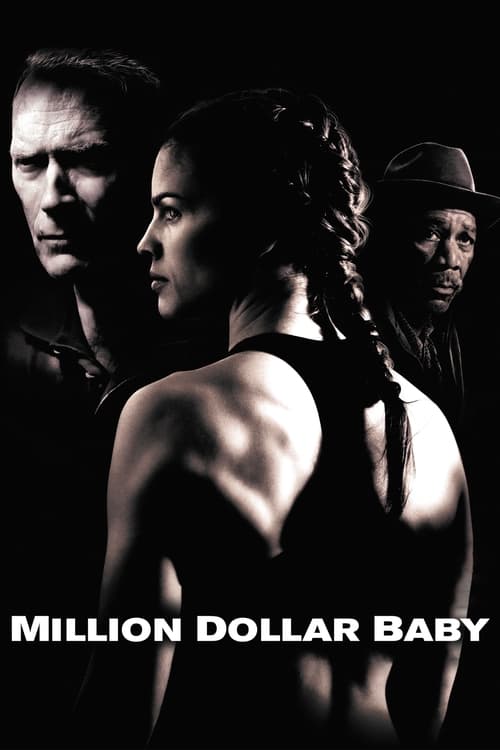
Million Dollar Baby
2004 · Clint Eastwood
For when you want a film that hits you square in the chest — a good cry that feels earned, not manufactured. This is challenge, not comfort; save it for a night you can give it your full heart.
What it's about
A guilt-haunted Los Angeles boxing trainer, long estranged from his daughter, runs a shabby gym and refuses to take risks with his fighters. Into it walks a waitress in her thirties — too old, too poor, too female by the sport's logic — who is flatly determined to turn pro and won't stop showing up. What starts as an underdog sports story becomes something deeper: a film about surrogate family and what we owe the people we love.
The experience
Quiet, patient, and then devastating. It earns your affection with gym-floor humor and slow-building trust, then asks you to sit with choices most films won't touch — expect to be wrung out by the end.
Performances
Hilary Swank is ferociously believable as a fighter who trained herself into the part, Clint Eastwood does some of his most vulnerable acting as the trainer, and Morgan Freeman's watchful, wry narration holds the whole film together — Swank and Freeman both won Oscars for it.
The craft
Eastwood directs with radical economy: pools of light and deep shadow in the gym, scenes cut to the bone, his own spare guitar-inflected score underneath. The restraint is the power — nothing is oversold, so when the story turns, there's nowhere to hide.
Why it matters
It swept the top Academy Awards including Best Picture and Best Director, cementing Eastwood's late-career standing as a major American filmmaker and sparking national debate about its ending.
Snapshot
Million Dollar Baby is a boxing picture that quietly dismantles itself into something far less consoling: a chamber tragedy about mortality, surrogate kinship, and the limits of what love can fix. Directed by Clint Eastwood for his own Malpaso Productions and released by Warner Bros. at the end of 2004, it pairs Eastwood as Frankie Dunn — a guilt-haunted Los Angeles trainer and gym owner estranged from his own daughter — with Hilary Swank as Maggie Fitzgerald, a waitress past the usual age of ambition who wills herself into the ring. Morgan Freeman, as the half-blind former fighter Eddie "Scrap-Iron" Dupris, both narrates and witnesses. The film's first two-thirds follow the contours of the underdog sports story; its final act turns on a paralyzing injury and a request to die, transforming a crowd-pleasing arc into a grave meditation on dignity and faith. It swept the principal categories at the 77th Academy Awards — Picture, Director, Actress, Supporting Actor — and stands as the keystone of Eastwood's remarkable late-career run as a director.
Industry & production
The film was produced through Eastwood's Malpaso banner in partnership with Lakeshore Entertainment, with Warner Bros. distributing — a continuation of the studio relationship Eastwood had cultivated for decades. Paul Haggis adapted the screenplay from stories in Rope Burns: Stories from the Corner (2000), a collection by F.X. Toole, the pen name of Jerry Boyd, a veteran boxing cornerman and cutman who began publishing fiction late in life and died in 2002, before the film was made. The project reportedly moved through development with some difficulty given its downbeat turn, and the modesty of its eventual budget — in the low tens of millions — reflects both Eastwood's economical methods and a subject matter unlikely to be mistaken for a tentpole.
Production exemplified the famously lean Malpaso operation. Eastwood shoots quickly, prints early takes, and brings films in ahead of schedule and under budget; the company is a small, loyal repertory of collaborators who have worked together across many pictures. Robert Lorenz served as a producing partner and assistant director within that apparatus, alongside Eastwood's longtime production team. The picture opened in limited release in December 2004 to qualify for awards and expanded in early 2005, building on critical momentum into a strong theatrical performance; precise grosses are not reproduced here, but it substantially exceeded its modest cost.
Technology
Million Dollar Baby was photographed on 35mm film — Eastwood remains a committed traditionalist in an era of accelerating digital adoption, and his films of this period retain a photochemical texture. Its most distinctive technical signature is not a gadget but a lighting philosophy: cinematographer Tom Stern built the look around pools of light surrounded by deep, near-total shadow, a high-contrast approach that depends on very precise control of practical and minimal sources. The aesthetic is closer to mid-century studio chiaroscuro than to the brighter, more evenly exposed norms of contemporary drama, and it was achieved through restraint in lighting setups rather than novel hardware. I will not overstate format particulars beyond the film's evident widescreen, photochemical character, as detailed equipment lists for the production are not something I can verify with confidence.
Technique
Cinematography
Tom Stern, Eastwood's regular director of photography (and earlier his gaffer), gives the film its signature darkness. The Hit Pit gym is rendered as a cavern of shadow pierced by hard shafts of light, faces emerging from and receding into black. This is not stylistic decoration but dramatic argument: the film is about people who live in the margins, and the photography literally surrounds them with the unlit. Stern frequently lets parts of the frame fall to pure shadow, trusting silhouette and the suggestion of form. The boxing matches eschew the kinetic, hyper-cut spectacle of many fight films in favor of legible, grounded coverage; the camera respects the geography of the ring. The visual scheme grows starker as the story darkens, and the late hospital scenes use the same vocabulary of isolated light and engulfing shadow to render Maggie's confinement.
Editing
Joel Cox, Eastwood's editor of long standing and an Academy Award winner for Unforgiven, cut the film and received an Oscar nomination for it. The editing matches the director's temperament: patient, unhurried, willing to hold on a face or let a beat breathe. Because Eastwood shoots relatively little coverage and favors early takes, the cutting works with deliberately chosen material rather than assembling from abundance. The structural masterstroke is the film's tonal pivot — the boxing-movie rhythms of training, rising fortunes, and bigger purses are allowed to accumulate momentum precisely so that the rupture lands with full force. Cox's pacing makes the second-half deceleration feel inevitable rather than imposed.
Mise-en-scène / staging
The world is small and worn: a rundown gym, a diner, cheap motels, a hospital room. Production designer Henry Bumstead — a veteran whose career reached back to the classical studio era and included collaborations with Hitchcock and other major directors — grounds the film in unglamorous, lived-in spaces. The staging is intimate and frequently still; conversations are blocked simply, two people in a frame, and Eastwood trusts the actors and the light to carry the scene. The gym functions as a found family's home, the diner as Maggie's point of departure, and the recurring image of the open road and Frankie's truck gestures toward the escape the characters keep imagining.
Sound
The sound design favors quiet. Eastwood's films are often notable for their hush — long silences, ambient room tone, the absence of wall-to-wall scoring — and Million Dollar Baby uses restraint as an emotional instrument. The crack of gloves, the squeak of shoes on canvas, and the muffled acoustics of the gym are foregrounded against this quiet. Morgan Freeman's narration, delivered in his characteristically grave register, threads through as connective tissue and is ultimately revealed to be addressed, as a letter, to Frankie's absent daughter — a framing that recasts everything we have heard.
Performance
Performance is the film's center of gravity. Hilary Swank, who undertook substantial physical training to embody a credible fighter, plays Maggie with an unguarded hunger and dignity that earned her a second Best Actress Oscar; the role asks her to traverse from raw aspirant to champion to a woman seeking to end her life, and she sustains the emotional truth across that arc. Eastwood, in one of his finest performances as an actor, plays Frankie with a clenched, interior reticence — a man whose tenderness is buried under decades of self-recrimination, his Catholic guilt expressed through needling exchanges with a parish priest. Morgan Freeman won Best Supporting Actor as Scrap, the moral conscience and memory of the gym. The three performances interlock as a study of chosen family.
Narrative & dramatic mode
The film's architecture is its boldest gambit. It adopts, faithfully and even affectionately, the grammar of the boxing underdog story — the reluctant trainer, the overlooked talent, the montage of improvement, the climb toward a title — and then refuses the genre's promised catharsis. A single illegal blow after the bell paralyzes Maggie, and the narrative reorients from triumph to the question of how she will live, and whether she will be helped to die. The dramatic mode is realist tragedy: cause and consequence are pitiless, and the resolution offers no redemptive victory, only a wrenching act of love that is also a moral and spiritual transgression for the devoutly Catholic Frankie. Freeman's retrospective narration lends the whole an elegiac, confessional cast, situating the events as something already mourned.
Genre & cycle
Million Dollar Baby belongs to the long lineage of American boxing films, a genre that has repeatedly used the ring as a stage for class striving, bodily sacrifice, and masculine self-definition — from Body and Soul and The Set-Up through Requiem for a Heavyweight, John Huston's Fat City, Rocky, and Scorsese's Raging Bull. Eastwood's film is in conversation with this tradition while deliberately subverting it. Where Rocky delivers uplift, Million Dollar Baby withdraws it; its closest spiritual kin is the bruised naturalism of Fat City, with its losers and its unsentimental view of the fight game. The film also participates in a smaller cycle of works centering a female fighter, but its lasting generic significance is the way it weaponizes audience familiarity with the underdog formula to deepen the eventual devastation.
Authorship & method
The film is a near-total expression of Eastwood's authorial method and of the repertory company that enables it. As director, Eastwood is an avowed minimalist — a former actor who dislikes excessive takes, values spontaneity, and brings a jazz musician's sensibility for tempo and improvisation to the set. He also composed the spare, melancholy score himself, built around simple piano and guitar motifs that refuse to manipulate; the music's quietness is of a piece with the film's reticence. The key collaborators are the constants of his late period: cinematographer Tom Stern, whose shadow-drenched photography defines the look; editor Joel Cox, whose patient cutting matches the director's tempo; production designer Henry Bumstead, who anchors the film in unglamorous reality; and screenwriter Paul Haggis, who shaped Toole's stories into a single, escalating dramatic structure. Eastwood's authorship descends from his apprenticeships with Sergio Leone and especially Don Siegel — directors of economy and control — and by 2004 had matured into a body of work preoccupied with violence's cost, aging, guilt, and moral reckoning.
Movement / national cinema
This is American cinema in a classical-realist key, made largely outside the prevailing blockbuster economy yet within the major-studio system via Warner Bros. Eastwood functions as one of the last working inheritors of the studio-era craft tradition — efficient, actor-centered, unshowy — even as he operates with the autonomy of an auteur who controls his own production company. The film does not belong to any self-conscious movement; rather, it represents the persistence of a mainstream, character-driven American dramatic filmmaking that prizes legibility and emotional directness over formal experiment.
Era / period
Million Dollar Baby arrived at the height of Eastwood's late-career renaissance as a director. It followed immediately on Mystic River (2003), another grave, critically lauded drama, and preceded the diptych Flags of Our Fathers and Letters from Iwo Jima (2006). Within mid-2000s Hollywood — increasingly oriented toward franchises and digital spectacle — Eastwood's film stood out as a deliberately adult, somber, mid-budget drama, and its awards triumph over the more conventionally grand The Aviator read at the time as a vindication of restraint over scale. Its release also coincided with active public debate in the United States over end-of-life decisions, which sharpened the reception of its final act.
Themes
At its core the film concerns surrogate family and the redemption it offers and withholds: Frankie, who cannot reach his estranged daughter, and Maggie, abandoned by a grasping family of origin, build a father-daughter bond that the genre seems to promise will heal them both — and which the tragedy instead consecrates through loss. The Gaelic endearment mo chuisle (rendered in the film as "mo cuishle," glossed as "my darling, my blood") becomes the emblem of that adopted kinship. Catholic faith runs throughout: Frankie's running dialogue with his priest stages a man wrestling with sin, mercy, and the unforgivable, and the climactic act of euthanasia is framed explicitly as a spiritual crisis rather than a political position. Mortality, bodily sacrifice, dignity, and the question of who has the right to decide how a life ends are the film's deepest preoccupations.
Reception, canon & influence
Critical reception was strong and admiring, with particular praise for the three central performances, Stern's photography, and Eastwood's confident tonal control; the film's awards run culminated in four Academy Awards, including Best Picture and Best Director, with additional nominations for Eastwood as actor, Haggis's screenplay, and Cox's editing. It was not without controversy: the euthanasia ending drew sustained objection from disability-rights advocates, who argued the film equated paralysis with a life not worth living, and from conservative commentators who attacked its conclusion on moral and political grounds. That debate became part of the film's public footprint and remains the central interpretive fault line in its reception.
Looking backward, the film draws on the entire boxing-film tradition noted above — its naturalism most indebted to the Huston/Fat City strain — and on Eastwood's own decades-long thematic interest in violence and its consequences. Looking forward, its influence is felt less in imitation than in what it confirmed: that a quiet, photochemically dark, character-driven adult drama could still command the industry's highest honors in the mid-2000s, and that the underdog sports formula could be turned against itself to devastating effect. Together with Mystic River, it cemented the critical consensus around Eastwood's directorial seriousness and helped sustain a market, however narrow, for somber prestige drama within an increasingly franchise-driven Hollywood. Within Eastwood's own filmography it endures as a defining late work — the film most often cited alongside Unforgiven as evidence of his stature behind the camera.
A Deleuzian reading
Start with a face coming out of the dark.
The full Deleuzian reading of Million Dollar Baby →
Reception
It swept the 2005 Oscars (Picture, Director, Swank, Freeman) as an instant prestige classic, but its stock among cinephiles has cooled since — in 2004-retrospectives it's now the winner people rank below Eternal Sunshine or Before Sunset, a respected film more than a beloved one.
How Million Dollar Baby was received, from release to now →
Influences: the films it descends from and the films it influenced
- Fat City (1972) — The film's naturalist boxing milieu descends directly from Huston's strain — Conrad Hall's low-key photography of derelict gyms, sun-bleached arenas, and small-time fighters, with stakes located in worn-out bodies and rented rooms rather than the ring's outcome.
- Body and Soul (1947) — James Wong Howe's chiaroscuro and roller-skate handheld inside the ring established the boxing-noir lighting grammar — pooled overhead lamps, deep shadow surrounding the canvas — that Stern's low-key gym interiors inherit.
- The Set-Up (1949) — Wise's near-real-time portrait of an aging club fighter pioneered the patient, durational pacing and shadowed-arena restraint, refusing montage uplift in favor of a single fight observed to its grim end.
- Champion (1949) — Supplies the rise-and-fall boxing-tragedy architecture that Haggis and Eastwood deliberately invert — the underdog ascent staged only to be turned against itself.
- Raging Bull (1980) — De Niro's physical-transformation method — building and then destroying the fighter's body as the performance itself — is the template for Swank's months of training and muscle gain as embodied character work.
- Unforgiven (1992) — Eastwood's own foundational genre subversion: the same Malpaso method of turning a popular formula against itself, weighting violence with moral cost and aftermath rather than catharsis, shot in deep low-key murk.
- Bird (1988) — Jack Green's shadow-drenched, near-black palette and Eastwood's jazz-tempo sense of scenes that breathe and drift establish the chiaroscuro and improvisational rhythm Stern and Cox later refine.
- Dirty Harry (1971) — Eastwood's avowed apprenticeship to Siegel's economy — minimal coverage, few takes, lean staging that trusts the actor and the empty frame — is the directorial discipline underwriting Million Dollar Baby's restraint.
- The Outlaw Josey Wales (1976) — Introduces Eastwood's recurring surrogate-family structure — a hardened loner accreting a found family of the wounded — that Frankie, Maggie, and Scrap reprise in a gym instead of a frontier.
- Rocky (1976) — Builds its boxing film on the Rocky core of a gruff mentor and a working-class fighter's hard-won self-respect via training montage, then deliberately darkens the genre's uplift into tragedy.
- The Bridges of Madison County (1995) — Extends the late Eastwood grammar — contained interiority, naturalistic low-key lighting, and a stripped renunciation/sacrifice climax delivered in near-silence.
- Letters from Iwo Jima (2006) — Extends Stern's near-monochrome, desaturated low-key photography to its extreme, confirming the shadow-and-silence aesthetic as the signature of Eastwood's late period.
- The Wrestler (2008) — Carries forward the anti-formula sports tragedy — naturalist, body-destroying, observed in unglamorous backrooms — turning the comeback narrative against its protagonist exactly as Eastwood does the underdog arc.
- The Fighter (2010) — Extends the lived-in boxing-naturalism strain — working-class milieu, physical-transformation performances, family as both support and damage — into the prestige sports drama of the next decade.
- Warrior (2011) — Fuses combat-sport spectacle with somber family melodrama and the trainer/father-figure bond, sustaining the surrogate-family-in-the-gym structure that Million Dollar Baby centered.
- Creed (2015) — Builds its emotional core on the aging-trainer-as-surrogate-parent relationship — the mentor confronting mortality while shaping a fighter he comes to love as kin — the Frankie/Maggie dynamic transposed into a new franchise.
- The Smashing Machine (2025) — Anti-triumphal fight drama that converts the sports-victory arc into bodily catastrophe and aftermath, modeling the refusal of redemptive climax central to the film's structure.
- The Hunger Games (2012) — Tom Stern's photochemical, low-key 'available-light' naturalism and Eastwood-school restraint, carried directly into the film's 35mm District photography.
- Me Before You (2016) — The refused-redemptive ending — a paralyzed character's assisted death treated as the film's tragic terminus rather than an obstacle to be overcome — the narrative move MBY controversially adopts.
- Jersey (2019) — Pairs the middle-aged comeback with a retrospective voiceover frame that recolors the entire preceding story, plus low-key naturalistic lighting chosen over sports-movie gloss.
- Changeling (2008) — Perfects the pools-of-light-against-black chiaroscuro and Eastwood's own spare score as emotional restraint, the precise craft package reused on Changeling.
- Dangal (2016) — Built the gruff patriarch-coach who shapes a female fighter's body and fate, the exact patriarchal-liberation-paradox dynamic Mahavir enacts over his daughters.
- Southpaw (2015) — Tom Stern lit the Hit Pit as near-black with isolated practicals, making the gym a moral interior rather than a location, and built the film on a trainer who becomes a surrogate parent — the lighting scheme and relational architecture Southpaw hands to Fiore and Whitaker.
- Mystic River (2003) — Its immediate companion in the late renaissance: the same Stern/Cox/Bumstead repertory, Catholic-guilt realist tragedy, and somber working-class staging shot the year before with identical authorial method.
- Gran Torino (2008) — Reworks the same surrogate-family-and-redemptive-sacrifice structure with explicit Catholic confession, Eastwood as the gruff aging mentor, and violence framed as moral reckoning.
- The Sea Inside (2004) — The same-year right-to-die-drama twin: pivots to a newly quadriplegic protagonist whose plea for death is staged as intimate persuasion, dramatizing autonomy-versus-sanctity-of-life in restraint.
- Cinderella Man (2005) — Contemporaneous prestige boxing drama using shadowed low-key light and muffled subjective ring sound around an understated lead.
Similar films
- Unforgiven (1992) — influence & lineage · same viewing thread
- Raging Bull (1980) — influence & lineage
- The Wrestler (2008) — influence & lineage
- The Fighter (2010) — influence & lineage
- Mystic River (2003) — influence & lineage
- Warrior (2011) — influence & lineage
- Body and Soul (1947) — influence & lineage
- Creed (2015) — influence & lineage
All the films related to Million Dollar Baby →
Watch it with: curated runs of related films
- Judgment and Mercy — Watch these together for the way each puts a life on the scales — a jury room, a death-row block, a slave plantation, a gunfighter's conscience — and asks what mercy costs the people handing down the verdict.