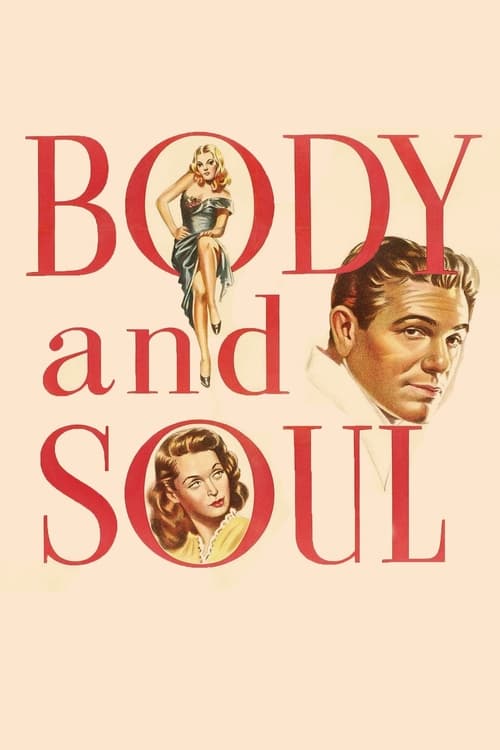
Body and Soul
1947 · Robert Rossen
For when you want a classic Hollywood drama with real anger in it — a crackling story that doubles as an argument about money and what it buys. Absorbing rather than heavy; it moves like a thriller.
What it's about
Charley Davis, a poor Jewish kid from New York's Lower East Side, defies his mother and becomes a boxer — and a very good one. As he punches his way toward the middleweight championship, promoters and gangsters buy pieces of him one at a time, and the money that lifts him out of the tenements steadily costs him his integrity, his relationships, and his sense of the people he came from. Eventually the fight game presents him with the choice it presents everyone it owns.
The experience
Tense, fast, and bruising, with the moral weight of a parable under the melodrama. The fight scenes hit hard, but it's the deals made in back rooms that leave the real marks — you feel Charley's soul being sold in installments.
Performances
John Garfield gives a career-defining performance as Charley — swaggering, wounded, and self-aware enough to know exactly what he's trading away, which makes every compromise sting.
The craft
James Wong Howe's camerawork is the legend here: he shot fight footage from inside the ring with startling immediacy, decades ahead of its time. Abraham Polonsky's screenplay gives the pulp material a bitter, eloquent edge, and Rossen keeps the whole thing lean and driving.
Why it matters
Widely regarded as one of the templates for the modern boxing film, its ring style echoing through the genre for decades — and a landmark of the postwar social-realist Left in Hollywood, made just before the blacklist scattered its makers.
Snapshot
Body and Soul is the story of Charley Davis, a poor kid from New York's Lower East Side who fights his way to the middleweight championship and, in the process, sells nearly everything worth keeping — his integrity, his relationships, his sense of the people he came from — to the gangsters and promoters who own the fight game. It is at once one of the finest boxing pictures ever made and a parable of American capitalism, in which the ring is simply the arena where money buys men. Directed by Robert Rossen from an original screenplay by Abraham Polonsky, photographed by James Wong Howe, and built around a career-defining performance by John Garfield, the film distilled the concerns of the postwar social-realist Left into a tense, kinetic melodrama. It was made by the independent Enterprise Productions and remains historically inseparable from the anti-Communist blacklist that would, within a few years, damage or destroy the careers of almost everyone who made it.
Industry & production
Body and Soul was produced by Enterprise Productions, a short-lived independent company founded in the postwar moment when returning talent and loosening studio control briefly made ambitious, artistically serious independent filmmaking seem viable. It was released through United Artists. Crucially, the picture was a vehicle for Garfield's own producing ambitions: it was made in association with his production entity (Roberts Productions), reflecting the star's move — like many actors of the late 1940s — toward independence from the long-term studio contract that had bound him at Warner Bros. That independence was itself a political and creative statement; Garfield gravitated toward socially conscious material that the majors handled more cautiously.
The film gathered a remarkably cohesive group of left-leaning artists. Rossen, Polonsky, Garfield, and supporting players Anne Revere and Canada Lee were all figures of the Popular Front milieu, and the collaboration has the density of shared conviction. The production is generally understood to have been a tightly controlled, relatively economical shoot by major-studio standards, though precise budget and grosses are not something I can cite reliably here. What is documented is its awards standing: the film earned Academy Award nominations for Garfield as Best Actor and for Polonsky's original screenplay, and it won the Oscar for Best Film Editing.
Technology
Body and Soul was made with the standard tools of late-1940s Hollywood: black-and-white 35mm photography, the Academy 1.37:1 aspect ratio, and optical monaural sound. It predates any of the widescreen or color pressures that would reshape the industry in the following decade. Its technological interest lies not in any new format but in how conventional equipment was made mobile. The most celebrated instance is the handheld camerawork in the fight sequences, where cinematographer James Wong Howe famously operated a lightweight camera while being pushed around the ring on roller skates. This was less a matter of new hardware than of ingenuity in liberating a heavy, tripod-bound apparatus, anticipating the mobile, subjective camera aesthetics that lighter equipment would later make routine.
Technique
Cinematography
Howe's photography is the film's technical glory and one of the landmarks of American cinematography. His approach is expressionist noir — deep shadows, hard key light, wet streets and smoke-hazed interiors — applied to a story of moral descent. In the climactic championship bout, Howe abandoned the fixed ringside vantage of conventional boxing scenes and put himself inside the action, hand-holding the camera on roller skates so that the lens weaves, lunges, and reels with the fighters. The effect is visceral and disorienting, collapsing the distance between spectator and combatant and turning the fight into a subjective ordeal rather than a spectacle observed from a safe seat. Elsewhere Howe uses low angles, tight framing, and pooled light to make the fight world feel both glamorous and predatory, so that the visual style itself carries the film's argument about corruption.
Editing
The film's editing, credited to Francis D. Lyon and Robert Parrish, won the Academy Award for Best Film Editing, and the recognition was well earned. The boxing sequences are cut with a percussive rhythm that intensifies Howe's mobile photography — short, hard shots colliding to convey impact — while the dramatic scenes are edited for tension and psychological pressure. The cutting is one of the reasons the fight scenes have retained their reputation as a benchmark; the collaboration between camera and cutting room produced an immersive kineticism unusual for the period. (Parrish would go on to a substantial directing career of his own.)
Mise-en-scène / staging
Rossen and his collaborators stage the film as a study in environments that shape and finally trap the protagonist: the cramped family apartment and candy store of Charley's origins, the seedy grandeur of the fight promoters' offices, the nightclub demimonde. The staging repeatedly contrasts the world Charley comes from — poor, communal, morally legible — with the world he ascends into, which is spacious, glossy, and rotten. Milieu functions as moral geography, and blocking often isolates Charley within the frame as his choices cut him off from the people who love him.
Sound
The film uses sound conventionally for its era but effectively, with the roar of fight crowds, the physical thud and scuffle of the ring, and the smoky diegetic music of the nightclub world all deployed to texture its environments. Hugo Friedhofer's score underlines the melodrama and the tightening tension without overwhelming the naturalistic surfaces; the interplay of crowd noise and silence in the final bout heightens the sense of a man alone with an impossible choice.
Performance
Body and Soul is one of the great vehicles for John Garfield, and it draws directly on the qualities that made him a distinctive star — the street-smart intensity, the wounded pride, the coiled physicality of a man who came up hard. His Charley Davis is by turns hungry, arrogant, ashamed, and finally defiant, and the performance earned a Best Actor nomination. Garfield's naturalism, rooted in his Group Theatre background, points forward to the Method-inflected acting of the 1950s. He is surrounded by strong work: Lilli Palmer as the artist Peg, who represents the conscience Charley betrays; Anne Revere as his mother, embodying the values he abandons; Hazel Brooks as the corrupting temptation; and William Conrad among the fight-world heavies. The performance that has grown most in stature is Canada Lee's as Ben, the wronged Black former champion — a role given unusual dignity and thematic weight for a Black character in 1940s Hollywood, played by an actor who had himself been a boxer.
Narrative & dramatic mode
The film's dramatic mode is the rise-and-fall tragedy of American ambition, told in an intense social-realist register that shades into film noir. Its structure is notable: the film opens near its end, on the eve of the fight Charley has agreed to throw, and then moves through extended flashback to trace how he arrived at this moral crossroads, before returning to the present for the climax. This retrospective architecture — a hallmark of noir storytelling — frames the whole narrative as a reckoning, so that we watch Charley's ascent already knowing it has led to disgrace. The dramaturgy is built on choices: Polonsky's screenplay repeatedly forces Charley to decide between money and loyalty, and each compromise narrows his options until the last fight becomes a test of whether he can still refuse.
Genre & cycle
Body and Soul sits at the intersection of two currents: the boxing picture and the postwar cycle of socially conscious, noir-inflected dramas about corruption and the price of success. As a boxing film it belongs to a lineage stretching back through the 1930s, but it raised the form's artistic ambition and effectively set the template for the "corrupt fight game" drama, in which the ring stands for a rigged system and the promoter is the true antagonist. As a work of late-1940s social realism, it belongs with the wave of message pictures made by Popular Front artists probing the underside of the American Dream. Its noir credentials — the flashback structure, the shadowed cinematography, the fatalism, the femme fatale figure — place it firmly within that broader cycle as well.
Authorship & method
The film is a genuine collaboration among strong authorial voices. Robert Rossen, who had come up as a screenwriter, directs with a dramatist's attention to conflict and a social critic's thematic focus; Body and Soul is a key film in his development toward the confident direction of later works such as All the King's Men (1949) and The Hustler (1961), both of which likewise anatomize ambition and its costs. Abraham Polonsky's screenplay is the film's intellectual spine — a taut, morally serious script that treats boxing as an allegory of capitalist exploitation; Polonsky would direct Garfield the following year in Force of Evil (1948), a companion piece often regarded as his masterpiece. James Wong Howe's cinematography and the Oscar-winning editing of Francis D. Lyon and Robert Parrish give the film its physical charge, and Hugo Friedhofer's score its emotional undertow. The method throughout is one of applying serious artistic craft and left political conviction to popular genre material — making a mass-audience melodrama carry a critique of the system that produced it.
Movement / national cinema
As American cinema, Body and Soul is a signal product of the postwar Popular Front — the loose coalition of Left and liberal artists whose social-realist sensibility flourished briefly in Hollywood in the late 1940s before the blacklist scattered it. Aesthetically it also participates in the film noir tendency that defines so much American filmmaking of the period. It is not tied to a foreign movement, but its combination of gritty urban realism, moral seriousness, and stylized expressionist photography resonates with international currents of the moment; its lasting influence, however, runs primarily through the American tradition.
Era / period
The film is deeply of 1947 — a hinge year. It was made in the last window of postwar optimism and independent ambition, and released almost simultaneously with the opening of the House Un-American Activities Committee's Hollywood hearings, which would inaugurate the blacklist. The film's very existence, and the fates of its makers, mark the closing of the Popular Front era. Within a few years Polonsky was blacklisted, Rossen was called before HUAC (eventually giving names in a decision that cost him within the Left), Anne Revere and Canada Lee saw their careers curtailed, and Garfield — hounded for refusing to name associates — died in 1952 at thirty-nine. Body and Soul thus stands as a high-water mark of a cinematic moment just before it was destroyed.
Themes
The governing theme is the corruption of integrity by money — the idea that in a system where everything, including a man's body, can be bought and sold, success is itself a form of moral defeat. Boxing is the extended metaphor: the fighter's body is capital, his fights are financial instruments to be fixed, and the promoter's power rests on treating human beings as commodities. Around this the film weaves themes of class and origin (the pull between Charley's poor, decent roots and the glittering corruption above), of loyalty and betrayal, and of the possibility of redemption through refusal. The subplot of Ben, the exploited Black champion, extends the critique to race, framing the fight world's exploitation as systemic. The famous defiant note on which the film ends — Charley's refusal to throw the fight and his contemptuous dismissal of the men who own him — insists that individual moral resistance, however costly, remains possible.
Reception, canon & influence
Body and Soul was well received on release as both a gripping entertainment and a serious drama, and it was recognized by the industry with three major Oscar nominations and the win for editing. Over time its reputation has only grown, and it is now firmly canonical — regularly cited among the greatest boxing films and as one of the essential achievements of postwar Hollywood social realism and film noir; the picture was later selected for preservation in the National Film Registry as a culturally significant work.
Looking backward, the film draws on the 1930s boxing-melodrama tradition, on the Group Theatre's naturalistic acting values (transmitted through Garfield), and on the expressionist visual grammar of film noir and the German-influenced Hollywood style that Howe had helped shape over decades. Its social critique grows out of the Depression-era and wartime Popular Front sensibility that its makers shared.
Looking forward, its influence is broad and durable. Its immediate companion is Polonsky's Force of Evil (1948), which reunited him with Garfield to pursue the same critique of American capitalism. Its innovations in filming the ring — Howe's mobile, subjective camera — reshaped how boxing was photographed thereafter, and it is frequently named as a touchstone for later fight films; Martin Scorsese has been among the filmmakers who acknowledged its cinematographic influence on Raging Bull (1980). Its template of the corrupt fight game and the fighter as exploited commodity echoes through decades of boxing drama. And beyond the genre, the film endures as a document of a vanished moment in American cinema — proof of how much political and artistic ambition Hollywood briefly contained, and, in the subsequent fates of its makers, of how thoroughly that ambition was punished.
A Deleuzian reading
A cameraman on roller skates, camera held in his hands instead of bolted to a tripod, being shoved around a boxing ring while two fighters work in front of him.
The full Deleuzian reading of Body and Soul →
Reception
A box-office hit in 1947 that earned John Garfield an Oscar nomination — then the blacklist gutted almost everyone who made it (Garfield, writer Polonsky, Rossen, Canada Lee, Anne Revere). Today it's canonized as the definitive boxing noir and a monument to the Hollywood left that HUAC destroyed.
How Body and Soul was received, from release to now →
How to watch Body and Soul: what to notice on a first viewing
- Watch deep shadow fall across every promoter's office. Howe lights Charley's rise in hard key light and deep shadow, wet streets and smoke-hazed rooms, so the visual world grows more oppressive as his fortunes improve. The lighting argues against the story's surface success before a single line does.
- Track how each new room looks more expensive. Rossen stages Charley's origins in a cramped apartment and candy store, then moves him through glossier promoter's offices and a nightclub, each setting more spacious and less honest than the last. You can read his moral position off the furniture in every scene.
- Count how many short, hard cuts land per punch. The boxing scenes are edited in quick, colliding shots that convey impact directly through the cutting, a rhythm distinct from the slower pace of the dramatic scenes. You feel each hit through the edit, not just through what is shown on screen.
- Watch the camera move inside the ring itself. Howe shoots the fight handheld while being pushed on roller skates, so the lens weaves and reels with the fighters instead of holding a fixed ringside position. You lose the safe distance of a spectator and end up inside the mauling.
- Watch Garfield's posture change as his fortune rises. Garfield plays Charley's confidence as something physical, a coiled stance and street-smart edge that shifts subtly as money and flattery accumulate around him. His body tells you what is happening to him before the plot catches up.
The whole guide to watching Body and Soul, with the keys for a rewatch →
Influences: the films it descends from and the films it influenced
- Golden Boy (1939) — Clifford Odets's Group Theatre boxing melodrama supplies the violinist-turned-prizefighter template and the naturalistic ensemble acting values that John Garfield carried directly into Charlie Davis.
- Kid Galahad (1937) — Warner Bros. fight-racket melodrama that codified the fixed-bout, corrupt-manager plot machinery Polonsky's screenplay inherits and moralizes.
- The Champ (1931) — Establishes the boxing-melodrama trope of the fighter as sentimental commodity bought and sold inside a rigged fight economy.
- The Roaring Twenties (1939) — Warner social-melodrama rise-and-fall arc — a Depression striver climbs on rackets and is destroyed by them — that structures Charlie's parabola.
- Citizen Kane (1941) — Its flashback frame anatomizing a self-made man's ascent and ruin models the retrospective, fragmented narrative architecture Rossen uses to try Charlie's soul.
- Transatlantic (1931) — James Wong Howe's early deep-focus, low-key expressionist photography here is the germ of the German-influenced noir chiaroscuro he brings to the fight film.
- Fury (1936) — Popular Front social-realist indictment smuggled inside genre entertainment — the same craft of making a mass melodrama carry a systemic critique.
- Hangmen Also Die! (1943) — James Wong Howe extends the expressionist-realist low-key scheme he built here — grimy naturalist surfaces cut by hard directional shadow — into definitive film-noir cinematography.
- The Set-Up (1949) — Extends Howe's mobile, subjective in-ring camera and percussive fight cutting into a real-time boxing noir where the fixers own the fighter's body.
- Champion (1949) — Reruns the rise-and-fall of a boxer corrupted by the money system, with Oscar-winning percussive fight editing that descends straight from Lyon and Parrish's cutting.
- On the Waterfront (1954) — Carries the Group Theatre/Method naturalism and the milieu-as-moral-geography staging into a washed-up fighter's story of exploitation and conscience.
- The Harder They Fall (1956) — Explicit exposé of the corrupt fight game as a commodity racket, extending Body and Soul's fighter-as-exploited-property thesis into 1950s muckraking noir.
- The Hustler (1961) — Rossen's own return to the same craft — anatomizing ambition and its costs through a hustler owned by his backers, the pool hall standing in as the ring's moral geography.
- Fat City (1972) — Inherits the milieu-as-moral-geography realism, treating the small-time fight world as a corrupt ecology that consumes its men.
- Raging Bull (1980) — Scorsese explicitly cited Howe's mobile subjective ring camera and percussive fight cutting, amplifying the roller-skate POV and rhythmic montage into expressionist in-ring choreography.
- The Wrestler (2008) — Its handheld camera bodily following the fighter through the arena is a direct heir to Howe's roller-skate mobile, subjective in-ring photography.
- A Streetcar Named Desire (1951) — John Garfield's Group Theatre naturalism is the direct on-screen precursor to Brando's Method — a Stanislavski-trained actor bringing inner-life realism to a Hollywood lead.
- Sweet Smell of Success (1957) — James Wong Howe's mobile, high-contrast handheld-feel photography of a corrupt milieu — the direct technical precursor to his nocturnal Sweet Smell camerawork.
- Creed (2015) — James Wong Howe's skate-mounted, handheld in-ring camerawork pioneered the subjective fighter's-eye boxing coverage from which Alberti's body-close intimacy descends.
- Million Dollar Baby (2004) — James Wong Howe's chiaroscuro and roller-skate handheld inside the ring established the boxing-noir lighting grammar — pooled overhead lamps, deep shadow surrounding the canvas — that Stern's low-key gym interiors inherit.
- Force of Evil (1948) — Direct companion piece: Polonsky reunites with Garfield to pursue the identical allegory of capitalism-as-corruption, extending the taut, morally serious screenwriting into stylized quasi-verse dialogue.
- The Hurricane (1999) — Defined the boxing-noir of the fixed/stolen decision — the corrupt-verdict motif Hurricane transposes from the ring (the disputed Giardello bout) onto the courtroom.
- Tatami (2024) — James Wong Howe's on-skates handheld camera shooting inside the ropes in high-contrast B&W established the intimate, sweat-lit combat photography Tatami echoes on the tatami surface.
Similar films
- Raging Bull (1980) — influence & lineage
- The Set-Up (1949) — influence & lineage
- The Hustler (1961) — influence & lineage
- The Harder They Fall (1956) — influence & lineage
- The Wrestler (2008) — influence & lineage
- On the Waterfront (1954) — influence & lineage
- Million Dollar Baby (2004) — shared sensibility
- GoodFellas (1990) — shared sensibility