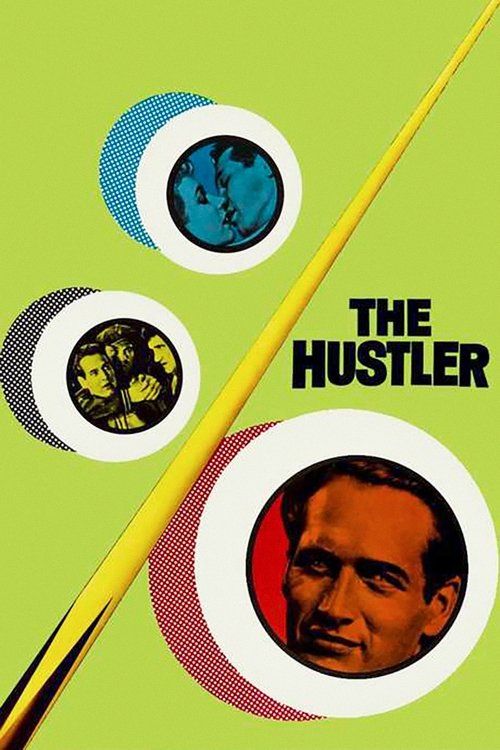
The Hustler
1961 · Robert Rossen
For when you want a serious, grown-up drama to sit with — the kind of black-and-white classic that rewards full attention and stays with you for days. Challenge over comfort, and worth it.
What it's about
'Fast' Eddie Felson is a small-time pool hustler with enormous talent and a self-destructive streak to match, working smoky halls for money and reputation. His bravado drives him to challenge the legendary Minnesota Fats in a marathon high-stakes match — and into the orbit of a hard-eyed gambler and a fragile, damaged woman, where he learns that talent and character are not the same thing.
The experience
Smoky, tense, and quietly devastating — long matches that play like duels, and in between them a bruising study of ambition and self-sabotage. It leaves you chewing on what winning actually costs.
Performances
Paul Newman is magnetic as Eddie — cocky, wounded, impossible to look away from — while Jackie Gleason brings unexpected gravity and grace to Minnesota Fats. George C. Scott is chilling as a gambler who prices human beings, and Piper Laurie is heartbreaking; all four earned the film much of its nine Oscar nominations.
The craft
Robert Rossen shoots the pool halls in stark, Oscar-winning black-and-white widescreen, turning green felt and hanging lamps into an arena. The match sequences are edited with the rhythm of a prizefight, and the hard, unglamorous New York milieu grounds every frame.
Why it matters
A landmark that proved a sports milieu could carry a serious character study, it fixed the pool hall in the American imagination and gave Newman one of his defining roles — one significant enough that he returned to it decades later. Its DNA runs through every 'gifted self-destroyer' drama since.
Snapshot
The Hustler is a black-and-white character study disguised as a sports melodrama — a film about pool halls that is really about the difference between winning and being a winner. Adapted from Walter Tevis's 1959 novel, it follows "Fast" Eddie Felson (Paul Newman), a gifted, self-sabotaging pool hustler who talks his way into a marathon match against the revered Minnesota Fats (Jackie Gleason), loses not on talent but on character, and spends the rest of the film learning — at devastating cost — what character is. Directed by Robert Rossen near the end of his career, the film pairs a hard, unglamorous New York milieu with a quartet of extraordinary performances (Newman, Gleason, George C. Scott, Piper Laurie). It earned nine Academy Award nominations, won two (Cinematography and Art Direction, both in the black-and-white categories), and left a long afterlife: a durable American antihero template, a revival of interest in billiards, and, twenty-five years later, a Martin Scorsese sequel that finally handed Newman the Oscar this film had been nominated for. It stands as a hinge work — one of the last great studio pictures shot in expressive monochrome, and an early, uncompromising portrait of the beautiful loser who would dominate American film in the decade to come.
Industry & production
The Hustler was produced and distributed by 20th Century-Fox and made largely on the East Coast, away from the studio's Los Angeles apparatus — a choice that shaped both its look and its independence of spirit. Rossen produced as well as directed and co-wrote, giving him unusual authorial control for a studio release of the period. The film was drawn from Tevis's debut novel, and Rossen developed the screenplay with Sidney Carroll. Production drew on New York locations and interiors to capture the world of urban poolrooms, bus stations, and cheap apartments.
The context matters. By 1961 Hollywood was contracting under the pressure of television and the collapse of the old contract system, and color and widescreen spectacle were the industry's defensive weapons against the small screen. A black-and-white, adult, downbeat drama about a pool hustler ran against that commercial grain, and its production reflected a growing willingness at the majors to underwrite smaller, more serious, location-based films aimed at an adult audience — the same current that produced the New York realist pictures of the era. Real-world authenticity was pursued directly: the legendary professional champion Willie Mosconi served as technical advisor and executed many of the trick shots on camera, lending the pool sequences a documentary credibility that no amount of staging could fake. Newman trained extensively to handle his own cue work convincingly. The film was a critical success on release and became commercially durable, though precise contemporaneous box-office figures are not something I can cite reliably here.
Technology
Technologically, The Hustler is defined by a deliberate contrarian choice: it was shot in CinemaScope — the anamorphic widescreen format Fox had championed since 1953 — but in black and white, at a moment when the industry increasingly reserved its widescreen frames for color spectacle. The combination is unusual and pointed. The wide anamorphic frame, normally deployed for landscape and pageantry, is here turned inward on the horizontal geometry of the pool table and the cavernous, smoke-hung interiors of the poolroom, so that the format's width becomes a tool for isolation and for organizing bodies in deep, layered space rather than for grandeur.
The monochrome cinematography relied on fast panchromatic stock and hard, controlled lighting to render the specific textures of this world — the felt of the tables, cigarette haze, sweat, the sheen of worn wood and cheap fabric. Deep-focus staging, achievable with the available lenses and lighting, keeps foreground and background legible simultaneously, essential in a film where watching and being watched is a constant dramatic condition. The technology is, in short, used against type: the era's most spectacular format enlisted for one of its most intimate and austere pictures.
Technique
Cinematography
The photography, by the German émigré cinematographer Eugen Schüfftan, won the Academy Award for Best Cinematography (Black-and-White) and is the film's most celebrated craft achievement. Schüfftan — a veteran of Weimar cinema, associated with the special-effects "Schüfftan process" used in Metropolis — brought an Expressionist sensibility to a resolutely American subject. His poolrooms are chiaroscuro spaces: pools of hard light over green baize, faces carved out of surrounding darkness, deep blacks that swallow the edges of the CinemaScope frame. The camera favors deep focus and long, patient setups that let the geometry of the table and the arrangement of onlookers carry meaning. Light functions morally as well as visually — the arena of the match is bright and merciless, while the corners where money and manipulation change hands recede into shadow. Schüfftan's monochrome gives the film its distinctive register: glamorous and squalid at once, romantic about the game and unsparing about the people who play it.
Editing
The editing was by Dede Allen, then near the beginning of the ascent that would make her one of the most influential American editors of the following generation (her later work on Bonnie and Clyde is often credited with importing European New Wave cutting into Hollywood). In The Hustler her work is disciplined rather than flashy, shaped to the rhythms of the game: the long opening contest between Eddie and Fats is built through duration and accumulation, holding on the ritual of play — chalking, sighting, the slow drift of exhaustion across a marathon night — so that the passage of hours becomes physically felt. Allen modulates between the extended, almost real-time patience of the matches and sharper cutting in the dramatic scenes, using the contrast to distinguish the film's two arenas: the table, where time is endured, and the human relationships, where time runs out.
Mise-en-scène / staging
The film's art direction — by Harry Horner and Gene Callahan — also won an Academy Award (Black-and-White), and the sets are inseparable from the film's meaning. Ames Billiards and its kin are rendered as secular temples: high-ceilinged, church-like halls where the green tables sit like altars under hanging lamps and the spectators gather in reverent hush. The staging repeatedly organizes the frame around watchers ringing a central performer, making the poolroom a theater of judgment. Against these public arenas the film sets cramped, shabby private spaces — Sarah's apartment, bus depots, bars — that press the characters into intimacy and exposure. Props and physical detail carry weight: the cue case Eddie guards, the cash on the felt, the bottle. The mise-en-scène consistently frames the game as spectacle and the people around it as its casualties.
Sound
Kenyon Hopkins's jazz-inflected score gives the film an urban, nocturnal texture appropriate to its milieu, used sparingly enough that the poolroom's own soundscape can dominate — the click of balls, the murmur of crowds, the ambient hum of these late-night rooms. That naturalistic sound design is central to the film's realism; the matches derive much of their tension from what we hear as much as what we see, the near-silence of concentration broken by contact and reaction. The detailed record of the sound work is thinner than that of the image, but the effect is unmistakable: an atmosphere of smoke, cash, and fatigue conveyed as much through the ear as the eye.
Performance
The performances are the film's living center, and all four principals were recognized by the Academy. Paul Newman's Fast Eddie is a definitive early statement of his screen persona — charismatic, wounded, arrogant, and self-destructive — a Method-influenced performance of enormous physical and emotional specificity. Jackie Gleason, cast against his comedic fame, plays Minnesota Fats with an almost still, dignified economy; his Fats says relatively little, and Gleason's restraint makes the character a study in the professional composure Eddie lacks. George C. Scott's Bert Gordon is one of American cinema's great portraits of predatory intelligence — cold, watchful, transactional — the man who sees "character" only as an exploitable commodity. Piper Laurie's Sarah Packard, alcoholic and adrift, gives the film its bruised heart and its tragic conscience. The interplay among these four — talent, mastery, corruption, and love — is the drama's true subject.
Narrative & dramatic mode
Structurally the film is a tragedy of temperament. It opens with a bravura set piece — the all-night duel with Fats — that functions as a false climax: Eddie has the superior talent and loses anyway, undone by hubris and lack of discipline. The remainder is the working-out of why, and at what price wisdom is bought. The dramatic mode is character-driven rather than plot-driven; external events (matches, wagers, a road trip, a death) exist chiefly to test and reveal interior qualities. The film's key term, spoken and enacted, is "character" — the quality that separates a player who wins games from one who is a winner. Eddie's arc is a fall-into-knowledge: he acquires the maturity to beat Fats only by losing everything that made life worth the winning. The tone is unsentimental and closes on ambivalence rather than triumph — a downbeat, adult resolution far from the tidy uplift of the conventional sports narrative.
Genre & cycle
Nominally a sports film, The Hustler belongs more truly to the cycle of hard-edged American character dramas that flourished around the turn of the 1960s — realist, urban, morally serious, focused on marginal or self-defeating men. It shares DNA with the boxing-picture tradition of moral compromise in the ring, but transposes the arena to the poolroom and largely abandons the redemptive uplift of that genre. More significantly, it is an early instance of the antihero cycle that would define New Hollywood: Eddie Felson is a prototype of the flawed, alienated, self-sabotaging protagonist who would populate American film through the following decade. Within the pool-and-hustle subgenre it is effectively foundational, the template against which all later films about the game are measured.
Authorship & method
Robert Rossen is the governing authorial presence — producer, co-writer, and director — and the film is often read through his biography. A former Communist Party member, Rossen was caught in the HUAC investigations of Hollywood: he refused to name names in 1951, was blacklisted, and then in 1953 testified and named others in order to resume work. That history of talent, compromise, and the wages of survival shadows a film so preoccupied with selling out and the cost of winning; critics have long seen Eddie's education in moral compromise as bearing the imprint of Rossen's own. His earlier All the King's Men (1949), a study of corrupted ambition, had won Best Picture, marking him as a filmmaker drawn repeatedly to the theme of power's corrosions. The Hustler was among his last films; he died in 1966.
The collaborators are equally essential to the achievement. Screenwriter Sidney Carroll shared the adaptation and the Academy Award nomination with Rossen. Cinematographer Eugen Schüfftan supplied the Expressionist monochrome vision that gives the film its visual identity. Editor Dede Allen shaped its distinctive rhythm of endurance. Composer Kenyon Hopkins provided its jazz atmosphere, and art directors Harry Horner and Gene Callahan built its cathedral-like poolrooms. The film is a genuinely collaborative authorship, with Rossen's thematic obsessions realized through an unusually strong technical roster.
Movement / national cinema
The Hustler sits at a confluence. It is an American studio film, but its cinematography carries the inheritance of German Expressionism through Schüfftan, giving it a European darkness. It aligns with the location-based New York realism emerging around 1960 — films that fled the backlot for actual city interiors and the grain of ordinary American life — and with the Actors Studio Method culture that produced Newman's kind of performance. It anticipates, without belonging to, the New Hollywood that would arrive later in the decade; through Dede Allen especially, there is a direct through-line from this film to the movement that transformed American cinema after 1967. It is best understood as a transitional work: classical Hollywood craft in the service of a new, more disillusioned sensibility.
Era / period
Made in 1961, the film is a product of Hollywood's anxious transitional moment — the studio system in decline, television ascendant, censorship loosening, and audiences fragmenting. Its willingness to be downbeat, adult, morally ambiguous, and formally austere reflects the loosening of old constraints and the industry's turn toward serious drama to differentiate cinema from the small screen. Its monochrome widescreen photography places it at the tail end of the golden age of black-and-white filmmaking, just before color became near-universal. It is very much a film of the early 1960s: poised between the classical era that formed its makers and the counterculture era its antihero would come to embody.
Themes
The film's central theme is the meaning of character — the moral and psychological quality that Bert Gordon defines coldly as the capacity to win, and that the film ultimately redefines as something closer to integrity and the ability to love. Around this cluster its concerns: the American obsession with winning and the emptiness at its center; talent as insufficient without discipline and self-knowledge; self-destruction and the figure of the "born loser"; the commodification of human beings, embodied in Bert's transactional worldview, which treats people as investments to be owned and cashed. Love and its impossibility under such conditions run through the Eddie–Sarah relationship, the film's tragic register. And beneath all of it lies the theme of moral compromise — what one sells to succeed, and what is lost in the selling — a preoccupation impossible to separate from Rossen's own history. The poolroom becomes a microcosm of an American economy of exploitation, in which mastery is real but ownership is always someone else's.
Reception, canon & influence
The Hustler was received on release as a serious achievement and has only grown in stature. It drew nine Academy Award nominations — including Best Picture, Best Director, Best Actor (Newman), Best Actress (Laurie), two Best Supporting Actor nods (Gleason and Scott), and Adapted Screenplay — winning for Schüfftan's cinematography and for the black-and-white art direction. Newman's Fast Eddie became one of the defining performances of his early career and a benchmark of the emerging Method-inflected American acting; the film is frequently cited among the best of the 1960s and has been preserved as a work of enduring cultural significance.
Looking backward, the film draws on the boxing-and-corruption strain of the American sports melodrama, on the moral-fable tradition of Rossen's own All the King's Men, on Tevis's source novel, and on the visual inheritance of German Expressionism carried by Schüfftan. Looking forward, its influence is substantial and traceable. It effectively created the modern pool film and is credited with reviving popular interest in billiards in the United States. Its self-destructive antihero prefigured the alienated protagonists of New Hollywood, and Dede Allen's presence links it directly to that movement's editing revolution. Most concretely, its afterlife includes Martin Scorsese's The Color of Money (1986), in which Newman reprised Fast Eddie Felson a quarter-century older and won the Best Actor Oscar that had eluded him here — a rare instance of a film's legacy completing itself through its own sequel. Walter Tevis, the source novelist, would later reach an even wider audience through the adaptation of another of his books, The Queen's Gambit, extending the lineage of the material. The Hustler endures as both a superbly crafted studio drama and a foundational text for the disillusioned American cinema that followed it.
Reception
A critical and box-office hit in 1961 — nine Oscar nominations — that has only grown in stature since, now standing as one of the defining American films of its era and even credited with single-handedly reviving the pool-hall business across the country.
How The Hustler was received, from release to now →
Influences: the films it descends from and the films it influenced
- Metropolis (1927) — Eugen Schüfftan devised his optical process and sharpened his Expressionist command of light-carved architecture here, the same monochrome chiaroscuro he later brought to The Hustler's cathedral-like poolrooms.
- Menschen am Sonntag (1930) — Schüfftan's camerawork fused documentary-naturalistic location texture with Expressionist tonal control — the exact hybrid he reprised photographing Eddie's smoky, low-key world.
- Body and Soul (1947) — Rossen's own boxing-corruption melodrama supplies the template Eddie inherits — the gifted man who must sell his talent to survive — plus James Wong Howe's mobile, in-the-arena camera as a model for photographing sport as fate.
- All the King's Men (1949) — Rossen's Best Picture study of ambition rotting under power establishes his authorial method — deep-focus, semi-documentary realism married to a moral fable — that The Hustler restages around a pool cue.
- Citizen Kane (1941) — Gregg Toland's deep-focus staging and ceilinged, chiaroscuro compositions are the visual grammar Schüfftan extends, keeping table, hustler, and backers all in cruel simultaneous sharpness.
- Champion (1949) — Defines the self-destructive sports antihero whose need to win corrodes everyone around him — the tragedy-of-temperament arc Fast Eddie completes.
- A Streetcar Named Desire (1951) — Brings Actors Studio Method interiority to the screen inside a theatrically compressed chamber space — the performance idiom and staging-as-judgment that Newman and Laurie inherit.
- On the Waterfront (1954) — Boris Kaufman's stark monochrome realism plus Method-inflected acting dramatize a man's education in compromise — a HUAC-shadowed moral reckoning Rossen, himself a namer of names, reworks.
- Nightmare Alley (1947) — A low-key, chiaroscuro-lit study of a gifted con/gambler destroyed by his own hubris, carrying forward the tragic-arc editing and moral downfall of a virtuoso operator.
- The Harder They Fall (1956) — Rossen returns to the corruption procedural — a gifted competitor owned and stage-managed by a mercenary backer — in Eugene Shuftan's low-key monochrome, the noir grammar of talent-as-property carried into the pool hall.
- The Cincinnati Kid (1965) — Transposes The Hustler's structure wholesale to poker — young challenger versus aging master in a marathon showdown that tests character over skill.
- Bonnie and Clyde (1967) — Dede Allen carries the elliptical, endurance-shaped cutting rhythm she pioneered on The Hustler into the film that ignited New Hollywood's editing revolution.
- Slap Shot (1977) — Reunites Newman as a disillusioned sportsman with editor Dede Allen, extending the Hustler team's portrait of talent grinding against a corrupt game.
- Raging Bull (1980) — Renders the self-destructive athlete's tragedy of temperament in Expressionist black-and-white — the Hustler antihero recast as pure appetite and self-ruin.
- The Color of Money (1986) — The direct sequel: Newman reprises Fast Eddie a quarter-century older, completing the character's arc and winning the Oscar the original denied him.
- Rounders (1998) — Rebuilds the pool-hustler foundational template beat for beat in underground poker — the mentor, the mark, the compulsion to prove oneself at the table.
- The Queen's Gambit (2020) — Adapts Walter Tevis, the same novelist, dramatizing a prodigy consumed by mastery of a game — the material lineage of The Hustler reaching a new medium and audience.
- Cool Hand Luke (1967) — Newman's performance mode of strategic withholding — the still face that conceals ambition and despair behind charisma, the body that holds its interior at a distance from the camera — is fully developed here by director and star together; Cool Hand Luke is architecturally built on the same psycho-physical grammar, Luke's cool opacity a direct reprise of Fast Eddie Felson's.
- The Sting (1973) — Newman's Fast Eddie codified the charming-rogue whose compulsion overrides skill as a screen persona that Redford's Hooker directly inherits; Rossen's pool hall also established the deception-as-spectator-sport staging—a performance space watched by an audience within the film—that The Sting's betting parlor replicates.
- Patton (1970) — Scott's Fast Eddie Felson established his inhabitation method — physical precision, contempt for weakness, barely-controlled aggression expressed through stillness and posture — which he transferred unchanged to Patton, giving Schaffner a performer who could make a monologue feel like a physical contest.
- Whiplash (2014) — A two-hander of psychological domination between a gifted protégé and a manipulative master, dramatizing whether being broken builds 'character' — the chamber-drama spine of Andrew and Fletcher.
- The Verdict (1982) — Fixes Paul Newman's signature register of the broken charmer seeking redemption that Galvin directly extends, shot in a chiaroscuro lensing of a man in decline.
- Sweet Smell of Success (1957) — James Wong Howe's glinting deep-focus chiaroscuro renders a nocturnal American world of talent for sale — the same predatory monochrome milieu, shot a few years apart.
- Hud (1963) — Newman again plays a magnetic heel cast against his own charm, photographed in wide-screen black-and-white deep focus (Wong Howe) — the against-type antihero of The Hustler pushed further toward the amoral.
- Requiem for a Heavyweight (1962) — Contemporaneous black-and-white sports melodrama of a broken competitor and his handlers, extending the boxing-and-corruption strain into the same naturalistic, tragedy-of-temperament register.
- Absence of Malice (1981) — Establishes Newman's signature register of charismatic, simmering anger held just beneath the surface — the precise 'banked anger' Pollack mines for the wronged businessman.
- Glengarry Glen Ross (1992) — Black-and-white nocturnal world of con and hustle where masculine worth is settled through verbal predation and the long game, prefiguring Glengarry's framing of selling as a rigged contest among desperate men.
- Days of Thunder (1990) — Source of the mentor-protégé / fallen-veteran-rebuilds-a-talent dynamic (Hyde-and-Richmond reworked) that gives the Duvall–Cruise bond its dramatic spine.
Similar films
- Raging Bull (1980) — influence & lineage
- Body and Soul (1947) — influence & lineage
- Hud (1963) — influence & lineage
- On the Waterfront (1954) — influence & lineage
- Casino (1995) — shared sensibility
- The Maltese Falcon (1941) — shared sensibility
- GoodFellas (1990) — shared sensibility
- American Hustle (2013) — shared sensibility