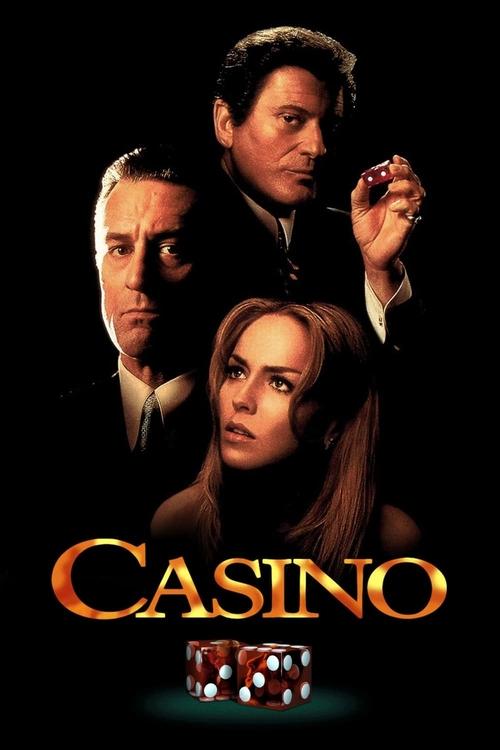
Casino
1995 · Martin Scorsese
His "Marvel isn't cinema" comments spawned a years-long culture war about what cinema even is; Killers of the Flower Moon added runtime discourse and questions about centering white perspectives in Osage history. Also beloved as a TikTok dad and Letterboxd's patron saint.
For when you're in the mood for something big, loud, and morally sordid — a sprawling crime saga to sink into on a night you've got time and appetite. More adrenaline than comfort.
What it's about
Las Vegas, the 1970s: a brilliant sports handicapper is installed by the Chicago mob to run a glittering casino, his hot-headed enforcer best friend follows him out, and a dazzling hustler becomes the one bet he can't calculate. It's the story of how the mob ran Vegas — the skim, the muscle, the excess — and how greed, ego, and love tore the whole machine apart.
The experience
Three hours of pure velocity — narration, needle drops, and dazzling surfaces carrying you through an empire's rise and rot. It's intoxicating and then genuinely harrowing, a party that turns into a tragedy while you're still enjoying the music.
Performances
Robert De Niro's meticulous control and Joe Pesci's terrifying volatility play off each other perfectly, but Sharon Stone is the revelation — her Ginger is glamorous, desperate, and heartbreaking, career-best work that earned her an Oscar nomination.
The craft
Martin Scorsese directs at maximum intensity: whip-fast editing, dueling voiceovers, a wall-to-wall soundtrack, and costume and production design that make 1970s Vegas feel like a fever dream of money. Few films look this expensive or move this fast at this length.
Why it matters
The capstone of Scorsese's mob-epic mode, it fixed the image of old Las Vegas — the era before the corporations — in the popular imagination.
Snapshot
Casino is Martin Scorsese's three-hour crime epic about the intersection of organized crime, showbiz aspiration, and American capitalism in Las Vegas during the 1970s and early 1980s. Adapted from Nicholas Pileggi's nonfiction account of the same name — the journalist having also co-written GoodFellas with Scorsese five years earlier — the film follows Sam "Ace" Rothstein (Robert De Niro), a brilliant sports handicapper installed by the Chicago Outfit to run the fictional Tangiers Casino, his volatile enforcer Nicky Santoro (Joe Pesci), and Ginger McKenna (Sharon Stone), the woman whose addiction and volatility Ace cannot rationalize away as he does every other variable in his world. Structured as a tragedy — hubris, overreach, and the arrival of corporate Las Vegas destroy what the mob once controlled — Casino received Academy Award attention primarily for Stone's performance and has been steadily reappraised in the decades since, now regarded as one of the major works in Scorsese's filmography and a foundational document for how American popular culture understands the mob era in Las Vegas.
Industry & production
Casino was produced by Barbara De Fina and Irwin Winkler for Universal Pictures, with a reported production budget in the range of fifty-two million dollars — a substantial figure for the period that reflects the logistical complexity of period-accurate Las Vegas recreation and the extended runtime. The film went into production in 1994, shooting extensively on location in Las Vegas, with the Riviera Hotel and Casino serving as the exterior of the fictional Tangiers, as well as in Los Angeles. The scale of the casino sequences required coordination with working establishments and involved large numbers of period-costumed extras populating fully operational casino floors or meticulously dressed practical sets.
Pileggi's source material was itself rigorously reported: his book drew on court records, FBI surveillance files, and interviews to reconstruct how Frank "Lefty" Rosenthal — the real handicapper behind Ace Rothstein — managed the Stardust and other Chicago Outfit–controlled Las Vegas properties, and how Anthony "Tony the Ant" Spilotro, the basis for Nicky Santoro, operated as the Outfit's enforcer on the ground. Scorsese and Pileggi's screenplay hews closely to this documentary record while compressing and dramatizing it, giving the film an almost procedural authority in its early sections, as casino operations are explained with the granular specificity of trade journalism.
The casting of Sharon Stone, known at the time primarily for Basic Instinct (1992) but not for dramatic awards-circuit work, proved one of the production's most consequential decisions. Stone's preparation for Ginger McKenna involved research into the real Geri McGee, Frank Rosenthal's wife, whose life ended in a drug overdose in 1982.
Technology
Casino was shot on 35mm film in the anamorphic widescreen format (2.35:1), a ratio that cinematographer Robert Richardson used to sustained expressive effect: the horizontal spread accommodates the casino floor's density — dealers, pit bosses, surveillance apparatus, gamblers pressing at the frame's edges — making the space feel simultaneously overwhelming and controlled. Richardson, whose prior major collaborations had been with Oliver Stone on Platoon, JFK, and Natural Born Killers, brought to Casino a high-contrast, jewel-saturated palette that turns the neon glare of the Strip into something close to infernal glamour. The Steadicam is deployed with the same kinetic fluency Scorsese had developed through GoodFellas, threading through casino interiors and tracing characters through crowds in long, uninterrupted takes that convey institutional mastery — Ace surveilling his domain — before the machinery begins to come apart.
Freeze-frames punctuate key passages, particularly in the film's second half, functioning as mortality markers: pinning characters at the moment before catastrophe, as if the film itself is performing an autopsy on lives whose endings are already known.
Technique
Cinematography
Richardson's work distinguishes Casino from the cooler, more desaturated crime films of the period. The color design is organized around excess: the casino floor bathes in amber and gold, pool sequences are overlit to harshness, and Ginger's entrance into Ace's life arrives in a swirl of warm backlight that marks her immediately as both object of desire and source of danger. As the empire deteriorates, the palette grows colder and more institutional — the FBI sequences and congressional hearings are filmed with a brackish sobriety that underscores the contrast between the world Ace built and the bureaucratic machinery dismantling it. Richardson frequently shoots De Niro in close-ups that emphasize stillness and calculation, then cuts to the kinetic handheld and Steadicam passages that characterize Nicky's sections. The visual grammar differentiates the two men before the narrative has to labor the point.
Editing
Thelma Schoonmaker, Scorsese's editor since Raging Bull and one of the most decorated editors in American cinema, assembled Casino's nearly three-hour runtime from a voluminous amount of material. The editing strategy in the first act is deliberately overwhelming: quick cuts between surveillance-camera angles, cutaways to money-counting and chip-sorting, intercut with voiceover narration — a deliberate mimicry of the casino's own informational overload, which presents the audience as both spectator and mark. As the film's structure tightens around its personal catastrophes, Schoonmaker's cutting becomes more focused, holding longer on faces. The opening sequence — a car bomb detonation that initiates a non-linear frame before folding back into chronological order — establishes the film's relationship to time as retrospective rather than suspenseful: we know Ace survives the blast before the story begins.
Mise-en-scène / staging
The costume design for Ace Rothstein became one of the film's most discussed elements: designers Rita Ryack and John Dunn created more than seventy custom suits for De Niro's character, drawing on accounts of Frank Rosenthal's actual wardrobe — Rosenthal was known for his pastel colors and bold tailoring, and the film amplifies this into a visual language of aspiration and displacement. No one in the Tangiers dresses like Ace; the suits mark him as someone who has money and status but whose aesthetic sense betrays his origins and his fundamental outsider condition in the world he inhabits. The costumes are simultaneously an expression of character and a form of comedy.
Scorsese's staging consistently uses depth of field to populate backgrounds with meaningful activity so that conversations in the foreground always register as occurring within an institutional context. In domestic scenes, by contrast, the staging increasingly isolates characters: Ace and Ginger's deteriorating marriage is conducted in large, underutilized rooms where they orbit each other without contact, the space between them as expressive as anything in the dialogue.
Sound
The film's use of popular music is among its most analytically rich features. Casino employs an extensive, decades-spanning song score — from Louis Prima's mid-century swing through rock, soul, and pop of the 1970s and early 1980s — that functions simultaneously as period marker and emotional counterpoint. The songs are frequently chosen for ironic or intensifying contrast with the action: violence plays against exuberant or celebratory music, a technique Scorsese had refined through Mean Streets and GoodFellas and which here achieves particular force in the film's most brutal passages. The diegetic sound of the casino — the mechanical percussion of slot machines, the murmur of the floor — is maintained as a constant ambient texture, a white noise of capital that underlies nearly every interior scene and registers as both setting and argument: the money never stops moving.
Performance
Casino contains three distinct performance registers that never quite merge, which is partly the point. De Niro's Ace is controlled, interior, analytical — a performance built on stillness and precision that makes the character's eventual loss of control genuinely affecting. Pesci's Nicky operates in a register of pure dangerous energy, extending and darkening the mode he had perfected as Tommy DeVito in GoodFellas; the two characterizations are explicitly structured as complementary pathologies, and the performances enforce this architecturally. Stone's Ginger is the film's most complex and most debated performance: she plays a woman whose self-destruction is the product of genuinely limited options, resisting the film's occasional tendency — present in Pileggi's source material — to treat her purely as Ace's problem. Stone received an Academy Award nomination for Best Actress, the most prominent recognition the film received from the Academy, and it remains the performance for which she is most seriously regarded.
Narrative & dramatic mode
Casino is structured as a retrospective confession — its framing positions Ace as a survivor narrating a collapse from enforced exile. The dual voiceover (both Ace and Nicky narrate, occasionally simultaneously, their accounts at minor but telling cross-purposes) complicates straightforward reliability and situates the audience within a specifically criminal epistemology: we know only what these men know, and what they choose to say. The film is less a plot-driven thriller than a chronicle — it follows the shape of the historical record it adapts — and its three-hour length reflects that chronicling impulse: Scorsese and Pileggi are tracing an entire system as well as its human casualties.
The dramatic structure is essentially classical tragedy in organized-crime dress. Ace's fatal flaw is his inability to release the uncontrollable — Ginger, Nicky, political entanglements — when calculation demands it. The epilogue, in which Ace surveys a corporatized Las Vegas from which the mob has been entirely expunged, inverts The Godfather's elegiac mode: there is no dynasty, only dispersal. The closing voiceover's observation that the new Las Vegas resembles "Disneyland" lands as lament and as analysis, arriving at the film's central argument — the mob and the corporation are variants of the same extractive logic — with a bluntness that is itself Ace's register.
Genre & cycle
Casino belongs to the crime epic subgenre — long-form, based-on-true-events, centered on the rise and fall of criminal figures — that The Godfather inaugurated in the early 1970s and that GoodFellas renovated at the decade's turn. Its most direct generic predecessor is GoodFellas; the two films share a screenwriter (Pileggi), an editor (Schoonmaker), a lead actor (De Niro), and a structural approach (voiceover-driven chronicle of criminal ascent and collapse). Casino extends the GoodFellas formula into what some critics characterized as excess — the longer runtime, the wider institutional canvas — and others identified as the logical intensification of the mode: if GoodFellas traced the foot soldier, Casino traces the manager.
The film participates in the broader 1990s cycle of nostalgia-inflected organized crime cinema (Donnie Brasco, Carlito's Way, Heat appeared in adjacent years) while distinguishing itself through its institutional focus. Casino is as much about an organization — the Outfit, the casino system — as it is about individuals within it.
Authorship & method
Scorsese's collaboration with Nicholas Pileggi on Casino followed the same basic pattern as GoodFellas: Pileggi's journalistic research provided the documentary framework, and Scorsese imposed on it the visual and rhythmic strategies he had been developing since Mean Streets. Robert Richardson's cinematography marked the beginning of a significant ongoing partnership — the two subsequently collaborated on The Aviator (2004) and Hugo (2011), among other projects — suggesting a genuine aesthetic alignment between Richardson's lushness and scale and Scorsese's epic ambitions. Richardson's approach differed meaningfully from that of Michael Ballhaus, who had shot GoodFellas: where Ballhaus's work has a steelier, more kinetic quality suited to GoodFellas's relentless forward momentum, Richardson's palette for Casino is richer and more operatic, befitting the film's greater temporal and institutional sweep.
Thelma Schoonmaker's work on Casino continues the collaboration that has defined Scorsese's mature career. Her editorial approach — rhythmic precision within apparent excess, the willingness to hold long takes against rapid montage without losing tonal coherence — is essential to Casino's success in sustaining nearly three hours of audience investment.
Movement / national cinema
Casino is a product of American cinema's post-New Hollywood consolidation: made within the studio system by a director whose prestige afforded considerable creative autonomy, but bearing the marks of European influence — particularly the French New Wave's use of freeze-frame and self-conscious narration, and the Italian Neorealist interest in social documentary texture — that Scorsese absorbed at NYU and through his early cinephile formation. The Italian-American cultural experience is less foregrounded here than in Mean Streets or Raging Bull, but the milieu — the Chicago Outfit, the Sicilian-American organizational structures of the mob — remains central to the film's world. Casino might be understood as Scorsese's most sociological work: a film less interested in individual interiority than in the institutional systems that produce and destroy such individuals.
Era / period
Casino belongs to the mid-1990s moment in which several major American directors produced ambitious, long-form works consolidating their careers: Michael Mann's Heat appeared the same year, as did David Fincher's Se7en and Tim Robbins's Dead Man Walking. The film was made and released as digital filmmaking was beginning its ascent; it is emphatically a product of the photochemical era, and its visual richness is inseparable from Richardson's 35mm work and the particular quality of light that format renders.
The period depicted — Las Vegas from approximately 1973 to 1983 — is rendered with considerable historical specificity, capturing the transition from mob-controlled to corporate casino capitalism that is now a well-documented chapter in the city's history and that the film helped to mythologize.
Themes
The film's central argument concerns the American dream's compatibility with organized violence: Ace Rothstein is a genuine meritocrat who cannot operate within legitimate society and whose talents are therefore available only to criminal organizations. His rise is a perverse fulfillment of the Horatio Alger myth; his fall is precipitated not by law enforcement alone but by his own appetites and by the institutional logic of the Outfit, which cannot tolerate a figure who draws disproportionate attention. The film reads Las Vegas itself as a figure for American capitalism in the abstract — a system designed to extract money by offering the illusion of possibility.
The Ginger subplot develops a parallel argument about gender and foreclosed agency. Ginger is a woman of intelligence and charisma who has been socialized entirely within transactional relationships and who cannot survive within the constraints Ace's world imposes on her. The film does not sentimentalize her trajectory, but it also resists treating her purely as Ace's catastrophe — she is a catastrophe in her own right, with her own logic.
At a more formal level, Casino constitutes an extended meditation on surveillance and control: the casino as a Panopticon, and the irony that the machinery of total surveillance built to protect the mob's investment ultimately becomes the instrument of its destruction.
Reception, canon & influence
Influences on the film (backward): The Godfather established the crime epic's moral seriousness and elegiac scale. GoodFellas provided the immediate template for voiceover, music-driven montage, and the rise-and-fall chronicle. Scorsese's own Mean Streets and Raging Bull inform Casino's approach to masculine self-destruction and Italian-American criminal milieu. The French New Wave — Godard particularly — is present in the freeze-frame work and the self-conscious narration. Pileggi's nonfiction book belongs to the tradition of long-form American journalism about organized crime that stretches back through the Kefauver Committee hearings and beyond.
Critical reception: Casino opened to mixed-to-positive notices in late 1995. Many critics measured it against GoodFellas and found it somewhat wanting — longer, more sprawling, less surgically precise. Roger Ebert awarded it four stars and praised its ambition without reservation. The prevailing critical consensus in the years immediately following release characterized Casino as second-tier Scorsese: technically accomplished but thematically redundant. Stone's performance was the near-universal exception; her Oscar nomination was broadly considered earned, though she did not win (the award went to Susan Sarandon for Dead Man Walking).
Legacy (forward): The film's influence has been substantial, if diffuse. The Sopranos (1999–2007) absorbed Casino's interest in the institutional mechanics of organized crime and its willingness to render criminal figures as morally complex but ultimately corrosive agents; David Chase has acknowledged Scorsese's centrality to the show's visual and tonal conception. The mob-era Las Vegas mythology Casino elaborates has become so dominant in American popular culture that the film now partly reads as the origin text of a discourse it was itself reporting. The use of popular music as ironic-intensifying counterpoint to violence — developed from Mean Streets through GoodFellas into Casino — became a widely imitated mode across American crime cinema and television, a grammar that has since grown into cliché through misapplication. Critically, Casino has been steadily reappraised: contemporary assessments are considerably more generous than the initial reviews, and it is now regularly included in discussions of Scorsese's major works rather than treated as a postscript to GoodFellas. The film's account of corporate capitalism displacing criminal capitalism in Las Vegas has, with time, come to read as a structural analysis of American institutional life well beyond the Strip.
A Deleuzian reading
The film opens with a man getting into his car, turning the key, and vanishing into a column of orange fire.
The full Deleuzian reading of Casino →
Reception
Dismissed in 1995 as 'Goodfellas in Vegas' — a retread with the same star, writer, and rise-and-fall shape — it has since been steadily reappraised, and 'Casino is actually the better film' is now a respectable cinephile position rather than a hot take.
How Casino was received, from release to now →
Influences: the films it descends from and the films it influenced
- GoodFellas (1990) — The Scorsese-Pileggi co-writing partnership, Schoonmaker's freeze-frame mortality editing, and the De Niro/Pesci volatile-partnership dynamic were all originated here and carried directly into Casino's expanded tragic arc.
- Raging Bull (1980) — Established the Scorsese-Schoonmaker grammar of De Niro's controlled interiority and freeze-frame punctuation as markers of slow self-destruction — the formal template Casino inherits for its chronicle of Ace Rothstein's collapse.
- Mean Streets (1973) — Originated Scorsese's technique of counterpointing ironic pop and rock songs against criminal violence — 'Be My Baby' over neon-lit streets — the same device Casino deploys across a three-hour period soundtrack.
- À bout de souffle (1960) — Godard's jump-cut disruptions of spatial and temporal continuity gave Casino its formal license to treat time as retrospective and non-linear — images compressed, sequences out of expected order — rather than building suspense chronologically.
- Citizen Kane (1941) — Welles' retrospective non-linear framing — narrating a fallen empire's arc from its ruins via multiple unreliable voices — is the structural template for Casino's car-bomb cold open and its dual voiceover mourning an already-lost world.
- The Godfather (1972) — Established costume-as-power-semiotics in the American crime epic — wardrobe meticulously tracking organizational rank and moral position — a convention Casino inherits and extends through Ace Rothstein's obsessively documented personal wardrobe.
- The Conversation (1974) — Coppola's surveillance-as-paranoid-epistemology — the recorded voice as evidence of institutional betrayal, the watcher trapped by his own apparatus — is the formal ancestor of Casino's intercut FBI wire-tap surveillance montage sequences.
- Once Upon a Time in America (1984) — Leone's criminal chronicle organized through retrospective voiceover narrating an already-lost empire — memory as both organizing principle and mourning ritual — directly precedes Casino's dual-narration structure mourning the mob's Las Vegas dominion.
- Bugsy (1991) — Directly extends the Mob-built-Vegas origin myth Bugsy seeded, with the gangster reframed as visionary builder and the casino as cathedral of self-made ambition.
- Boogie Nights (1997) — Anderson adopts Casino's Steadicam-through-an-institution long-take as opening gambit (the Reseda nightclub tracking shot) and its ironic pop-music counterpoint layered over a period-chronicle rise-and-fall of a criminal-adjacent enterprise.
- Magnolia (1999) — Anderson translates Casino's retrospective voiceover chronicle and ironic music-against-disaster counterpoint into an ensemble suburban tragedy, extending the form's capacity to narrate institutional collapse through multiple simultaneous perspectives.
- The Departed (2006) — Scorsese and Schoonmaker extend Casino's surveillance-montage architecture — the institutional watcher-and-watched hierarchy — into a doubled structure, with the freeze-frame mortality grammar redeployed as sudden, withholding informational brutality.
- There Will Be Blood (2007) — Anderson extends Casino's classical American tragedy chronicle and controlled-interiority performance model — Day-Lewis's Plainview built on De Niro's template of the brilliant self-destroying operator — into a longer-take, more austere formal register.
- Zodiac (2007) — Fincher adopts Casino's surveillance-montage-as-procedural-structure and archive-building chronicle form — evidence folders, wire transcripts, institutional hierarchy mapped obsessively — translating the mob's operational machinery into a manhunt's documentation logic.
- The Wolf of Wall Street (2013) — Scorsese's explicit self-extension: Schoonmaker's freeze-frame mortality markers, voiceover chronicle of institutional excess, and ironic music counterpoint directly continue Casino's formal vocabulary while transposing its mob-as-capitalism thesis onto Wall Street.
- Molly's Game (2017) — Extended retrospective voiceover across multiple narrating perspectives tracking a protagonist's mastery of and expulsion from a male-dominated high-stakes underworld economy, with the operation's mechanics conveyed through insider fluency rather than external observation.
- Killers of the Flower Moon (2023) — The embedded-perpetrator voice-over that simultaneously confesses and disavows — narrator as both architect and witness of the crime — is the direct formal model Killers complicates by distributing narration across Ernest and then finally abandoning it for the radio-drama epilogue.
- Nameless Gangster (2012) — Extends Goodfellas into the procedural mechanics of how an operation actually launders, bribes, and distributes — the dense 'how the system works' exposition that Yoon adopts to explain customs-bureau graft and prosecutorial leverage.
- American Hustle (2013) — Models the dual competing narrators and the obsessive period-costume/hair maximalism — coiffures and wide lapels treated as character information — that Wilkinson and Becker's design directly extends.
- I, Tonya (2017) — Pioneers the dueling-voiceover structure I, Tonya adopts, with two narrators (Ace and Nicky) recounting overlapping events from incompatible vantage points so no single account governs the truth.
- The Cooler (2003) — Supplies the elegy of old mob-run Vegas dissolving into corporate management, and the procedural eye for casino-floor mechanics and surveillance light that frames Bernie as a relic of a dying staffing model.
- Scarface (1983) — De Palma's jewel-saturated color design as signifier of criminal excess and costume-as-power-display — Montana's wardrobe charting his rise and vulgarization — runs parallel to Richardson's Casino palette strategy and Ace's wardrobe as compulsive self-documentation.
- Heat (1995) — Mann's anamorphic crime epic with De Niro's controlled interiority and precisely calibrated diegetic ambient sound design — the heist's acoustic specificity, the diner's deliberate silence — makes it Casino's closest formal sibling in the same release year.
- Blow (2001) — Casino is the immediate formal sibling: retrospective voiceover crime biography with era-coded visual design tracking from the 1970s through the 1980s, needle-drop sequencing as primary editing rhythm, and the same ambivalent sympathy register for a protagonist who comprehends his own destruction only from the wreckage.
- JFK (1991) — Carries Robert Richardson's signature top-light, blown-out highlights and restless format-mixing into another epic built on layered voiceover and montage.
- Born on the Fourth of July (1989) — Richardson migrates his blown-out, halated overhead key lighting — developed under Stone — into Scorsese's work, spreading the trademark luminous-hotspot cinematography across American cinema.
- The Irishman (2019) — Originates the deadpan onscreen accounting of how mobsters die and the matter-of-fact narration of violence that The Irishman literalizes into its freeze-frame death titles.
Similar films
- Heat (1995) — influence & lineage · same viewing thread · often watched together
- Raging Bull (1980) — influence & lineage · same viewing thread · often watched together
- Once Upon a Time in America (1984) — influence & lineage · same viewing thread · often watched together
- Mean Streets (1973) — influence & lineage · same viewing thread
- GoodFellas (1990) — influence & lineage · often watched together
- The Godfather (1972) — influence & lineage · often watched together
- Scarface (1983) — influence & lineage · often watched together
- The Departed (2006) — influence & lineage · often watched together
All the films related to Casino →
Watch it with: curated runs of related films
- American Crime, Long Memory — A run of mob epics, noir, and neighborhood tragedies that all circle the same wound — loyalty, masculine violence, and the past that never lets go — so watch them close together and let the decades and cities blur into one long American story.