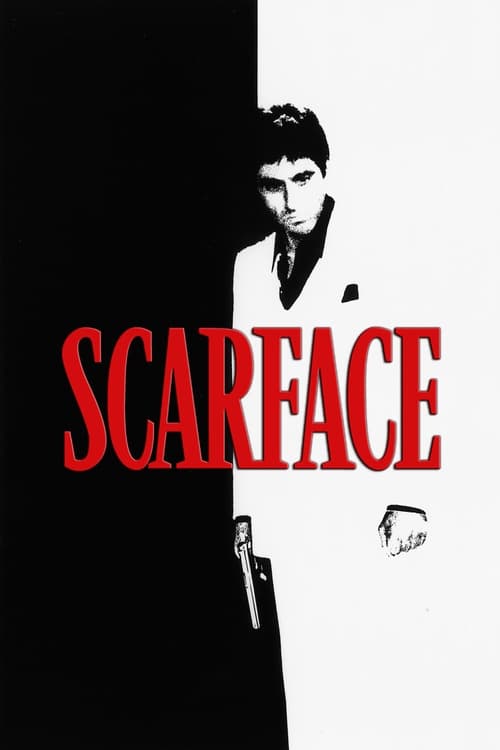
Scarface
1983 · Brian De Palma
When you want maximum intensity — a big, quotable, go-for-broke epic for a night when subtlety is the last thing on your list. A challenge in length and violence, but a wildly entertaining one.
What it's about
Tony Montana arrives in Miami from Cuba with nothing but ambition and nerve, and sets out to take over the city's cocaine trade by force. As the money, the mansion, and the paranoia pile up, he wages war on cartels, cops, and eventually everyone close to him — including his own family. It's the immigrant hustle pushed to its most violent, excessive extreme.
The experience
Loud, lurid, and operatic — nearly three hours of escalating appetite, profanity, and bloodshed that plays like a fever dream of the American Dream. It's exhilarating and repellent at once, and it doesn't do anything halfway.
Performances
Al Pacino goes all in as Tony Montana — a snarling, swaggering, completely uninhibited performance that became one of the most imitated and quoted in movie history.
The craft
Oliver Stone's script gives the rise-and-fall arc a savage political edge, and De Palma stages it with neon-and-pastel Miami excess, a throbbing synth score, and set pieces that keep topping themselves. Everything is deliberately too much — that's the point, and it hits hardest big and loud.
Why it matters
Dismissed by many critics on release, it was reclaimed as a cultural monument — embraced by hip-hop, endlessly quoted and postered, and now shorthand for the gangster epic of 1980s excess.
Snapshot
Scarface is Brian De Palma's lurid, operatic gangster epic, a loose updating of Howard Hawks's 1932 film of the same name that transplants the rise-and-fall arc of the immigrant criminal from Prohibition-era Chicago to cocaine-saturated Miami at the dawn of the Reagan decade. Written by Oliver Stone and produced by Martin Bregman, it stars Al Pacino as Tony Montana, a Cuban refugee who arrives in the 1980 Mariel boatlift and claws his way to the top of the Florida drug trade before his appetite, paranoia, and self-destruction bring the whole edifice down. Running nearly three hours and steeped in profanity, blood, and cocaine, the film was a critical pariah on release and a commercial modest-performer, only to be canonized over the following decades as a touchstone of excess — embraced by hip-hop culture, endlessly quoted, and reframed as a defining American immigrant fable turned inside out. It is at once a maximalist genre exercise, a moral cartoon, and a sincere tragedy, and its reputation rests on the productive tension among those registers.
Industry & production
The project originated with producer Martin Bregman, Pacino's longtime collaborator (Serpico, Dog Day Afternoon), who reportedly conceived a remake after Pacino saw the Hawks original and was struck by it. Bregman brought in Sidney Lumet to direct early on; Lumet's idea — to make the gangster a Cuban refugee and tie the story to contemporary drug politics and U.S. foreign policy — proved decisive, even though creative disagreements led to his departure. The script went to Oliver Stone, then a rising screenwriter who would soon win acclaim for his own directorial work; Stone has said he wrote much of the screenplay while himself trying to break a cocaine habit, and he conducted research into the Miami drug trade. De Palma came aboard as director, and Universal Pictures distributed.
The production was contentious on multiple fronts. The film's depiction of Cubans as drug criminals drew protest from Miami's Cuban-American community, and location shooting in Miami was curtailed; much of the film was ultimately shot in and around Los Angeles standing in for Florida. The budget rose to a then-substantial figure in the mid-tens of millions. The most public industry battle came with the MPAA ratings board, which initially assigned an X rating for violence and language; Bregman and the filmmakers appealed repeatedly, and after several submissions — and testimony from drug-enforcement experts that the film's brutality was realistic — it was released with an R. De Palma has claimed the version released was effectively close to an early submitted cut, a point that became part of the film's lore about institutional squeamishness.
Technology
Scarface was shot photochemically on 35mm anamorphic, exploiting the wide Panavision frame for its compositions of opulent interiors and Miami expanse. The production is a conventional early-1980s studio undertaking technologically — no significant optical or proto-digital innovation drives it — but it is notable for the scale of its practical effects work in the climactic assault on Tony's mansion, with extensive squib work, blood effects, and the famous grenade-launcher destruction staged in-camera. The film's sound was released in Dolby Stereo, and Giorgio Moroder's synthesizer-driven score reflects the era's embrace of electronic music production, situating the film sonically alongside the synth-pop and electronic dance culture of its moment rather than the orchestral traditions of earlier gangster pictures.
Technique
Cinematography
John A. Alonzo, an accomplished cinematographer (Chinatown), shot the film, and its visual signature is one of saturated, glossy color and controlled widescreen geometry. The palette runs to neon pinks, blues, and the white-on-white of Tony's later mansion, capturing both the tropical glare of Miami and the cold luxury of acquired wealth. Alonzo and De Palma exploit the anamorphic frame for the director's characteristic long takes and graphic compositions: balanced symmetries, deep-focus staging, and reflective surfaces. The visual scheme tracks Tony's ascent — early scenes in cramped, grimy spaces give way to the gilded, mausoleum-like emptiness of his fortified estate, the décor itself dramatizing the hollowness of his triumph. De Palma's signature mobile camera, including sweeping crane and Steadicam moves, lends set pieces an operatic sweep.
Editing
Jerry Greenberg and David Ray edited the film, which at roughly 170 minutes is deliberately expansive — a slow accumulation of episodes rather than a tightly compressed thriller. The pacing is part of the film's design: long stretches of escalating dialogue and confrontation punctuated by sudden, shocking bursts of violence. De Palma favors sustained scenes that build tension through duration — the early chainsaw sequence in the Sun Ray motel bathroom is a masterclass in withheld and displaced violence, much of the horror kept at the edge of frame or implied while the camera cranes away to the street. The climactic shootout, by contrast, is a prolonged crescendo, editing accumulating bodies and gunfire into a sustained delirium.
Mise-en-scène / staging
The film's production design (Ferdinando Scarfiotti served as visual consultant) is central to its meaning. Tony's world is a progression of spaces that externalize his psychology and the era's vulgar materialism: the refugee tent city under the highway, the gaudy nightclub Babylon, and above all the mansion with its surveillance monitors, mounted machine gun, and the now-iconic "The World Is Yours" blimp visible through the window — a globe-and-slogan motif that recurs as Tony's grandiose self-mythology and, finally, ironic epitaph. De Palma stages key scenes around these emblems; the mountain of cocaine on Tony's desk in the finale literalizes consumption as self-annihilation.
Sound
Giorgio Moroder's electronic score is one of the film's most distinctive and divisive elements — pulsing synthesizers and period source music that root the film firmly in 1983 rather than aiming for timelessness, including songs like "Push It to the Limit" and "Rush Rush." The aural texture of the film is also defined by Pacino's Cuban-inflected voice and the relentless, rhythmic profanity of Stone's dialogue, which functions almost musically in its repetition. The sound design heightens the violence — the whine of the chainsaw, the percussive gunfire of the finale — while Moroder's score lends even the brutality a propulsive, danceable sheen that complicates any straightforward moralism.
Performance
Al Pacino's Tony Montana is a deliberately large, theatrical performance — a calculated abandonment of naturalism in favor of operatic excess. Pacino, who reportedly worked extensively to develop the accent and physicality and immersed himself in the role to a degree that affected his health, builds Tony as a creature of pure appetite whose monstrousness is shadowed by a perverse code (his refusal to kill a target's children) and a childlike loyalty curdling into possessiveness. The supporting cast is essential: Steven Bauer as Manny Ribera, Tony's loyal friend; Michelle Pfeiffer in a breakout role as Elvira, the cocaine-numbed trophy wife whose brittle disgust mirrors the film's; Mary Elizabeth Mastrantonio as Tony's sister Gina, the object of his incestuous-tinged obsession; Robert Loggia as the boss Frank Lopez; and F. Murray Abraham as the treacherous Omar. The performances range register intentionally, with Pacino's maximalism setting the key.
Narrative & dramatic mode
Scarface follows the classical rise-and-fall structure of the gangster tragedy — the genre's foundational shape since the early 1930s. Tony arrives with nothing, ascends through ruthlessness and luck, overreaches, and is destroyed, in large part by the same hungers that propelled him. The dramatic mode is tragic but pitched toward the operatic and grotesque rather than the realist: Tony is both a fully embodied character and an allegorical figure, the American Dream's logic of more taken to a homicidal extreme. Stone's screenplay foregrounds the immigrant's-eye critique — Tony's belief that America is a place where a man with nerve can take what he wants is at once endorsed and indicted. The narrative is episodic and accretive, its dialogue confrontational and declamatory, and its moral architecture deliberately stark: there is no redemption, only the spectacle of a self consuming itself.
Genre & cycle
The film is a gangster picture in direct, self-conscious dialogue with the genre's history, explicitly a remake of Hawks's Scarface: The Shame of a Nation (itself drawn from the Al Capone myth and Armitage Trail's novel) and preserving structural echoes including the protagonist's incestuous fixation on his sister and the "X" motif of the original (transmuted here into recurring death imagery). It arrives within a broader cycle of late-1970s and 1980s gangster and crime films grappling with the long shadow of The Godfather (in which Pacino had defined a very different kind of criminal). Where Coppola's films offered elegiac restraint, Scarface offered maximalism and vulgarity — a deliberate counter-statement. It also belongs to the cocaine-era crime subgenre that the 1980s produced, anticipating and paralleling the decade's fascination with Miami, drugs, and excess (e.g., Miami Vice on television).
Authorship & method
Scarface is a genuinely collaborative authorship in which several strong sensibilities pull against one another. Brian De Palma, the director, brings his fascination with operatic violence, voyeurism, surveillance, and the long, choreographed set piece — the film fits his career-long interest in spectacle and excess, though it is less overtly Hitchcockian than his thrillers. Oliver Stone, the screenwriter, supplies the political anger, the immigrant-critique framework, and the percussive, profane dialogue, prefiguring the moral intensity of his own directorial career. Producer Martin Bregman and star Al Pacino were the project's driving engine, with Pacino's commitment shaping the entire enterprise around his central performance. Giorgio Moroder (composer) gives the film its electronic, of-the-moment sonic identity; John A. Alonzo (cinematographer) its glossy widescreen surface; editors Jerry Greenberg and David Ray its expansive rhythm; and visual consultant Ferdinando Scarfiotti its emblematic production design. The film's distinctive character comes precisely from the friction among De Palma's formalism, Stone's polemic, and Pacino's theatricality — no single author fully domesticates the others.
Movement / national cinema
Scarface is a mainstream American studio film and not the product of any organized film movement, but it can be read as a late, baroque outgrowth of the New Hollywood generation. De Palma, Stone, Pacino, and Bregman were all products of the 1970s American cinema that prized auteurist ambition within commercial forms, and the film carries that generation's appetite for moral seriousness and formal risk into the changed, more spectacle-driven climate of the 1980s. Its subject — the Mariel boatlift and Cuban-American Miami — ties it to a specific moment in U.S. immigration and Cold War history, though the film treats that context as raw material for myth rather than offering documentary fidelity, a choice that fueled the contemporary protests over its representation of Cubans.
Era / period
The film is saturated in its early-1980s moment: the Reagan-era ethos of wealth and acquisition, the explosion of the cocaine economy, the aesthetics of pastel Miami excess, and the synthesizer textures of period pop. It functions almost as a time capsule of 1983 — its fashions, its drug culture, its conspicuous consumption — while using that specificity to make a larger argument about capitalism and the American Dream. Set against the 1980 Mariel boatlift and the years following, it dramatizes a particular collision of immigration politics and the narcotics trade. Crucially, the film's period-bound surface, initially a liability that made it seem garish and dated, became an asset as the 1980s receded into nostalgia and the film's iconography acquired the patina of an era's defining image.
Themes
The film's central theme is the American Dream as a machine of self-destruction: Tony's literal-minded pursuit of "everything" — money, power, the woman, the world — reveals the dream's promise of limitless acquisition as a recipe for ruin. Allied themes include the immigrant's outsider hunger and resentment; the corrupting logic of capitalism, in which the drug lord is figured as an entrepreneur whose only sin is honesty about his appetites (Tony's restaurant tirade — "you need people like me" — voices the film's mordant thesis that the criminal merely enacts society's hidden values); loyalty and betrayal; and a recurrent, transgressive sexual undercurrent in Tony's possessive obsession with his sister Gina. Cocaine itself operates as the master metaphor — the substance that builds the empire and then, consumed without limit, dissolves the self. The recurring "The World Is Yours" slogan crystallizes the irony at the film's heart: the promise of total possession ending in a body face-down in a fountain.
Reception, canon & influence
On release in December 1983, Scarface was met with sharply divided and often hostile reviews. Many critics found it excessive, repugnant, overlong, and morally crude, recoiling from its violence and language; some, however, recognized its operatic ambition and Pacino's audacity. Notably, some figures in the film community defended it — the film acquired vocal admirers even amid the disdain. Commercially it performed respectably without being a blockbuster, and for some years it carried a reputation as a notorious, overheated misfire.
Influences on the film (backward): The most direct is Howard Hawks's Scarface (1932), from which it takes its title, structure, sibling-obsession motif, and rise-and-fall arc, ultimately deriving from the Al Capone legend via Armitage Trail's novel. Behind it stands the entire 1930s Warner Bros. gangster cycle (Little Caesar, The Public Enemy) that codified the immigrant-criminal tragedy. Sidney Lumet's early conceptual contribution — recasting the story around Cuban refugees and the contemporary drug trade — shaped the film's whole premise. And the long shadow of The Godfather, against which Scarface defines itself by sheer maximalism, is everywhere felt.
Legacy (forward): Scarface's afterlife dwarfs its initial reception. Through home video and cable it became a cult object and then a genuine cultural monument, embraced with particular intensity by hip-hop culture, where Tony Montana became an emblem of ambition, defiance, and self-made power; the film is referenced endlessly in rap lyrics, sampled, and quoted, and its imagery adorns posters and merchandise. Lines like "Say hello to my little friend" and "The world is yours" entered the common vocabulary. It reshaped the gangster genre toward a more excessive, materialist, and morally ambiguous register, influencing crime cinema and television (its Miami-drug-empire template echoes through later work) and informing the rise-and-fall narratives of subsequent films and series. It even generated a major video game adaptation and persistent remake talk. The film's critical standing rose accordingly, with many later reassessments treating it as a flawed but vital American epic — a case study in how a derided film can, through cultural adoption, become canonical. Its trajectory from pariah to icon is itself one of the more instructive reception histories in modern American cinema.
A Deleuzian reading
Start with the mountain.
The full Deleuzian reading of Scarface →
Reception
Critics in 1983 largely trashed it as vulgar, excessive, and morally bankrupt — Universal even fought the MPAA over its rating — but it was resurrected by hip-hop culture in the '90s and now sits comfortably in the gangster-movie canon.
How Scarface was received, from release to now →
Influences: the films it descends from and the films it influenced
- Scarface (1932) — The direct source De Palma remakes scene-for-beat: the rise-and-fall arc, the recurring X death-marker motif, and the incestuous sibling-protectiveness toward the sister that motivates the hero's final collapse.
- Little Caesar (1931) — Codified the immigrant-criminal tragedy structure Stone inherits — the gutter-to-penthouse ascent ending in a megalomaniac's solitary death ('Mother of mercy, is this the end of Rico?') mirrored in Tony's last stand.
- The Public Enemy (1931) — Established the displaced-violence grammar Scarface extends — brutality staged at the edge of frame or just off-screen (the breakfast grapefruit, the offscreen machine-gunning) so suggestion does the work of explicit gore.
- White Heat (1949) — Cagney's psychotic, mother-fixated gangster and his 'Top of the world!' immolation are the operatic-megalomania template behind Tony's coked-out 'world is yours' final apotheosis.
- The Godfather (1972) — The classical, restrained crime-as-family-tragedy epic that Scarface defines itself against by sheer maximalism — answering Coppola's burnished chiaroscuro and operatic gravity with garish excess and synthetic surfaces.
- Psycho (1960) — The Hitchcockian set-piece logic De Palma carries throughout — terror built through prolonged subjective suspense and a famously withheld/implied act of violence, the model for the chainsaw bathroom scene's offscreen dread.
- Midnight Express (1978) — Direct personnel lineage: an Oliver Stone screenplay scored by Giorgio Moroder, fusing Stone's individual-vs-monstrous-system rage with the synth idiom both honed on Midnight Express.
- The Untouchables (1987) — De Palma returns to the gangster genre carrying Scarface's method forward: the meticulously orchestrated showpiece (the Union Station staircase shootout) as the film's formal centerpiece.
- Carlito's Way (1993) — The De Palma–Pacino crime-tragedy reunion that inverts Scarface — same mobile-camera virtuosity and doomed-rise structure, but a reformed criminal pulled back down, climaxing in another bravura tracking set-piece.
- Wall Street (1987) — Stone transplants his Scarface screenplay's engine — the immigrant-hunger American-dream-as-self-destruction polemic — into finance, with 'Greed is good' as the boardroom echo of 'The World Is Yours.'
- Boogie Nights (1997) — Explicitly models its coke-binge-and-collapse third act and roving Steadicam excess on Scarface, even quoting its imagery, to stage another self-made empire dissolving in eighties drug paranoia.
- Blow (2001) — Adopts Scarface's cocaine-baron rise-and-fall template wholesale — the immigrant-outsider's hunger, the empire built on the eighties drug trade, the inevitable hubristic collapse.
- City of God (2002) — Carries forward the operatic gangster rise-and-fall and kinetic mobile-camera maximalism into the drug economy of Rio's favelas, staging criminal ascent as frenzied, stylized spectacle.
- True Romance (1993) — De Palma's maximalist staging of a man who builds his entire identity from B-movie archetypes — Tony Montana as self-assembled myth — shapes Tarantino's construction of Clarence, and the ensemble casting of recognizable actors in heightened genre roles establishes the density True Romance inherits.
- Mesrine: Public Enemy #1 (2008) — De Palma's staging of the protagonist's narcissistic self-presentation against environments that mirror his grandiosity — decor as index of hubris — structures Richet's treatment of Mesrine's escalating self-mythologization through disguises, hotel rooms, and staged media appearances.
- The Wolf of Wall Street (2013) — De Palma's criminal-rise-to-grotesque-spectacle picaresque is the formal DNA Wolf inherits and ironizes, replacing De Palma's operatic visual register with comedic vulgarity while preserving the excess-as-self-destruction arc and the immigrant striver's performance of wealth.
- Gomorrah (2008) — The negative model held up for critique: Gomorrah literally quotes Tony Montana as the aspirational fantasy that seduces and destroys the wannabe gangsters Marco and Ciro.
- King of New York (1990) — The operatic immigrant-outsider crime epic with synth-driven scoring and excess as moral statement, plus the antihero's delusion of building an empire on his own terms, a direct gangster-film forebear.
- Paid in Full (2002) — The canonical 1980s rise-and-fall drug epic structured as a moral ledger of appetite and collapse, whose operatic accumulation-then-ruin arc Paid in Full compresses and de-glamorizes.
- American Gigolo (1980) — Shares Giorgio Moroder's pulsing electronic score and the same glossy, materialist sheen — the synth-and-surfaces aesthetic that fixes both films to early-eighties consumerist sleekness.
- Thief (1981) — Contemporary crime film that, like Scarface, fuses neon-lit widescreen surfaces with a propulsive synthesizer score (Tangerine Dream) to render the criminal's world as cold electronic spectacle.
- Blow Out (1981) — De Palma's immediately prior film, exhibiting the same authorial signature applied to Scarface — choreographed long set-pieces, restless mobile/crane camerawork, and operatic build toward a single catastrophic climax.
- Goodfellas (1990) — Extends the maximalist, materialist gangster register Scarface opened — narcotic excess, cocaine-fueled paranoia, and the visceral rise-and-fall arc rendered through restless, mobile camera energy rather than Coppola's restraint.
- Casino (1995) — De Palma's jewel-saturated color design as signifier of criminal excess and costume-as-power-display — Montana's wardrobe charting his rise and vulgarization — runs parallel to Richardson's Casino palette strategy and Ace's wardrobe as compulsive self-documentation.
Similar films
- The Godfather (1972) — influence & lineage · same viewing thread
- GoodFellas (1990) — influence & lineage · often watched together
- Scarface (1932) — influence & lineage
- Carlito's Way (1993) — influence & lineage
- The Untouchables (1987) — influence & lineage
- Blow (2001) — influence & lineage
- The Godfather Part II (1974) — same viewing thread
- Casino (1995) — often watched together
All the films related to Scarface →
Watch it with: curated runs of related films
- Rise, Reign, and Ruin — Watch these together for the full arc of the self-made man — the hunger, the empire built on violence, and the rot that comes for whoever built it.