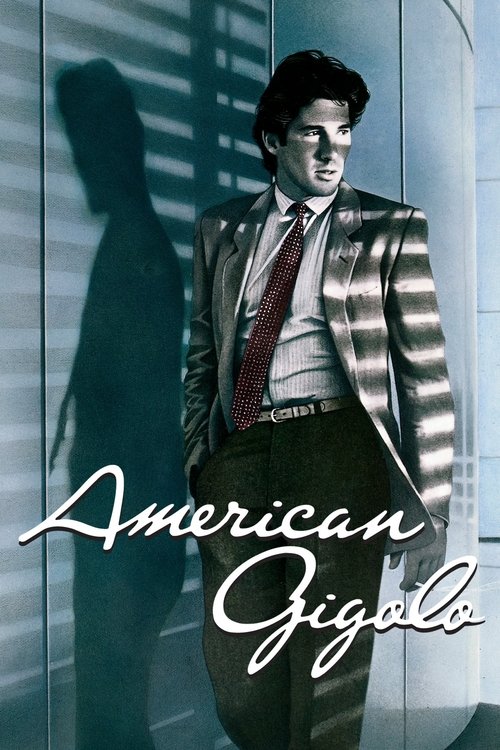
American Gigolo
1980 · Paul Schrader
For a late-night, moody watch when you want style, neon, and existential chill rather than jump-out-of-your-seat thrills — a film to sink into, not to grip your armrest through.
What it's about
Julian Kay is a high-end male escort in Los Angeles who services wealthy older women and treats his body, his wardrobe, and his taste as a professional instrument. He starts an unpaid, genuinely felt affair with a politician's wife — and then one of his clients turns up murdered, a detective starts circling, and Julian realizes the polished world he's built offers him no alibi and no friends.
The experience
Cool to the touch: sleek, deliberate, hypnotic, more interested in surfaces and solitude than in thriller mechanics. The tension is less whodunit than watching a man's immaculate life get peeled away layer by layer, and the ending lands somewhere unexpectedly tender.
Performances
Richard Gere, in the role that made him a star, gives a fearless, physically exposed performance — vain, controlled, and then quietly desperate as the control fails. Lauren Hutton brings real warmth to what could have been a decorative part.
The craft
Paul Schrader turns a murder plot into a study of surface and self-display: gliding camerawork, immaculate interiors, and the Armani wardrobe that practically launched a fashion era. Giorgio Moroder's pulsing electronic score — with Blondie's "Call Me" as its anthem — gives the whole film its cool, cruising rhythm. It rewards a good sound system and a dark room.
Why it matters
It made Richard Gere a star, put Giorgio Armani on the American map, and set the visual and musical template for the glossy, morally ambivalent LA noir of the 1980s.
Snapshot
American Gigolo is Paul Schrader's third film as director and the work in which his recurring figure — the alienated man alone in a sealed room, narrating his own damnation toward an unexpected grace — migrated from the grimy night world of Taxi Driver (which Schrader scripted) into the chrome, glass, and tailored wool of late-1970s Los Angeles affluence. Julian Kay (Richard Gere) is a high-end male escort who services wealthy older women, prides himself on his craft and his refinement, and is then framed for the murder of a client. The plot is nominally a neo-noir thriller, but Schrader treats the mystery as a vehicle for a spiritual and erotic study of surface, commodity, and self-display. The film is now remembered less for its whodunit mechanics than for three things: it made Richard Gere a star, it made Giorgio Armani a household name in America, and it fused Giorgio Moroder's pulsing synthesizer score to a glossy consumer surface in a way that helped set the visual and sonic template for the decade that followed.
Industry & production
The film was produced by Paramount Pictures, with Freddie Fields producing and a young Jerry Bruckheimer among the production team — years before the Simpson/Bruckheimer high-concept blockbuster machine. Its casting history is among the most-cited in the period. John Travolta, then at the height of his post-Saturday Night Fever / Grease stardom, was originally attached to play Julian; he departed before production, and the much less established Richard Gere stepped in. Various accounts attribute Travolta's exit to script and scheduling friction and to discomfort with the role's nudity and sexual content; because the principals have told the story in differing ways over the years, the precise cause is genuinely contested, and it is safest to say only that Travolta left and Gere replaced him. The substitution proved decisive: Gere, who had drawn notice in Looking for Mr. Goodbar (1977) and Days of Heaven (1978), became a leading man on the strength of Julian.
The production's most consequential industrial fact is its costume sourcing. Schrader and the filmmakers turned to Giorgio Armani to dress Gere, and the film functioned as an extended showcase for Armani's softly tailored, unstructured menswear. The collaboration is routinely credited as the breakthrough that established Armani in the American market and as a landmark in the relationship between Hollywood and the fashion industry — the moment film costume became overt designer branding. The film's commercial life was buoyed by its soundtrack: the Blondie single "Call Me," written by Moroder with Debbie Harry, became a major chart hit and one of the defining singles of 1980, giving the film a cross-promotional reach beyond the theater.
Technology
American Gigolo is a conventional 35mm anamorphic-era production rather than a technical experiment, and its innovations are aesthetic rather than mechanical. The most forward-looking technological element is its music: Moroder, fresh from his pioneering electronic work on Donna Summer's "I Feel Love" and the score for Midnight Express (1978), built the film's sound around sequenced analog synthesizers and drum-machine pulse. That choice — scoring an American crime drama almost entirely with electronics rather than an orchestra — was still novel in 1980 and pointed directly toward the synth-driven screen and television aesthetics of the mid-decade. Beyond the score, the film's "technology" is really the technology of consumer surfaces: hi-fi, designer clothing, modernist architecture, and automobiles deployed as signifiers of a commodified self.
Technique
Cinematography
The photography is by John Bailey, for whom American Gigolo was an early and career-defining feature (Bailey would go on to a long, distinguished career and eventually the presidency of the Academy of Motion Picture Arts and Sciences). Bailey's images are cool, controlled, and architectural: hard reflective surfaces, pastel and desaturated palettes, light sliced by blinds and bounced off glass. The visual scheme deliberately flattens and beautifies, rendering Julian's world as a series of elegant, depthless planes that mirror his own cultivated surface. The camera frequently isolates Gere within geometric architecture, and the film's sense of glamour is achieved less through movement than through composition, color, and the luxe finish of the lighting.
Editing
The film was cut by Richard Halsey (an Oscar winner for Rocky). The editing is largely classical and unhurried, allowing scenes of dressing, driving, and waiting to breathe — the rhythm of a man who lives by performance and self-maintenance. The most discussed editorial passage is the famous sequence in which Julian lays out shirts, ties, and jackets across his bed, sorting his wardrobe to Smokey Robinson's "The Love I Saw in You Was Just a Mirage." Here cutting, music, and gesture combine into a near-musical interlude that defines the character entirely through objects and grooming, with no expository dialogue.
Mise-en-scène / staging
The decisive creative hand on the film's look belongs to Ferdinando Scarfiotti, the Italian production designer (credited as visual consultant) celebrated for his work with Bernardo Bertolucci on The Conformist (1970) and Last Tango in Paris (1972). Scarfiotti imported the cool, painterly, modernist surface of European art cinema into a Los Angeles setting, and Schrader has repeatedly credited him as central to the film's visual identity. The staging emphasizes emptiness and design: spare apartments, glass-walled houses, hotel corridors, and showrooms in which human figures are arranged like elements of a composition. Clothing, furniture, and architecture do the work of characterization. The result is a mise-en-scène of beautiful alienation, where the protagonist's environment is as polished, expensive, and emotionally vacant as the persona he sells.
Sound
Moroder's electronic score is the film's sonic signature — a propulsive, synthetic pulse that lends even quiet scenes a glassy unease and gives the murder-thriller plot a sleek momentum. The integration of the Blondie title song with the underscore knits the film's sound design to the pop marketplace. Diegetic music (notably the Smokey Robinson cue) is used pointedly, and the overall sound world favors smoothness and cool over the rough naturalism of much 1970s American cinema.
Performance
Gere's Julian is built from poise and physical self-regard: a performance of surfaces that gradually cracks to reveal panic and need. The role asked for confidence, vanity, and eventual vulnerability, and Gere's willingness to be objectified — to be looked at as Julian's clients look at him — is part of the film's argument. Lauren Hutton plays Michelle, the politician's wife whose love finally redeems him; her warmth provides the human counterweight to Julian's armored cool. Hector Elizondo brings dry, watchful intelligence to Detective Sunday, Bill Duke is menacing as the pimp Leon, and Nina van Pallandt plays the madam Anne. The supporting performances are calibrated to the film's restrained register.
Narrative & dramatic mode
Structurally the film borrows the machinery of detective fiction — a murder, a frame-up, an investigation, a protagonist who must clear himself — but Schrader subordinates suspense to character study and moral allegory. The dramatic mode is interior and confessional: Julian is a man defined by control who is slowly stripped of it, forced from self-sufficiency into dependence. The investigation functions less to generate thrills than to dismantle Julian's illusion of autonomy, exposing how completely his identity is bound to his clientele and his image. The climax is explicitly redemptive rather than procedural. Schrader has openly modeled the ending — Michelle declaring her love and providing the alibi that frees him, Julian pressing his face to the glass of the prison visiting room — on the conclusion of Robert Bresson's Pickpocket (1959), in which a thief finds grace through a woman's love across the bars of a cell. The thriller's resolution is thus reframed as a spiritual deliverance.
Genre & cycle
The film sits at a hinge point in American genre history. It is a neo-noir — a tale of a glamorous loner ensnared by a femme/homme fatale dynamic, a frame-up, and a corrupt night world — but rendered in sun-bleached, designer-clad color rather than shadow. More importantly, it is widely regarded as a foundational text of the 1980s erotic thriller, anticipating the genre's fusion of sex, money, murder, and gloss that would flower in films like Body Heat (1981) and, later, the Joe Eszterhas–scripted cycle. Its glossy treatment of crime, fashion, and electronic music also prefigures the look of Miami Vice and a broader 1980s visual culture.
Authorship & method
American Gigolo is a quintessential Schrader film, written and directed by him and continuous with his obsessive central subject: the lonely, self-punishing man who keeps a journal of his isolation, lives in an austere room, and seeks transcendence through suffering — the "man in his room" Schrader traces from Bresson and Dostoevsky through Taxi Driver, Light Sleeper (1992), and First Reformed (2017). Schrader, raised in a strict Calvinist household and the author of the scholarly study Transcendental Style in Film: Ozu, Bresson, Dreyer (1972), here works his theological preoccupations — sin, grace, the impossibility of self-redemption — into the body of a sleek L.A. thriller.
His key collaborators shaped the film decisively. Ferdinando Scarfiotti's visual design supplied the European-modernist surface. John Bailey's cinematography translated that design into cool, reflective light. Giorgio Moroder's electronic score gave it a contemporary pulse and a hit single. Richard Halsey's editing set its unhurried rhythm. And Giorgio Armani's wardrobe turned the protagonist's clothing into a co-author of meaning. The film is a striking instance of a personal, almost ascetic authorial vision realized through, and partly in tension with, the most luxurious commercial surfaces available.
Movement / national cinema
The film belongs to American cinema's transition out of the gritty, character-driven "New Hollywood" of the 1970s and into the gloss of the 1980s. Schrader is a New Hollywood figure — a film-school-and-criticism intellectual turned screenwriter-director — but here he is plainly importing the European art film into Hollywood: Bresson's spiritual narrative architecture and the Italian visual sensibility of Scarfiotti and Bertolucci's cinema. The result is a hybrid: an American genre picture carrying the formal and theological DNA of post-war European modernism.
Era / period
Released in February 1980, the film is a precise document of its cultural moment — the threshold between the disco-era hedonism of the late 1970s and the conspicuous consumption of the Reagan 1980s. Its preoccupation with designer labels, body maintenance, real estate, and self-as-product captures the dawn of yuppie consumer culture and the commodification of identity. Made before the AIDS crisis reshaped American attitudes toward sex, it treats its world of paid intimacy with a glossy frankness that the rest of the decade would complicate.
Themes
The film's governing themes are commodification and the self-as-surface: Julian sells intimacy as a luxury good and has so thoroughly merchandised himself that he scarcely possesses an interior. Schrader links this to vanity and narcissism — the endless grooming, the wardrobe ritual, the man who is constantly looked at — and to alienation, the loneliness beneath the beautiful exterior. Running beneath the secular plot is Schrader's persistent theological structure: pride, isolation, the inability to accept love, and finally grace arriving from outside the self through another's sacrifice. The film also explores the inversion of the erotic gaze, deliberately positioning a male protagonist as the desired, objectified body, and it interrogates how class, money, and appearance constitute identity in late-capitalist Los Angeles.
Reception, canon & influence
On release the film was a commercial success and a cultural event, propelled by Gere's emergence, the Armani phenomenon, and the ubiquity of "Call Me." Critical reception was more divided: reviewers admired its style, atmosphere, and Moroder's score while some found it cold, hollow, or morally evasive — a debate over whether the film's glossy emptiness was a critique of surfaces or merely an indulgence in them. That very coolness is now often read as the point, and the film's critical standing has risen as Schrader's career-long spiritual project has come into clearer focus.
Looking backward, the film's influences are explicit and acknowledged: Bresson's Pickpocket for its redemptive ending and ascetic protagonist; Schrader's own Taxi Driver for the diaristic lonely man; the Italian art cinema of Bertolucci and Scarfiotti for its visual surface; and film noir for its frame-up structure. Looking forward, its legacy is substantial. It launched Richard Gere's stardom and globalized Armani's brand, cementing the modern alliance of cinema and designer fashion. Its marriage of synthesizer score, fashion-plate cinematography, and crime narrative helped define the 1980s aesthetic that would crystallize in Miami Vice and the era's music-video culture. It is frequently named a progenitor of the 1980s–90s erotic thriller. And within Schrader's own filmography it stands as the central panel of his "man in his room" cycle, a direct thematic forebear of Light Sleeper and First Reformed — the film in which his austere moral cinema first put on a beautiful suit.
A Deleuzian reading
A man lays clothes on a bed.
The full Deleuzian reading of American Gigolo →
Reception
Critics in 1980 were lukewarm — too cold, too glossy — but it was a hit, and it's since been reappraised as a key text of 80s style and the start of Schrader's 'man in his room' cycle it shares with Taxi Driver and Light Sleeper.
How American Gigolo was received, from release to now →
Influences: the films it descends from and the films it influenced
- Pickpocket (1959) — Schrader lifts the redemptive jail-cell coda — love arriving through a barrier as unearned grace ('the way I had to take to reach you') — and the ascetic, ritual-handed protagonist almost beat-for-beat as his stated transcendental-style template.
- Diary of a Country Priest (1951) — Supplies the diaristic first-person voiceover of an isolated man chronicling his own spiritual suffering — the journal-of-isolation device Schrader installs in every 'man in his room.'
- Taxi Driver (1976) — Schrader's own earlier script established the lonely self-punishing diarist; Gigolo transposes Travis's notebook and mirror-monologue into Julian's reflective surfaces and confessional narration.
- The Conformist (1970) — Schrader directly imported its visual author, Ferdinando Scarfiotti, whose cold modernist-deco architecture and fascist-era surfaces become Gigolo's European production-design skin.
- L'Eclisse (1962) — Models the emptied modernist interior and reflective architectural void as an expression of erotic anomie — the alienation-amid-luxury-surface grammar Schrader names as his art-cinema import.
- Out of the Past (1947) — Provides the noir frame-up engine — a fatalistic loner set up for a murder he didn't commit — that Schrader, author of 'Notes on Film Noir,' grafts onto the gigolo's downfall.
- La Dolce Vita (1960) — Schrader transplants La Dolce Vita's passive male protagonist adrift in glamorous social surfaces to Los Angeles, using lateral tracking shots through party environments and Giorgio Moroder's synthesizer score in an ironic-commentary function directly modeled on Rota — music that aestheticizes the milieu while simultaneously draining it of meaning.
- Midnight Express (1978) — Moroder carries the Midnight Express synth idiom into a glossy contemporary thriller, consolidating the pulsing electronic sound as a marketable signature.
- First Reformed (2017) — The most distilled transcendental-style entry of the same 'man in his room' — bare room, voiceover diary, withheld-then-granted grace — that Gigolo first dressed in couture.
- Body Heat (1981) — Revives the noir frame-up as a sweat-and-skin erotic thriller, taking up the exact genre lineage Gigolo is credited with reopening for the 1980s.
- Miami Vice (1984) — Codifies Gigolo's marriage of synthesizer score, pastel fashion-plate cinematography, and crime plot into a TV grammar — the aesthetic the film is most directly named as seeding.
- To Live and Die in L.A. (1985) — Inherits the synth-scored (Wang Chung), high-gloss Los Angeles neo-noir surface and fashion-conscious criminal cool, framing a loner inside reflective sun-and-neon imagery.
- Basic Instinct (1992) — The full flowering of the glossy erotic thriller — sleek surfaces, sex, and homicide investigation — whose progenitor Gigolo is routinely named.
- American Psycho (2000) — Pushes Gigolo's commodification and designer-branding-as-self to satire — Armani, business cards, and skincare ritual standing in for identity in the objectified consuming male.
- A Single Man (2009) — Carries the Armani-as-co-author logic to its endpoint: a literal fashion auteur turning immaculate commodified surfaces and a beautifully-suited grieving man into the film's primary meaning.
- Drive (2011) — Reassembles the Gigolo kit — Cliff Martinez synth score, neon-reflective L.A. night, and a near-silent loner whose scorpion jacket functions as Julian's Armani — around the same redemptive-violent arc.
- Risky Business (1983) — Moroder's sequencer pulse married to designed, reflective surfaces — mirrors, glass, laid-out merchandise — so that the score and the décor together state the film's thesis that a young man's body and taste are inventory.
- Light Sleeper (1992) — Explicit continuation of the cycle: a nocturnal courier keeping a journal in an austere apartment, walking the identical redemptive-confessional arc toward grace through another's hand.
- The Card Counter (2021) — Repeats the ascetic ritualist in a stripped room narrating a penitential journal, extending Julian's self-punishing-monk-in-a-thriller structure.
- Thief (1981) — Pairs a Tangerine Dream synth pulse with rain-slicked reflective night surfaces and a taciturn professional loner — the Moroder-score/Bailey-light template running in parallel.
- Ordinary People (1980) — John Bailey's cinematography here supplies the same cool, ordered, controlled surfaces — composed light over emotional refrigeration — that he brings to Ordinary People the same year.
- Scarface (1983) — Shares Giorgio Moroder's pulsing electronic score and the same glossy, materialist sheen — the synth-and-surfaces aesthetic that fixes both films to early-eighties consumerist sleekness.
Similar films
- American Psycho (2000) — influence & lineage
- Basic Instinct (1992) — influence & lineage
- Thief (1981) — influence & lineage
- Dressed to Kill (1980) — shared sensibility
- The Long Goodbye (1973) — shared sensibility
- Body Double (1984) — shared sensibility
- Le Samouraï (1967) — shared sensibility
- The Bird with the Crystal Plumage (1970) — shared sensibility