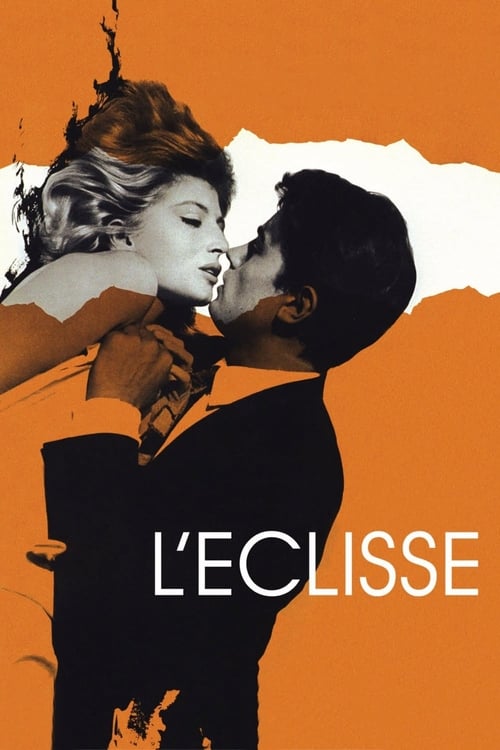
L'Eclisse
1962 · Michelangelo Antonioni
For when you want a film to chew on for days, not a plot to follow — a late-night, phone-off watch for a contemplative frame of mind. This is challenge, not comfort, and it rewards patience richly.
What it's about
In early-sixties Rome, Vittoria, a young literary translator, ends a long relationship with a writer and drifts through a city of new money and modern apartments. On the frantic floor of the stock exchange — where her mother gambles her savings — she meets Piero, a young stockbroker who moves as fast as the market. Their tentative affair plays out between his world of ringing phones and hers of quiet unease, two people circling each other without quite connecting.
The experience
Slow, cool, and hypnotic — less a story than a mood you inhabit. It works on you like the hour before a storm: beautiful, unhurried, and quietly unsettling, with images that stay in your head long after you've forgotten what anyone said.
Performances
Monica Vitti is extraordinary — restless, watchful, radiating an unease she never has to explain — and Alain Delon's glossy charm as Piero is used with real precision: you see exactly why she's drawn to him and why it can't be enough.
The craft
Antonioni composes in stark black and white like an architect, placing people against blank walls, half-built suburbs, and glass towers until the spaces say what the characters can't. The stock-exchange sequences are astonishing bursts of noise and bodies, and the film's famous final minutes are among the most daring and most analyzed in all of cinema.
Why it matters
The closing panel of Antonioni's celebrated trilogy on modern alienation, it won the Special Jury Prize at Cannes and redrew the boundaries of what a film could do without conventional storytelling, influencing generations of slow, image-driven cinema.
Snapshot
The third and most severe panel of Antonioni's alienation trilogy — following L'Avventura (1960) and La Notte (1961) — L'Eclisse tracks a Roman woman through the dissolution of one love affair, the tentative beginning of another, and the eventual disappearance of both. Its last seven minutes, in which neither protagonist shows up to a promised meeting and the camera catalogs familiar locations now drained of human presence, constitute one of cinema's most analyzed passages and a formal declaration that narrative cinema could end not with resolution but with absence. The film won the Special Jury Prize at Cannes in 1962.
Industry & production
L'Eclisse was a Franco-Italian co-production between Interopa Film (Rome) and Paris Film Production; producers Robert and Raymond Hakim underwrote a budget that allowed Antonioni his characteristic unhurried schedule and facilitated the casting of Alain Delon, then at his commercial peak following Rocco e i suoi fratelli (Visconti, 1960) and Plein soleil (Clément, 1960). The French-Italian axis was commercially motivated — Delon's marquee value opened French distribution — but Antonioni absorbed the pairing into the film's thematic architecture: Piero's Roman volatility and Vittoria's untethered interiority are partly coded as cultural temperamental distances that money cannot bridge. Monica Vitti, Antonioni's companion and the defining presence of his major period, returned in her third consecutive lead role for the director; by L'Eclisse the Vitti-Antonioni collaboration had developed its own grammar of hesitation, drift, and interrupted gesture. The screenplay was developed by Antonioni alongside Tonino Guerra (his primary literary collaborator across much of the 1960s), Elio Bartolini, and Ottiero Ottieri. The Rome locations were selected with architectural precision: Vittoria's neighborhood was filmed almost entirely in EUR (Esposizione Universale Roma), the rationalist district designed under Mussolini for a 1942 world's fair that never materialized, its wide avenues and geometric facades lending the film its atmosphere of depopulated modernity.
Technology
Gianni Di Venanzo shot the film in high-contrast 35mm black and white, using lenses and lighting ratios that sharpened the orthogonal geometry of EUR into something approaching Giorgio De Chirico's Piazze d'Italia paintings — sun-bleached masonry, ink-black shadows, a vacancy that feels willed rather than accidental. Di Venanzo, who had shot Fellini's 8½ (1963) and would return for Antonioni's Il deserto rosso (1964) in color, was at the height of his technical command; his work on L'Eclisse is regularly cited as a masterclass in using deep-focus and foreground-background separations to convey emotional distance without recourse to conventional close-up psychology. The Stock Exchange sequences required coordination with the Borsa Valori in Rome, filming among actual traders, and Di Venanzo's fluid handheld work in those scenes forms a deliberate contrast with the locked, architecturally fixed compositions that dominate the rest of the film.
Technique
Cinematography
Di Venanzo's visual approach operates through a consistent grammar of negative space and geometric containment. Characters are habitually framed against walls, windows, or reflective surfaces that subdivide the image — Vittoria viewed through a car window while Piero is outside it, or isolated in the vast EUR plaza with the receding colonnade reducing her to a figure in an abstract plan. The EUR sequences exploit the district's inhuman scale: roads designed for processions dwarf the actors, and Di Venanzo shoots from angles that emphasize the grid over the figure. In contrast, the interior scenes — the all-night breakup with Riccardo, the apartment conversations — are shot in closer quarters where objects (a fan, a framed picture face-down, a half-drunk coffee) receive the same careful attention as faces. Light in EUR tends toward harsh, declarative sunshine; light in interiors is more uncertain, suggesting enclosure without comfort.
Editing
The editing, credited to Eraldo Da Roma (Antonioni's regular collaborator across this period), is defined by what it refuses: conventional shot-reverse-shot structures that might assign clear emotional valence to exchanges are systematically avoided in favor of extended single-take coverage or cuts that land in the wrong dramatic place — after a line rather than on it, or with a beat of dead time held past comfort. The "dead time" principle — shots sustained after the narratively meaningful action has concluded, watching a character stand or drift — derives from Antonioni's conviction that cinema's conventional elision of duration falsifies psychological experience. The result is a rhythm that feels almost geological in its patience.
Mise-en-scène / staging
Antonioni's staging throughout consistently undermines conventional romantic syntax. Piero and Vittoria rarely share an axis that straightforwardly codes desire; their approach-and-retreat choreography is interrupted by her attention to objects, animals, or architecture. The Borsa sequence introduces a symbolic counterpoint to intimacy: the frenetic collective body of traders, surging and shouting, a communal organism driven by pure appetite, against which Vittoria is isolated and observant. Most striking is the African interlude in Marta's apartment, where Vittoria dresses in garments from a Kenya photo collection and dances to records — a sequence that has attracted postcolonial critical attention for the casual colonial nostalgia it stages without obvious authorial irony, and which remains genuinely difficult to resolve in contemporary viewing. The film does not frame it critically; whether Antonioni intended ambiguity or simply reproduced the unreflective attitudes of his milieu is a matter the scholarly record has not settled with confidence.
Sound
Giovanni Fusco's score (the composer who provided Antonioni's musical environment from Cronaca di un amore through this trilogy) is characteristically spare: individual instruments, modal harmonies, silences treated as compositional material equal to sound. The Stock Exchange sequences use ambient noise — the roar of trading — as something close to scored texture. Elsewhere, environmental sound is selectively heightened: the creak of an apartment, traffic filtered through glass, a sprinkler in EUR. The famous final sequence is almost entirely without musical underscore, relying on ambient nighttime city sound, which deepens its quality of depopulation.
Performance
Vitti's performance is the most physically mobile and tonally varied of her Antonioni collaborations — less the frozen, stunned figure of L'Avventura than a woman briefly animated by erotic interest before the animation drains away. Her laughter with Piero in the early courtship is genuinely light, which makes the subsequent emotional retraction feel less like character pathology than a kind of meteorological shift. Delon, in one of his few art-cinema ventures, is convincing in his animal confidence and more limited in conveying interiority — a casting choice that may be partly strategic: Piero's opacity is the condition of his appeal and the reason for his disappearance. Francisco Rabal as Riccardo is present only at the opening, but his performance encodes the entire preceding relationship: a man who has argued himself into an understanding of love that Vittoria can no longer share.
Narrative & dramatic mode
L'Eclisse operates by systematic de-dramatization. The breakup with Riccardo that would anchor a conventional melodrama is placed before the opening titles, already exhausted; we arrive at the aftermath. The courtship with Piero proceeds through a series of scenes that substitute gesture and spatial arrangement for declaration. The film never dramatizes the emotional crisis it is about — the incapacity to sustain feeling — because dramatization would betray it. Its most radical formal decision is structural: the narrative simply stops without concluding, the camera wandering the intersection where Vittoria and Piero agreed to meet as dusk falls and neither appears, familiar objects (a barrel, a section of fence) returning as fragments, strangers moving through the frame, and finally a streetlamp igniting in the dark. The eclipse of the title, mentioned in passing dialogue, has generally been read as the obliteration of connection under the historical weight of the early 1960s — nuclear anxiety, the anomic expansion of postwar capitalism — though Antonioni resisted programmatic interpretation.
Genre & cycle
The film belongs to what has been retrospectively consolidated as European modernist art cinema: a mid-century cycle (roughly 1959–1967) in which the inherited forms of melodrama, comedy, and social realism were subjected to systematic deformation in the work of Antonioni, Godard, Resnais, Bergman, and Tati, among others. In Italian terms, L'Eclisse continues the divergence from neorealism's social reportage toward an internalized, affective cinema more concerned with psychological atmosphere than social documentation. The alienation trilogy as a whole constitutes perhaps the most sustained formal argument within that cycle: three films that take the failure of bourgeois romantic love as both subject matter and structural principle.
Authorship & method
Antonioni's method was famously process-oriented: locations were chosen before shooting scripts were finalized, and spatial relationships discovered on-site regularly reshaped scenes. He described the director's task as finding what the film wanted to become rather than executing a predetermined plan. His collaboration with Di Venanzo (replacing L'Avventura's cinematographer Aldo Scavarda) deepened the visual strategy established in the first two trilogy films: Di Venanzo's technical precision gave Antonioni the ability to execute extremely controlled geometric compositions without sacrificing the film's quality of open, exploratory attention. Tonino Guerra's contribution to the screenplay brought a poet's economy to the dialogue, which tends toward ellipsis and the deliberately incomplete sentence. The director's relationship with Vitti — both personal and professional, beginning in 1957 — gave her performances in his films an intimacy of communication that later collaborators have noted as essentially irreplicable: she understood what he was looking for at an intuitive level that reduced the need for explicit direction.
Movement / national cinema
L'Eclisse is a central text of Italian modernist cinema and of the broader European art cinema that Italian critics and festivals had done much to institutionalize by 1962. It is positioned against but not entirely free of neorealism: the film uses actual locations and non-studio spaces with neorealist fidelity, but empties them of social specificity in favor of psychological and metaphysical register. The EUR sequences engage, at least obliquely, with the postwar Italian economic miracle and its spatial expression — rationalist architecture initially built for Fascist pageantry repurposed into middle-class residential modernity — though the film does not pursue explicit social critique in the manner of, say, Visconti.
Era / period
The film was made and set at the apex of the Italian economic boom (il miracolo economico), the years of rapid industrialization and consumer expansion that transformed Italian society between roughly 1958 and 1963. The Stock Exchange sequences register this context directly: the Borsa is the film's most energetic and least sympathetic space, its collective fever of speculation an index of the period's confusion of desire with liquidity. The ambient texture of early-1960s Rome — light suits, Vespas, the specific look of EUR's unfinished modernism — grounds the film historically even as its concerns are resolutely ahistorical in ambition.
Themes
The primary thematic concern is the failure of emotional duration: not romantic disappointment in the conventional sense, but the incapacity to hold feeling in place long enough for it to become what one hoped it would be. This is connected throughout to the film's spatial argument: EUR's inhuman scale, the Stock Exchange's collective hysteria, the apartment interiors that enclose without sheltering. A secondary current runs through the film's relationship to visibility — Vittoria observes, photographs, watches through windows, while Piero operates entirely on the surface of things. The title's eclipse functions as a figure for the moment when one thing passes in front of another and briefly cancels it: Vittoria's desire briefly eclipses her habitual withdrawal, and then the eclipse passes. Nuclear anxiety is a recurrent minor key — characters mention Hiroshima, newspaper headlines appear in the closing sequence — adding an eschatological undertone to the more intimate emotional register.
Reception, canon & influence
Critical reception: The Special Jury Prize at Cannes 1962 confirmed Antonioni's standing as one of world cinema's major figures, though critical response to the film's radical finale ranged from reverent to baffled. Subsequent decades have been consistently generous: the film ranks among Antonioni's three or four most discussed works, and its closing sequence has been cited by critics including Seymour Chatman, Peter Brunette, and Laura Mulvey as a touchstone for understanding modernist cinema's relationship to narrative closure.
Influences on the film: The neorealist tradition provides the location practice and the commitment to duration; Bresson's elliptical dramaturgy — the removal of explanatory glue between scenes — is a visible structural influence; De Chirico's metaphysical painting offers an iconographic model for the EUR sequences. The existentialist intellectual climate of postwar Europe (Camus, Sartre, and the Italian tradition of Cesare Pavese and Alberto Moravia, several of whose novels of alienated urban life precede and parallel the film) provides a philosophical atmosphere without direct textual influence.
Legacy: The closing sequence has exerted influence difficult to overstate. Terrence Malick's sustained attention to spaces between events, Wong Kar-wai's use of architecture and city as emotional residue, and Sofia Coppola's Lost in Translation (2003) — which inherits Antonioni's device of protagonists failing to fully arrive at each other — all register the film's formal discoveries. Godard's engagement with Antonioni throughout the 1960s (particularly in 2 ou 3 choses que je sais d'elle, 1967) and the Brazilian Cinema Novo's interest in Antonionian spatial detachment both acknowledge the film's reach. More broadly, the permission L'Eclisse extends to narrative cinema — to end on absence rather than resolution, to treat duration as meaning rather than packaging — remains among the most consequential formal gifts of postwar European cinema.
A Deleuzian reading
A streetlamp comes on in the dark, and the film is over.
The full Deleuzian reading of L'Eclisse →
Reception
Divisive on release — it won the Special Jury Prize at Cannes in 1962 while plenty of critics dismissed it as chic tedium, the height of what detractors mocked as Antonioni's fashionable ennui. Now it's widely regarded as the peak of his alienation trilogy, a fixture of greatest-films polls and the one cinephiles increasingly call his masterpiece.
How L'Eclisse was received, from release to now →
Influences: the films it descends from and the films it influenced
- Cronaca di un amore (1950) — Antonioni developed his signature mobile tracking shot here — a camera that follows characters through space rather than cutting to privileged dramatic moments — inventing the choreographic grammar of bodies and empty urban intervals that L'Eclisse's negative-space framing and dead-time staging directly inherit.
- Umberto D. (1952) — De Sica's extended maid-waking sequence — pure non-event filmed at full duration without narrative justification — established the Italian neorealist permission to let quotidian time accrue meaning through accumulated detail rather than plot function, the structural foundation for L'Eclisse's dead-time editing philosophy.
- Journal d'un curé de campagne (1951) — Bresson's elliptical scene construction — cutting between states without bridging explanation, forcing the viewer to supply the elided connective tissue — directly influenced L'Eclisse's between-scene gaps; the dossier identifies this as the structural model for Antonioni's de-dramatized transitions.
- L'Avventura (1960) — The first film of the trilogy establishes the open-ended narrative structure (a disappearance never resolved), anti-shot-reverse-shot conversation staging, and the spatial alienation of bodies marooned in landscape that L'Eclisse inherits and concentrates into the EUR sequences and closing seven-minute absence.
- La Notte (1961) — The immediate predecessor in the trilogy develops the Vitti performance mode — physical withdrawal coded as emotional truth — and the use of modern architecture (Milan's new-build periphery) as emotional cartography; L'Eclisse refines both devices, replacing Milanese glass towers with Rome's EUR rationalist grid.
- Hiroshima mon amour (1959) — Resnais systematically dismantles shot-reverse-shot grammar through temporal layering and withholds the establishing shot as an ideological act; the film's structural embedding of nuclear catastrophe as an unspeakable off-screen presence directly precedes L'Eclisse's anti-shot-reverse-shot editing and its use of nuclear anxiety as formal rather than merely thematic pressure.
- Journey to Italy (1954) — Pushes Journey's empty-time aesthetic to its limit, ending on emptied locations devoid of the protagonists — the environment outlasting the human drama that Rossellini's Pompeii sequence first proposed.
- Il Grido (1957) — Pushes elliptical editing and Giovanni Fusco's underline-refusing score — the same director-composer method — toward the final environment-only montage.
- Il deserto rosso (1964) — Antonioni extends L'Eclisse's object-attention and anti-romantic choreography into color, using Ravenna's industrial landscape the way L'Eclisse uses EUR — a physical environment that materializes psychological alienation through composition and color desaturation rather than through dialogue or event.
- 2 ou 3 choses que je sais d'elle (1967) — Godard explicitly adopts Antonioni's treatment of architecture and city as social-emotional text, using Paris's peripheral grands-ensembles — visual rhymes for EUR's rationalist geometry — to map alienation through negative-space framing and ambient sound, and credits the Antonionian model directly in his contemporaneous criticism.
- Jeanne Dielman, 23 quai du Commerce, 1080 Bruxelles (1975) — Akerman's radical expansion of dead-time cinema as a structural argument: domestic objects filmed at full duration without narrative justification, the non-event as the event's true content — a systematic enlargement of the formal permission L'Eclisse grants to absence, silence, and the meaning produced by sustained attention to ordinary things.
- In the Mood for Love (2000) — Wong's systematic use of architectural negative space — hallway geometry, doorframes, stairwells photographed as the screen for unfulfilled desire — inherits L'Eclisse's negative-space framing and object-attention as emotional displacement; the dossier explicitly identifies Wong's use of architecture and city as emotional residue as a register of the film's influence.
- Chungking Express (1994) — Wong extends L'Eclisse's closing sequence logic — architecture and environment persisting after human presence has withdrawn — into Hong Kong genre filmmaking: city spaces and objects carry emotional charge as residue of the person who has left, treating the urban environment as an index of feeling rather than backdrop for it.
- Lost in Translation (2003) — Coppola directly inherits L'Eclisse's device of protagonists failing to fully arrive at each other — anti-romantic choreography staged through hotel corridors and city spaces that substitute for intimacy, sparse ambient score as emotional register — a transposition the dossier identifies by name as a measurable formal legacy.
- The Thin Red Line (1998) — Malick extends L'Eclisse's permission to treat duration as meaning rather than packaging: sustained attention to dead time within battle — landscape contemplated, soldiers at rest, the spaces between events filmed as the film's true subject — applies to a war film the same formal argument Antonioni applied to romantic disintegration.
- The Currents (2025) — Emptied modernist architecture and elliptical cutting carry emotional withholding, the template for architectural isolation expressing what characters cannot say.
- La Grazia (2025) — Origin of the restraint-economy register: performance pared to glances and pauses, deliberative stillness over event — the muted two-hander rhythm Servillo's President embodies.
- Blow-Up (1966) — The film's final seven-minute coda showing locations simply absent of their protagonists—pure spatial observation without a human subject to motivate it—is the formal ancestor of Blow-Up's dissolution of narrative into empty park space and the mime tennis game that replaces resolution.
- The Double Life of Véronique (1991) — Antonioni's seven-minute closing sequence — the arranged meeting that never happens, the frame waiting as the city continues indifferently — defines the withheld meeting as a formal device capable of bearing a film's full emotional weight without resolution, a structural principle Kieślowski absorbs directly into Véronique's architecture of perpetually deferred connection.
- Shame (2011) — Symmetrical architectural framing and stretches of 'dead time' that strand the alienated figure inside modernist interiors — the compositional logic of Shame's glass-and-concrete apartment.
- Le Mépris (1963) — Godard maps a relationship's disintegration through architectural space using sustained takes and bodies that fail to occupy the same zone — consciously working in the Antonionian mode while adapting a Moravia novel, the same alienated-Italian-bourgeoisie literary milieu that shadows L'Eclisse — and positions Bardot's physical withdrawal as a structural echo of Vitti's.
- La Dolce Vita (1960) — Fellini contemporaneously maps the Italian economic miracle's spiritual vacuum through EUR-adjacent Roman new-build landscape, staging alienation through postwar prosperity's architecture with a comparable attention to how rationalist modern spaces fail to contain human longing — the films share a city, a milieu, and a formal argument about the new Italy.
- Persona (1966) — Bergman's parallel European modernist invention: two women failing to fully inhabit the same psychological space, staged through object-attention and physical proximity that substitutes for intimacy, with elliptical dialogue and radically de-dramatized narrative that mirrors L'Eclisse's anti-romantic choreography — both films end by dissolving the distinction between character and vacancy.
- The Silence (1963) — Antonioni's thirteen-minute terminal sequence — empty locations, ambient city sound, no characters, no score — is the Italian modernist equivalent of Bergman's sonic and spatial void; both films end by abandoning character psychology for ambient diegetic space as emotional argument.
- Memories of Underdevelopment (1968) — Model for the long-lens gaze that isolates an alienated protagonist against architecture, where looking replaces acting and the frame itself dramatizes emotional and political paralysis.
- The Wind Will Carry Us (1999) — Its final montage of emptied, human-absent spaces models the durational hold on a location after the characters recede — the same trust in environment-over-event that governs the Siah Dareh village shots.
- Il Posto (1961) — Made a year later, it sets economic-miracle alienation inside the stock-exchange/office milieu, using the same diminishment of the human figure by modern financial architecture.
Similar films
- La Notte (1961) — influence & lineage · same viewing thread
- La Dolce Vita (1960) — influence & lineage · same viewing thread
- L'Avventura (1960) — influence & lineage · often watched together
- Red Desert (1964) — influence & lineage
- Cléo from 5 to 7 (1962) — same viewing thread
- Contempt (1963) — influence & lineage · often watched together
- Umberto D. (1952) — influence & lineage · often watched together
- Diary of a Country Priest (1951) — influence & lineage · often watched together
All the films related to L'Eclisse →
Watch it with: curated runs of related films
- Adrift in the Modern World — Watch these when you want to drift through postwar Rome and Paris alongside people who have everything and feel nothing — they rhyme on beautiful boredom, aimless days, and a search for meaning that modern comfort keeps failing to supply.