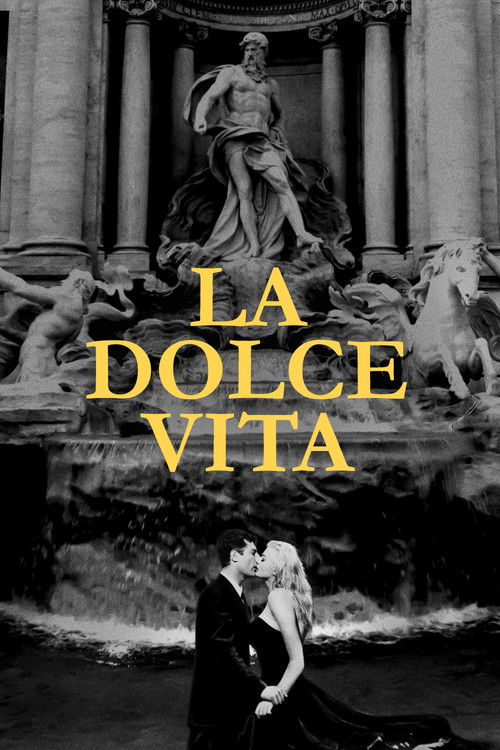
La Dolce Vita
1960 · Federico Fellini
For when you want to be swept into a whole world — a long, luxurious watch for a night when you have time to spare and an appetite for glamour with an aftertaste. It leaves you pleasantly wrecked rather than cheered.
What it's about
Marcello is a Rome tabloid journalist who wanted to be a serious writer and instead spends his nights chasing movie stars, heiresses, and miracles for the gossip pages. Over a string of loosely connected nights and dawns — a starlet wading into the Trevi Fountain, a fake sighting of the Madonna, endless parties that curdle before sunrise — he drifts between the glamour of the celebrity circuit and a home life that suffocates him. It's a portrait of a man, and a city, gorging on pleasure and starving for meaning.
The experience
Sprawling, seductive, and slowly melancholy — three hours that move like one long night out, dazzling at midnight and hollow by dawn. It's funny and glamorous on the surface with a persistent sadness rising underneath.
Performances
Marcello Mastroianni makes chronic indecision magnetic — charming, weary, and self-loathing all at once, in the role that defined his screen persona. Anita Ekberg's midnight wade into the Trevi Fountain is one of the most famous scenes ever filmed.
The craft
Fellini stages each episode as its own set piece, from a helicopter carrying a statue of Christ over Rome's rooftops to society parties that dissolve into dawn wreckage, all in sumptuous widescreen black and white with a Nino Rota score that swings between carnival and lament. The bigger the screen, the better — this is spectacle with a soul.
Why it matters
It won the Palme d'Or, scandalized the Catholic Church, and gave the world the word 'paparazzo' — few films have named a cultural moment so completely. It marks the point where Fellini left realism behind and became cinema's great ringmaster.
Snapshot
A three-hour episodic descent through Rome's celebrity demimonde, La Dolce Vita follows Marcello Rubini — tabloid journalist, aspiring serious writer, chronic drifter — across seven loosely connected nights and dawns in a city gorged on postwar prosperity and spiritual vacancy. The film opens with a helicopter ferrying a statue of the risen Christ over the Eternal City's rooftops and closes with a rotting sea monster hauled from the Tyrrhenian surf; between these two images lies one of cinema's most comprehensive diagnoses of modern aimlessness. Shot in widescreen black and white by Otello Martelli, with a score by Nino Rota, the film premiered in Rome on 5 February 1960 and won the Palme d'Or at Cannes that May. It introduced the word paparazzo into global usage, scandalized the Italian Catholic hierarchy, and altered the trajectory of world cinema.
Industry & production
La Dolce Vita was produced by Angelo Rizzoli through Riama Film (Italy) and Gray Films (France), a co-production arrangement that gave Fellini an unusually large budget by Italian standards of the period, though precise figures remain a matter of differing accounts in the trade press and should not be stated with false precision here. What is documented is that the production was extensive: Fellini and his team shot across 1958 and 1959 in Rome, using both real locations — the Via Veneto, the Trevi Fountain, the EUR district's rationalist architecture — and elaborate reconstructions built on the stages at Cinecittà. The Via Veneto café world, notoriously, was partly recreated on a Cinecittà backlot, allowing Fellini to control the swarming crowd choreography that the actual street could never have accommodated.
Rizzoli's backing was decisive. A publishing magnate with no prior film production experience at this scale, he absorbed significant financial risk for a film running nearly three hours with no conventional plot. The completed film ran to approximately 174 minutes in its Italian release. Its controversy — Cardinal Alfredo Ottaviani publicly condemned it as an offense against decency, neo-fascist protesters reportedly spat on Fellini at a screening — paradoxically guaranteed its commercial viability, a dynamic Rizzoli is said to have understood even when the Church did not. International distribution through Astor Pictures (U.S.) brought it to American audiences in 1961, though in a version trimmed for censorship compliance.
Technology
Fellini and Martelli shot La Dolce Vita in Totalscope, the Italian variant of the anamorphic widescreen process, yielding a 2.35:1 aspect ratio. The choice was culturally and aesthetically programmatic: the CinemaScope-style frame, widely associated by 1960 with Hollywood spectacle, is here turned against spectacle, used to isolate figures in vast, indifferent spaces or to pack the frame with so many bodies that no individual face registers. The broad canvas makes Rome itself a protagonist — or a symptom.
The production relied on a mixture of natural light and high-powered artificial sources. The Trevi Fountain sequence, perhaps the film's most celebrated set piece, required nighttime location work with substantial lighting rigs to render Anita Ekberg's figure luminous against the baroque stonework. Accounts from the production suggest the exterior shooting ran through a bitterly cold Roman winter, with Ekberg reportedly enduring the fountain's freezing water for extended takes while Mastroianni wore a protective wetsuit beneath his suit. The scene's technical accomplishment — sustaining dramatic luminosity while maintaining the sense of a real Roman night — established a benchmark for glamorous nocturnal cinematography.
Synchronized sound recording on location, still technically demanding in 1960, was employed selectively; much of the dialogue was post-dubbed in the Italian industry's long-standing doppiaggio tradition, which gave the sound design a particular polish and distance.
Technique
Cinematography
Otello Martelli, who had previously shot Rossellini's Paisà (1946) and Luchino Visconti's Ossessione (1943), brought a documentary-rooted precision to the wide anamorphic frame. His lighting strategy distinguishes sharply between registers: the Via Veneto exteriors are rendered in a hard, slightly bleached chiaroscuro that flattens celebrities into photographic surfaces (a pointed analogy to tabloid imagery), while interior sequences — Steiner's intellectual salon, the aristocratic castle party, Emma's apartment — develop a more graduated, psychologically differentiated depth. Martelli's compositions consistently use the horizontal width to establish social geometry: Marcello rarely occupies the center, drifting laterally through frames whose edges contain the world's competing claims on him.
The camera movement is predominantly tracking and panning rather than cutting, allowing scenes to breathe and accumulate without resolution. The celebrated helicopter prologue is achieved through aerial photography married to ground-level reaction shots, the juxtaposition carrying its full theological irony without editorial comment.
Editing
Leo Cattozzo edited the film, working with Fellini to construct the episodic structure from material that could, on any given segment, have expanded or contracted considerably. The editing philosophy is one of duration: scenes run to their emotional conclusion rather than being tightened for pace. The rhythm between episodes — marked by ellipsis, by sudden changes of light suggesting days skipped — creates a cumulative sense of repetition and entropy rather than narrative momentum. Individual episodes are internally coherent; their concatenation produces the film's true argument about circularity and spiritual stasis.
Mise-en-scène / staging
Fellini's staging draws on his background in theater and variety entertainment, organizing crowd scenes with a choreographic density unusual in dramatic cinema. The castle party sequence is the exemplar: dozens of aristocrats and hangers-on perform a kind of collective disintegration, the camera finding in the human mass the same spiritual vacancy it finds in Marcello's individual face. Fellini frequently positions his protagonist at the edge of group compositions, observing rather than participating, a spatial metaphor the staging makes literal.
The use of real Roman locations — particularly the EUR rationalist quarter, built under Mussolini and by 1960 repurposed for a booming bureaucratic class — supplies a layer of historical irony the fiction does not need to articulate. Modernity's architecture frames modernity's moral failure.
Sound
Nino Rota's score, composed in his characteristic vein of bittersweet romanticism tinged with irony, operates less as emotional underscore than as commentary. Rota's themes for La Dolce Vita are deceptively light — the main title's mambo-inflected theme has a celebratory surface that the images consistently undercut. Diegetic music is deployed with equal care: the parties produce jazz and cha-cha heard as social noise, fragments competing and dissolving. The Steiner sequence pointedly uses Bach on the church organ — a moment of genuine spiritual reach that the narrative will shortly destroy.
Performance
Marcello Mastroianni, cast partly against the expectations his earlier career had established (he had been seen primarily in conventional romantic leads), develops a performance of radical passivity. Marcello Rubini participates in events without transforming them; his expressiveness is mostly reactive, absorbing the world through a face of intelligent, helpless receptivity. This was a new model for male screen performance in European art cinema — the protagonist as witness rather than agent — and Mastroianni sustained it with a precision that looked, deceptively, like effortlessness.
Anita Ekberg as Sylvia — the visiting American movie star — performs at the opposite register, projecting an almost mythological vitality that the film treats with simultaneous awe and analytical detachment. Ekberg was not primarily a dramatic actress, and Fellini's direction understands this, casting her physicality as the point: Sylvia is a force of nature navigated by Marcello rather than a character he encounters. Anouk Aimée as Maddalena brings a different register again — aristocratic fatalism, sexual appetite coexisting with existential boredom — and the contrast between the three women who orbit Marcello structures the film's emotional argument more completely than any dialogue.
Narrative & dramatic mode
La Dolce Vita abandons conventional dramatic structure entirely. The film comprises seven or eight discrete episodes (depending on how one counts the transitional sequences), each a self-contained encounter or event in Marcello's itinerant social life, linked only by his presence and the suggestion that they occur across consecutive nights and mornings. There is no throughline of action, no antagonist, no goal-oriented plot. The film's form is its argument: the repetition of episodes without development mirrors the spiritual repetition Marcello cannot escape.
The ending — Marcello on a beach at dawn after an all-night orgy, catching a brief glimpse of Paola, the innocent young girl from an earlier episode, across an estuary he cannot cross — is the film's only moment of direct, unironic longing, and it is deliberately unreachable. Paola mouths words he cannot hear across the water; he shrugs and turns back to the party. Fellini refuses to sentimentalize even this.
Genre & cycle
The film sits at the intersection of several mid-century Italian cycles: the commedia all'italiana tradition in its satirical engagement with the nouveau-riche bourgeoisie, the melodrama of postwar moral crisis, and the emerging art-cinema mode of episodic, character-centered narrative. It is not exactly any of these. Internationally, it arrives contemporaneously with what critics would later call the "modernist" turn in European cinema — the same Cannes festival at which La Dolce Vita won the Palme d'Or saw Antonioni's L'Avventura receive the Jury Prize, a remarkable concentration of Italian art cinema at the edge of its transformation. Fellini and Antonioni were arriving, by different routes, at a similar formal conclusion: that the bourgeois character's inner life could no longer be rendered through inherited narrative conventions.
Authorship & method
Fellini's working method by 1960 was collaborative but directorial in the strongest sense: he shaped material from improvisatory development rather than from a finalized script. The screenplay, credited to Fellini, Tullio Pinelli, Ennio Flaiano, and Brunello Rondi, evolved substantially during production. Flaiano — a novelist and satirist of postwar Italian manners — supplied much of the film's sharpest sociological observation; Rondi contributed to its more mystical and religious registers. The balance between these sensibilities is part of what gives the film its dual nature: scathing documentary and unresolved spiritual inquiry simultaneously.
Nino Rota's collaboration with Fellini, which had begun with Lo sceicco bianco (1952) and would continue through Amarcord (1973), found in La Dolce Vita one of its most complete expressions. Rota understood Fellini's tonal requirements — irony that never tips into contempt, nostalgia that never tips into sentimentality — and the score remains a model of this calibration.
Martelli's cinematography, as noted, brought a neorealist discipline to the widescreen format. Fellini would subsequently work with Gianni Di Venanzo (8½, Juliet of the Spirits) and Giuseppe Rotunno (Amarcord, And the Ship Sails On), moving toward increasingly subjective visual registers; Martelli's approach for La Dolce Vita is somewhat more restrained, which suits the film's documentary aspiration.
Movement / national cinema
La Dolce Vita belongs to the Italian cinema of the economic miracle — the boom years of 1958–1963 in which Italy's rapid industrialization produced extraordinary wealth alongside acute anxiety about cultural and moral identity. The film is one of its era's most penetrating documents of this anxiety, cataloging the forms of distraction — celebrity gossip, aristocratic ritual, religious spectacle, sexual pursuit, intellectual posturing — through which a society avoids self-examination.
It occupies a pivotal position in Italian film history: formally, it announces the end of neorealism's dominance and the beginning of a period in which Italian directors pursued psychological interiority and formal experimentation over documentary fidelity. Thematically, it inaugurates decades of Italian cinema's engagement with modernity's spiritual costs. Visconti, Antonioni, Pasolini — each was already working through related terrain — but La Dolce Vita's scale and its popular impact made it the definitive statement.
Era / period
The Rome of La Dolce Vita is precisely 1958–1960: a city processing its Fascist past through conspicuous amnesia, integrating American mass culture through its celebrity machinery (the Via Veneto's café culture had attracted Hollywood productions throughout the 1950s), and experiencing the early strains of the consumer society that would reshape Italian life across the following decade. The film's journalists, socialites, artists, and aristocrats are all types of the boom moment, their moral disorientation a function of a society whose material conditions have changed faster than its ethical frameworks.
The presence of the Church — the Trevi Fountain, the chapel where Steiner plays Bach, the miracle-seeking crowd in the Roman suburb — is pervasive but impotent. Organized religion appears throughout the film as spectacle rather than spiritual resource, a parallel to celebrity culture the film draws without laboring.
Themes
The film's central thematic concern is the condition of modern consciousness in a world of material abundance and spiritual vacancy. Marcello is not a villain or a victim but an intelligent man who has understood his situation and continued nonetheless: his self-awareness intensifies rather than alleviates his paralysis. The film treats this not as personal failure but as structural — the condition of a particular historical moment.
Celebrity and its mechanisms constitute a second major theme. The paparazzo (the name taken by Flaiano for the character played by Walter Santesso, reportedly derived from a character in a George Gissing travel memoir about Calabria — though the exact etymology has been contested) is not a peripheral figure but a structural revelation: the camera that transforms living people into images is what the entire film is about. Marcello is himself a kind of paparazzo of the social world, recording without comprehending.
The contrast between authentic innocence and corrupted sophistication — figured most explicitly in Paola, the young waitress from Umbria who appears briefly in the middle of the film and returns at its close — is handled with Fellini's characteristic ambivalence. Innocence is real but inaccessible; the film neither romanticizes it nor abandons the aspiration toward it.
Reception, canon & influence
Influences on the film. Fellini's trajectory through I Vitelloni (1953) and Il bidone (1955) had already established his interest in male characters adrift in cycles of pleasure and self-deception; La Dolce Vita scales this interest to the social panorama of an entire city. Rossellini's example — particularly the wandering, episodic Viaggio in Italia (1954), in which a marriage dissolves against the backdrop of Naples — is a nearer precedent for the film's discursive structure than anything in Hollywood narrative tradition. Fellini's readings in Jungian psychology, which deepened throughout the 1950s, inflected the film's symbolic architecture: the rotting sea monster is legible as a return of the repressed, a figure from the unconscious depths that the characters cannot name.
Critical reception. The immediate Italian response was divided along predictable cultural-political lines: left-wing critics celebrated the film's social satire; Catholic institutions condemned its moral framework; the wider public, stimulated by the controversy, attended in large numbers. The Cannes Palme d'Or provided international legitimation that insulated the film from domestic attacks. Subsequent critical consensus across the following decades ranked it among the essential works of world cinema; it has appeared consistently on major critical polls, including Sight & Sound's decennial surveys.
Legacy and influence. The film's most measurable cultural contribution is linguistic: paparazzo (pluralized to paparazzi in Italian) entered global usage almost immediately, and the word now describes an entire profession and its ethics — a remarkable instance of fiction generating fact. Beyond language, the film's model of episodic, non-teleological narrative structured around a morally passive male protagonist became a template for European art cinema across the 1960s and well into the 1970s. Antonioni's La Notte (1961) and L'Eclisse (1962) develop parallel concerns with different formal solutions; the conversation between the two directors' works defines a decade of Italian cinema. Bob Fosse acknowledged the film's influence on All That Jazz (1979); Woody Allen returned to it across multiple films set in European cities. The Trevi Fountain sequence in particular has been cited, parodied, and quoted so extensively that it now exists as a cultural icon independent of the film that produced it — a fate Fellini might have recognized as the film's final irony.
A Deleuzian reading
A statue of Christ, arms spread wide, hangs from a cable beneath a helicopter and floats over the rooftops of Rome.
The full Deleuzian reading of La Dolce Vita →
Reception
It scandalised Italy on release — the Vatican's newspaper condemned it and Fellini was reportedly spat at by outraged patrons at the Milan premiere — yet it won the Palme d'Or at Cannes that same year and is now a fixture of greatest-films lists.
How La Dolce Vita was received, from release to now →
Influences: the films it descends from and the films it influenced
- Paisà (1946) — Otello Martelli shot both films; his practice of reading actual Roman locations through high-contrast available-light cinematography is the direct technical foundation Fellini recruited for La Dolce Vita's nocturnal exterior work, and Paisà's multi-episode elliptical structure is the narrative template Fellini scales up.
- Ossessione (1943) — Martelli's method of flattening Italian location surfaces into hard chiaroscuro planes — developed here under Visconti — is the precise visual grammar La Dolce Vita recruits for the Via Veneto sequences, where celebrities are rendered as photographic surfaces rather than psychological interiors.
- I Vitelloni (1953) — Fellini's own first full elaboration of the passive male protagonist embedded in a non-teleological social survey, with Nino Rota's ironic commentary score already operational; La Dolce Vita is structurally I Vitelloni scaled from provincial ennui to metropolitan spectacle, with the same episodic ellipsis between night-and-dawn segments.
- La Strada (1954) — Nino Rota's scoring method of undercutting emotional weight with deceptively simple melodic material — jaunty tunes playing against suffering — is fully crystallized here; La Dolce Vita inherits this as its primary tonal instrument, with Rota's themes for the celebrity demimonde operating in the same ironic-counterpoint mode.
- Le notti di Cabiria (1957) — The final pre-La Dolce Vita consolidation of the Fellini–Rota–doppiaggio triumvirate; Giulietta Masina's performance of archetypal spiritual grace amid corruption directly prefigures Ekberg's Sylvia as embodied mythological figure, establishing the template of the female protagonist functioning as an unreachable standard against which the passive male protagonist measures his own vacancy.
- Umberto D. (1952) — De Sica's editorial principle — scenes run to their complete emotional exhaustion before a cut, with no tightening for narrative efficiency — is the direct precedent for Leo Cattozzo's duration-based rhythm in La Dolce Vita, where the accumulation of unresolved time within each episode is itself the argument about circularity and entropy.
- White Nights (1957) — Builds a nocturnal Rome as a studio dreamworld at Cinecittà bound by a Nino Rota score, extending White Nights' fully-fabricated mood-city into Italian cinema's international signature.
- 8½ (1963) — Fellini's improvisatory authorship method — developed through La Dolce Vita's unscripted crowd choreography and character improv — here turns inward and becomes the explicit subject; Rota's ironic commentary score integrates further into dream-logic, and the passive male protagonist's inability to synthesize his experience is pushed from social observation into autobiographical confession.
- Blow-Up (1966) — Antonioni directly inherits the paparazzo figure Fellini named and conceptualized in La Dolce Vita, transforming the celebrity photographer's morally ambivalent gaze — powerful at the moment of capture, vacant thereafter — into the film's central epistemological subject; the lateral tracking through fashionable London crowds extends La Dolce Vita's crowd choreography into pure surface abstraction.
- Fellini Satyricon (1969) — Giuseppe Rotunno extends Martelli's Totalscope anamorphic grammar into phantasmagoric register; Fellini pushes La Dolce Vita's episodic ellipsis to its logical dissolution — episodes connect by pure juxtaposition with no causal tissue — and the mythological physicality of Ekberg's Sylvia (goddess-as-grotesque) becomes literal ancient spectacle.
- Roma (1972) — Fellini applies La Dolce Vita's crowd choreography method — large masses of bodies managed through lateral tracking rather than cutting, no single figure registering — to the city itself as sole subject, with Rotunno's nocturnal location lighting systematically extending the Trevi fountain benchmark across the whole film.
- American Gigolo (1980) — Schrader transplants La Dolce Vita's passive male protagonist adrift in glamorous social surfaces to Los Angeles, using lateral tracking shots through party environments and Giorgio Moroder's synthesizer score in an ironic-commentary function directly modeled on Rota — music that aestheticizes the milieu while simultaneously draining it of meaning.
- C'era una volta in America (1984) — Leone carries the doppiaggio post-dub tradition to its terminal elaboration, using the deliberate distance of post-synchronized dialogue as a formal instrument of temporal dislocation; Ennio Morricone's score operates in the same ironic-commentary function as Rota's in La Dolce Vita, with nostalgic melodic material playing against images of violence and moral vacancy.
- La Grande Bellezza (2013) — Sorrentino maps La Dolce Vita's specific formal apparatus — passive journalist protagonist, nocturnal Rome party circuit, lateral tracking shots through crowd choreography, aerial prologue, dawn-and-dusk episodic rhythm, score (Pärt and Tavener used in Rota's ironic-counterpoint mode) — onto contemporary Via Veneto equivalents; the structural homage is architecturally precise, not atmospheric.
- Yes (2025) — Builds the episodic picaresque drift through a decadent elite with the artist-figure as compromised witness — the descent structure Yes adopts.
- La Grazia (2025) — Establishes the template of the solitary, watchful protagonist read against a melancholic Roman skyline — the 'figure-against-Rome' composition Sorrentino directly inherits via D'Antonio's framing.
- Darling (1965) — Fellini's episodic procession through glamour parties and a press-and-publicity milieu supplies Darling's structure of a hollow protagonist drifting through self-cancelling social tableaux.
- Santa Sangre (1989) — Source of the processional set-piece and spectacle-as-memory; Santa Sangre's elephant funeral, with its mourners and bannered hearse winding through the streets, descends directly from Fellini's grand public parades.
- Babylon (2022) — Its episodic string of decadent nocturnal parties dissolving into emptiness supplies the structural rhythm of Babylon's set-piece hedonism, each revel escalating and curdling.
- L'Avventura (1960) — Released the same year and in the same anamorphic widescreen format, both films use the 2.35:1 horizontal field to enforce the same compositional argument: protagonists placed at frame edges in architecturally indifferent spaces, the wide canvas producing social geometry rather than heroic centrality; Antonioni's spatial grammar is the closest formal parallel to Martelli's lateral-drift framing.
- Il Sorpasso (1962) — The core commedia all'italiana sibling: Risi maps the same Italian economic miracle aimlessness through a passive male protagonist adrift in conspicuous prosperity, using an episodic road-movie structure without teleological resolution and scene construction that lets moments breathe past their comedic purpose into something darker.
- Le Mépris (1963) — Godard shoots in the same Totalscope anamorphic format on Italian locations, deploying the horizontal frame to enforce spatial alienation between figures; Michel Piccoli's passive observer-protagonist — embedded in a film industry milieu, unable to act on what he perceives — mirrors Marcello's structural role as witness to a world he cannot escape or transform.
- L'Eclisse (1962) — Fellini contemporaneously maps the Italian economic miracle's spiritual vacuum through EUR-adjacent Roman new-build landscape, staging alienation through postwar prosperity's architecture with a comparable attention to how rationalist modern spaces fail to contain human longing — the films share a city, a milieu, and a formal argument about the new Italy.
- Landscape in the Mist (1988) — Its opening airlift of a Christ statue over Rome is directly quoted in the helicoptered giant hand pulled from the sea — spectacle recast as desolation, a deliberate intertextual citation.
- The Hero (1966) — Anatomizes celebrity and the press's fabrication of the famous — the art-versus-fame tension Nayak dramatizes between star and interviewing journalist.
Similar films
- I Vitelloni (1953) — influence & lineage · same viewing thread
- Roma (1972) — influence & lineage
- 8½ (1963) — influence & lineage
- The Great Beauty (2013) — influence & lineage
- Nights of Cabiria (1957) — influence & lineage
- Satyricon (1969) — influence & lineage
- La Strada (1954) — influence & lineage
- L'Avventura (1960) — influence & lineage
All the films related to La Dolce Vita →
Watch it with: curated runs of related films
- Adrift in the Modern World — Watch these when you want to drift through postwar Rome and Paris alongside people who have everything and feel nothing — they rhyme on beautiful boredom, aimless days, and a search for meaning that modern comfort keeps failing to supply.