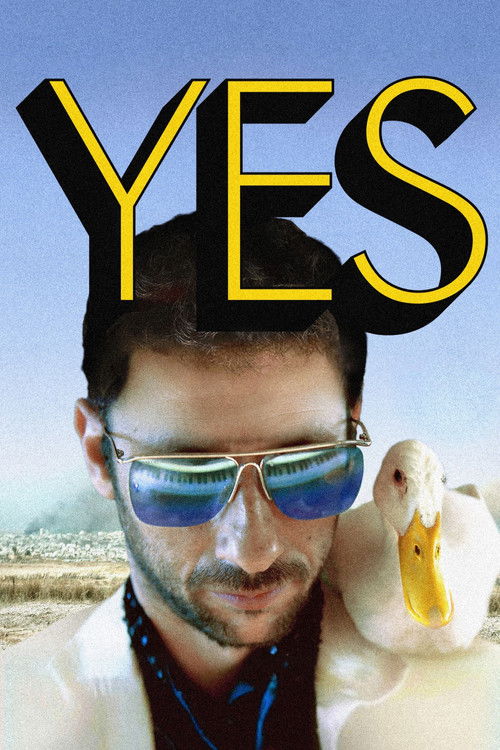
Yes
2025 · Nadav Lapid
For when you want cinema as provocation — a film that grabs current history by the collar and won't let you watch neutrally. Emphatically a challenge; save it for a night you want to be confronted, not soothed.
What it's about
In the raw months after October 7, Y., a Tel Aviv jazz pianist, and his wife Yasmin, a dancer, adopt a survival strategy: say yes to everything. They perform on command for Israel's political, military and monied elite, selling their art and themselves piece by piece — until Y. is handed the ultimate commission, composing the music for a vengeful new national anthem bankrolled by an oligarch patron. It's a portrait of two artists trading their souls in installments, and of a country in fever.
The experience
Convulsive, confrontational and deliberately too much — swinging between grotesque party sequences, tenderness, and fury, often within a single scene. At two and a half hours it's an endurance test that means to leave you shaken and arguing.
Performances
Ariel Bronz throws himself into Y. with reckless physical abandon — debasing, funny and heartbreaking by turns — while Efrat Dor gives Yasmin a grounded ache that keeps the film's wildest passages tethered to a real marriage.
The craft
Nadav Lapid's signature style is at full volume: careening handheld camerawork, music used as assault and seduction, scenes choreographed like dance numbers that curdle mid-step. It's sensory filmmaking that rewards good speakers and a viewer willing to be knocked around.
Why it matters
One of the most incendiary films of its Cannes year, it cemented Lapid's standing as Israeli cinema's fiercest internal critic and became a flashpoint in the debate over art made in wartime.
Snapshot
Yes is Nadav Lapid's first feature since Ahed's Knee (2021), and his most direct reckoning with the country that has been his career-long antagonist and subject. Set in the months after October 7, 2023, it follows Y. (Ariel Bronz), a jazz pianist and would-be comedian, and his wife Yasmin (Efrat Dor), a dancer, who decide—as a survival strategy and a moral capitulation at once—to say "yes" to everything. They perform on demand for Israel's monied and military elite, and Y. is eventually commissioned to set music to the lyrics of a new, vengeful national anthem, financed by a Russian-oligarch patron (Aleksei Serebryakov) who expects pro-IDF triumphalism. Premiering in the Directors' Fortnight at the 2025 Cannes Film Festival on 22 May, the roughly two-and-a-half-hour film extends Lapid's signature mode—convulsive handheld camerawork, musical eruptions, satire that curdles into anguish—into a furious, self-lacerating portrait of art-for-hire under nationalism. It is best understood as the third panel of a loose triptych on Israeli identity that runs from Synonyms (2019) through Ahed's Knee. Because the film is so recent, its critical standing is still forming; what follows synthesizes the documented production record with Lapid's established authorship, and flags where the public record remains thin.
Industry & production
Yes is a France-led European co-production—France, Israel, Cyprus, and Germany—a financing structure that has become characteristic of Lapid's work, where French money underwrites films too critical of the Israeli state to expect comfortable domestic backing. The lead producers are Judith Lou Lévy, Hugo Sélignac, and Antoine Lafon, with production companies including Les Films du Bal, Chi-Fou-Mi Productions, Bustan Films, the German firm Komplizen Film (Maren Ade's company, behind Toni Erdmann), AMP Filmworks, and Arte France Cinéma. Distribution fell to Les Films du Losange in France—where the film opened theatrically on 17 September 2025—and to Kino Lorber in the United States, both arthouse-specialist distributors whose involvement situates Yes squarely in the international festival-and-specialty pipeline rather than any commercial mainstream.
This transnational arrangement is not incidental to the film's meaning. Lapid has, since Synonyms, worked from a position of partial exile, and Yes was made by an Israeli director addressing the immediate aftermath of October 7 with European institutional support. The film's premiere outside the Cannes main competition, in the Directors' Fortnight, places it in the festival's more rebellious sidebar—fitting for a work whose provocations are aimed at the consensus of its own national audience. Concrete data on budget and box office is not part of the reliable public record at this writing, and should not be asserted.
Technology
There is no indication that Yes departs from the digital-capture workflow standard to contemporary European art cinema, and Lapid's recent films have been shot digitally. His aesthetic does not foreground technological novelty; the camera is a handheld, highly mobile instrument, and the relevant "technology" is less the apparatus than its violently kinetic deployment. Reviews describe a camera that "gyrates" and lurches, suggesting lightweight rigs operated for maximum bodily freedom rather than stabilized precision. The film's most arresting formal gambits—long takes, abrupt musical intrusions—rely on choreography and timing more than on any visible technical machinery. Absent confirmed details on cameras, lenses, or post pipeline, it would be invention to specify them.
Technique
Cinematography
Shaï Goldman, Lapid's cinematographer on both Synonyms and Ahed's Knee, returns, and the continuity matters: the restless, destabilizing handheld grammar that critics have come to call "Lapidian" is in large part Goldman's. Here the camera has been likened to "a drunken dancer on the verge of throwing up"—a description that captures the deliberate vertigo, the way framing refuses to settle into composure or moral safety. The lens whips, tilts, and circles bodies, implicating the viewer in the characters' frenzy. Set against this churn is at least one bravura long take in which a character recites the atrocities of October 7 while overlooking a Gaza City wreathed in smoke and fire—a sustained, unbroken shot that swaps the surrounding chaos for unbearable stillness. The oscillation between dervish-like movement and held duration is the film's central visual rhythm.
Editing
The film is cut by Nili Feller and organized into chapters—reviews describe a tripartite structure, with a hedonistic opening movement giving way to a more introspective middle section titled "The Route." (Lapid's earlier work was edited by his mother, Era Lapid, until her death; the editing partnership here is a later one.) The cutting serves Lapid's characteristic tonal whiplash: lurches from satire to dread, from techno-scored excess to confessional quiet. Editing in his cinema is less about continuity than about rupture—the jolt that keeps a scene from resolving into easy irony or easy pathos.
Mise-en-scène / staging
Production designer Pascale Consigny seeds Israeli flags through nearly every location, turning the national symbol into an inescapable, almost wallpaper-like presence—a staging choice that literalizes the film's argument that nationalism saturates private and artistic life. Lapid stages bodies in extremis: dance, sexual transaction, performance-on-command. The "selling of bodies and souls" in the premise is realized through physical degradation and display, the couple's artistry repurposed as service to power. Staging consistently pushes toward the grotesque and the carnivalesque, a register Lapid has long used to make the familiar machinery of patriotism appear obscene.
Sound
Sound is foundational, not decorative—unsurprising for a film about a musician commissioned to write an anthem. The opening movement is driven by pounding techno "that will blast your brains out," an assaultive sonic environment that mirrors the characters' surrender to sensation. The score is credited to the band Sleeping Giant and to Omer Klein, an Israeli jazz pianist whose involvement is pointed given that the protagonist is himself a jazz pianist; the casting of a real jazz idiom against the demand for a martial anthem stages the film's core tension at the level of sound itself. Music in Yes is the instrument of complicity—the thing Y. is paid to corrupt.
Performance
Ariel Bronz anchors the film as Y., a performer asked to embody compromise: the comedian and musician who keeps saying yes. Efrat Dor plays Yasmin, the dancer-wife whose body is likewise conscripted; the two register the couple's descent as both farce and slow self-destruction. Naama Preis (a Lapid regular) appears as Leah, Sharon Alexander as Avinoam, and the Russian actor Aleksei Serebryakov—internationally known from Andrey Zvyagintsev's Leviathan—as the billionaire patron, a casting choice that imports a face associated with state-power critique. Lapid's direction of actors tends toward the heightened and the physically exposed; performances here are described as expressionistic, pitched between musical-number bravura and inner collapse.
Narrative & dramatic mode
The film operates as satirical fable shading into tragedy. Its premise—a couple who resolve to say "yes" to everything—is a moral thought-experiment dramatized to its grotesque conclusion: total assent as the logic of life under a violent, monied, zealous order. The chaptered structure moves from bacchanalian excess through a more reflective passage, refusing the consolations of a conventional arc. Lapid favors digression, direct address, and tonal instability over tidy causality; the "mission" of composing the anthem provides a spine, but the dramatic mode is closer to picaresque descent than to thriller or character study. Critics have framed the film as posing thorny questions rather than answering them—a deliberately unresolved provocation.
Genre & cycle
Officially tagged drama and comedy, Yes is more precisely political satire in the maximalist, confrontational vein Lapid has made his own. It belongs to a small, charged cycle of films interrogating Israeli national identity from within—most directly Lapid's own Synonyms and Ahed's Knee—and to a broader lineage of European art-cinema satires that use grotesquerie to indict their societies. The "say yes to everything" conceit links it loosely to fables of moral capitulation, but its specific target—art commissioned to sanctify state violence in the immediate wake of October 7—makes it a near-unique entry in the cinema responding to that event. It is among the first major fiction features to confront the post-October 7 moment head-on, which is part of what makes its reception so freighted.
Authorship & method
Yes is unmistakably a Nadav Lapid film, and its method is continuous with his body of work: the convulsive camera, the eruption into song and dance, the body as the site where ideology is enforced and resisted, the satirist's rage turned against his own nation and, implicitly, himself—what one review called "cinematic self-flagellation." Lapid wrote as well as directed, sustaining the autofictional, essayistic charge of his earlier scripts (several co-written with his father, the novelist Haim Lapid; the writing credit on Yes in the public record is Lapid's own). His key collaborators reinforce the authorial signature: Shaï Goldman's cinematography and the chaptered editing extend the formal language of Synonyms and Ahed's Knee, while the prominence of jazz musician Omer Klein in the music ties the film's sound directly to its protagonist's predicament. The recurrence of actress Naama Preis underscores the repertory continuity across Lapid's recent features. Lapid's method has always been to convert personal fury and national shame into formal aggression; Yes applies that method to the rawest possible material.
Movement / national cinema
The film sits at a fault line in Israeli national cinema. Lapid is among the most internationally celebrated Israeli directors of his generation, yet his work is fundamentally adversarial toward the Israeli state and the affective machinery of Israeli patriotism—a stance that has made him a controversial figure at home. The French-led co-production of Yes exemplifies a now-familiar pattern in which dissident Israeli cinema finds its support and primary audience in Europe. The film thus belongs simultaneously to Israeli cinema (in language, subject, and the director's biography) and to a transnational European art cinema (in financing, distribution, and festival home). Its arrival in the Directors' Fortnight rather than the Israeli mainstream is itself a statement about where such work can currently live.
Era / period
Yes is inseparable from its moment: it is explicitly a post–October 7 film, made and set in the immediate aftermath of the Hamas attacks and the ensuing war, with Gaza burning visibly on its horizon. It belongs to the first wave of ambitious fiction filmmaking to metabolize that rupture, and it does so without the distance of hindsight—an artistic risk the film courts deliberately. As a 2025 release it also reflects the present condition of politically engaged art cinema: dependent on international co-financing, premiering at festivals, addressing a global audience as much as a national one. The very recency of the film means its place in the period's cinema is still being written.
Themes
The film's governing theme is complicity—specifically the complicity of the artist who lends beauty to power. The commission to compose a national anthem makes literal the corruption of art into propaganda; the title's "yes" names assent as the era's defining moral failure. Adjacent themes radiate outward: the body as commodity and battlefield (the couple selling "their bodies and souls"); nationalism as an atmosphere that infiltrates intimacy, signaled by the omnipresent flags; violence, zealotry, and money as the ruling powers of contemporary Israeli life; and self-destruction, both personal and collective, as the price of saying yes. Running beneath is Lapid's enduring preoccupation with the impossibility of innocent art in a militarized society, and with shame as a national condition. The film offers no redemption and proposes no program; its argument is its refusal of consolation.
Reception, canon & influence
Initial critical reception was strongly favorable: early aggregated reviews registered broad acclaim from festival critics, with praise for the film's formal audacity and the consensus that it raises difficult questions with comedic force rather than offering answers. Reviewers consistently invoked its maximalism, its provocation, and its courage in confronting October 7 so directly—though that same directness guarantees the film will remain politically contested, and a full picture of its reception (including any Israeli-domestic response and any controversy) is still emerging.
Influences on the film are primarily Lapid's own prior cinema—Synonyms and Ahed's Knee above all—and the broader tradition of confrontational European political satire that uses the grotesque and the carnivalesque to indict a society; the centrality of dance and music extends a thread present throughout his filmography. As for its forward legacy: it is too soon to assess. Yes arrives as one of the earliest major artistic responses to the post–October 7 moment, and its significance will depend on how the cinema of that period develops and on whether Lapid's uncompromising approach finds successors. Any claim about its lasting influence at this stage would be speculation rather than history.
Sources: Wikipedia) · The Hollywood Reporter review · Variety · Quinzaine des Cinéastes
A Deleuzian reading
The camera can't hold still.
The full Deleuzian reading of Yes →
Reception
It premiered in Cannes 2025's Directors' Fortnight — a sidebar placement that raised eyebrows after Ahed's Knee had played main competition — to divided raves, and within a year had grown from 'divisive festival satire' into a full-blown international cause célèbre.
How Yes was received, from release to now →
How to watch Yes: what to notice on a first viewing
- Watch how much the handheld camera refuses to hold still. Goldman's camera whips, tilts, and circles bodies throughout, a restless grammar critics compare to a drunken dancer, refusing to settle into composure. The instability puts you inside the characters' frenzy instead of watching it from a safe distance.
- Notice how many Israeli flags appear in a single room. Production design seeds flags through nearly every location until the national symbol becomes wallpaper, an inescapable presence in even the most private scenes. The flags argue that nationalism has saturated private life, not just public ceremony.
- Listen for the pounding techno in the opening scenes. An assaultive wall of techno drives the hedonistic first movement, mirroring the couple's surrender to sensation before a single word explains their decision. The sound tells you they've already said yes before the plot catches up to explain why.
- Watch what Y. and Yasmin's bodies are asked to do on command. Lapid stages dance, sexual transaction, and performance-on-demand as the literal form the couple's 'yes' takes, so compliance is shown as a physical posture. You read their surrender in what their bodies are made to do, not in anything they say.
The whole guide to watching Yes, with the keys for a rewatch →
Influences: the films it descends from and the films it influenced
- Synonyms (2019) — Establishes the convulsive, body-chasing handheld (Shaï Goldman's lensing) in which flight from national identity becomes physical compulsion — the camera grammar Yes inherits wholesale.
- Ahed's Knee (2021) — Pioneers Lapid's filmmaker-protagonist as vehicle for rage turned against Israel and self, plus abrupt eruptions into lip-sync/dance that Yes escalates into a structural device.
- Policeman (2011) — Introduces the bipartite split between opposed bodies and ideologies, and the trained body as instrument of the state — the formal binary Yes refracts through chaptering.
- The Kindergarten Teacher (2014) — First develops Lapid's theme of artistic complicity — art appropriated, the artist's devotion compromised — which Yes literalizes as the commissioned-artist's predicament.
- Weekend (1967) — Models the picaresque road-descent through a society's rot, intertitle chaptering, jazz rupture and the long take as political weapon — Lapid's satirical-fable architecture.
- Salò, or the 120 Days of Sodom (1975) — Catalogs the body as commodity across chaptered 'circles,' weaponizing the grotesque as an indictment of power — the cold structural cruelty Yes echoes.
- Sweet Movie (1974) — Fuses body-as-commodity (the beauty-pageant/sugar conceit) with carnivalesque grotesquerie as political montage, the register Yes pushes toward provocation.
- WR: Mysteries of the Organism (1971) — Splices documentary and fiction with abrupt register shifts — the essayistic tonal whiplash that organizes Yes's editing.
- The Discreet Charm of the Bourgeoisie (1972) — Renders complicity and accommodation as absurdist repetition — the satirical-fable mode in which the powerful endlessly perform their own comfort.
- La Grande Bouffe (1973) — Stages grotesque consumption-unto-death as carnivalesque indictment, the body as site of ideological appetite — Yes's grotesque-carnivalesque lineage.
- La Dolce Vita (1960) — Builds the episodic picaresque drift through a decadent elite with the artist-figure as compromised witness — the descent structure Yes adopts.
- Beau Travail (1999) — Turns the sudden eruption of dance into the body's release of repressed ideology, choreography as emotional climax — the dance-as-rupture Lapid threads through his work.
- Holy Motors (2012) — Builds an episodic, chaptered descent through grotesque set-pieces with violent tonal whiplash, performance staged as exhausting compulsion of the body.
- The Square (2017) — Satirizes the artist/curator's complicity and cowardice through grotesque performance-art set-pieces that humiliate the cultured class.
- Triangle of Sadness (2022) — Deploys body-as-commodity and carnivalesque bodily excess as class indictment, the grotesque escalated to physical revulsion as political comedy.
- Foxtrot (2017) — Uses tripartite chaptered structure and stylized formal aggression to convert Israeli national trauma into self-critique, including its own eruption into dance.
- Bacurau (2019) — Mounts a political fable with deliberate genre/tonal whiplash, indicting a nation through escalating grotesque allegory.
Similar films
- Tatami (2024) — same viewing thread
- Atropia (2025) — same viewing thread
- All That's Left of You (2025) — shared sensibility
- No Other Land (2024) — shared sensibility
- Babylon (2022) — shared sensibility
- Paradise Now (2005) — shared sensibility
- No Bears (2022) — shared sensibility
- Sirāt (2025) — shared sensibility
All the films related to Yes →
Watch it with: curated runs of related films
- No Way to Say No — Watch these when you want to see individuals forced to perform for a state, an army, or a corporation — they rhyme on the impossible arithmetic of complicity and defiance.