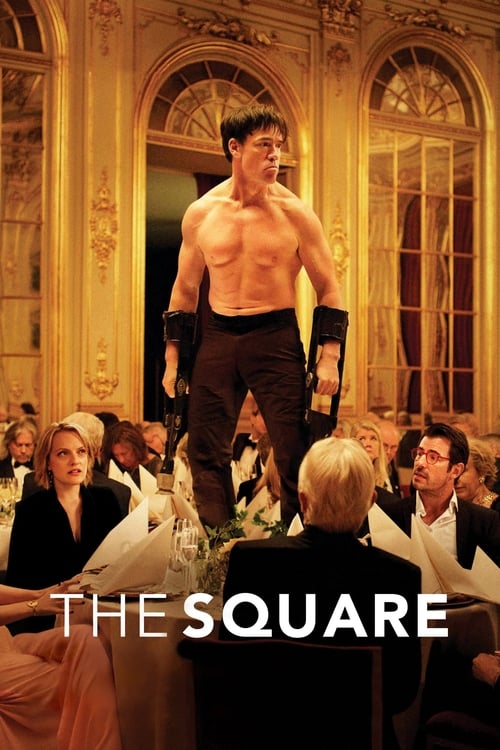
The Square
2017 · Ruben Östlund
Two-time Palme d'Or winner (The Square, Triangle of Sadness) whose eat-the-rich satires get accused of being smug about smugness; the vomiting-yacht sequence became a cultural shorthand. Loved and resented in roughly equal measure — which is the point.
For when you want sharp, uncomfortable satire that makes you examine your own reflexes — a film to argue about over drinks afterward. Challenge, not comfort, though it's frequently hilarious.
What it's about
Christian is the effortlessly suave chief curator of a Stockholm contemporary art museum, preparing an installation called 'The Square' — a small bordered zone billed as a sanctuary of trust and caring where everyone shares equal rights. Then his phone and wallet are stolen in a street scam, and his attempt to get them back kicks off a cascade of moral failures that make a mockery of everything the artwork preaches. Around him, the museum's marketing team cooks up a viral campaign that goes catastrophically wrong.
The experience
Squirm-in-your-seat funny — the comedy of watching a polished man's principles buckle under mild inconvenience. It moves in long, escalating set pieces that start awkward and keep tightening until you're laughing and covering your eyes at the same time.
Performances
Claes Bang is perfect as a man whose charm is a load-bearing wall, and Terry Notary's performance-artist set piece at a museum gala is one of the most jaw-dropping single scenes of its decade — pure physical commitment that tips a room from amusement into terror.
The craft
Ruben Östlund builds each episode as a precisely staged social experiment, holding shots long past comfort so you feel every beat of hesitation and cowardice. The framing is cool and immaculate — very much the aesthetic of the art world it's skewering — and the sound design weaponizes silence and crowd noise. The big scenes genuinely land harder with an audience or on a large screen.
Why it matters
It won the Palme d'Or at Cannes in 2017 and cemented Östlund as European cinema's leading satirist of polite society and the liberal conscience.
Snapshot
The Square is Ruben Östlund's fifth feature and the film that consolidated his international standing, winning the Palme d'Or at the 2017 Cannes Film Festival from a jury presided over by Pedro Almodóvar. A scabrous, episodic satire of the contemporary art world and the liberal European conscience, it follows Christian (Claes Bang), the suave chief curator of a Stockholm contemporary art museum, the X-Royal, as he prepares an installation called "The Square" — a literal bordered space on the museum forecourt billed as "a sanctuary of trust and caring," within which everyone shares equal rights and obligations. The conceptual humanism of the artwork is set against Christian's own cascade of moral failures after his phone and wallet are stolen, and against the museum's catastrophic viral marketing campaign. The film braids together strands of social comedy, art-world burlesque, and discomfort cinema, and its set-piece — a performance artist (Terry Notary) impersonating an ape who terrorizes a black-tie donors' gala — became one of the most discussed scenes in European art cinema of the decade. Co-produced across Sweden, Germany, France, and Denmark, it confirmed Östlund as the leading practitioner of a distinctly Scandinavian cinema of social embarrassment.
Industry & production
The Square was produced by Erik Hemmendorff for Plattform Produktion, Östlund's long-standing production company, in co-production with Essential Films (Germany), Coproduction Office, Parisienne, Film i Väst, and Danish and other European partners — a financing structure typical of mid-budget European auteur cinema reliant on regional film funds, public broadcasters, and pan-European subsidy. The Swedish Film Institute and Film i Väst (the regional fund based in Trollhättan that has underwritten much of Östlund's career and that of his contemporaries) were central backers. The film arrived on the strength of Force Majeure (2014), Östlund's breakout, which had won the Un Certain Regard Jury Prize at Cannes and been shortlisted for the Academy Award for Best Foreign Language Film, raising both expectations and budget.
Crucially, the project did not originate as a screenplay. Östlund and the veteran producer-artist Kalle Boman had earlier conceived and physically realized "The Square" as an actual art installation — a symbolic zone of mutual trust — first installed in the town of Värnamo and later elsewhere in Sweden. The film grew outward from that conceptual artwork, an unusual genesis in which the central metaphor predated the narrative. The casting reflected the film's pan-European, art-world-cosmopolitan texture: the Danish actor Claes Bang, then little known internationally, was cast as the Swedish curator; the American Elisabeth Moss, fresh from television prominence, plays a visiting journalist; and the British actor Dominic West appears as a needling artist. After its Palme d'Or, The Square was selected as Sweden's submission for the Academy Award for Best Foreign Language Film and earned a nomination, extending its festival prestige into the awards circuit.
Technology
The Square was shot digitally by Fredrik Wenzel, Östlund's regular cinematographer, in a clean, high-resolution image that suits the antiseptic surfaces of the contemporary museum, the curated minimalism of Christian's life, and the glassy modernism of Stockholm. The aesthetic is one of cool precision rather than technological display: Östlund's method depends less on novel capture technology than on the disciplined exploitation of digital cinema's deep focus, latitude, and capacity for very long, uninterrupted takes that can be assembled in the edit. The production made conspicuous use of practical scale and choreography — the gala set-piece, with its large assembly of formally dressed extras reacting in real time to Terry Notary's physical performance, is built on staging and rehearsal rather than on visual effects. Where the film touches digital-media technology thematically — the viral promotional clip engineered to "provoke" — it treats contemporary internet culture as subject matter, satirizing the metrics-driven logic of virality and outrage rather than foregrounding any production-side technical novelty.
Technique
Cinematography
Wenzel's photography is the formal signature of the film: predominantly static or near-static wide compositions, frequently symmetrical, that frame human behavior within rigorously controlled architectural space. Östlund's preference, sustained from his earlier work, is for the long, locked-off shot that holds on a social situation until it curdles into discomfort — the camera refusing the relief of a cut. Museum corridors, stairwells, and the geometric forecourt become stages on which figures are made small and exposed. The palette is muted and institutional — concrete grays, gallery whites, the blacks of evening wear — and the lighting is even and unsentimental. By withholding close-ups and conventional coverage, the cinematography forces the viewer into the position of an observer scanning the frame for the source of unease, a strategy that converts the audience into a kind of complicit bystander.
Editing
Edited by Östlund with Jacob Schulsinger, the film is structured as a sequence of discrete, often self-contained set-pieces rather than a tightly causal plot. The cutting rhythm is patient to the point of provocation: scenes are held past the point of comfort, and the editing's principal expressive tool is duration — the decision of when, finally, to cut. This generates the film's characteristic tension, in which embarrassment accumulates because the edit denies escape. The episodic architecture allows tonal modulation between satire, farce, and genuine dread, and the film's considerable length (well over two hours) is itself part of the method, the accretion of incidents building a cumulative indictment.
Mise-en-scène / staging
Staging is arguably Östlund's central art. He composes social space as a behavioral laboratory, arranging bodies within the frame so that group dynamics — diffusion of responsibility, herd conformity, the failure to intervene — become legible as spatial relationships. The "Square" installation itself is a piece of mise-en-scène turned thesis: a bordered zone that visualizes the social contract. The gala dinner is the masterclass: a vast room of seated guests, a single performer moving among them, and the slow migration of the crowd's collective mood from delight to paralysis to violence. Everyday environments — a convenience store, an apartment stairwell, a press conference, a child's birthday party glimpsed obliquely — are similarly staged so that ordinary spaces become arenas of moral testing.
Sound
The soundscape is largely diegetic and naturalistic, in keeping with Östlund's observational ethic, punctuated by bursts of music used for ironic or destabilizing effect. The film deploys sound design to heighten discomfort — the ambient hush of galleries, the clatter of the gala, sudden intrusions that rupture decorum. Östlund characteristically favors selective, almost editorial uses of music against an otherwise unscored realism rather than a continuous orchestral score; the precise cues are best left to the film itself, but the principle is one of contrast, music arriving as a jolt rather than as emotional underlining.
Performance
The performances are calibrated to Östlund's deadpan realism. Claes Bang's Christian is a study in well-groomed self-regard — charming, articulate, and morally weightless — whose breakdown is played in small registers of evasion and rationalization. Elisabeth Moss brings a brittle, off-kilter comic energy to Anne, the journalist, most memorably in a post-coital negotiation over a used condom that ranks among the film's most excruciating two-handers. Dominic West and the supporting ensemble sustain the tone of cultured awkwardness. The performance that organizes the film, however, is Terry Notary's: a motion-capture and physical performer by trade, Notary plays Oleg, the artist-as-ape, with a committed, frightening animality that makes the gala scene legible as a real test of the spectators' — and the audience's — nerve.
Narrative & dramatic mode
The film's dramatic mode is satirical and episodic, closer to a series of moral parables than to a goal-driven causal narrative. Its engine is the gap between professed values and actual behavior: Christian curates an artwork about trust and shared obligation while himself behaving with cowardice, class condescension, and bad faith. The lost-phone subplot — in which Christian, tracking his stolen devices to a low-income apartment block, distributes a threatening letter to every resident and thereby wrongs an innocent boy — supplies the nearest thing to a through-line, but its function is ethical rather than mechanical. Östlund works in the mode of the social experiment dramatized: each scene poses a question about what people do when the social contract frays, and the dramatic satisfaction comes not from resolution but from recognition, the queasy acknowledgment that one might behave no better.
Genre & cycle
The Square sits at the intersection of the art-world satire, the comedy of social embarrassment, and the European "discomfort film." As art-world satire it belongs to a lineage of films and artworks skewering the pretensions, money, and jargon of contemporary art, though Östlund's target is less the art itself than the gulf between progressive ideals and lived conduct. As a comedy of embarrassment it extends a register associated with observational realism and cringe humor into feature-length moral inquiry. Within Östlund's own oeuvre it forms part of an unofficial cycle of films dissecting masculine self-image, social cowardice, and the hypocrisies of the affluent West — a cycle that runs from Force Majeure through The Square to Triangle of Sadness (2022), each escalating the satire's scope and bite.
Authorship & method
Östlund is the film's sole credited writer and director, and The Square is a thoroughgoing expression of his authorial system. Trained partly in the making of ski films — an origin often cited for his interest in long takes and human behavior under stress — he developed a method rooted in sociological and psychological premises: the diffusion of responsibility, the bystander effect, the herd instinct, and the performance of social roles. He constructs scenes as controlled situations and films them in extended, composed takes, prioritizing behavior over psychology and observation over identification. His key collaborators recur across his films: producer Erik Hemmendorff and Plattform Produktion as the institutional base; cinematographer Fredrik Wenzel as the eye that realizes the static, architectural compositions; and editor Jacob Schulsinger as co-author of the film's punishing rhythms. The conceptual partnership with Kalle Boman on the original "Square" installation underscores that Östlund's authorship extends beyond the screenplay into the realm of the conceptual artwork. Notably, Östlund works without a traditional composer-driven score, reinforcing the realist surface that makes his satirical incisions land.
Movement / national cinema
The film belongs to contemporary Swedish and broader Nordic art cinema, a tradition that since the 2000s has been shaped institutionally by the regional fund Film i Väst and aesthetically by a turn toward cool, observational realism and social critique. Östlund is the most internationally prominent figure of this moment, and his work is sometimes read against the towering precedent of Ingmar Bergman — though Östlund's clinical, ironic sociology is in many respects an anti-Bergmanian project, exchanging metaphysical interiority for behavioral exteriority and spiritual anguish for social embarrassment. The film's pan-European co-production financing and multinational cast also situate it within a wider European auteur cinema that circulates through the festival system, with Cannes as its decisive marketplace and arbiter.
Era / period
The Square is emphatically a film of the mid-2010s. It registers the anxieties of post-2008 affluent Europe: visible homelessness and begging on prosperous Scandinavian streets, debates over immigration and the limits of liberal compassion, the precarity beneath the welfare state's self-image, and the ascendance of social media, virality, and outrage as governing forces in public life. The museum's marketing fiasco — a deliberately provocative clip designed to go viral — captures the period's collision of institutional respectability with attention-economy logic. The film's preoccupation with the performance of progressive virtue, and with the hypocrisies that performance conceals, marks it as a document of a specific cultural moment in Western Europe on the eve of the late-2010s reckonings around populism, migration, and online discourse.
Themes
At its center is the social contract: the question of what we owe one another, dramatized through an artwork that asks people to behave well and a protagonist who cannot. The film anatomizes the bystander effect and the diffusion of responsibility — the gala scene is its laboratory — and probes the failure of the comfortable to act when action carries risk. It is a sustained study of hypocrisy and virtue signaling, the gap between liberal self-conception and self-interested conduct, and of class and inequality, staging repeated encounters between the cultured elite and the city's poor, homeless, and marginalized. Trust, its fragility and its exploitation, recurs as both subject and structure. Masculinity and status — Christian's vanity, his evasions, his need to be seen as good — extend a preoccupation visible across Östlund's work. And throughout runs a meta-reflection on art itself: its complicity with money and prestige, its capacity to provoke, and the uneasy relation between the moral claims of art and the behavior of those who make and consume it.
Reception, canon & influence
The Square premiered in competition at Cannes in May 2017 and won the Palme d'Or, the festival's highest honor, a result that surprised some observers and cemented Östlund's arrival in the front rank of auteurs. Critical reception was strong if not unanimous: admirers praised its formal control, its mordant wit, and the bravura of the gala set-piece, while skeptics found it overlong, thematically diffuse, or its satire of an easy target. It went on to be nominated for the Academy Award for Best Foreign Language Film as Sweden's official entry and won the European Film Award for best film, among other honors, securing a place in the canon of 2010s art cinema.
The influences on the film are several and acknowledged in its texture: Östlund's behavioral, long-take realism descends from a European observational tradition; his interest in social experiments and the bystander effect draws on social psychology as much as on cinema; and his satirical engagement with the art world joins a long lineage of art-about-art critique. The looming national precedent of Bergman functions as much as a foil as an inheritance. The genesis in a real installation aligns the film with conceptual-art practice as a source.
Looking forward, The Square's legacy is clearest in Östlund's own subsequent work: Triangle of Sadness (2022) extended its method and won him a second consecutive Palme d'Or, a rare achievement that retroactively framed The Square as the middle panel of a satirical triptych on Western privilege. More broadly, the film reinforced an international appetite for the cinema of social embarrassment and for sharp-edged satires of the liberal professional class, and the ape-gala sequence entered the common stock of celebrated contemporary scenes, frequently cited in discussions of audience complicity and the limits of performance. Its full influence on younger filmmakers continues to unfold, but its immediate effect was to establish Östlund's clinical, discomfiting satire as one of the defining auteur modes of its decade.
A Deleuzian reading
Start with the ape.
The full Deleuzian reading of The Square →
Reception
Its 2017 Palme d'Or win was a genuine surprise — plenty of critics called it baggy and smug even as others hailed it — but it's since settled in as the film that announced Östlund's cringe-satire mode, retroactively looking like a warm-up for Triangle of Sadness.
How The Square was received, from release to now →
Influences: the films it descends from and the films it influenced
- Force Majeure (2014) — Östlund's own prior film established the template The Square refines: a single behavioral failure (here a father fleeing an avalanche) staged in long, locked-off composed takes as a controlled social experiment in male cowardice and the performance of social roles.
- Play (2011) — Built scenes as documented real-world social experiments shot in static distant wide masters that withhold close-ups, training Östlund's bystander-effect method and refusal of psychological identification.
- Involuntary (2008) — Pioneered his episodic structure of discrete behavioral set-pieces on the diffusion of responsibility and herd conformity, each filmed in unbroken observational takes without score.
- The Exterminating Angel (1962) — The original social-contract parable as laboratory: bourgeois guests trapped by an invisible rule, exposing the thin veneer of civility — the conceptual engine behind The Square's gala-and-gallery experiments in herd behavior.
- The Discreet Charm of the Bourgeoisie (1972) — Satirizes the rituals and self-regard of the liberal professional class through interrupted set-piece dinners, the genre lineage of art-world hypocrisy Östlund extends.
- Caché (2005) — Clinical static long-take surveillance of a cultured bourgeois protagonist whose buried moral failure surfaces — the withheld-information, guilt-of-the-comfortable mode Östlund inherits.
- Funny Games (1997) — Weaponized audience complicity, implicating the spectator in onscreen transgression — the direct ancestor of the ape-gala sequence's interrogation of bystander passivity and viewer comfort.
- The White Ribbon (2009) — A scoreless, severely composed social-contract parable that diagnoses a community through accumulated observed incidents rather than plot, modeling Östlund's unscored realist surface and parable structure.
- Playtime (1967) — Choreographs human behavior within rigid modernist architecture using deep static wide shots where the gag emerges from staging and space, not close-up — the architectural-comedy grammar of Östlund's gallery interiors.
- Songs from the Second Floor (2000) — Swedish deadpan satire built from meticulously composed locked-off tableaux of absurd social ritual, the national tradition of clinical wide-shot comedy Östlund descends from.
- Wild Tales (2014) — Builds satirical set-pieces of bourgeois composure cracking under deliberate provocation, the same 'pressure applied until decorum shatters' construction Szifron runs per segment.
- Mon Oncle (1958) — Satirizes curated design culture from inside its own glass-and-concrete rooms using long static wide takes that withhold the reaction shot and let social embarrassment accumulate in real time — Tati's architecture-as-comedy method aimed at the museum.
- Triangle of Sadness (2022) — Directly extends The Square's method — episodic set-pieces, behavioral-laboratory staging, and unscored long takes — into a satire of wealth and hierarchy, completing the privilege triptych.
- The Menu (2022) — Östlund's 'Monkey Man' dinner-party sequence — a performance escalating from conceptual discomfort to physical violence while affluent guests remain paralyzed by social propriety — is the most immediate formal antecedent for The Menu's dining room staging, and the film's grammar of the art world as a site where class performance anxiety and aesthetic value collapse together.
- The Drama (2026) — Satirizes the performance of good taste inside pristine aspirational interiors, letting single scenes run well past the comfort threshold into agony.
- Dogtooth (2009) — Treats the family as a sealed behavioral laboratory, filming aberrant conditioning in flat affect and deadpan compositions — the same anthropological coldness applied to social rules.
- The Lobster (2015) — A scoreless deadpan social-experiment parable that literalizes the social contract as institutional rule-system, sharing Östlund's clinical staging and comedy of enforced conformity.
- Toni Erdmann (2016) — Sustains agonizing comedy of embarrassment among the professional class through long unbroken takes that let social mortification play out in real duration, the contemporary parallel to Östlund's duration-as-tension.
- You, the Living (2007) — Extends the locked-off tableau-vivant method into interlocking vignettes of human folly, a sibling practice of deadpan episodic social observation.
- Kontinental '25 (2025) — Runs the same scalpel over liberal conscience and complicity, satirizing an educated protagonist's gap between professed values and conduct toward the poor.
- Yes (2025) — Satirizes the artist/curator's complicity and cowardice through grotesque performance-art set-pieces that humiliate the cultured class.
- A Poet (2025) — Shares the deadpan satire of cultural institutions and the commercialization of art, staging the humiliation of a self-serious cultured man as escalating social comedy.
Similar films
- Triangle of Sadness (2022) — influence & lineage · same viewing thread
- You, the Living (2007) — influence & lineage
- Songs from the Second Floor (2000) — influence & lineage
- The Discreet Charm of the Bourgeoisie (1972) — influence & lineage
- Funny Games (1997) — influence & lineage · same viewing thread
- Force Majeure (2014) — influence & lineage · same viewing thread
- A Pigeon Sat on a Branch Reflecting on Existence (2014) — shared sensibility
- The Other Side of Hope (2017) — shared sensibility
All the films related to The Square →
Watch it with: curated runs of related films
- When Everyone Finally Snaps — A run of films where an ordinary scene — a birthday dinner, a small town, a quiet house, a man at the end of his patience — gets pushed past its breaking point until the whole social order detonates.