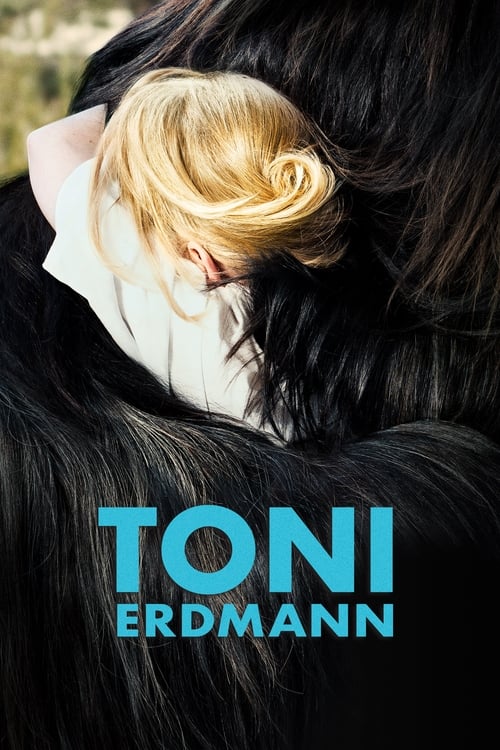
Toni Erdmann
2016 · Maren Ade
When you want to laugh until it hurts and then unexpectedly need to call your dad — a film for when you're up for something long, strange, and deeply human. Challenging in shape, comforting in heart.
What it's about
Winfried, a shaggy retired music teacher addicted to pranks and novelty teeth, becomes convinced his estranged daughter Ines — a high-pressure corporate consultant working in Bucharest — has forgotten how to laugh. So he shows up unannounced, invents an outrageous alter ego named Toni Erdmann, infiltrates her professional world in a bad wig, and simply refuses to leave.
The experience
A slow-burn comedy of pure squirming embarrassment that sneaks up on you emotionally — you wince, you laugh out loud at scenes of jaw-dropping audacity, and then it ambushes you with real tenderness. At 162 minutes it takes its time, and the length is exactly why the payoffs hit so hard.
Performances
Sandra Hüller and Peter Simonischek are astonishing together — she plays Ines's armored professionalism cracking by millimeters, he makes the father's clowning both ridiculous and quietly desperate. Two or three of their scenes together are among the most talked-about comic set pieces of the decade.
The craft
Maren Ade builds her comedy out of duration and discomfort: scenes run long past the point of politeness, the humor comes from real observed behavior rather than jokes, and the corporate world of consultants and team-building rituals is rendered with documentary sharpness. There's no score telling you how to feel — the laughs and the ache both arrive unassisted.
Why it matters
Its Cannes premiere produced one of the most unanimous critical raptures in recent festival memory, and it's credibly called the most important European film of the 2010s — a landmark for a generation of German filmmaking and for comedy taken seriously as art.
Snapshot
A 162-minute German-language comedy in which a bumbling, prank-addicted retired music teacher named Winfried Conradi travels to Bucharest to reconnect with his estranged daughter Ines, a high-pressure corporate consultant. Adopting a series of alter egos — most persistently "Toni Erdmann," complete with novelty teeth and a bad wig — he infiltrates her professional world and refuses to leave. The film refuses the conventions of both the family-reunion comedy and the social-realist drama, arriving instead at something formally distinctive: a sprawling, slow-burning work of embarrassment and grief that has been credibly described as the most important European film of the 2010s. Its Cannes premiere in May 2016 produced what is frequently cited as one of the most unanimous critical responses in recent festival memory.
Industry & production
Toni Erdmann was produced by Komplizen Film, the Berlin-based company co-founded by Maren Ade alongside producers Janine Jackowski and Jonas Dornbach. The company has become one of the most significant independent production houses in German-language cinema, associated with precisely calibrated, director-led projects. The film was a German-Austrian co-production; Austrian company Coop99 Filmproduktion was among the co-producers. Shooting took place primarily in Bucharest, Romania — used for its recognizable landscape of post-socialist corporate transition — as well as in Cologne and the surrounding area for the German sequences.
The film was distributed in German-speaking territories by Komplizen Film's distribution arm and internationally by several regional partners; Drafthouse Films handled North American release. It premiered in the main competition at the 2016 Cannes Film Festival, where it won the FIPRESCI Prize awarded by the international critics' jury. The Palme d'Or that year went to Ken Loach's I, Daniel Blake, a result that provoked considerable critical debate. In the subsequent awards cycle, Toni Erdmann won the European Film Award for Best Film (2016) and was Germany's submission for, and a nominee for, the Academy Award for Best Foreign Language Film at the 89th Academy Awards (2017). A Hollywood remake was announced by Paramount Pictures, with Adam McKay attached to direct and Jack Nicholson and Kristen Wiig in the lead roles; the project was shelved after Nicholson effectively retired from acting, a development that itself became a minor piece of film industry lore. The precise budget for the original film has not been widely published.
Technology
The film was shot digitally, almost certainly on the Arri Alexa, which was by 2015–16 the dominant acquisition format in European art cinema and the platform of choice for cinematographers seeking a film-like color response in natural light conditions — though the specific camera model has not been extensively documented in published interviews with the production team. No large-format or anamorphic lens systems were employed; the images retain a flat, documentary proximity consistent with the realist aesthetic Ade and cinematographer Patrick Orth pursued. Post-production conformed to standard digital intermediary workflows. There is no VFX or digital augmentation of note; the film's technical signature is defined by what it withholds rather than what it deploys.
Technique
Cinematography
Patrick Orth, a frequent Ade collaborator who also shot her second feature Everybody Else (2009), adopts a handheld observational mode that refuses to aestheticize its subjects. Shots tend to be long, wide-ish, and slightly off-axis — the camera rarely claims an authoritative vantage point. Interior spaces are lit to match available or practical sources wherever possible, giving the corporate environments of Bucharest their particular affectless glare. Orth's work resists the temptation toward beauty even in exteriors; the Romanian city is rendered neither picturesque nor grimly expressionist, simply present. The distance maintained between camera and character — a compositional reticence that recalls the work of Éric Rohmer and the Dardenne brothers without directly imitating either — allows the performances to breathe without cinematic mediation. Crucially, Orth does not signal which moments are important: the camera withholds editorial judgment, distributing attention across the film's 162 minutes with something close to democratic impassivity.
Editing
The editing by Heike Parplies is the film's invisible structural achievement. The cut rate is low by contemporary standards; sequences expand into durations that force the audience to inhabit discomfort rather than be rescued from it by rhythm. The famous "Greatest Love of All" karaoke sequence — in which Ines, cornered at a business dinner, begins singing Whitney Houston's song and escalates into something approaching genuine release — is permitted to run long enough that the tonal shift from comedy to emotion becomes formally irreversible. Parplies and Ade reportedly worked through an extensive post-production period to arrive at the film's final structure; the sheer running time suggests a process of accretion rather than compression, with sequences given room to find their own endings.
Mise-en-scène / staging
Ade's staging draws on the tradition of behavioral cinema: actors move through spaces governed by practical necessity, and the camera accommodates them rather than choreographing their movement. The film's set pieces depend on this quality of apparent spontaneity. The birthday party sequence — in which Ines, alone in her apartment, receives an unexpected visitor and resolves the situation by simply opening the door naked and declaring the gathering a "naked" party, which her baffled guests then comply with — works because the staging refuses to editorialize. The scene is funny and terrible and moving all at once, and its staging trusts the audience to hold those registers simultaneously. Corporate offices, hotel lobbies, and business dinners are rendered with the specificity of lived experience rather than design; the world feels like it was found rather than built.
Sound
There is no composed score. Music appears only as source sound — the Whitney Houston track, a German pop song, an Easter choral performance near the film's opening. This is not a novel choice in European art cinema, but Ade and sound designer Andreas Mücke-Niesytka use the absence of underscore with particular intent: the film offers no affective cues, no tonal guidance about how to feel. Ambient sound — office noise, street sound, the hum of airport terminals — fills the film with the textures of contemporary mobile professional life. The silences between characters carry enormous weight precisely because they are not musically inflected.
Performance
Peter Simonischek, a veteran of the Vienna Burgtheater, brings to Winfried a quality of patient, slightly desperate warmth that never collapses into sentimentality. The role requires him to sustain multiple registers — clownishness, melancholy, genuine unsettling intrusion — and the performance's achievement is that none of these modes feels like the "real" one underlying the others. Sandra Hüller's Ines is among the major screen performances of the decade. Hüller, who had established herself in German theater and film (most notably in Requiem, 2006, for which she won the Silver Bear at Berlin), creates a character whose self-presentation is so carefully managed that its occasional ruptures are genuinely shocking. Her physical precision — the way Ines holds her body, inhabits her professional wardrobe, modulates her voice across languages and contexts — is the film's actual subject as much as its narrative. The dynamic between Simonischek and Hüller resists every opportunity for easy resolution; they do not arrive at clarity, which is the film's most honest formal choice.
Narrative & dramatic mode
Toni Erdmann operates through accumulation and adjacency rather than classical plot mechanics. There is no crisis that demands resolution, no clear antagonist, no conventional arc of change. The narrative mode is closer to the novel of manners — specifically to the European comic tradition that runs from Thomas Bernhard through the socially mortifying observations of contemporary auteurs — than to the cause-and-effect construction of mainstream comedy. Scenes often end before their apparent conclusion; conversations are interrupted or abandoned. The film's forward movement comes less from event than from the deepening of attention: we become increasingly precise readers of Ines and Winfried's performances of self, and the comedy accrues from the collision of two highly developed but incompatible self-presentations. The film's dramatic mode is finally tragicomic in the classical sense: it holds suffering and absurdity in suspension without resolving either.
Genre & cycle
The film belongs to a loosely defined cycle of European art comedy — a mode that became increasingly visible in the 2010s alongside works by Ruben Östlund (Force Majeure, 2014; The Square, 2017), Miguel Gomes, and others — in which comedy functions not as relief but as diagnostic. These are films that deploy cringe, embarrassment, and social transgression to anatomize contemporary European life: its class structures, its professional ideologies, its gender arrangements. Within German cinema specifically, Toni Erdmann participates in a long tradition of work interrogating the German family and its suppressions, though Ade's treatment of the father-daughter dyad is notably free of the expressionist weight that burden much German-language Vaterfilm. The film also connects, obliquely, to the European critique of neoliberal corporate culture legible in the work of the Dardenne brothers and others — though Ade refuses the moralistic framing such readings might imply.
Authorship & method
Maren Ade studied at the Hochschule für Fernsehen und Film München (University of Television and Film Munich) and has made three features to date, each expanding her formal ambitions while maintaining a consistent concern with power, intimacy, and performance within relationships. The Forest for the Trees (2003) and Everybody Else (2009) — the latter winning the Silver Bear Grand Jury Prize at the 2009 Berlinale — established her as a rigorous, patient filmmaker whose interests converge on the mechanisms by which people perform acceptable selves for one another. Ade wrote the screenplay for Toni Erdmann herself, a process she has described as taking several years and involving substantial structural rethinking; the film's apparently loose texture is the product of precise formal planning.
Cinematographer Patrick Orth and editor Heike Parplies are the film's principal collaborators, and both have worked with Ade across multiple projects. The absence of a composer is itself an authorial statement. As a producer, Ade has also been instrumental in the development of other significant German-language films through Komplizen Film, including work by Christian Petzold — a detail that situates her within the broader ecology of contemporary German cinema as both director and institutional force.
Movement / national cinema
Toni Erdmann is a product of the loose formation sometimes called the Berlin School or its aftermath — a tendency in German cinema that emerged in the late 1990s and 2000s around filmmakers including Christian Petzold, Angela Schanelec, Thomas Arslan, and others, characterized by a shared commitment to formal rigor, observational distance, and social specificity. Ade is adjacent to rather than strictly within this movement; her sensibility is warmer and more explicitly comic than the cooler registers favored by the core Berlin School figures. But the formal commitments — naturalistic performance, long takes, ambient sound, refusal of melodrama — place her work in recognizable proximity. Toni Erdmann's international success brought unprecedented visibility to German-language art cinema, and the film's Cannes profile helped consolidate a renewed sense of German cinema's place in the global festival ecosystem.
Era / period
The film is a document of European life in the mid-2010s: the age of mobile professional classes, cross-border consultancy, the post-2008 restructuring of Eastern European economies under Western corporate pressure, and a pervasive anxiety about what productive lives are actually for. The Bucharest setting is not incidental: Romania's integration into the European corporate economy provides the film with a landscape where the costs of modernization are legible in ways they are not in Berlin or Frankfurt. That a German consultant oversees the rationalization of a Romanian oil company — a process that will involve local layoffs — gives the film's comedy an undertow of political meaning that is never made explicit but is never absent either.
Themes
The film's central preoccupation is the relationship between performance and authenticity — a question posed as both personal and political. Ines has constructed a professional self so complete that her father, arriving as an agent of disruption, cannot find a point of entry; his pranks and disguises mirror rather than oppose her own strategies of self-presentation. The film asks whether joy can survive the discipline required by contemporary professional life, and whether the categories of "work" and "self" can be meaningfully separated. It is also a film about fathers and daughters, and specifically about the particular kind of helplessness felt by a parent who cannot reach a child who has successfully become someone else. Gender is implicated throughout: the film is minutely attentive to the additional labor Ines must perform as a woman in corporate environments — the management of male colleagues' comfort, the navigation of professional spaces that are not designed for her. Winfried's obliviousness to these pressures is both comic and damning.
Reception, canon & influence
Critical reception. The Cannes premiere in May 2016 produced near-universal acclaim; Screen International's Cannes jury grid, which aggregates critics' scores, ranked Toni Erdmann the highest-rated film in competition by a significant margin. Cahiers du Cinéma, Sight & Sound, Film Comment, and most major English and European critical publications placed it among the best films of 2016; several ranked it first. The consensus was unusual in its breadth: critics who rarely agreed found common ground in the film's achievement. The FIPRESCI Prize was a mild institutional acknowledgment of this consensus, though many critics were vocal about what they considered the main jury's failure to award the Palme d'Or.
Influences on the film (backward). Ade has cited John Cassavetes as a formal reference point — specifically his commitment to performance and duration as the primary cinematic materials. The film's observational mode connects it to Éric Rohmer's conversational cinema and to the behavioral naturalism of the Dardenne brothers. Within German-language cinema, the inheritance of Thomas Bernhard — whose comedy is rooted in social humiliation and the relentless exposure of bourgeois self-deception — is legible in the script's structure and in Winfried's function as an irritant who reveals what comfort conceals. The Romanian New Wave (Cristi Puiu, Cristian Mungiu) arguably informed the approach to shooting in Bucharest, though the film is not part of that movement and the connection has been noted by critics rather than confirmed by Ade.
Legacy and forward influence. Most concretely, Toni Erdmann launched Sandra Hüller to international prominence; her subsequent roles in Anatomy of a Fall (2023, Palme d'Or, directed by Justine Triet) and The Zone of Interest (2023, directed by Jonathan Glazer) established her as perhaps the defining European film actress of the period, and both of those films might be understood as building on the appetite for her specific kind of rigorous, interior performance that Toni Erdmann created. The film contributed to a broader critical conversation about the underrepresentation of women directors in major festival competition, and Ade's profile — as both director and producer — became a reference point in those debates. Its influence on subsequent European comedy-drama is harder to trace with precision, as is typically the case with formally distinctive work; but the film's demonstration that a 162-minute German comedy could achieve unanimous international acclaim and near-canonical status within two years of release has not gone unnoticed by the industry ecosystem in which future films are commissioned and funded.
A Deleuzian reading
Start with the teeth.
The full Deleuzian reading of Toni Erdmann →
Reception
It premiered at Cannes 2016 as the best-reviewed film of the festival — then the jury famously gave it nothing, a snub critics groused about for years. It topped the Sight & Sound and Cahiers du Cinéma polls that year anyway, and Sandra Hüller's later ascent (Anatomy of a Fall, The Zone of Interest) keeps sending new viewers back to where international audiences first met her.
How Toni Erdmann was received, from release to now →
Influences: the films it descends from and the films it influenced
- A Woman Under the Influence (1974) — Ade cited Cassavetes directly; his extended-take method in which Rowlands navigates multiple emotional registers without editorial signaling establishes the formal principle Ade applies — performance duration as primary cinematic material, with the actor's body rather than plot as the site of tragicomic tension.
- Ma Nuit chez Maud (1969) — Ade cited Rohmer; his conversational cinema locates all dramatic action in the behavioral nuances of extended dialogue scenes where social performance and private desire are inseparable, providing the formal model for Toni Erdmann's talk-based sequences with no score to signal emotional valence.
- Le Fils (2002) — Explicitly cited in the film's dossier; the Dardennes' close-following handheld attached to an actor's back, combined with diegetic-only sound and no score, uses physical behavior rather than dialogue to externalize interior states — the specific observational grammar Ade inherits for her Bucharest sequences.
- Jeanne Dielman, 23 quai du Commerce, 1080 Bruxelles (1975) — Akerman's accumulation structure — meaning built through patient behavioral observation of domestic routine rather than dramatic incident, significance accruing through duration — is the formal ancestor of Toni Erdmann's 162-minute refusal to summarize its characters psychologically.
- 4 Months, 3 Weeks and 2 Days (2007) — Mungiu's long-take static camera recording social discomfort in real time during his dinner party sequence directly anticipates Toni Erdmann's own party scenes; his diegetic-only interior sound design in crowded Romanian spaces is a technique the dossier explicitly identifies as inherited by Ade.
- The Death of Mr. Lazarescu (2005) — Puiu's observational handheld follows a protagonist through institutional systems using only diegetic sound, rendering bureaucratic dark comedy and human tragedy formally indistinguishable — the template for Ade's treatment of Winfried's corporate disruptions as simultaneously farcical and devastating.
- The Seventh Continent (1989) — Carries the deadpan, unscored observation of corporate-bourgeois routine and emotional glaciation, sustaining long anti-dramatic takes that locate dread in the surfaces of professional affluence.
- The Firemen's Ball (1967) — Modern heir to the observational tragicomedy of social embarrassment — long, patient behavioral takes where a group's mannered decorum collapses into humiliating comedy.
- Anatomy of a Fall (2023) — Sandra Hüller's casting draws directly on the multi-register performance economy Toni Erdmann established internationally — charming and cold, truthful and performed simultaneously — while the courtroom accumulation structure extends Ade's method of building interpretive uncertainty through sustained behavioral duration rather than revelation.
- The Zone of Interest (2023) — Sandra Hüller's performance of domestic normalcy with complete interior opacity builds on the behavioral register developed in Toni Erdmann; Glazer's exclusive use of diegetic ambient sound — offscreen industrial noise replacing any composed score — extends Ade's diegetic-only sound strategy to its most extreme expression.
- Undine (2020) — Produced by Komplizen Film (Ade's company) after Toni Erdmann's success expanded international appetite for German behavioral cinema; Paula Beer's simultaneous emotional availability and withholding echoes the performance register Hüller established, while Petzold's diegetic-only sound design is continuous with the formal norms Ade helped institutionalize.
- Everybody Else (2009) — Ade's own prior feature deploys the identical formal apparatus — handheld behavioral observation, low cut rate, diegetic-only sound, available light — to investigate performance and power within a couple, functioning as the direct technical prototype from which Toni Erdmann inherits its entire grammar.
- Barbara (2012) — Petzold's Berlin School behavioral naturalism — available light, long observational takes recording a protagonist's controlled exterior concealing interior resistance, diegetic sound — circulates within the same ecosystem Ade inhabits as Petzold's producer through Komplizen Film, constituting an active peer exchange of formal norms.
- Winter Sleep (2014) — Extended long-take dialogue scenes expose bourgeois self-deception through behavioral performance without musical editorializing; the drama lives in the gap between a character's spoken self-justification and what the body betrays, sharing Toni Erdmann's accumulation structure and its comedy of unmasked social performance.
- Happy Hour (2015) — The 317-minute low-cut-rate accumulation structure uses ensemble behavioral performance in long-duration scenes to investigate how people perform authenticity within social scripts — duration as the instrument for revealing what shorter films can only assert, a formal logic identical to Ade's.
- Certified Copy (2010) — Long-take conversational cinema with available light investigates whether a relationship is performed or real; performance-vs-authenticity is simultaneously the film's explicit subject and its formal method, mirroring Toni Erdmann's structural preoccupation at both levels.
- Force Majeure (2014) — European tragicomedy using long takes to record social humiliation in real time without musical commentary, comedy arising from behavioral contradiction rather than joke structure — sharing Toni Erdmann's interest in the performance of social adequacy and the genre's refusal to privilege comedy over devastation.
- The Worst Person in the World (2021) — European art comedy using behavioral naturalism and a tragicomic register that refuses to privilege comedy over pathos, with a protagonist navigating performed selves across social and romantic contexts — sharing Toni Erdmann's preoccupation with authenticity-as-performance within a contemporary bourgeois milieu.
- The Square (2017) — Sustains agonizing comedy of embarrassment among the professional class through long unbroken takes that let social mortification play out in real duration, the contemporary parallel to Östlund's duration-as-tension.
- Another Round (2020) — European tragicomedy of tonal-modulation that builds to a single needle-drop set-piece performance — the Whitney Houston number — detonating suppressed feeling exactly as Mikkelsen's final dance does.
- A Poet (2025) — A long, loose, behavior-forward character study whose comedy and feeling are generated entirely through escalating awkwardness and social humiliation—the same digressive editing logic.
Similar films
- The Worst Person in the World (2021) — influence & lineage
- Anatomy of a Fall (2023) — influence & lineage
- 4 Months, 3 Weeks and 2 Days (2007) — influence & lineage
- Do Not Expect Too Much from the End of the World (2023) — shared sensibility
- Sound of Falling (2025) — shared sensibility
- Sentimental Value (2025) — shared sensibility
- The Phoenician Scheme (2025) — shared sensibility
- Jeanne Dielman, 23, quai du Commerce, 1080 Bruxelles (1976) — shared sensibility