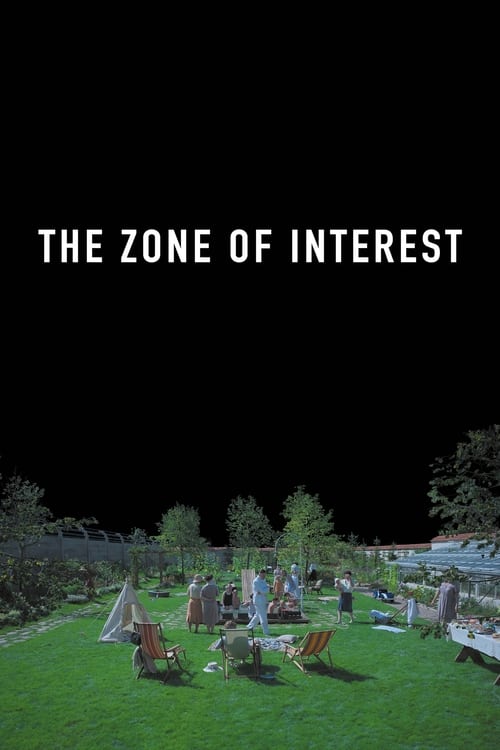
The Zone of Interest
2023 · Jonathan Glazer
The Holocaust film as sound-design dare, then Glazer's Oscar speech about Gaza turned it into the most contested acceptance moment in memory, with dueling open letters from hundreds of industry figures.
For when you want cinema at its most serious — a film to watch with full attention and talk about afterward, not to unwind with. Choose it when you're ready to be genuinely disturbed by an idea rather than an image.
What it's about
Rudolf Höss, the commandant of Auschwitz, lives with his wife Hedwig and their children in a handsome villa with a swimming pool and a lovingly tended garden — and the camp's wall runs along the property line. The film simply observes the family's domestic routine: birthdays, gardening, career worries, visits from relatives. The atrocity next door is never shown; it's always there in the sounds drifting over the wall.
The experience
Chilling in a way almost no film is — placid, even banal on the surface, while the soundtrack's distant drone, shots, and screams do their work on you. It demands you sit with your own ability to tune horror out, and it leaves a residue that lasts for days.
Performances
Sandra Hüller is frighteningly good as Hedwig, playing a woman fully absorbed in her garden and her status with not a flicker of performance-signaled guilt — the ordinariness is the horror.
The craft
Glazer shoots the house with fixed, dispassionate cameras, like surveillance footage of family life, and hands the film's true content to its extraordinary sound design — the genocide exists entirely on the soundtrack. This is a film where good speakers or headphones aren't a luxury; the sound is the movie.
Why it matters
It won the Grand Prix at Cannes in 2023 and immediately reset the conversation about how — and whether — cinema should depict the Holocaust, with its sound work becoming an instant landmark of the craft.
Snapshot
The Zone of Interest is Jonathan Glazer's fourth feature and his most formally radical reckoning with how cinema can — or should — represent the Holocaust. It observes the household of Rudolf Höss, commandant of Auschwitz, and his wife Hedwig as they cultivate a comfortable bourgeois idyll in a villa whose garden wall is the camp's perimeter. The atrocity is never shown. It exists entirely off-screen and on the soundtrack: a low industrial drone, distant gunshots, screams, the chuffing of trains and crematoria, smoke drifting across a clear sky. The film's governing idea is the partition between the seen and the heard, between domestic foreground and genocidal background, and the spectator's discomfort at how easily the family tunes the latter out. Premiering in competition at Cannes in May 2023, it won the Grand Prix, and went on to take the Academy Awards for Best International Feature (representing the United Kingdom) and Best Sound, with further nominations including Best Picture and Best Director. It stands as one of the defining art films of its decade and a landmark in the long argument — running from Lanzmann through Haneke — about the ethics of depicting the unrepresentable.
Industry & production
The film was produced by A24 (which also handled US distribution) with Film4 and Access Entertainment, and was a UK–Poland–US co-production, with Glazer's longtime producer James Wilson among the producing team. It is loosely derived from Martin Amis's 2014 novel of the same title, though Glazer discarded almost all of Amis's plot and invented characters, returning instead to the historical Höss family. The development was famously protracted — consistent with Glazer's decade-long gaps between features (Sexy Beast 2000, Birth 2004, Under the Skin 2013) — and involved extensive archival and testimonial research into the real geography of the Höss residence beside Auschwitz I.
Production was based in Poland, with the household reconstructed near the actual site. Glazer and his team rebuilt the Höss house and replanted Hedwig's garden adjacent to the camp wall, working from historical records of the original. Sandra Hüller, then among the most acclaimed German actors of her generation, took the role of Hedwig, with Christian Friedel as Höss; the cast performed in German. The film's modest scale — a chamber piece, essentially, confined to a house and garden — belied an unusually research-intensive and technically ambitious shoot. Precise budget and box-office figures are not something I can responsibly state here; the film performed strongly for a subtitled art release on the festival-and-awards circuit but I won't invent numbers.
Technology
The most consequential technological choice was the shooting method. Rather than conventional coverage, Glazer and cinematographer Łukasz Żal rigged the reconstructed house with a network of hidden, remotely operated cameras — by widely reported accounts roughly ten cameras running simultaneously, positioned around the rooms like a surveillance or reality-television installation. Crew and director worked from a separate monitoring space, so that the actors moved through the house largely unobserved by an on-set apparatus, performing continuously across whole rooms rather than to a single lens. This produced the film's distinctive flat, frontal, observational framing and its sense of a domestic ecosystem caught rather than staged.
The second key technology was thermal/infrared imaging, used for the nocturnal sequences in which a local Polish girl moves through the dark leaving food for prisoners. Shot so that figures glow ghost-white against black, these passages register as a tonal and moral negative of the daylight scenes — the one gesture of human resistance rendered in a register utterly unlike the rest of the film. Otherwise the film relies heavily on available and naturalistic light, in keeping with the hidden-camera approach.
Technique
Cinematography
Żal — the Polish cinematographer of Ida and Cold War — composes in cool, clean, almost clinical wide and medium shots, frequently symmetrical and static, with the camera held at a slight remove. The look is deliberately un-beautiful in the conventional sense: bright, even, documentary-flat, refusing the burnished tragic lighting one expects of Holocaust cinema. The garden blooms in saturated color; the wall and guard tower sit at the edge of frame as banal architecture. The multi-camera scheme means compositions often feel found rather than authored, with characters wandering in and out of frame. Punctuating the naturalism are several non-representational interludes — a screen saturated in red, and a blinding white-out — that function as ruptures, refusals of the image, where the film withdraws into pure color and sound.
Editing
Paul Watts's editing favors duration and juxtaposition over momentum. Scenes play long, in real or near-real time, building an accretion of routine — breakfasts, garden tours, bureaucratic meetings about crematorium efficiency delivered in the same flat register as any office logistics. The cutting logic is spatial and ironic rather than dramatic: it lets the soundtrack's horror bleed across cuts and trusts the viewer to supply the connective moral inference. The film's most discussed editorial gesture is its coda, in which Höss, pausing on a darkened staircase and retching, is intercut with present-day footage of the Auschwitz-Birkenau State Museum — cleaners and curators tending the exhibits, the piled shoes behind glass — collapsing the historical past into the maintained memorial present.
Mise-en-scène / staging
The mise-en-scène is the film's argument. Every element of the household — manicured flowerbeds, a greenhouse, a pool, fur coats and confiscated lingerie tried on by the family, children playing — is staged against the constant proximity of the wall, the smokestacks, the noise. Hedwig presides over her garden as a domestic sovereign (the dialogue's "Queen of Auschwitz" epithet); Höss reads bedtime stories. The staging is naturalistic and uninflected precisely so that the obscenity is structural rather than underlined. Glazer withholds editorializing camerawork; the horror is a question of what shares the frame, and of what the characters have trained themselves not to see.
Sound
Sound is where the unshown atrocity lives, and it is the film's true co-author. The sound designer Johnnie Burn built the off-screen camp from extensive research — survivor testimony, the camp's physical geography, documentation of which sounds would have carried over the wall — assembling a vast library and a detailed map of the soundscape so that gunshots, commands, machinery, and human cries are spatially and historically plausible relative to the house. The result is a continuous, almost subliminal layer of dread that the family ignores and the audience cannot. Burn's work, with the re-recording mix, won the Academy Award for Best Sound and is among the most significant sound-design achievements in recent narrative film. The film also opens on an extended black screen carrying only Mica Levi's score, conditioning the ear before the eye is ever engaged.
Performance
Christian Friedel plays Höss with chilling administrative blankness — a functionary's calm, attentive to logistics and career, affectionate to his children, emotionally sealed. Sandra Hüller's Hedwig is the more frightening creation: proprietary, comfortable, contemptuous, fiercely defensive of the home she has built on plunder, refusing to leave when her husband is transferred. Because of the hidden-camera method, the performances avoid the legibility of conventional screen acting; the actors inhabit routine rather than play scenes toward the lens, which is exactly what gives the characters their opacity. Hüller — who the same year also led Anatomy of a Fall — drew particular acclaim for refusing any flicker of conscience that might let the audience off the hook.
Narrative & dramatic mode
The film is largely plotless in the conventional sense, organized as a series of observed domestic episodes rather than a causal dramatic arc. Its loose narrative spine is Höss's professional advancement and a proposed transfer that threatens Hedwig's attachment to the house. The dramatic mode is observational and ironic — closer to structural or "dedramatized" cinema than to the historical melodrama the subject usually invites. Meaning is generated by the gap between foreground (mundane family life, rendered with full sympathy of attention) and background (industrialized murder, rendered only as sound and smoke). It is a film built on dramatic irony in its purest form: the audience holds the knowledge the film's surface withholds.
Genre & cycle
Nominally a historical war drama, The Zone of Interest belongs more precisely to the lineage of Holocaust cinema and, within that, to the strain that interrogates the act of representation itself. It positions itself against the empathetic, victim-centered, dramatically cathartic tradition (Schindler's List being the implicit antagonist) and aligns instead with Claude Lanzmann's refusal of reenactment, with Elem Klimov's Come and See, and with the perpetrator-focused unease of films like The Conformist and the cool moral provocations of Michael Haneke. It also participates in a contemporary cycle of art films about perpetration and complicity, and in the "slow cinema"–adjacent register of duration and observation.
Authorship & method
The film is unmistakably Glazer's — the culmination of a body of work (Birth, Under the Skin) preoccupied with estrangement, the alien within the ordinary, and form as moral instrument. His method here was to remove the director's hand from the actors' space and to build an apparatus that would observe rather than dramatize, a conceptual rigor closer to installation art than to standard narrative filmmaking. The key collaborators are integral to that authorship: cinematographer Łukasz Żal, whose flat naturalism enacts the film's refusal of aesthetic consolation; composer Mica Levi, reuniting with Glazer after Under the Skin for a spare, eerie score concentrated at the film's edges (overture, white-outs, coda) rather than scoring scenes; editor Paul Watts; and sound designer Johnnie Burn, whose construction of the off-screen camp is arguably the film's central creative act. Glazer himself adapted the screenplay, departing radically from Amis's novel to anchor the film in the historical Höss family.
Movement / national cinema
The film resists tidy national classification — a British-led production, shot in Poland, in the German language, by a British auteur, about German history, on Polish soil. It was the United Kingdom's submission for the international Oscar, which it won, making it part of British art cinema's auteur tradition even as its texture is thoroughly Central European, indebted to Polish cinematography (Żal) and to the physical and moral weight of shooting at the actual site. It belongs less to a national movement than to a transnational art-cinema culture organized around festivals (Cannes), A24-style distribution, and a self-conscious post-Lanzmann ethics of representation.
Era / period
Made and released in 2023, the film sits at a moment of renewed urgency about historical memory, the testimony of the last living survivors, and the resurgence of authoritarian and antisemitic politics — contexts that sharpened its reception and that Glazer addressed pointedly (and divisively) in his Oscar acceptance speech, drawing a line from the film's warning to the present. Formally it reflects a 2020s art-cinema appetite for dedramatized, conceptually severe approaches to historical horror. Its setting is the early 1940s, at the height of the camp's operation, reconstructed with documentary fidelity to the Höss household's real life beside Auschwitz I.
Themes
The film's central theme is the banality of evil in Hannah Arendt's sense — atrocity as administered routine, sustained by ordinary people pursuing ordinary ambitions and comforts. Around it cluster: complicity and willed not-seeing (the wall as a psychological as much as physical partition); the domestication of plunder (the family living on stolen wealth, wearing the dead's clothing); the ethics of the image and the limits of representation; the continuity between perpetrator comfort and a manicured idea of the good life. The thermal-camera resistance plot and the museum coda extend the theme into the present, asking what it means to preserve, view, and clean up after such history — implicating the spectator in the act of looking.
Reception, canon & influence
Critical reception was extraordinary, with particular praise for its formal audacity and its sound design; it was widely cited among the year's and the decade's most important films, though some critics debated whether its rigorous distancing risked aestheticizing or even anaesthetizing the horror it withholds. It won the Cannes Grand Prix in 2023 and the Academy Awards for Best International Feature and Best Sound, with nominations for Best Picture, Best Director, and Best Adapted Screenplay among others.
Its influences run backward to Claude Lanzmann's Shoah and its prohibition on reenactment, to Michael Haneke's cinema of complicity and off-screen violence, to Come and See, and to a broader modernist tradition (Bresson, Akerman) of duration and ascetic form; the perpetrator's-eye-view recalls The Conformist. Its forward legacy is still forming, but it has already become a reference point in debates about Holocaust representation and is likely to influence how filmmakers handle off-screen atrocity, sound-as-subject, and the ethics of the perpetrator perspective — reorienting the conversation, as Lanzmann once did, away from depiction and toward what is deliberately left unseen. Given its recency, claims about its long-term canonical standing remain provisional, but its immediate critical and institutional consecration was decisive.
A Deleuzian reading
A wall runs along the back of a garden.
The full Deleuzian reading of The Zone of Interest →
Reception
It arrived at Cannes 2023 as an instant event — Grand Prix, then Oscars for Best International Feature and Best Sound — and has only hardened into 'defining Holocaust film of its era' status since; the discourse around Glazer's 2024 Oscar acceptance speech gave it a second, very heated life beyond cinephile circles.
How The Zone of Interest was received, from release to now →
Influences: the films it descends from and the films it influenced
- Shoah (1985) — Establishes the prohibition on reenactment — rendering the camps through testimony, absence and present-day landscape rather than depiction, the discipline Glazer extends by withholding the camp from the image entirely.
- Night and Fog (1956) — Tracks through the emptied, present-tense camp and intercuts it with the museum/archive register — the formal seed of Glazer's coda that cuts to the Auschwitz museum's cleaning staff and display cases.
- Come and See (1985) — Pioneers the researched, immersive war soundscape and the ringing, dissociated off-screen aural field — the model for Johnnie Burn's construction of atrocity carried by sound alone.
- Caché (2005) — Uses the static, surveillance-like fixed frame to implicate the watcher and locate violence off-screen — the cinema of complicity Glazer formalizes into an observational apparatus.
- Funny Games (1997) — Keeps the killings off-screen and turns the act of representation into the film's subject, foregrounding the ethics of who is permitted to watch.
- The White Ribbon (2009) — Deploys flat, anti-aesthetic naturalist framing of orderly domestic/communal life as the seedbed of atrocity — banality staged with refused consolation.
- The Conformist (1970) — Inhabits the fascist functionary's point of view, modeling the perpetrator's-eye perspective and administrative blankness Glazer gives the Höss household.
- Jeanne Dielman, 23 quai du Commerce, 1080 Bruxelles (1975) — Builds drama from real-time domestic routine in fixed, frontal frames where the catastrophe sits in the gaps — duration-over-momentum as moral form.
- Au Hasard Balthazar (1966) — Ascetic, dedramatized construction and the use of affectless 'models' rather than performances — the lineage of administrative blankness and refusal of psychology.
- Sátántangó (1994) — Privileges sustained duration and observational stasis over narrative propulsion, the modernist long-take patience Glazer adopts to deny momentum.
- Under the Skin (2013) — Glazer's own prototype for the hidden multi-camera rig observing performers without a director in the space, plus Mica Levi's eerie score concentrated at the film's edges rather than scoring scenes.
- Birth (2004) — Develops Glazer's estrangement of the ordinary through held takes and performative blankness — form as a moral instrument, carried forward into the Höss domestic frame.
- The Act of Killing (2012) — Centers the perpetrators' banal, domestic and bureaucratic self-presentation, exposing the administrative blankness of genocide from inside the killers' everyday.
- The Voice of Hind Rajab (2025) — Renders mass atrocity entirely off-screen through a designed soundscape of unseen horror, refusing to aestheticize death—a shared ethics underlined by common producer James Wilson.
- Sound of Falling (2025) — Concrete off-screen sound design carrying the film's real meaning beyond a fixed domestic house set, sound weighted above any score.
- Society of the Snow (2023) — Both films subordinate dialogue systematically to environmental sound design as a formal strategy for rendering collective historical atrocity as quotidian reality; they competed in the same Academy Awards cycle as formally convergent ethical responses to mass survival and witness.
- The Girl with the Needle (2024) — Glazer's use of industrial ambience as the primary sonic carrier of horror and his depth-of-field staging that places structural evil at the threshold of visibility — refusing catharsis or moral resolution, making the audience's proximity to violence the ethical question — is the closest contemporary sibling in how horror is conveyed through mise-en-scène and sound design rather than dramatic event.
- Green Border (2023) — A Venice-2023 companion in craft: it stages atrocity through the lens of nature's indifference and bureaucratic bystander complicity, the same moral-complicity register Holland works.
- Yellow Letters (2026) — Administrative violence staged as domestic routine: the horror exists only in Johnnie Burn's offscreen sound field and in paperwork read aloud at a kitchen table, with Mica Levi's low percussive drones supplying the dread the static, unemphatic framing refuses to.
- Tuner (2026) — Johnnie Burn's year-built sound library and Atmos placement make off-screen audio the film's actual subject while the image stays flat and available-light, the strongest recent argument that a mix, not a camera, can organize a whole picture.
Similar films
- Son of Saul (2015) — influence & lineage · same viewing thread
- Shoah (1985) — influence & lineage · same viewing thread
- Sound of Falling (2025) — influence & lineage
- The Voice of Hind Rajab (2025) — influence & lineage
- The White Ribbon (2009) — influence & lineage
- The Pianist (2002) — same viewing thread
- Schindler's List (1993) — same viewing thread
- The Fifth Seal (1976) — same viewing thread
All the films related to The Zone of Interest →
Watch it with: curated runs of related films
- In the Shadow of the Reich — A run of films about ordinary people inside the Nazi era — surviving it, resisting it, or trying to reckon with how it happened — that rhyme on conscience, complicity, and who chooses to act.