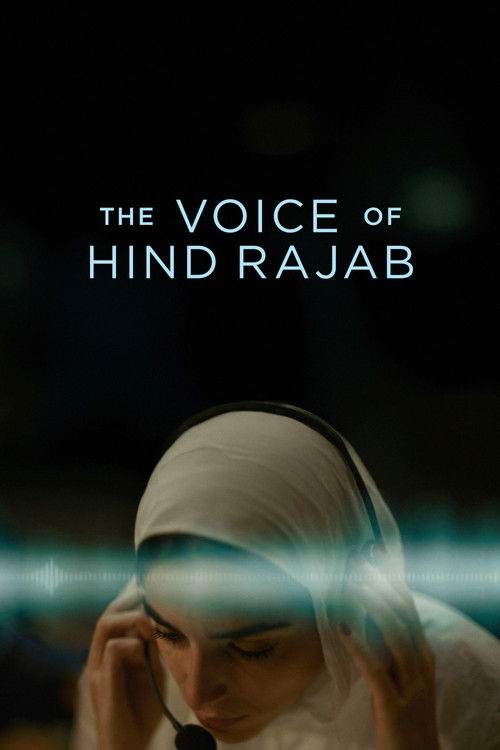
The Voice of Hind Rajab
2025 · Kaouther Ben Hania
Four Daughters' hybrid form earned an Oscar nod, then The Voice of Hind Rajab — built around the real audio of a Palestinian child's final phone call — drew a record-breaking Venice ovation and became the most emotionally charged festival event of 2025.
Not an easy night in — reach for it when you're ready to bear witness and want cinema that confronts the news rather than escaping it. Watch it when you have space afterward to sit with what you've seen.
What it's about
On January 29, 2024, dispatchers at the Palestine Red Crescent in Ramallah receive an emergency call: a five-year-old girl named Hind Rajab is trapped in a car under fire in Gaza, pleading for rescue. The film stays inside the call center with the volunteers who try to keep her on the line while fighting to get an ambulance cleared to reach her. Its defining choice is that the child's voice is not performed — Ben Hania builds the drama around the real recordings of the actual emergency calls.
The experience
Almost unbearably tense and deeply wrenching — a real-time vigil where the stakes are total and the helplessness is shared with everyone on screen. It is devastating by design, and it stays with you long after; this is a film you absorb more than watch.
Performances
The actors playing the dispatchers carry the film with wrenching restraint — professionals trying to hold their voices steady for a child while coming apart — and they're acting opposite the most powerful element in the film: Hind's actual recorded voice.
The craft
Ben Hania's docudrama construction is the story — roughly seventy minutes of authentic Red Crescent audio woven into a reconstructed call center, blurring the line between document and drama with rigorous purpose. The sound is everything here: a film experienced largely through a phone line, it demands quiet and attention rather than spectacle.
Why it matters
One of the most talked-about and argued-over films of its year, it turned a single documented emergency call into an international reckoning with the war in Gaza and pushed the boundary of what documentary material can do inside fiction.
Snapshot
The Voice of Hind Rajab is an 89-minute docudrama, a Tunisian–French production directed and written by Kaouther Ben Hania, built around a single, almost unbearable premise: on 29 January 2024, dispatchers at the Palestine Red Crescent Society in Ramallah stayed on the phone with a small child trapped in a car under fire in Gaza, trying to keep her alive long enough for an ambulance to reach her. The child was Hind Rajab—six years old by most accounts, five in some—and the film's central, defining gambit is that her voice is not performed. Ben Hania obtained the Red Crescent's authentic recording of the emergency calls, roughly seventy minutes of material, and constructed a fiction around it: actors play the dispatchers and crisis coordinators in a reconstructed call center, but the voice pleading from the wreckage is the real one. The result premiered in competition at the 82nd Venice International Film Festival on 3 September 2025, took the Silver Lion Grand Jury Prize, drew a standing ovation reported among the longest in the festival's history, and went on to a Best International Feature nomination at the Academy Awards as Tunisia's submission. It is at once a procedural thriller, a work of mourning, and a deliberate act of documentary preservation.
Industry & production
The film's industrial profile is unusual: a modestly scaled Arab-European art film carrying an extraordinarily heavy bench of international backers. It was produced by Nadim Cheikhrouha—Ben Hania's longtime producer, whose company Tanit Films, alongside Mime Films, anchors the production—together with Odessa Rae (an Oscar winner for Navalny) and James Wilson (a producer on Jonathan Glazer's The Zone of Interest). It is a Tunisia–France co-production, made in association with Film4, MBC Studios, WILLA, and Plan B Entertainment among other partners. The executive-producer roster became a story in itself: Brad Pitt, Dede Gardner and Jeremy Kleiner through Plan B, plus Joaquin Phoenix, Rooney Mara, Alfonso Cuarón, Jonathan Glazer, Spike Lee, Michael Moore, and Jon Kilik, among others.
That alignment of marquee names behind a film about a Palestinian child killed in Gaza is significant context rather than mere glamour: it signals an attempt to give a politically combustible subject the protective weight and distribution reach of established Hollywood prestige. The film was acquired for U.S. release by WILLA, with a streaming life subsequently reported on Hulu. As with much of Ben Hania's career, the production sits at the intersection of European public-service financing (Film4), Gulf regional capital (MBC Studios), and Maghrebi authorship—a configuration that has become characteristic of the most visible Arab cinema reaching Western festivals.
Technology
Technologically the film is defined less by image-capture novelty than by its treatment of recorded sound as primary document. Shot digitally by Juan Sarmiento G., it is a contemporary, controlled-environment production; the public record is thin on specific camera or lens choices, and it would be invention to assign them. The decisive technical idea is the integration of the authentic telephone audio into a constructed dramatic space. Ben Hania foregrounds the data of the recording itself: the film at points displays audio waveforms and digital file names on screen, and at moments overlays the real dispatcher voices against the actors' performed lines. This is a technological gesture with an ethical purpose—it insists on the recording's status as evidence, a file with a provenance, rather than dissolving it into seamless illusion. The telephone, the dispatch console, and the recorded waveform are effectively the film's central instruments, and its sound design treats the compressed, intermittent, distance-degraded quality of a real emergency call as something to be preserved rather than cleaned away.
Technique
Cinematography
Juan Sarmiento G.'s photography works almost entirely within the confines of the Red Crescent operations room, and its discipline is to make a static, interior, deskbound situation legible and tense. The challenge of a single-location film is that the camera cannot go where the drama actually is—inside the besieged car in Gaza, which the film never shows. Cinematography here therefore studies faces, hands, screens, and the spatial relations between coordinators who can hear catastrophe but cannot see or reach it. The visual grammar privileges the listening body: the held look, the pressure of waiting, the small physical tells of people managing terror with procedure. Where the record is thin on the film's precise lighting and lens strategy, what is clear from its reception is that the image is kept austere and proximate, refusing spectacle in favor of human attention.
Editing
Editing is, structurally, the film's most consequential craft, and it was handled by Qutaiba Barhamji and Maxime Mathis together with Ben Hania herself—Barhamji a seasoned documentary editor who cut Ben Hania's Four Daughters. The film unfolds in something close to real time, governed by the duration of the call, so the editing's task is to sustain a single escalating present while cross-cutting among the coordinators and intercutting the authentic audio. The cutting must manage an agonizing tension between urgency and helplessness—the impulse to act against the immobility of people tied to a phone line—without releasing it into conventional thriller relief. The presence of a documentary editor on a fiction film is telling: the assembly logic is closer to the shaping of found material than to classical dramatic construction.
Mise-en-scène / staging
The staging confines the action to the dispatch center, and the film draws its power from that confinement. The operations room becomes a pressurized chamber: screens, phones, the geography of who sits where, who can authorize what, who must wait for coordination with outside authorities before an ambulance can move. The off-screen space—the car, the road, the soldiers—is rendered entirely through sound and reaction, a deliberate withholding that places the atrocity beyond the frame and keeps the camera with those who bear witness to it by ear. This is staging as ethical position: the film refuses to reconstruct or dramatize the violence done to the child, locating its action instead in the impossible labor of the would-be rescuers.
Sound
Sound is the film's substance and its argument. The authentic recording of Hind Rajab's voice is the irreducible core, and the entire production is organized around it; Amine Bouhafa's score—Bouhafa being Ben Hania's frequent musical collaborator—works around that voice rather than over it, and the film's restraint lies in how sparingly it allows music to intervene on documentary fact. The sonic texture of degraded telephone audio, dead air, redials, and overlapping coordination chatter does the dramatic work that images cannot. By literally layering real dispatcher voices against performed dialogue at points, the sound design makes audible the seam between record and reconstruction, never letting the audience forget which is which.
Performance
The performances—Saja Kilani as Rana Hassan Faqih, Motaz Malhees as Omar A. Alqam, Amer Hlehel as Mahdi M. Aljamal, and Clara Khoury as Nisreen Jeries Qawas—are calibrated to a specific and difficult register: they are reacting, in character, to a real recording of a dying child. The ensemble must convey professional composure cracking under moral anguish, the discipline of crisis work giving way to grief and rage. Because the actors are responding to authentic audio, their performances carry an unusual documentary charge—the emotion is performed but its object is real—and reviewers singled out the cast's restraint and the collective, choral quality of their work, in which no single star turn dominates the shared ordeal.
Narrative & dramatic mode
The film operates in a real-time, single-location, procedural mode—the "dispatch drama" in which the protagonists can hear a catastrophe but only intervene by voice. Its dramatic engine is not whether the rescuers will succeed in a conventional sense but the widening gap between their frantic effort and their structural powerlessness, hostage to coordination, permissions, and the indifference of force on the ground. Because the historical outcome is known and grievous, the film cannot trade in suspense of result; instead it generates an almost intolerable suspense of duration, the question of how long the voice will continue and what it will cost those listening. The mode is closer to tragedy and to testimony than to thriller, even as it borrows the thriller's clock.
Genre & cycle
Formally the film belongs to a recognizable lineage of confined real-time films built around a phone line and a desk—works in which the limits of a single location concentrate rather than diminish dramatic pressure. It also belongs to the docudrama and reconstruction tradition, and more specifically to a still-forming cycle of cinema responding directly to the war in Gaza after October 2023, in which filmmakers have sought forms adequate to atrocity that is being documented in real time on phones and in dispatch logs. Within Ben Hania's own work it extends her signature cycle of hybrid films that braid documentary fact with staged enactment.
Authorship & method
Kaouther Ben Hania is, by this point, one of the defining authors of contemporary Arab cinema, and The Voice of Hind Rajab is a logical culmination of her method rather than a departure. Her earlier features—Beauty and the Dogs (2017), the Oscar-nominated The Man Who Sold His Skin (2020), and especially Four Daughters (Les Filles d'Olfa, 2023), which won the L'Œil d'or at Cannes and earned a Best Documentary Oscar nomination—have repeatedly interrogated the boundary between the real and the reenacted, using actors, restaging, and self-aware framing to approach traumas that resist direct representation. Four Daughters literally cast professional performers alongside real subjects to reconstruct a family's history; Hind Rajab inverts the proportion, embedding a single, sacrosanct piece of authentic record inside an otherwise fictional reconstruction.
Her key collaborators reinforce this continuity: producer Nadim Cheikhrouha and composer Amine Bouhafa are longstanding partners, and editor Qutaiba Barhamji brings a documentary sensibility to the cut. Ben Hania's method here is fundamentally one of ethical framing—deciding what may be shown, what must only be heard, and how to honor a recording without aestheticizing a death. Her authorship is visible precisely in the film's refusals.
Movement / national cinema
The film is, officially, Tunisian cinema—Tunisia's Academy submission—and Ben Hania stands at the head of a generation of Maghrebi and Arab women filmmakers achieving sustained international visibility. Yet its subject and cast are Palestinian, and it converses directly with Palestinian cinema's long tradition of witness and the cinema of the besieged, the work of filmmakers who have made the documentation of dispossession a central project. The production's pan-Arab and Euro-financed structure typifies how contemporary Arab auteur cinema is made and circulated. The film thus sits at a meeting point: a Tunisian author, a Palestinian story, French and Gulf money, and Anglo-American prestige patronage—an emblem of how a transnational coalition can be assembled around an act of testimony.
Era / period
The Voice of Hind Rajab is unmistakably a film of its precise moment: the mid-2020s, the period of the war in Gaza following October 2023, and the first wave of feature cinema to metabolize that catastrophe while it remained ongoing. It belongs to an era in which atrocity is recorded ambiently—on phones, in call logs, in dispatch files—and in which the artist's question becomes what to do with such material. Its festival-to-streaming trajectory (Venice, then theatrical release and a reported Hulu streaming life) is equally of the period, as is the speed with which a high-profile film can be mobilized as a cultural and political event.
Themes
The film's governing themes are witness and helplessness—the moral condition of those who can hear suffering in real time and are structurally prevented from ending it. It is centrally concerned with the value and vulnerability of a single child's life set against the machinery of war and bureaucratic coordination, and with the gap between human urgency and institutional process. It meditates on the recorded voice as both evidence and relic, and on the ethics of representation: how to render an atrocity without spectacle, how to honor a victim without exploiting her, where to place the camera so that it witnesses rather than consumes. Underlying all of it is the theme of testimony as resistance—the conviction that preserving and amplifying a real voice is itself a moral and political act.
Reception, canon & influence
Critically and at festivals the film's reception was immediate and intense. Its Venice premiere produced an ovation widely cited as among the longest in the festival's history, and it left with the Silver Lion Grand Jury Prize; reviewers framed it as one of the most powerful and politically charged works of the year, while inevitably situating its impact within the surrounding debate over Gaza. It went on to strong festival audience response—reported as a record audience score at San Sebastián—a Best International Feature Oscar nomination as Tunisia's entry, and a Golden Globe nomination for Best Non-English Language Film. As with any work this entangled with a live political conflict, its reception cannot be cleanly separated from its subject, and the film was received as much as an intervention as an artwork.
Looking backward, the film's influences are legible: Ben Hania's own hybrid documentary-fiction practice, the tradition of real-time confined dramas organized around a phone line, the reconstruction-based docudrama, and a broader ethics of representing atrocity by withholding its image—an approach that resonates with the off-screen logic of films such as The Zone of Interest, a connection underlined by the shared presence of producer James Wilson. It also draws on the long Palestinian and Arab cinema of witness.
Its forward influence is, necessarily, still forming and should not be overstated. What can be said is that the film established a high-visibility model for rapid-response cinema built around authenticated documentary material—how a small, ethically rigorous film can be amplified through a coalition of prestige patrons into a global event—and that it has functioned as a reference point in the wider conversation about how cinema should represent Gaza. Whether it proves a durable artistic landmark or chiefly a landmark of its political moment is a judgment the historical record is not yet old enough to make, and it would be premature to claim more.
A Deleuzian reading
A woman in a headset goes very still.
The full Deleuzian reading of The Voice of Hind Rajab →
Reception
It detonated at Venice 2025 with a 23-minute-50-second standing ovation — the longest in festival history — and took the Silver Lion Grand Jury Prize; by awards season it had become Tunisia's Oscar nominee for Best International Feature, though it lost on the night, which many felt was the Academy blinking.
How The Voice of Hind Rajab was received, from release to now →
How to watch The Voice of Hind Rajab: what to notice on a first viewing
- Notice the film never leaves the dispatch center room. Every scene stays inside the Red Crescent operations room, among desks, phones, and screens. The car in Gaza, the road, everything outside is kept off camera the entire time. You are placed exactly where the dispatchers are: able to hear everything and see nothing of what is actually happening.
- Listen for where the real recorded voice enters the scene. The film is built around the Red Crescent's actual emergency call audio. Everything else is performed, but that one voice, and only that voice, was never acted. One sound in this film was not written by anyone. Everything around it exists to carry that single fact.
- Watch the dispatchers' faces instead of listening only to their words. The cast plays trained professionals whose composure is visibly cracking under something they cannot fix. No single performer dominates; the restraint is shared across the whole ensemble. The film has nowhere else to put the feeling it cannot show, so it goes entirely into their faces.
- Notice the audio waveform and file name shown on screen. At points the film displays the digital waveform and file name of the actual recording, marking it as evidence rather than letting it blend seamlessly into the fiction. The film keeps proving its own sources instead of asking you to simply trust it, and that is the difference between a document and a story.
- Notice the film runs close to the actual length of the call. The film unfolds in something close to real time, governed by how long the call itself lasted, rather than compressing the wait into a shorter, tidier scene. You feel the actual duration of waiting for help, not a compressed version of it, and that duration is the point.
The whole guide to watching The Voice of Hind Rajab, with the keys for a rewatch →
Influences: the films it descends from and the films it influenced
- Four Daughters (2023) — Establishes Ben Hania's signature seam between authentic record and restaging, casting professional actors to reenact real testimony alongside the real subjects—the exact document-and-reconstruction method Hind Rajab inverts by sealing one sacrosanct recording inside fiction.
- Beauty and the Dogs (2017) — Stages trauma in long real-time takes confined to bureaucratic stations (hospitals, police desks), withholding the assault itself and building dread from procedure and waiting—the deskbound, off-screen logic Hind Rajab adopts in the dispatch room.
- The Man Who Sold His Skin (2020) — Continues Ben Hania's hybrid practice of treating a real person/object as an authenticated 'document' embedded in fiction, with longtime collaborators (producer Nadim Cheikhrouha, composer Amine Bouhafa) shaping the same austere ethical framing.
- Den skyldige (The Guilty) (2018) — The pure dispatch drama: a single deskbound operator in one room, the off-screen catastrophe existing only as voices and degraded phone audio, the camera fixed on a performer reacting to sound he cannot see.
- Locke (2013) — Builds an entire real-time feature from one location and a stream of phone calls, proving a confined drama can sustain feature length on disembodied voices and a single reacting face.
- United 93 (2006) — Cross-cuts among air-traffic and military control rooms in documentary-grade real time with restrained ensemble non-stars—the coordinated-dispatch montage and reconstruction-from-record method Hind Rajab borrows for its Red Crescent operators.
- The Battle of Algiers (1966) — Founding model of the Maghreb anti-colonial reconstruction docudrama, using newsreel-grade verisimilitude and non-professional faces to restage real events with the authority of documentary.
- Shoah (1985) — Defines the ethic of representing atrocity without ever showing it, refusing archival images in favor of voice and testimony—the principled refusal that governs Hind Rajab's withheld image.
- The Conversation (1974) — Makes a degraded audio recording the film's central document—replayed, cleaned, and re-listened to—turning the act of attending to imperfect captured sound into the dramatic engine.
- 5 Broken Cameras (2011) — Frontline Palestinian witness footage edited into first-person testimony, establishing the recorded-on-site document as both evidence and form within the cinema of occupation.
- The Zone of Interest (2023) — Renders mass atrocity entirely off-screen through a designed soundscape of unseen horror, refusing to aestheticize death—a shared ethics underlined by common producer James Wilson.
- The Act of Killing (2012) — Uses reenactment and self-aware restaging as the only ethical route to an atrocity that resists direct depiction, foregrounding the seam between performance and the real.
- Buried (2010) — Sustains a whole film in one claustrophobic space in real time, where a phone line is the sole lifeline to off-screen actors and an unseen, encroaching catastrophe.
- 20 Days in Mariupol (2023) — Rapid-response cinema of witness assembled from authenticated frontline footage of an active atrocity, modeling how raw documentary record is shaped into a global intervention.
- No Other Land (2024) — Collaborative Palestinian cinema-of-witness built from on-the-ground documentary recording and rushed to release as political intervention—the same coalition-amplified witness model as Hind Rajab.
- Waltz with Bashir (2008) — Reconstructs an unwitnessable massacre through mediated, stylized form before puncturing it with real footage—dramatizing the gap between authentic record and reconstruction that Hind Rajab holds in tension.
Similar films
- The Zone of Interest (2023) — influence & lineage
- No Other Land (2024) — influence & lineage
- All That's Left of You (2025) — same viewing thread
- Farha (2021) — same viewing thread
- Innocent Voices (2005) — same viewing thread
- The President's Cake (2026) — same viewing thread
- It Was Just an Accident (2025) — shared sensibility
- Capernaum (2018) — shared sensibility
All the films related to The Voice of Hind Rajab →
Watch it with: curated runs of related films
- War Through a Child's Eyes — Watch these in a run for how each sets a small, watchful child in front of a history far too big to understand — occupation, civil war, dictatorship, genocide — so the child's innocence throws the adult brutality into unbearable relief.