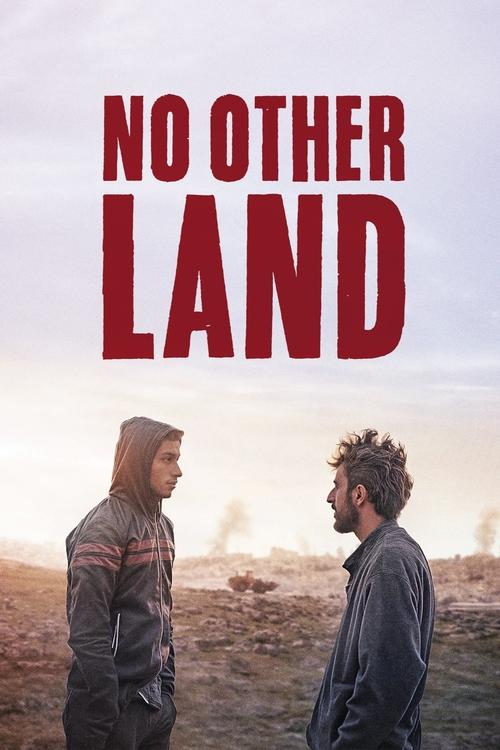
No Other Land
2024 · Rachel Szor
Won the documentary Oscar with no US distributor willing to touch it, then co-director Hamdan Ballal was attacked and detained in the West Bank weeks after the ceremony, and a Miami Beach mayor tried to evict the cinema that screened it — distribution, politics, and reception fused into one story.
For when you want a film that matters more than it entertains — choose it when you're ready to be confronted, informed, and moved, not when you need an escape.
What it's about
Filmed over roughly five years, this documentary follows the demolition of Masafer Yatta, a cluster of Palestinian villages in the occupied West Bank, as soldiers and bulldozers arrive again and again. At its center is the alliance between Basel Adra, a young Palestinian activist filming his community's erasure, and Yuval Abraham, an Israeli journalist who comes to cover it — a friendship marked by the brutal asymmetry between what each can risk and where each can go. It was made by a Palestinian-Israeli collective of four, who share the directing credit.
The experience
Raw, urgent, and hard to shake — much of it is handheld footage of homes coming down and families rebuilding, punctuated by quiet, thorny conversations between the two men. It's a heavy watch that earns its weight.
The craft
The power is in the filming itself: years of first-person, on-the-ground footage shot at real risk, cut into a chronicle where repetition — demolition, rebuilding, demolition — becomes the argument. The co-authorship across the Palestinian-Israeli divide isn't a credit-line detail; it's the film's structure and its ethical core.
Why it matters
It won the Academy Award for Best Documentary Feature and became one of the most discussed films of its moment — not least because it struggled to find U.S. distribution even while sweeping international honors.
Snapshot
No Other Land is a feature documentary about the slow-motion destruction of Masafer Yatta, a cluster of Palestinian hamlets in the South Hebron Hills of the occupied West Bank, filmed over roughly five years and released into one of the most politically charged moments in the region's recent history. A grounding correction is essential at the outset: the film is not the work of a single director but of a four-person Palestinian-Israeli collective — Basel Adra, Hamdan Ballal, Yuval Abraham, and Rachel Szor — who share the directing credit equally. Szor, named in this dossier's header, functions within that collective principally as cinematographer; the co-authorship across the national divide is not an incidental production fact but the film's central formal and ethical proposition. The work premiered in the Panorama section of the 2024 Berlinale, where it won both the Berlinale Documentary Award and the Panorama Audience Award, and went on to win the Academy Award for Best Documentary Feature at the 97th Academy Awards in March 2025. It is at once an observational record of demolition and expulsion, a first-person diary narrated by Adra, and a study of an unequal friendship between a Palestinian who cannot leave and an Israeli who can.
Industry & production
The film is a Palestinian–Norwegian co-production, assembled over approximately five years of shooting (broadly the 2019–2023 window) and completed in time for the February 2024 Berlinale. Its production model is characteristic of the low-budget, grant-and-fund-supported international documentary sector: European public film funding and documentary-focused financiers underwrote a project that had no commercial star, no scripted spine, and a subject matter guaranteed to complicate distribution. I will not attach specific budget figures or a full financier list to the record here, because those details are not something I can state with confidence, and inventing them would be worse than omitting them.
The more consequential industry story is what happened after completion. Despite winning at a top-tier festival and then winning the Oscar, the film struggled to secure conventional U.S. theatrical distribution and was released in the United States through the filmmakers' own self-distribution efforts rather than a major acquiring distributor — a fact widely reported and widely read as evidence of how politically radioactive the subject was judged to be by the American industry. In several other territories it did find distributors (in the United Kingdom, for instance, it was handled by the documentary specialist Dogwoof). That asymmetry — festival and Academy acclaim on one side, distribution reluctance on the other — became part of the film's public meaning.
Technology
No Other Land is a product of lightweight, largely handheld digital acquisition: the kind of prosumer and consumer cameras that allow a small crew to move fast, shoot in low light, and remain mobile during military raids and demolitions. Crucially, the film is technologically hybrid. It braids freshly shot observational footage with archival material of much lower and more varied resolution — including video shot by Basel Adra himself and by his family over years of documenting the campaign against Masafer Yatta. Adra grew up in a household where filming the demolitions was already an act of resistance, and that pre-existing archive of home-video-grade material is woven into the finished film. The camera here is treated less as a cinematographic instrument than as a civil-defense tool: a device whose recording function is understood, by both the residents and the soldiers, to carry evidentiary and political weight. This is a documentary in which people film because filming is one of the few forms of leverage available to them.
Technique
Cinematography
Szor's camerawork is proximate, embedded, and reactive. The dominant grammar is handheld observation at close range — the operator inside the event rather than surveying it from safety. This produces the film's signature tension: the frame is often unstable, chasing bulldozers, following residents into caves and half-demolished homes, or turning to confront soldiers directly. Night sequences and raids push the imagery toward low-light grain and available-light murk, which the film does not cosmetically correct; the roughness reads as authenticity and as danger. Against these kinetic passages, the film also finds stiller compositions — the landscape of the South Hebron Hills, domestic interiors, the geometry of rubble — that give the destruction a sense of place and permanence. The intercutting of professionally shot material with Adra's own coarser archival footage creates a deliberate textural stratification: the present tense of the crew's camera versus the accumulated past tense of a community that has been filming its own erasure for years.
Editing
The editorial challenge was structural: to shape a very large body of footage gathered across five years and multiple demolitions into a coherent, roughly 90-odd-minute arc without flattening the repetition that is itself the subject. The film organizes this through Adra's first-person narration and through on-screen markers of time and place, letting the audience feel the grinding recurrence of demolition-rebuild-demolition while still tracking an emotional throughline in the Adra–Abraham relationship. The editing was a collective, collaborative process within the four-person authorship rather than the product of a single credited outside editor as far as I can reliably attribute; I'll flag that as a point where I don't want to assign a definitive individual credit I'm not certain of. What is clear is the editorial intelligence of the choice to foreground futility and repetition as form — the cutting refuses catharsis because the situation offers none.
Mise-en-scène / staging
As an observational documentary, the film has no staging in the fiction sense; its "mise-en-scène" is the found reality of Masafer Yatta — the caves and stone dwellings, the tents and generators, the fresh rubble of homes and a school reduced to debris. What the filmmakers control is selection and framing: the recurring visual motif of families sitting amid or rebuilding from ruins, the confrontational two-shot of resident and soldier, the domestic detail (a child's belongings, a kitchen) that measures the human cost of a demolition order. The environment does the expressive work; the film's compositional discipline lies in knowing when to hold on it.
Sound
The soundscape is overwhelmingly diegetic and direct: the diesel roar of bulldozers, the mechanical percussion of demolition, generators, shouting, the acoustic of confrontation. This raw ambient sound carries much of the film's dread. Non-diegetic scoring is used sparingly rather than as an emotional driver — the film largely trusts its own noise. I am not confident enough about a specific composer or the extent of an original score to assert it, so I'll leave that as an honest gap rather than fabricate an attribution.
Performance
There are no actors; the "performances" are people being themselves under duress. Yet the film is acutely aware that its two central figures — Adra and Abraham — are also performing roles in a public drama: the activist-documentarian and the sympathetic Israeli journalist. Their on-camera presence is self-conscious in a productive way, because documentation and self-presentation are precisely what the film is about. Adra's weary, watchful screen persona and Abraham's more restless, sometimes frustrated one generate a genuine interpersonal dynamic that the film treats as its human center of gravity.
Narrative & dramatic mode
The film operates in a hybrid mode: observational vérité fused with first-person essay-diary. Adra's voiceover supplies the subjective spine, framing the events as lived autobiography rather than neutral reportage. Structurally, the film borrows the shape of a friendship narrative — the "buddy" pairing across an impassable divide — and uses the asymmetry within that friendship (one man free to come and go, the other trapped and endangered) as its core dramatic engine. There is no conventional resolution; the dramatic mode is deliberately anti-cathartic, built on repetition and attrition. The recurring cycle of demolition and return substitutes for rising action, so that the emotional payoff comes not from a plot turn but from the accumulated weight of witnessing.
Genre & cycle
No Other Land sits at the intersection of several documentary strains: the activist / human-rights documentary, the first-person diary film, and the vérité record of political violence. Within Palestinian and Israeli cinema it belongs to a specific cycle of collaborative, cross-national nonfiction filmmaking about West Bank land dispossession and village resistance. It is also legible within the broader 2020s wave of first-person, filmmaker-embedded documentaries in which the maker's own stake in the subject is foregrounded rather than concealed.
Authorship & method
The authorship is the method. A collective of four — two Palestinians (Adra, an activist and journalist from Masafer Yatta; Ballal, a photographer and farmer from the region) and two Israelis (Abraham, a journalist; Szor, the cinematographer) — share equal directing credit, and this shared credit enacts the film's political thesis about solidarity across the occupation divide. Adra provides the lived experience, the archive, and the narrating voice; Abraham provides the on-screen Israeli interlocutor and a journalistic frame; Szor provides the principal camera; Ballal contributes as filmmaker and photographer. The film is thus authored in a way that refuses the single-auteur model, and the collaboration's internal inequalities — of freedom, of risk, of citizenship — are not hidden but made part of the text. I'll avoid over-specifying discrete craft credits (a named composer, a single lead editor) where the collaborative, collective nature of the production makes clean individual attribution genuinely uncertain.
Movement / national cinema
The film belongs simultaneously to Palestinian cinema under occupation and to the tradition of Israeli documentary self-critique. On the Palestinian side, it extends a lineage of filmmaking that treats the camera as a means of asserting presence and recording erasure — a body of work stretching from the foundational figures of Palestinian cinema through to contemporary makers who document daily life under military rule. On the Israeli side, it participates in a critical documentary tradition that turns the camera back on the occupation from within Israeli society. What distinguishes No Other Land within both movements is that it does not choose between them; it fuses them into a single co-authored object, which is precisely why it drew such intense reaction from both audiences and states.
Era / period
The film is a document of the early 2020s West Bank, shot largely before October 2023 but completed and released into the acutely polarized aftermath, which magnified everything about its reception. It is also a product of the contemporary festival-and-streaming documentary economy, in which a Berlinale premiere and an Oscar can confer enormous prestige while doing little to guarantee ordinary theatrical access — a gap the film's distribution history exposed. Its release period is inseparable from its meaning: a five-year record of a specific local expulsion arrived at a moment when the wider conflict had become the defining international controversy of the day.
Themes
The film's governing theme is dispossession — the systematic destruction of homes, a school, and a way of life under military and legal machinery (the designation of the area as a firing zone and the court rulings that enabled expulsion). Braided through it are several others: home and its demolition as the elemental unit of loss; solidarity and its asymmetries, the film's clear-eyed refusal to pretend that the Palestinian and Israeli partners share equal risk; the camera as witness and as weapon, filming understood as both documentation and self-protection; and futility versus persistence, the endurance of a community that rebuilds knowing it will be demolished again. Above all, the film interrogates what an Israeli-Palestinian friendship can and cannot mean when one friend can drive home to safety and the other cannot.
Reception, canon & influence
Critically, the film was received as one of the major documentaries of its year: acclaim at the Berlinale, a strong run through the international festival and critics'-awards circuit, and finally the Academy Award for Best Documentary Feature. (I'll avoid citing a precise aggregator score or exact critics'-group tallies I can't verify, but the direction of the reception — broadly rapturous among critics — is well established.) Its acclaim was shadowed by controversy and by real-world consequences: at the Berlinale, acceptance-speech remarks by Adra and Abraham drew sharp condemnation from German officials, who characterized them as antisemitic, igniting a prolonged debate about the German cultural establishment and free expression; Abraham subsequently reported receiving death threats. After the Oscar win, co-director Hamdan Ballal was assaulted by Israeli settlers and briefly detained by the military — an episode that became international news and underscored the material stakes the film had always described.
Looking backward, the clearest influence on the film is Emad Burnat and Guy Davidi's 5 Broken Cameras (2011), the Oscar-nominated Palestinian-Israeli co-directed documentary about village resistance in Bil'in, which established the template of the co-authored, camera-as-resistance West Bank film that No Other Land both inherits and radicalizes into a fully collective authorship. It also draws on the broader practice — associated with Israeli human-rights organizations distributing cameras to Palestinian communities — of turning documentation into a form of protection, and on the wider traditions of observational vérité and the first-person essay documentary.
Looking forward, its legacy is still forming, but its significance is already legible on two fronts. As a work, it is likely to stand as a canonical reference point for collaborative, cross-national documentary made under conditions of profound power imbalance — a model of shared authorship as political act. As an event, its trajectory from Oscar podium to distribution difficulty to physical violence against one of its makers became a case study, cited well beyond film circles, in the costs and constraints of political documentary in the mid-2020s. Its full influence on subsequent filmmaking cannot yet be assessed honestly; what can be said is that it has already reset expectations for what a small, self-made, collectively authored documentary can achieve and provoke.
Reception
It arrived as a Berlinale prizewinner that no US distributor would touch, then won the 2025 Best Documentary Oscar anyway — and its afterlife has been shaped by real-world events, from co-director Hamdan Ballal being attacked and detained in Masafer Yatta weeks after the win to theaters facing political pressure just for screening it.
How No Other Land was received, from release to now →
How to watch No Other Land: what to notice on a first viewing
- Watch how close and unsteady the camera stays during raids. Rachel Szor shoots at close handheld range, chasing bulldozers and following residents into half-demolished homes rather than observing from a safe distance. The instability of the image puts you inside the danger instead of watching it from outside.
- Listen for the diesel roar of bulldozers under everything else. The soundtrack is built from direct, diegetic noise: engines, generators, shouting, the mechanical percussion of demolition, with almost no added score. The rawness of the sound carries the dread instead of music telling you how to feel.
- Notice how the film returns to the same demolitions. Homes are demolished and rebuilt and demolished again across the roughly five years the film covers, and the editing lets you feel that grinding recurrence rather than compressing it into a montage. The repetition itself is the point, since the situation offers no resolution to cut toward.
- Notice the household objects the camera lingers on after a demolition. A child's belongings, a kitchen, a school reduced to debris: the film measures loss through this kind of domestic detail rather than statistics. These small objects make the scale of what's being lost concrete instead of abstract.
- Watch how differently Adra and Abraham carry themselves on camera. Basel Adra appears weary and watchful on screen, while Yuval Abraham comes across more restless and often frustrated, and the film treats that contrast as its human center. Their differing temperaments make the asymmetry between them visible without either man having to state it.
The whole guide to watching No Other Land, with the keys for a rewatch →
Influences: the films it descends from and the films it influenced
- 5 Broken Cameras (2011) — Establishes the exact template No Other Land radicalizes — a Palestinian-Israeli co-directed West Bank diary in which the recording camera is itself the protagonist, its footage doubling as protective evidence against demolition and arrest.
- Chronicle of a Summer (1961) — Origin of the participatory vérité method No Other Land uses — subjects who are self-consciously aware of the lens and the filmmaker (Abraham) who enters the frame as an on-screen interlocutor rather than an invisible observer.
- Man with a Movie Camera (1929) — Founds the kino-eye premise of camera-as-witness that the film literalizes — foregrounding the recording apparatus as an active agent and social actor rather than a neutral window.
- Night and Fog (1955) — Pioneers the archival-hybrid device of intercutting present-tense footage of a site with earlier images to prove atrocity is an ongoing structure, not a closed past — the temporal montage logic behind the film's Adra family archive.
- The Battle of Chile (1975) — Model of filming state violence in real time so the footage becomes legal and political evidence, shot under direct physical threat to the crew — the documentation-as-protection ethic central to No Other Land.
- Harlan County USA (1976) — Embeds a crew inside a resistance struggle and keeps rolling through armed confrontation, so the camera's mere presence becomes an intervention that deters violence — the on-the-ground risk posture the film adopts during demolitions.
- Sans Soleil (1983) — Defines the first-person essay-documentary voice — reflective narration laid over gathered images that interrogates memory and the act of looking, the register of Adra's diaristic voiceover.
- The Gleaners and I (2000) — Legitimizes the intimate prosumer-digital handheld diary — a lightweight consumer camera wielded by the author as first-person essay tool, the technological and formal predicate of the film's self-shot aesthetic.
- Jenin, Jenin (2002) — Early Palestinian-cinema instance of on-the-ground testimonial documentary shot amid a demolished community, using resident witness accounts as the primary structuring material.
- For Sama (2019) — Extends the multi-year, participant-shot first-person video diary from inside a besieged community, structured as a direct address to a loved one — the closest contemporary sibling in self-authored conflict documentary.
- Little Palestine, Diary of a Siege (2021) — Carries forward the resident-authored first-person diary of dispossession, with the camera kept running under blockade as an act of witness by someone living the events rather than visiting them.
- NAZA (2026) — The same Abraham–Szor collaboration, with Szor's handheld low-light camera and an activist-journalist partnership. NAZA reverses its view, turning from the victims' footage to the perpetrators' testimony.
- The Law in These Parts (2011) — Exemplar of Israeli documentary self-critique that dissects the bureaucratic-legal machinery of occupation from within Israeli society — the institutional counterpart to Abraham's journalistic Israeli frame.
- The Gatekeepers (2012) — Israeli institutional self-examination made by turning the state's own security apparatus into confessing on-screen subjects, sharing the film's project of Israeli complicity spoken from inside.
- Waltz with Bashir (2008) — Israeli-authored reckoning with personal complicity in violence against Palestinians/Lebanese, extending the movement of Israeli documentary self-critique through a filmmaker implicating his own memory.
- The Act of Killing (2012) — Builds its form on self-conscious subjects who perform for the camera, weaponizing that performativity to implicate both maker and viewer — the same reflexive discomfort the film cultivates with its performing subjects.
- The Missing Picture (2013) — Survivor-authored reconstruction of atrocity that refuses spectacle and catharsis, using the maker's own testimony and archive — a peer in anti-cathartic, first-person camera-as-witness form.
- The Voice of Hind Rajab (2025) — Collaborative Palestinian cinema-of-witness built from on-the-ground documentary recording and rushed to release as political intervention—the same coalition-amplified witness model as Hind Rajab.
Similar films
- Waltz with Bashir (2008) — influence & lineage
- For Sama (2019) — influence & lineage
- NAZA (2026) — same viewing thread
- No Man's Land (2001) — same viewing thread
- Green Border (2023) — same viewing thread
- All That's Left of You (2025) — shared sensibility
- Our Land (2026) — shared sensibility
- No Bears (2022) — shared sensibility
All the films related to No Other Land →
Watch it with: curated runs of related films
- Bearing Witness — Watch these when you want cinema as testimony — ordinary people caught between armies, borders, prisons, and markets, filmed close to the ground and close to documentary.